Posted by paulpauper 6/25/2025
Another factor which will soon impact this, if it isn't already, is the rapidly changing nature of youth. Fertility rates have been dropping since 2009 or so. Average age of parents is increasing. Teen pregnancy on a long and rapid decline.
All of these working together means that each year the act of having a child is much more deliberate and the parents likely having more resources. Which in turn should mean fewer youth delinquency, which as the article notes is how most in prison started out.
This is both good and bad. Having a child is very difficult, but it gets harder as you get older. You lack a lot of monitory resources as a teen or the early 20s, but you have a lot more energy, as you get older your body starts decaying you will lack energy. A kid had at 40 will still be depending on your when you are 55 (kids is only 15), and if the kids goes to college may have some dependency on you when your peers are retiring. Plus if your kids have kids young as well as you, you be around and have some energy for grandkids.
Don't read the above as advocating having kids too young, it is not. However don't wait until you think it is the perfect time. If you are 25 you should be seriously thinking in the next 2 years, and by 30 have them (if of course kids are right for you - that is a complex consideration I'm not going to get into). Do not let fear of how much it will cost or desire for more resources first stop you from having kids when you are still young enough to do well.
It was really nice that I had time to establish my career and figure things out before having kids.
I was talking to a nice girl up until she mentioned still wanting kids in her late 40s. Maybe I’m old school, but telling someone you froze your eggs the same day you meet them is weird.
Society itself is broken. You SHOULD be able to graduate high school and make enough to support yourself and a family with a bit of struggle.
This rapidly transformed into no, get your masters, get 8 years of experience. Earn at least 300k as a couple. Then and only then should you consider a family. Childcare is 3k plus a month in many places.
For myself , I wish I made this happen in my mid 20s. I had to move back home to take care of a family member (fck cancer) and I suffered various personal setbacks due to it.
In my 30s I’ve let go of expecting anything. This world has already given me so much.
In my 20s, it felt indeed weird to bring that up early for me, because I wasn’t ready yet and didn’t even really know what I wanted yet. Later in life, when dating we always talked about potential family planning and general outlook on life early. (Unless it was never meant to be a serious relationship to begin with.)
Felt really awkward for small talk.
My point was the economy should support having a family in your 20s if that’s what you want to do. You shouldn’t need a well paid career, a quality lifestyle that supports a family should be available for everyone.
I imagine universal health care, paid family leave ( for months not weeks) and affirmative (free?) childcare could bring that gap.
At a point it isn’t even an age issue. A lot of people will never earn enough to really support a family, and that’s a failure of the social contract.
You should be able to get a job as a Walmart clerk, have your partner work part time and still afford to have a family.
I think I’ve muddled my own point here, but it should be easier. Maybe that Walmart clerk could own a house ?!
These conversations should not need to happen but they do because of the current inequality that exists. A couple can't change the world so they talk about these things since it's their best option
The ultimate purpose of dating is to meet your future spouse. We're turned it into some kind of senseless sexual escapade, and this has poisoned the relations between men and women. It makes them exploitative and dehumanizing in spirit: sprinkling them with the waters of "consent" doesn't change that, as the subjective cannot abolish the objective. We've reduced sex to something that is merely pleasurable and contradicted its intrinsic and essential function which is procreative by employing an array of technologies that impede and interfere with healthy procreative processes. This creates a mindset not unlike that of a drug user who is obsessed with getting another hit with no thought given to the damage, or the bulimic who wants the sensual satisfaction of eating, but not the calories.
The psychophysical reality of sexual intercourse is much more than some passing physical pleasure. It mobilizes processes in us that are completely oriented toward bonding and the strengthening of the relationship in preparation for children. Whence the stereotype that men will often exit quickly in the morning after a one night stand with a strange woman? Because both can feel, if only subconsciously, that the processes of bonding are taking place, and who wants to bond — and in such a profound and intimate way — with someone they've just met? In this regard, the character of Julianna in Vanilla Sky makes an astoundingly profound and accurate remark for a movie coming out of Hollywood: "Don't you know when you sleep with someone, your body makes a promise whether you do or not?" Our capacity for sexual intimacy is likewise dulled.
(Masturbation is even worse. Those processes bond us with a fictional harem of the imaginary and close us within ourselves. For social animals like us, this is a recipe for misery.)
We thwart and ignore our biological nature to our own detriment. The procreative prime spans the mid-twenties into the early 30s. Statistically, most people should be having families by their mid-20s. Our culture confuses people and creates a pointless obstacle course that leads them to postpone such things either because they're too immature (and encouraged to remain so, also by this unserious dating culture) or because they believe they must achieve some arbitrary milestones first. Furthermore, family and community support has been dashed by a culture of hyperindividualism.
The causes of demographic decline are not a mystery. People simply either don't think deeply enough, or they don't want to make the cultural changes necessary to restore normalcy.
Dating culture is evolved to help you find a mate based on YOUR choices and capability not your parents or class level. This allows you to “trial” compatibility over shorter time and find better fits.
What you seem to be talking about is 'Online Hookup Culture' which is more of a hobby if we are being honest than a way of finding a mate. And ultimately probably STILL better when faced with a society increasingly not finding mates or having kids at all. So basically all of your thoughts are self-contradictory due to a bit of self righteousness here.
Please don’t let your hangups around sex (correct or not) become a world view. It’s not a healthy obsession.
Masturbation is part of our biological nature and has been occurring for millions of years. Every primate does it.
Edit:
To be clear I appreciate this comment and agree with it in the large. It’s hard to talk about these things without being quickly dismissed in the current zeitgeist.
Sex is fun and most sex doesn't lead to procreation, nor is intended to. The last 50 times I've had sex, me and partner(s) involved have had no intention of making a baby, and that's fine. Nature/God agrees with me, because the number of children most families have are typically far less than the number of times the parents have had sex.
There's a lot of times people want sex and don't want it to be some big life changing event. I won't marry someone like that.
> This creates a mindset not unlike that of a drug user who is obsessed with getting another hit
Everyone wants pleasurable things with a minimum of bad or unwanted consequences. This is called being smart and using your God-given brain and free will. This doesn't make anyone a drug user. This puritanical war on pleasure can only serve authoritarian and anti-human ends, which is often an explicit or implicit base of forms of slavery/indenture, and is the main reason why I strongly advocate against it.
> The psychophysical reality of sexual intercourse is much more than some passing physical pleasure.
Anything that feels really good will beget attachment because you want more of it. When it's attached to a person, you're going to want to be around that person more. And of course, human beings are naked apes with courtship and bonding instincts and all that good stuff. But people bond over things other than sex, and any good relationship or marriage will have many bonds other than the sexual one. Indeed, marriages where sex is the only reason they got together are as hollow as this drug user strawman you trotted out.
> Masturbation is even worse.
People who become overly dependent on parasocial relationships with fictional anything, whether that's a harem, video game, movie star, person mentioned in a religious book, etc. need help. I masturbate from time to time and it does not give me any problems, but I'm not addicted to it. But I would rather lonely people masturbate themselves into a coma than sexually assault others simply because of people who will say masturbation is wrong but at the same time won't consider other things like legalizing prostitution.
> they don't want to make the cultural changes necessary to restore normalcy.
I don't. The old way sucked. Robots and AI should be doing all our menial work, and the possibilities for pleasure are endless. The people who just can't exist without an employer giving them meaning because they never got enough approval from their daddies need to move to another planet.
This has literally only been true for about 30 years out of the sum total of human history, would you like to guess when those 30 years happened to be?
Obviously the answer is "1950s america".
For the rest of human history, you needed something beyond the education you received until the age of 18 in order to support a family.
In reality in most families all family members were contributing something to the household income.
In the past, huge amounts of household work were done without any such exchange.
Today, child raising, cleaning, cooking, provisioning, and more remain unpaid household labor. The people who do that work were not idle 800 years ago, and they are not idle today.
If we are talking about "centuries" quite a lot of people including men did not worked as in being employed for salary. But their work was economical - necessarily so.
Being stay at home mom today is mostly battling boredom and demotivation. Or then, making up things to do. It is not the same as milking cows or making cheese.
I was a stay at home parent for my daughter. It was extremely far from battling boredom (except perhaps for first year and a half, if that, and even then anyone who is actually interested in child development will not find it boring) and it was the opposite of demotivating.
Rather than speak in such broad generalizations, I think it would be better to restrict your claims to specific, real stories.
Industrialization has pushed inequality to extremes while raising hours worked - even as productivity keeps shooting up. There's no good reason for people to tolerate this; it's just exploitation.
Yeah, and we now expect women to work 40+ hour work weeks and house work on top of that. That is the thing causing societal reproduction rates to plummet.
Let's just do the math: a day has 24 hours. The recommendation for healthy sleep is 8 hours. Then, you work for 8 hours, with 1 hour added for the unpaid lunch break. That's the two largest blocks, leaving 7 hours to distribute... dedicate 3 hours for the "staying alive" stuff (preparing for going to work in the morning, aka breakfast, shave, getting dressed, preparing dinner, eating dinner, have a shower and at least some unwind time to fall asleep).
And that in turn leaves only 4 hours for everything else: running errands (aka shopping, dealing with bureaucracy, disposing of trash, cleaning), just doing nothing to wind down your mind from a hard day at work, hobbies, social activities (talking with your friends and family or occasionally going out) and, guess what, actually having sex.
Easy to see how that's already a fully packed day. Society just took the productivity gains from women no longer having to deal with a lot of menial work (washing dishes and clothing, as that got replaced by machines, and repairing clothes) and redistributed these hours to capitalism.
And now, imagine a child on top of that. Add at least half an hour in the morning to help get the kid ready for school, an hour to drive the kid to errands (because public transit is more like "transhit"), and another two hours to help the kid with homework because that workload is ridiculous and you don't want the kid to fall behind kids of parents rich enough to afford private tutors. But... whoops, isn't that just about the entire "everything else" time block? And younger children need even more work, constantly changing nappies, going to the doctor's all the time because it's one new bug every new week and sometimes the bug also catches you cold...
The time constraints that come with a dual income certainly make the logistics of having children more difficult though.
I'm not talking about men, I'm talking about society itself. Try renting a family home on a single income in any moderate popular area. Owning a home is outright out of reach for even more people.
Like, this is a broad consensus thing. There's not really much debate; ethnographic studies have backed it up. Where are you getting your info from?
1. That there was war and war sucked; disease; and also infant mortality was high - therefore life sucked back then. None of that really factors in to the debate of how much free time people had; and those thing are all still very much with us (especially in America).
2. That food prep and gathering firewood takes time. Well, gathering firewood is also known as 'going for a walk in nature', and it's actually good for you. You can chat with your friends while you do it. It's not like your average job. It might not be technically 'idle', but it's a lot closer to 'idle' than flipping burgers in a sweatbox.
Same with food prep - picking through some dried beans, or stirring a pot every 30 mins and making sure it doesn't boil over, while you tell stories around the table just isn't comparable to working in an Amazon warehouse pissing into plastic bottles.
It's critique, and you can buy it if you want; but there's nothing there I would call substantial.
2. How'd you get those dried beans out of their pods? Where'd you get that pot? Where'd you get the water?
3. You didn't actually read the critique did you, you the wikipedia paragraph characterizing the critiques.
2. Sitting around the table, singing songs, telling stories, or quietly reflecting; all working at my own pace, in the comfort of a home that's been owned outright for generations, surrounded by organic soil free from pesticides and plastic.
3. I read your link, not every cited article. I've personally lived that way, and I know what I'm talking about. There's a big difference between shucking corn with your family or stacking logs, and shuffling numbers at a bullshit job which exists to make two or three incredibly rich people thousands of miles away a tiny bit wealthier. That said, if there's something more you'd like to bring to the discussion, bring it.
And anyways, if you’re a hunter-gatherer, you’re following your prey, not sitting around growing corn to be shucked while you sing songs or whatever.
By the way, my buddies and I tell each other stories at work all the time? You can do this at work too, you know. What you seem to be doing is imagining a world where you’ve outsourced all your labor to “it’ll get done” land, then combined hunter-gatherer lifestyles with agrarian lifestyles
And B, even if you wanted to live that way you can't any more; because the commons has been relentlessly exploited past its breaking point for centuries.
I shouldn't really have to explain any of this, but people generally seem to have some weird ideas and blind spots surrounding our history as a species.
Yes, the obstacle of living illegally on land that has been systematically over-exploited for centuries (or too harsh to bother), without any community or experience. Not sure I'm seeing your point.
Aside from the peer comment pointing out the bleedingly obvious, there's also a bit of history here:
  In 1907 Justice Henry Bourne Higgins, President of the Commonwealth Conciliation and Arbitration Court, set the first federally arbitrated wages standard in Australia.

  Using the Sunshine Harvester Factory as a test case, Justice Higgins took the pioneering approach of hearing evidence from not only male workers but also their wives to determine what was a fair and reasonable wage for a working man to support a family of five.

  Higgins’s ruling became the basis for setting Australia’s minimum wage standard for the next 70 years.
* https://www.nma.gov.au/defining-moments/resources/harvester-...
* https://www.fwc.gov.au/about-us/history/waltzing-matilda-and...
This is the list of awards: https://www.fairwork.gov.au/employment-conditions/awards/lis... it's pretty extensive
Each award is also complex, and covers a range of issues in the employment. For example, this is the Professional Employee award: https://awards.fairwork.gov.au/MA000065.html just working out what the minimum wage would be for a graduate engineer with 2 years experience is a complex, detailed matter.
But yes, probably, for most professions you could reasonably expect to support a family of 5 on the award, depending on location and definition of "support". Affording a house would largely depend on an additional inheritance, though.
It is perfectly doable, even common, to buy a home in low and medium COL areas without any assistance from family, living or dead. The fact that you can't do this in NYC or SF is not an indictment of anything other than NYC and SF.
But there aren't any jobs there, so you're going to need an inheritance to support your family of 5.
Tell me a place in any Western society (outside of run-down rural areas/flyover states) where an average employee (i.e. no ultra-rich tech hipster bros) is able to afford a home before the age of 30 purely by his own savings and income. That is frankly no longer a reality for most people.
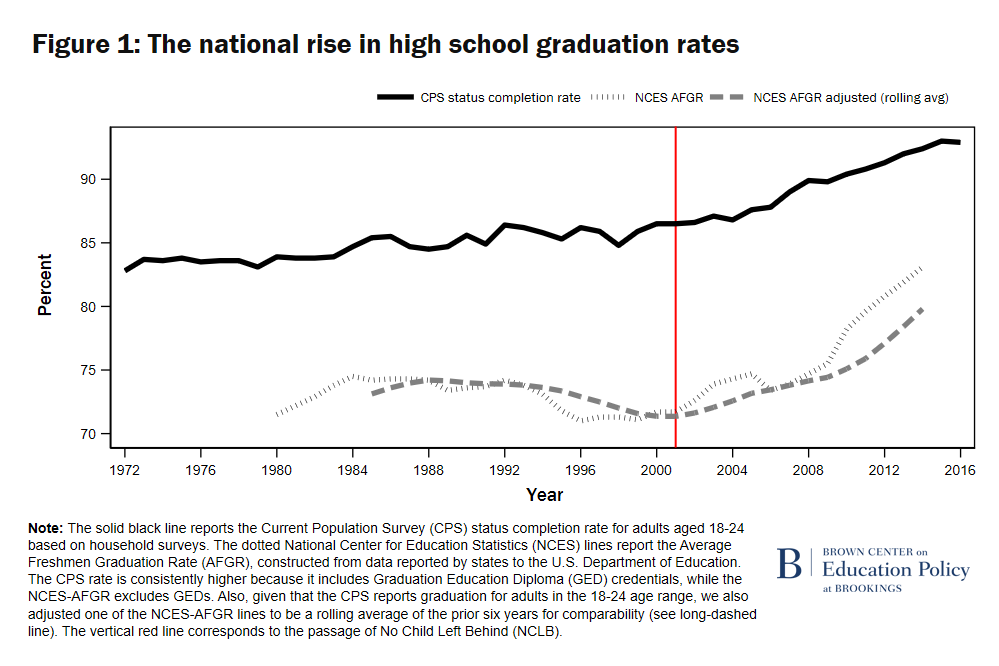
High school was advanced education in 2000. Basic education ended around grade 6-8.
https://www.brookings.edu/wp-content/uploads/2020/02/Grad-ra...
And the 50s to 80s anywhere else in the civilized world.
There are lot of alternatives. Men can be primary parents (I was, once the kids got to about the age of eight or so, and was an equal parent before that) and they could stay at home (I continued working, but I was already self-employed and working from home, and my ex never worked after having children).
I think the ideal set up (it would have been so for me) would have been for both parents to work part time.
Of course it still comes back to, you should be able to raise a family on the equivalent of one full time income.
Of course, if the leisured society predicted a few decades ago had come to pass it would be one part time salary.
today men have the ability to watch kids thanks to formula (though it is better for the kids to eat from mom - this is rarely talked about because it is easy to go too far and starve a baby to death in the exceptions).
Beautifully said, very progressive also!
I am a big fan of the 4-day work week (for the same amount of money as 5 days), it's been transformative for my life. The extra energy and focus you get from that 1 day translates to higher productivity in the 4 days where you do work. Sadly, the current "squeeze em', bleed em' dry, and drop em'" brand of capitalism is incompatible with the majority of the people to experience how good life can be like that.
I certainly ain't looking forward to them raising the retirement age to 1337 by the time I get to retire.
It's like a race where they repeatedly move the finishing line because the organizers took the medals and sold them, while waiting for you to drop dead so they don't have to give you what you are due.
If you, as an employer, want a motivated, energetic workforce who are not slacking off, it's also in your interest to give that opportunity to your employees, as multiple experiments have shown that 4-day work results in increased productivity and employee retention.
I hear ya. My spouse developed mental illness after sons 4,5 were born. A spouse can sabotage a lot of things when they set their mind to it - and their mind never stops. Not even at 3am. The first year was hard. The second was harder. After 5ys we run out of adjectives. After 15y we're using Dr.Seuss letters to spell out how things are.
Psychosis, bipolar, BPD, NPD, pretty much all the *PDs. She switched it up.
> was it directly related to the kids
As in stemmed from? No.
As far as challenge related to the kids, it was 1) keeping the them as safe as possible when she was not and 2) proving some semblance of parenting. Both were difficult-to-impossible, given that kids are trapped at home, thanks to eradication of free range areas.
…which is not necessarily problematic either. I was 43 and my wife 41 when our daughter was born. Our child has had a great life and so have we. While I’m 60 now and don’t have quite the same energy I had at 20-30’something, everything has worked out well for us.
Everyone’s path, goals and priorities is different and as long as would-be parents consider the trade offs all around, it’s hard to be prescriptive about this.
> Society itself is broken. You SHOULD be able to graduate high school and make enough to support yourself and a family with a bit of struggle.
No argument there. The complex socioeconomic forces that has created this dilemma are going to tough to unwind.
https://www.amazon.com/Why-Love-Hurts-Sociological-Explanati...
Not least the idea that if you keep dating you can find somebody better than you've found so far -- a problem that's worse in large cosmopolitan cities where the dating pool is large and perceived to be large.
Half the population has an IQ less than 100. Do not expect the low-IQ group to ever get a masters or earn 300K as a couple, etc.
Caveat- this may have to be amended due to the watering-down of educational standards in the USA.
San Francisco has the highest rate of geriatric pregnancies in USA. We are in a statistical bubble where having kids late is normal (because careers and hcol).
https://www.sfchronicle.com/bayarea/article/mother-birth-age...
So, if the due date is beyond your 35th birthday but you give birth early it's still a advanced maternal age pregnancy.
My ex-wife was 37, and I was an year older, when our younger one was born and energy was not the problem so I agree with you that 35+ should not be a problem.
However, a lot of people are having kids significantly older than that.
I not know whether I could cope with a baby 20 years later. Contrary to stereotypes I used to get up faster and more fully if a baby cried in the night. On the other hand, having a baby might energise and motivate me! Not planning to try it out though!
An older friend conveyed to me pretty much the exact same thing you are, that he cannot imagine having kids at 40 because you will not be able to keep up with them energy wise. You get old and your body really starts to give in.
Alright Geoff, thanks, but you are 54 and do zero exercise, have a diet of eating out at fast food and fast casual restaurants, a body type that would be described as "meatball", and a list of medical conditions which all scream lifestyle change.
Meanwhile at trail running meets, I bump into 60 year olds still giving some 35 year olds a run for their money.
I know two men 18 years apart in age who became fathers at the same time - two months apart to be exact. Even though the older is an avid gym-goer, it's only the younger who can pull off popping back into full strength after less than 6h of sleep.
> Meanwhile at trail running meets, I bump into 60 year olds still giving some 35 year olds a run for their money.
Yup, this is very much key.
So if you hear anyone telling you they can't imagine late fatherhood ignore them, they obviously aren't good at imagining things.
The chance you will need to take care of both your kids and your parents in your 50s is pretty high (not even going into you and your partner), while facing declining health yourself.
Could be easily manageable, or not. Ask me in a decade.
But one thing is darn true - if a good long term stable match is not there, no point pushing for kids. World really doesnt need more damaged folks struggling their whole lives to overcome shitty childhood. And thats fine, parenthood is not for everybody and there can be an amazing life to be had instead (and I mean it in best way possible, but that life shouod not be spent behind the desk and on the couch)
I am perfectly capable of keeping up with my kids.
My 72 year old father who is also in good condition keeps up with my 3 year old son.
The difference I see between a reasonably fit 40 year old and not is the massive gap.
Interrupt that 60 year old's sleep twice a night with a newborn crying, add a bunch of new responsibilities, and I'll be impressed if he even makes it to the meet.
You're comparing people who have made exercise their #1 priority in life to people who have made their kids and supporting their families financially their top 2 priorities. It's a bullshit comparison.
My father is 63, raised three children and has had a successful long marriage and retired from a good career. He also goes works out daily and did for most of my childhood. He didn't make exercise his number one priority.
I'm not suggesting it's better. But people seem to automatically assume that being older when having kids as better. I know some much older parents who were not good parents. I know I would not make a good parent to a younger child now that I'm in my 40s.
I don’t deny that your way can work out as well. But OPs advice was “get children before you are 30, don’t wait until after”. Whereas my honest advice, based on my experience, is “wait until you are 35, you’ll be much more stable life in several regards”.
Which approach is best for you depends on a lot of things. For me, I can honestly say, there is no way I would be where I am if I had had kids in my 20s or even early 30s, and I also wouldn’t have been as good a father as I am right now based on how I’ve grown since then. Both things that my child directly benefits from.
I feel like I do have the unique perspective having actually done both. I don't need to assume what kind of parent I was in my 20s because I was that parent. And I'm a different parent now. But being a younger parent was a great experience despite any other consequences.
And the life I have would just not have been possible if I had a child back then. Not even if I completely sacrificed family time and attention back then, which I never would have wanted.
But I guess we have to agree to disagree. For you, being a younger parent worked out better. For me, I’m certain I got my child at the right time. In any case, I find OPs general recommendation that if you want children, you should have them by 30, to be ill-advised to the point of being harmful. Many people would benefit from waiting until later.
I'm 32, and I think I currently have much less patience and understanding than I did at say 22. Life has basically broken me to the point that I simply don't have the capacity for these things that I used to.
Kids at 27 would have been a bad bad idea. Kids at 32 as well (wrong partner). I’m even older now but I am with the right partner and naturally want kids now. Before her, the topic wouldn’t even cross my mind.
I think it’s really hard to give general advice if one doesn’t mention how their advice interacts with other variables
I also have plenty of energy, the only real change I’ve noticed getting older is I’m in bed a bit earlier than I was in my 20s.
I don’t understand why people think midlife is some kind of drained, lifeless decrepitude
I think people have a variety of health conditions and lifestyle choices, some of which do indeed result in less energy in mid-life.
Kids change you, for the better if you let it. There's nothing like a completely helpless infant who is totally dependent on you to wear down your selfish tendencies.
However at 22 I wasn't the experienced person I am today. Nor was I stable, nor could I jump on opportunities like my peers could.
If having a child in your early 20s would mean not losing opportunities in progressing in a career, at least with enough free childcare and food to feed the children, people could be more inclined to have children while they get their life together. Our culture of moving away from home is also a big problem -- having 2 sets of grandparents helping raise a child REALLY helped me at my youth not miss out on youth and still raise my child.
kids between 25-32 is something our society should aim to be as practical and pleasant as possible.
Securing stable health insurance dictated most of my career decisions. I was captive to turrible gigs, had to pass on a lot of opportunities.
Want to revitalize our society?
#1 is Medicare for All. More startups, more risk taking & innovation, higher birth rate, etc.
#2 is childcare. Cheap, plentiful, good quality.
#3 is housing. Again: Cheap, plentiful, good quality. Plus, rentals better suited for young families (eg more 2 & 3 bedroom units).
This costs infinite money.
It's impossible to scale, because nobody wants an environment where their child is not getting attention from compassionate, engaged adults throughout the day. To get the same level of care as a stay at home parent, you need as many care workers as there are families with young children. And if you pay those workers comparably to the average wage, you need to tax the entire wages of one parent in each family to cover the care costs.
It's probably much cheaper to write checks to families encouraging them to have one parent care for their own children full time.
$50 if they’re watching 5 kids, $100 for 10, etc.
That’s assuming 0 overhead.
Ideally, yes.
But I'm not going to tell someone they can't work.
My wife was stay-at-home, until she couldn't take it any more, and then returned to work. Even though it cost us more overall (childcare, second car, etc).
There are definitely pros and cons, but overall I'd recommend kids in mid- to late-20s.
>However don't wait until you think it is the perfect time.
Yes! There is no perfect time to have kids, but there will definitely be a time when having kids isn't biologically likely anymore
A few years in and I feel "back on my feet", but it was harder for being older.
You write your comment about the maximum safe age for having children as if most people (at least in the advanced countries and moderately reasonable income brackets) were living the lives of 19th century industrial workers.
Kids take a lot of energy but they also give you a lot, no matter the age. We are biologically hardwired to rise to the challenge of having kids no matter the age.
Depending on the circumstances in a persons country, maybe getting children at a young age isn't that dumb. I'd argue that the best time to get kids is as a university student. You get free daycare, the government doubles your stipend (and it's extended), your housing subsidy increases, you generally have more free time as a student, grandparents are younger and able to help more and you have more energy and can more easily deal with lose of sleep.
As a bonus, when your kids move out, you're not even 40 year olds.
The only real issue is: Have you meet the right partner yet?
Where... where do you live? I'm all for having kids as soon as possible, but I was barely able to provide for just myself during university.
There's a bunch of stuff like that, some can be "stacked", some are mutually exclusive, some are "per child" some is per adult. Some are only available to single parents, some are only available if both parents are enrolled in an education, some are only available if you make less than a certain amount.
I'm in Spain, absolutely different landscape here. I guess your government is trying to boost both higher education and birth rates.
Various governments have also attempted to boost birth rates, but unsuccessfully.
Also, adopt. Before I was a parent I thought of a child as "mine" because of biology. Really you see that you shape people and form a connection with them because they are part of your family.
Which is another important point: if you want multiple children you probably want to have your first earlier than you might otherwise.
I need to push back on this because no one is actually an adult at the age of 25 despite those people wishing it were so. You do not have your shit figured out and assuming a partner of similar age, neither do they. It's only starting in your 30s where you start to understand what it is to be a responsible adult to yourself and to the world.
So please, do not seriously consider having kids in your 20s, for all our sakes.
Too strong.
You're an adult who doesn't have their shit figured out. Some people never get it figured out, others take into their 30s, 40s or even 50s.
And then in your 60s, you've got new shit to figure out.
It seems to me like when you move the definition of “adulthood” back to age X, fewer people function like adults prior to age X.
having energy is subjective and does not really depend on being young or old. some old folks are full of energy and live really active lives. It depends on your state of mind and lifestyle more than age.
I got my son at almost 40, and I’m positive I’m a much better parent because of that. Sure, kids cost energy, but at 40 and 50 you’re not geriatric. I often get the opportunity to compare our parenting style to younger parents, and it’s clear that they often have some emotional growing up to do themselves. They complain about normal parenting things that we just shrug about, they are torn between their career and raising a kid, and most importantly they often lack patience, where to us it just comes natural.
Having kids fast-tracked me to a critical increase in patience. I've grown so much in less than three years because of my kids. I'm not sure this growth would have ever happened so quickly through other means.
And I'll always have a special, particular respect especially towards my firstborn for causing that in me, and for enduring my shortcomings in the meantime.
I was more patient as a teen than I am now in my 40s. Now I am tired. All the time. I fear I would literally die of exhaustion if I had to maintain more irregular hours than I already do due to insomnia that I have developed over the last half decade.
Someone with no one to care about until their 40s is supposed to be in a much better shape than someone who raised three kids for the last +25 years.
Congrats on making it though, I completely understand why you would feel tired all the time!
biologically, and for pregnancy, yes you are.
Be it as it may, I conclude that there is an elevated risk for problems the older you get (although for some issues, cause and effect may be reversed, which is hard to resolve), but that that risk may not be so significant as to outweigh other advantages.
> A simulation study concluded that reported paternal age effects on psychiatric disorders in the epidemiological literature are too large to be explained only by mutations. They conclude that a model in which parents with a genetic liability to psychiatric illness tend to reproduce later better explains the literature.[9]
> Later age at parenthood is also associated with a more stable family environment, with older parents being less likely to divorce or change partners.[43] Older parents also tend to occupy a higher socio-economic position and report feeling more devoted to their children and satisfied with their family.[43] On the other hand, the risk of the father dying before the child becomes an adult increases with paternal age.[43]
> According to a 2006 review, any adverse effects of advanced paternal age "should be weighed up against potential social advantages for children born to older fathers who are more likely to have progressed in their career and to have achieved financial security."[63]
I think so too. Now to be sure to balance things, while I was 42 when we had our kid, my wife was only 28.
10 years later and things are still great.
I had my kids 25-35; all 5 are adults. We live together as is befitting a 4 income economy.
> and if the kids goes to college
Do you mean go away to college? Yeah. No.
> may have some dependency on you when your peers are retiring.
Me and peers are all working grey. End of career happens with first major illness intersects with the lack of health insurance and we die.
> Plus if your kids have kids
If one of my a sons pairs off with someone and they both work, they'll still be 2 typical incomes short of self sustenance.
BUT, if they got married and then married another couple, the 4 of them only have to find one more adult - the one who will parent during the work day. After the last child enters school, the core 4 can kick parent 5 to the curb.
> Do not let fear of how much it will cost
No fear. Just math.
> or desire for more resources first
But if they had more resources they might only need 3 or even 2 adults working full time to afford basic bills.
> Do not let ... it ... stop you from having kids when you are still young enough to do well.
Parents can (and do) parent while living in their car...
What is below RA/LE? My comment addressed common financial realities. It applied to every adult age, up to and including death.
> MY younger one turns 18 when I will be 58
okay.
> and I am a single parent.
You may be interested to know that parenting can be get much harder than that. ex: I would have loved my difficulty level to be dialed down to Single Parent.
> Baring accidents or the severely unexpected
I agree that some folks do experience year after year after year of luck.
> (which can happen at any age - plenty of people die in the 30s or 40s)
I agree that not having life-changing advantage & luck is pretty dang common.
> its not a problem.
What's not a problem? Taken together, your comment seems to be lacking a subject.
I did the best I could. If you could share which of my points you were responding to, that might help.
We recently saw this play out in the Queensland, Australia, state election where the opposition party, which was pretty much out of ideas, ran a scare campaign about youth crime in regional areas. Neighbourhood Facebook Groups where CCTV footage of "suspicious youth" are a mainstay and an aging population did the rest of the job and they won the election and passed "adult time for adult crime" laws: whether you agree with these or not, "adult time" in Australia means that the youth incarcerated will be adults in their 20s and 30s when they get out.
The Australian state of New South Wales routinely strip-searches young children, but again, there isn't much outcry.
It will be interesting to see how this plays out elsewhere. The worst case scenario is that kids will be politically scapegoated ("why should childless and aging taxpayers fund education?"), and it leads to a further decline in fertility rates.
Seems to be this weird reasoning (and I know it has cropped up in the US too) that - if they did an 'adult' crime they should be tried as an adult. It totally ignores what we know about developing brains - they are not fully developed, they don't consider consequences the same way as older people.
That's not to say they should be allowed to 'get away with it', but we need to take into account that it's not really the same thing as adults doing it.
However, they -clearly- do get away with it, continually the current method of punishment is not deterring them from crime. These are not 'oh he made poor decisions style crimes', you're not paying attention or are not living in this area if you think so.
I wish i could dig up the study from Townsville crime statistics (this is the closest i could find https://statements.qld.gov.au/statements/101697 )
The key takeway is:
“The residents living in these areas have been let down for too long under the former Government who allowed serious repeat youth offenders to avoid adequate punishment and let them continue to terrorise these communities,”
Current deterrents clearly are not working. There are only so many levers the government can pull. Children learn poor lessons and inadequate supervision from their families, but if they are taken from their home the media screams 'stolen generation' so in the end individuals terrorised by them have to deal with the burden of their continued long term criminal behavior.
You may believe that children can be rehabilitated, I'd dearly love this to be the truth, however my observations show that its not a reflection of reality.
In fact I’m not expressing any beliefs other than the (very well supported) notion that children’s brains are not fully developed and therefore they shouldn’t be dealt with in the same way as adults because that’s just dumb and is likely not to help.
All people have different brains; some are very low-intelligence and impulsive by nature and training, and this can apply at any age. The point of this punishment is not to apply a sort of cosmic morality according to the true culpability of a soul. Abstract principles about whether the person 'deserves' a punishment aren't actually relevant regardless of what shape their brain is. The point is the real-life consequence of their criminality on others, and how to stop them hurting people. We must stop them hurting people; let's figure out how.
This dedication to abstracted principles and cosmic morality over fixing the actual issue is really problematic; I see this more and more these days.
Except that is very much part of the justice system, and when people talk about "trying kids as adults" it is exactly about holding them culpable as if they were adults.
> We must stop them hurting people; let's figure out how.
I very much agree. "Lock 'em up and throw away the key", "they knew what they were doing!" and, an actual slogan from the queensland elections, "adult crime, adult time" don't really show a search for a solution. They're just appeals to base vengefulness.
Yes, kids commiting serious crimes need to be stopped. Victims and the wider society need to be safe. Yes the systems in Australia have been failing at this, over and over.
But young brains don't take consequences into account in the same way older brains do. They don't understand the impact that their actions will have on others or themselves in the longer term and aren't especially likely to consider harsher consequences as a deterrent because they aren't thinking about consequences. They literally aren't wired that way.
If your goal is actually reducing crime experienced by the community, you need to look at why kids are getting to that point, what's gone wrong in their upbringing, maybe holding parents more culpable, and intervening earlier. Otherwise you're not going to achieve anything more than a few appealing soundbites. And the problem with all of that in an Australian context is that there is a hidden subtext here - it's often (far from always, but often) First Nations kids who are causing the problem, and there is a long history of state intervention in First Nations families being - there's no other way to put this - actively evil.
It's a tough situation involving under-developed brains, ongoing generational trauma and all sorts of other crap.
For reference, here's what the Australian Human Rights Commission has to say - https://humanrights.gov.au/sites/default/files/2025.04.15%20...
"The evidence shows that the younger children are locked up, the more likely it is that they will go on to commit more serious and violent crimes. As shown in the HWE report making the justice system more punitive through longer sentences, harsher bail laws, and building more children’s prisons is the wrong approach.
That is because offending by children is a symptom of underlying causes and unmet needs that we are failing to address. The proposed measures in the Bill are likely to result in more crime, not less."
So I agree, action needs to be taken, people need to be safe. Trying kids as adults is a simplistic sop to anger, not a good solution and flies in the face of evidence.
tl;dr - It's dumb.
But if being arrested, handcuffed and taken in front of a judge is not enough to make you understand that this kind of behavior will not be tolerated, and you do steal a car again a few weeks later, then yes, we will have to escalate instead of saying "nothing we can do, it's just a kid". Otherwise we are literally sending the message that they can act with impunity.
Family friends have kids in a rural school with parents being those that haven’t moved 10 miles from the community where they grew up and small-town soap opera dynamics.
Babies can have kids?
Lead concentration in America "rapidly increased in the 1950s and then declined in the 1980s" [1]. There is a non-linear discontinuity among kids born in the mid 80s, with linear improvements through to those born in the late 2000s [2].
Arrest rates for violent crimes are highest from 15 to 29 years old (particularly 17 to 23-year olds) [3]. They're particularly low for adults after 50 years old.
We're around 40 years from the last of the high-lead children. 17 years ago is the late 2000s.
[1] https://www.sciencedirect.com/science/article/abs/pii/S10406...
[2] https://ehp.niehs.nih.gov/doi/10.1289/EHP7932
[3] https://kagi.com/assistant/d2c6fdd5-73dd-4952-ae40-1f36aef1e...
The 1st recorded cases of fatty liver disease and T2D in children were in the 1980’s are have continued growing since - lead must have been protecting children’s health.
Testosterone has been on a sharp decline during this same time period - lead must promote healthy testosterone production.
Debt of all kinds, from the national debt, to household debt, to student loans debt has increased exponentially and consistently with lead removal - lead must promote financial literacy.
There are many factors that correlate and potentially contribute to a reduction in incarceration rates.
There are estimated 1.8-1.9M incarcerated. Since 1980 to the present there are well over 1M violent crimes (rape, murder, aggregated assault, robbery) per year. Let’s look at another factor that might contribute to falling incarceration rates that tend to explain this discrepancy in incarceration vs total crimes…conviction rates:
Murder: ~57.4% in 1950 vs. ~27.2% in 2023—a ~2.1x difference.
Rape: ~17.3% in 1950 vs. ~2.3% in 2023—a ~7.5x difference.
Aggravated Assualt: ~19.7% in 1950 vs. ~15.9% in 2023—a ~1.2x difference.
The neurological effects of lead don’t tend to explain away falling police clearances nor convictions.
Kevin drum and Rick Bevin both did a ton to lay this out systematically.
As leaving drum has noted, Lead is NOT the only contributor to crime, but it was the cause of the largest variations for most of the 20th century.
https://en.wikipedia.org/wiki/Crime_drop#Decline_since_the_e...
Maybe they were doing similar things with lead or something else is a big factor. Perhaps the rise of ever more cheap entertainment for young males who are most likely to commit crime. That's a global thing.
Bad decisions like these get less common with age, partly because of consequences (jail, death, etc), partly because getting up to no good requires free time, ambition and freedom, all of which are in shorter supply with age and the resultant responsibilities competing for every individual's supply of these resources.
So if the replacement cohort of people who are coming into prime crime age decline to participate at the same rates the crime rate goes down.
Were the older people who grew up with lead exposure also experiencing higher rates of impulsive crime in the late >1990s relative to the new and prior generations? That would help eliminate the major differences in economics/culture/politics of their upbringing (for ex: mass flight of families moving to the suburbs to raise their young kids after the 1970s crime wave scared them away).
Instead the Flynn Effect seems to have been strongest during the era of high lead, and it's tailing-off now.
The human body and mind are always adapting, however subtly, to changing environments. So I wonder -- are IQ tests assessing abilities that may no longer be optimal today?
Homer likely had an exceptional memory, as did many ancient Greeks that participated in oral traditions. But how relevant is memorizing epics in the modern world?
plenty of criminals are intelligent.
https://www.sciencedirect.com/science/article/abs/pii/S01602...
Social media and modern games are keeping them occupied.
My coffee grinder may have been on my list, but I moved countries and the power is incompatible hah.
Let's say that there is a correlation between the number of flights between London and New York, and the prices of sulfur. The correlation is near perfect.
When your neocortex is working, you ignore it. You can't create any plausible scenario how this could work (it doesn't exist within your latent space) so you don't learn anything from it, it doesn't even register in your brain as anything worthy of notice.
But everybody with the cerebellum only absolutely does learn it. And completely for real, not just as some fun factoid, but as a fact that they know the same way you know that airplanes have wings, and everybody knows it, only you don't.
Then, one day out of nowhere people start buying sulfur. Your questions are met with laughter and mockery "dude, everybody's buying sulfur, are you autistic?". And you don't know, because you haven't even learned the pseudo facts that everybody else bases their reasoning on.
This is only a made up example, but this is exactly how it works.
One thing I've learned in my decades on this planet is that just about never is one explanation for a human condition mostly correct. Lead is a convenient technical explanation that underestimates the impact of upbringing and community.
It doesn't explain a lot of factors of juvenile delinquency that existed for generations before lead service lines or leaded gasoline.
Maybe industry and highways increase lead exposure which leads to crime, or maybe areas already high in crime are cheaper so that's where industry and highways go?
I think it absolutely affects the quality of politicians we get though. The best that a given generation can offer is probably lower if that generation huffed a lot of lead gas. So as they age out and younger people hit peak career and fill those roles things will probably improve a bit.
You'd have more success blaming COVID inflation and the general public's poor education in economics and lack of understanding why eggs were $3.50/dozen. (Today they are $6.00/dozen)
More of a pet theory, but voters born between 1950 and 1980, boomers and Gen X, have had a well-documented set of policy preferences.
Your points say old people have more lead, but then you say young people are more violent. That doesn't square with the articles point that incarceration rates are falling.
You don't just shrug that off and say "oh well, it'll probably be just fine."
the idea behind "population growth" is that we will need future slaves to prop up our social security and asset bubbles.
think of a country as an ant colony, what happens if population decreases? the queen will get less food
What on earth am I reading?
That's not a fantasy, it's the inevitable outcome of sub-replacement fertility, which is the state we find ourselves in (though my intuition says it will take longer than "a couple of centuries" to get to zero).
The US is unique (or maybe there are a handful of others, I don't know) in its ability to welcome immigrants who, within two generations, largely see themselves as Americans first and not as the identity of their grandparents. American identity politics has eroded this somewhat but it is still largely true, for example, that grandchildren of immigrants will usually have a very poor grasp of their grandparents' native languages.
American is not seen as promoting human rights, and to infer all immigrants are good is naive, hate to get off my porch about this. sits back down on rocking chair whistling “I Wish I was In Dixie” and widdling a hangman with the noose almost finished, just a few more threads
Japan and Korea have almost no immigration and abysmally low birth rates. Your arguments don't really hold water. Having children is actually more of a burden on the state, as those kids need schools, (in most western countries publicly funded) healthcare, etc. Taking in a healthy immigrant at 20 is better almost all round from a purely economic point of view.
And immigration doesn't suppress wages any more or less than having tons of kids would over the long term. A person "taking" a job is still a taking a person whether they were born or immigrated. This is ignoring the fact that more people over time enlarge the economy and opportunity in it. Would the United States be a better country today if it didn't accept the mass immigration from Italy, Ireland, and Eastern Europe between 1850-1914 and had 1/4 the population?
The US alone doubled it's population since the 1950s. Enough scaremongering.
Why? Why are we sure that the population will not settle? Or that our increased productivity won't offset a change in labor?
I do worry societies will fail to handle side effects like the temporary increased demand for elder care, but no real fear of total societal collapse.
A society that is producing children will not die off. The U.S. saw over 3.6 millions births in 2024.
This isn’t true. Right now each woman has to produce ~2.3 children for a population with no immigration to replace itself every year. This rate changes but can never fall below two, naïvely. See: https://en.m.wikipedia.org/wiki/Total_fertility_rate#Replace...
That's basically the same solution as dumping toxic waste overseas: you're just shifting the problem (depopulation) to someplace poorer and probably less able to deal with it.
Birthrates are declining everywhere, and the current global fertility rate is at replacement (so don't expect it to stay that high). In the future, there's going to be no magical place from which you can "import" all the people you need, because you chose not to make them yourself.
There's a tendency for people in developed (particularly western) countries to feel entitled to immigrants. It's weird to think you'll not only have people changing your diapers when you're 90, but that your country should actively bring in people and deprive poorer countries of similar care, then leave those poor working class immigrants to fend for themselves once they're old.
It's the same mindset that drove society since the 1950s: it makes my life convenient, who cares if it makes life harder for people far from me or after I'm dead? And now we're all living with the accumulated consequences of all that (depleted ozone, climate change, ocean acidification, microplastics, oceans stripped of life, teflon pollution, deforestation, CO2 rising rapidly).
The world needs better solutions.
*capitalist society will die off. ( )
See also: automation, ai, robots.... we probably don't need as many people / are headed for work shortages anyway.
People keep poking at the wrong reasons, but in some societies it is quite dire. South Korea with this year of 1, when 2.1 means 'static', means more than halving the population every 30 years or so.
For a reverse comparison, if you take a penny and double it every day, you end up with > $5M in 30 days. And yet this birthrate issue doesn't take into account plague, war, natural disasters, and potential issues with lack of food(starvation). And the worst of it?
Is that I believe it is 100% environmental.
People think "having children" is a conscious choice. And sure, there is some of that. But at the same time, it is the very point of existence for an organism. Actually producing children (not just performing the sex act) is an evolutionary requirement. It is literally the primary drive of existence. Risky behaviour is ingrained into us, if it enables the possibility of reproduction. The drives and energy we place into everything we do, has a background drive that is sexual in nature. We seek to excel, to impress the opposite sex.
Like it or not (I'm not like that, I decide, not my hormones!), this is effectively an accepted fact of animal psychology. It's a part of who we are, our culture is designed around it, and every aspect of our lives is ruled by it.
Why am I on about this??
Well, my point is that this is a primary drive, interlaced so deeply that it affects every aspect of who we are. Reproduction, the production and raising of offspring is an act we are, naturally, compelled to. Forced to. Need to do.
Unless of course specific chemicals, maybe microplastics or all of the "forever chemicals" in our blood, are blocking that process.
Again, people will chime in with the popular "But it's expensive". No. Just no. Nope! My point above is that this is primal drive. People have had children in the depression, on purpose. Historically people, even with contraceptives, have had children regardless.
If it's about money, why is the birth rate declining in countries with free daycare, universal health care, and immensely strong support for parents post birth? Mandated career protection for mothers, months and months of time off after birth all paid. Immense tax breaks making children almost a profitable enterprise. In fact, in some European countries, it is more affordable to have kids than at any time in human history... and the birth rate still declines. It's just not about money. It just is not.
Why I think this is immensely important, is because we aren't seeing a rate, but an ongoing declining rate. The rate isn't just the lowest in human history, but the rate continues to decline. It's not '1' for South Korea, it's 1 right now, and will be 0.5 eventually.
What happens when no one can have children?
I further ask this, because the entire future of the species is at risk. People get all "who cares about going on", but wars do happen, plagues do happen, and I assure you I'm happy to be here, regardless of what the survivors of the bubonic plague thought at the time. Yet if we see a plague that kills 1/2 the population, where does that leave this equation? And what happens if we see a war that kills mostly those of child bearing age? What then?
My secondary concern in all of this is, we have very specialized roles these days. There was a time where a person could be a "a physicist", yet now there are 1000s of sub-specialties in such fields. And not everyone in the population is capable of expanding science. Of discovering 'new'.
My thoughts here are that we require a certain base number of humans to continue to expand science. If we have 100M humans world wide, I do not believe we'll be capable of expanding our current knowledge base, instead, I think we'll regress. There simply will not be enough people intelligent in a way functional to, say, physics, to expand that field.
So if our population decreases too far, we may not be able to resolve issues with, say, forever chemicals. Or with microplastics. Our capacity to do research and resolve such issues may vanish.
Couple that with a graph that is constantly declining, and a simple 50% death rate in a plague, could mean the extinction of the human race.
So my real concern here is, we aren't swinging the pendulum on purpose. It's happening to us. We're in the middle of an extinction event.
And it's only going to get far, far worse.
Also appeals to evolution are extremely weak and lazy and unproven.
Yet the first is aggression often born from, again, reproductive drive. You don't see moose smashing the horns together for fun, they do it to exhibit dominance. All creatures strive to say "I'm the best!", in hundreds of subtle and overt ways. "Success" at any act means "I'm a better mate!".
All of human culture, all of human drive, all of our existence is laced, entwined, and coupled with this drive. You may think your fancy pants brain is the ruler of all, but it's not, for the very way you think, is predicated by an enormous amount of physiological drives, the primary being "reproduce".
Saying that "citing concepts from entire branch of science" is weak, is a very weird thing to do.
More people are alive today than have ever lived.
And you are concerned that the population will drop by a half?
Everyone will be richer and better off. The amount of pollution and resource use will be solved too. The underlying input to that is the number of people.
One third of arable land is undergoing desertification
Insects and other species are dying off precipitously
Corals and kelp forests too, entire ecosystems. Overfishing etc.
My thoughts here are that we require a certain base number of humans to continue to expand science. If we have 100M humans world wide, I do not believe we'll be capable of expanding our current knowledge base, instead, I think we'll regress.
That’s silly when AI can already make 1 person do the job of 100, and soon will be doing most of the science — it has already done this for protein folding etc. And it will happen sooner than in 30 years.
This argument you and Musk make about needing more humans for science is super strange. Because you know the AI will make everything 100x anyway. And anyway, I would rather have the current level of science than ecosystem collapse across the board.
Assuming you meant died instead of lived to avoid a potentially nonsensical reading, this is not true.
It seems this factoid[0] has been around since the 1970s, and at least in 2007 it was estimated to be 6% of people who'd ever lived being currently alive [1]
[0] In the original sense of factoid - being fact-like, but not a fact (i.e. not true). C.f. android, like a man
[1] https://www.scientificamerican.com/article/fact-or-fiction-l...
If you read more carefully, I am concerned by two things. A reduction to 0, and the lack of control over this. I think you don't get how the rate is continuing to decline, and further, that knowing why is important.
And I have not said we need "more humans". Instead, I said we need a base number of humans.
I think you need to drop back to reality to reassess your concerns. Barring a major disaster, there is no risk of extinction. Population decline is a factor only in economic terms, as demographics alone will require a significant chunk of a nation's productivity potential to sustain people who left the workforce. However, countries like the US saw it's population double in only two or three generations, and people in the 50s weren't exactly fending off extinction.
That sounds like the plot of a sci-fi movie.
In 30 years time, people might be uploading their consciousness to computers, or colonising the moon. Making dire warnings about a concept like breeding that we might just get rid of seems foolish at best.
>We're in the middle of an extinction event.
No we are not. Lmao. Same way Horse Manure didnt snuff out life in London.
Small example (multiply all numbers by 1M), average birth rate of 1.5 can be a group of 4 people where one had 0 children, one had 1, one had 2, one had 3. If each child has as many children as its parents, next generation, 0 have 0 children, 1 has 1, 2 have 2, 3 have 3, for a new average of 2.33.
If you take a higher starting average but a tight spread [2, 2, 2, 2], the next average is only 2. Or if you have [0, 1, 2, 3] but kids model society instead of parents, you get 1.5 again.
Of course children didn't model their parents the past couple of generations, but times may be changing.
That's wrong, actually what's happening is police have just given up on arresting kids who will be released.
Or the less popular more controversial hypothesis: the steepest decline in births is among the poor, a population with, on average, worse impulse control and more issues with mental health, and since all qualities are at least partly heritable...
Surprisingly, the fertility rate among the affluent does not appear to be nearly as impacted.
Generally, fertility rates are higher among poorer populations compared to wealthier populations. This pattern is observed both at the national level, with poorer countries generally having higher fertility rates than wealthier ones, and at the individual level, with poorer families tending to have more children than wealthier families.
https://www.stlouisfed.org/on-the-economy/2016/december/link...
Yes, but they were even higher in the past. Fertility has declined among the poorer classes much more than among higher income classes, probably due to the availability of contraceptives and abortion:
Crime used to pay. Your expected return on a crime was pretty good for the risk involved. Nowadays though, because of technology, risk has increased while the returns have also decreased. Barriers to entry for crimes worth committing are now way higher. Robbing a gas station decades ago could yield a nice chunk of cash that could probably pay bills for a month. But now with less people using cash and cost of living increasing, there’s no point. Most registers have pitiful amount of cash. And mugging strangers on the street is likely even worse. No one carries wads of cash anymore.
The hot industry to be in is ransomware. The sums are vast and the risk is low if you do it right. But it’s very white collar, it requires skills that your typical low level criminal won’t have.
Overall, it means there’s a lot of crimes that are done not for any financial reason, just for personal satisfaction.
It has been a common refrain that someone has an AirTag or other electronic surveillance they used to identify a thief, for which the police do nothing.
[0] https://en.wikipedia.org/wiki/2014_California_Proposition_47
Below the felony threshold the system is far more free to let you go back out and keep doing what you're doing.
So the actual dollar threshold of felony theft is really just a crappy (because not all states go equally hard on non-felony crime) proxy for the rate of recidivism.
My state has guns and a felony theft limit higher than Cali and we neither have store clerks regularly killing people nor businesses closing due to theft.
Inflation would eventually make stealing a candy bar a felony. Or we could updated the numbers periodically
Incarcerating people likely to commit crimes will mean their future crimes are much less likely to be reported.
This does not mean less crime, it means crime just isn’t being recorded.
Even the most rigorous studies account for crimes committed in prisons.
The "California decriminalized theft" narrative is nonsense.
Quotes from the article:
     > As of 2016—the most recent year for which data are available—the average man in state prison had been arrested nine times, was currently incarcerated for his sixth time, and was serving a 16-year sentence.


     > But starting in the late 1960s, a multidecade crime wave swelled in America, and an unprecedented number of adolescents and young adults were criminally active. In response, the anti-crime policies of most local, state, and federal governments became more and more draconian.


> Rapidly declining numbers of youth are committing crimes, getting arrested, and being incarcerated.Well also, the number one crime these youths were getting arrested for was drug possession. With drug trafficking being second. 15 years ago the vast majority of people in prison in texas were there for drug possession or trafficking. If all of a sudden everyone's drug of choice is marijuana, and it's being decriminalized everywhere, I have to think that makes it hard to get the numbers you used to get in terms of arrests.
Not that this is a bad thing. I'm just pointing out that while arrests did go down, I don't necessarily believe that the prevalence of pot smoking decreased.
One benefit is that this new environment should help them to have better futures than the youths that came before them.
And the ones who didn't get sent to prison, stunt their career by being useless hippies or drive their muscle cars drunk so habitually that laws got passed are the current heads of most public and private institutions.
So things will likely improve a bit when those people age out as their replacements will likely be picked from an unleaded pool.
https://www.findlaw.com/state/criminal-laws/marijuana-posses...
May be the result of a rapidly declining birth rate.
To foment hysteria in feeble minded neurotics?
It’s a bit easier to explain away the inconvenience of locked individual items as a response to a rise in crime rather than the store’s choices.
I doubt it’s a direct motivation but that isn’t to say it’s not a useful outcome either.
One of the biggest ones, GEO, only made $30m last year with a margin of 1.1%.
Another one, CXW, made $84m.
SSTI is losing money.
Microsoft makes $284m… per day.
https://www.opensecrets.org/orgs/microsoft-corp/summary?id=d... https://www.opensecrets.org/orgs/geo-group/summary?id=D00002...
If it is not, crime rates are up, and by a lot.
If it is, crime rates are down.
When you flip from one to the other, takes about 15/20 years for the effect to show up.
Rationale is that forcing parents to have their kids when they're not ready for them significantly increases delinquency in young adults.
This is apparently the only possible theory at the moment. It's not proven, of course, but the other theories which were given have been found lacking. This is the only theory which has some evidence, and hasn't been found to be wrong.
https://www.americanscientist.org/article/freakonomics-what-...
Unleaded gasoline could also be a factor. Every country has shown drops in crime rates when leaded gasoline was phased out.
If I recall, leaded gasoline was phased out in the 80ies, which fits a drop in crime rates in the 90ies.
https://www.scientificamerican.com/article/the-sunny-side-of...
https://www.sciencedaily.com/releases/2010/11/101130111326.h...
https://www.psychologytoday.com/us/blog/all-about-sex/201601...
The data I saw, probably about 20 years ago...
https://qph.cf2.quoracdn.net/main-qimg-d6f248400fd5308b6d5d0...
I can't verify the source since this data is 20 years old and I can't remember where it came from, but at the time it seemed like a good enough source, and this was before "truth" lost all meaning in the age of the conservative-bent "my feelings are as good as your facts" world we currently live in.
https://ourworldindata.org/grapher/homicide-rate-1990-vs-202...
But sure, let's ban all porn and watch the rape cases start increasing - I'm sure that's the best way forward. /s
Uh, yep? I absolutely did that. Your goalposts were in a crazy place. If your goalposts are “rape has to be a special type of violent crime even though rapists frequently (kind of by definition) commit other violent crimes” then yes, I moved them to where pretty much everyone else has them: among other heinous, violent crimes that share the same downward trend over the same period of time.
>the data I showed correlates reduction in RAPE with availability of porn
I could also draw a graph of rapes going down from 1990 and mp3 usage going up, would that indicate that there is a causal relationship between the two?
>nothing more, nothing less.
That is factually untrue. I showed you data of another correlation. That would be the more or less.
Unless the porn and rape graph is meaningful but the rape and murder graph is not? Or the rape and assault graph? Only porn has a meaningful correlation to rape? If your assertion is that rape does not correlate with other violent crime then the onus is on you to provide data and explain why.
Also I’m not anti-porn at all. I think it’s great and consenting adults should be able to watch other consenting adults do whatever. But I have never seen a worse argument for it than “porn line go up rape line go down down therefore causality”. It is a fantastical and indefensible assertion based on anecdotes at best. It is basically what I would come up with if my specific goal was to not be taken seriously.
You just made that up
Oh for the love of $DEITY, this is some /r/shithackernewssays. Rape is not a crime about sex. Please don't do this.
https://en.m.wikipedia.org/wiki/Legalized_abortion_and_crime...
In NYC the black community has a majority of pregnancies not end with the birth of a child. This is where abortion policy is focused.
I am not a violent kid, but when I was young I would cause some mischief in the form of making fires in the forest and using pipe to blow paper darts into open windows. Then when video games came up, we stopped going outside and played video games together.
Coincidentally, cyber crime is massively rising and a lot of the perpetrators are relatively young in my experience. I feel like maybe violent crime is dropping because these people found different ways of getting what they want, like selling bogus investment schemes online.
Compare the US to every other OECD country.
Nobody outside the US would even waste their time on having the discussion it is so blaringly obvious, but those in the US suffering the effects will denounce it till the cows come home.
The US has vastly higher illiteracy than OECD countries.
People with tertiary education who paid a lot for it or are in debt for it do not commit large numbers of crimes!
Not sure what you mean by "illiteracy" which is measured in different ways. US PISA reading scores are higher than all but 2 EU countries
https://en.wikipedia.org/wiki/Programme_for_International_St...
When you don't give a human resources, they will find a way to take it. When you force humans with no resources to have kids, well...
Condoms are their own bag of worms. I think there are cultural differences in condom use here, as well as the same problem with them being a cost. This doesn't even touch on men being shady with stealthing and pressure.
On the other hand, the abortion clinic requires only an appointment and a way to get there.
It's no wonder we had so many teen pregnancies.
Injury "can be" prevented by seatbelts, that is a valid claim.
The implied meaning is: "Not both because one can be prevented by the other".
Communist Romania once banned even contraceptives, and yet it never became a violent crime haven, not even after Communism fell. (Which was some 25 years after the ban, so the unwanted kids should still have been in their prime criminal age.)
Maybe the correlation isn't causational, maybe it only works in specific demographic groups...
If most prisoners are younger, starting their incarceration incidents in their teens or twenties, then basically the fewer young people you have, the less people in prison:
https://populationeducation.org/u-s-population-pyramids-over...
Compare 1960 to 2020.
2014 seemed like the big year where smartphone ubiquity changed US teen culture. Less boredom, dumb adventure, drinking, etc. (For better or worse but in this case better.)
If your point is that the benefits of crime reduction due to smartphones are outweighed by harms to mental health, then I think most people would disagree.
But this is also probably painting far too rosy a picture of what Meta is doing.
My hot take is that previous generations weren't better prepared for the adult world than today's kids. They were more "mature" (sex, violence, abuse resistance) in some respects, but not specially ready for caring about society.
"ADHD medication still reduces risks, but benefits have weakened over time"
https://jamanetwork.com/journals/jamapsychiatry/fullarticle/...
The obvious answer was: drugs. People like me used to do a lot of drugs.