Posted by paulpauper 6/25/2025
From the end of World War II until the mid-1970s, the proportion of Americans in prison each year never exceeded 120 per 100,000
I guess if you're considering a sufficiently small population you could go from ~600,000 people in Vermont * 120/100,000 -> ~720 imprisoned people in Vermont trivially, but we're the second smallest state. This certainly doesn't scale to cities over a million. At least I'd start having to think harder about it.
Crime statistics (e.g. homicides) are often quoted as 'n per 100,000 population'.
It's probably also easier for mental math, e.g. here's a city with 1 million population, that's 10 100Ks, so 1200 people in prison.
Worse would be 1,000 per 100,000, which is 1% but there's no way to tell that it's not rounded or truncated.
I’ve never seen a period used like that in census data. It seems like a conscious choice because the period is confusing when used in the middle of a phrase. 12E1 makes more sense but is abnormal notation for many people.
> Trailing zeros in an integer may or may not be significant, depending on the measurement or reporting resolution.
120 is either two or three significant figures, and you can't know which without knowing how the number was arrived at.
E.g. Boston had 1,575 reports of auto theft in 2012, compared with 28,000 in 1975; Massachusetts had 242 murders in 1975, and 121 in 2012. (a 56% drop in homicide rate, as population went up 14%)
Are there any aspects of the crime that make it less appealing? Electronic counter measures too good? Price of replacement parts no longer carry a premium? Too easy to get caught?
I would bet that the pervasive use of electronic records has something to do with it, too. According to this 1979 report from the Nat'l Assoc. of Attorneys General, in the 70s there were a lot of paths to retitling a stolen vehicle back then, which along with the the rise of chop shops and easier export of stolen cars, supported a large stolen-car economy: https://www.ojp.gov/pdffiles1/Digitization/59904NCJRS.pdf
- While the Freakanomics citation of widespread access to abortion has been debunked as a sole cause, I think it remains credible for at least a contributing factor. Fewer young people born to folks who are too poor/busy/not wanting to raise them is doubtlessly going to reduce the number of young offenders who become the prison system's regular customers their whole lives.
- Beyond just abortion, contraceptives and contraceptive education have gotten much more accessible. For all the endless whining from the right about putting condoms on cucumbers poisoning children's minds with vegetable-based erotica, as it turns out, teens have sex, as they probably have since time immemorial, and if you teach them how to do it safely and don't threaten their safety if they do, they generally will do it safely.
- Additionally, there has been a gradual ramp-up in how badly negative outcomes stack in life, and "messing up" on your path to adulthood carries higher costs than it ever has. Possibly contradicting myself, teens are having less sex than ever, as all broad forms of socializing have decreased apart from social media, which is exploding but doesn't really present opportunities to bone down. Add to it, young people are more monitored than they've ever been. When I was coming up, I had hours alone to myself to do whatever I wanted, largely wherever I wanted as long as I could get there and my parents knew (though they couldn't verify where I was). Now we have a variety of apps for digitally stalking your kids, and that's not even going into the mess of extracurricular activities, after school events, classes, study sessions, sports, etc. that modern kids get. They barely have any unmonitored time anymore.
- Another point: alternative sexuality (or the lack thereof) is more accepted than it's ever been by mainstream society, and anything that isn't man + woman is virtually guaranteed to not create unwanted pregnancy unless something truly interesting happens.
- Lastly, I would cite that even if you have a heterosexual couple who is interested in having kids, that's harder than ever. A ton of folks my age can't even afford a home, let alone one suitable for starting a family. The ones that do start families live either in or uncomfortably close to poverty, and usually in one or another variety of insecurity. The ones that can afford it often choose not to for... I mean there's so many reasons bringing kids into the world right now feels unappealing. It's a ton of work that's saddled onto 2 people in a categorically a-historic way, in an economy where two full time salaries is basically mandatory if you want to have a halfway decent standard of living, and double that for one that includes children. That's not even going into the broader state of the world, how awful the dating market is especially for women, so many reasons and factors.
Any stressed animal population stops reproduction first. I don't see why we'd think people would be any different.
"World Ends, Women Most Affected."
...about putting condoms on cucumbers poisoning children's minds with vegetable-based erotica
Don't worry, I assure you it's just as terrible on the other side of the fence.
Very rough midpoint years; Baby Boomers 1949, Gen X 1979, Millennial 2009.
https://www.pewresearch.org/short-reads/2024/04/24/what-the-...
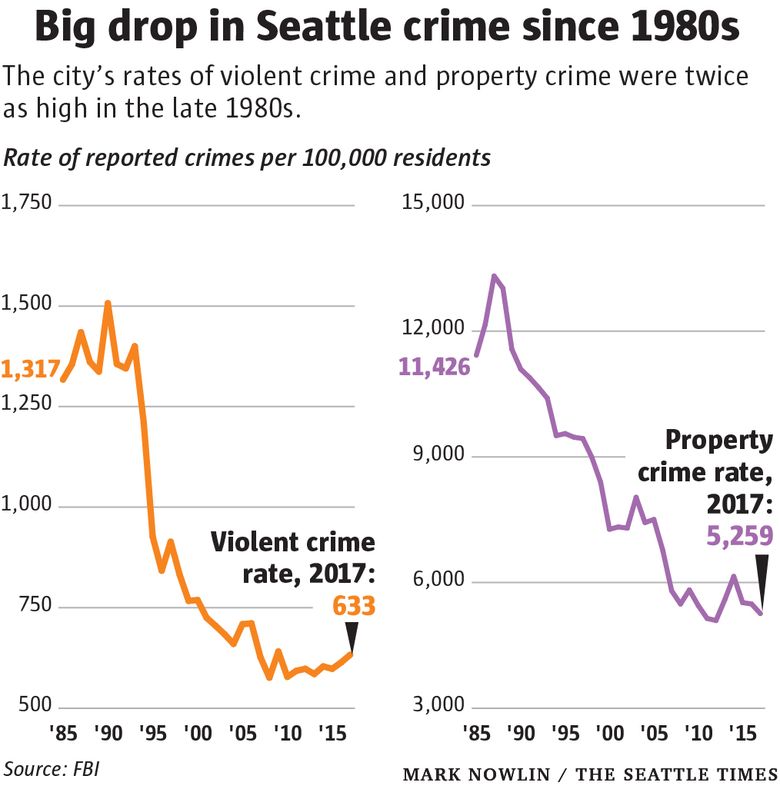
A shopkeeper friend of mine closed his business in Seattle after multiple lootings of his place and the police never showing up. He relocated to a bedroom community.
Crime statistics are not necessarily accurate, and politicians have an interest in minimizing those statistics one way or another.
My experience also seems to match statistics. So, it would seem that your friend's experience might be the outlier -- I'm not saying they are wrong, I'm saying their experience doesn't match the data and there's at least one anecdote (mine) that runs counter to their anecdote. Seems like a good opportunity to try and find data that supports your hypothesis?
Seattle had the highest burglary rate in the nation of any large city as recently as 2023 (1201 per 100k residents!). https://www.safehome.org/resources/crime-statistics-by-state...
from 1999-2018 (most recent I can find a chart for), Violent crime ebbed and flowed but ended essentially where it started: 680/100k residents, almost double the US average. https://www.macrotrends.net/global-metrics/cities/us/wa/seat.... I believe this uses FBI numbers.
Seattle Police report 5394 violent crimes in 2024, with 755k residents that's ~700 violent crimes per 100k, or roughly where it was in both 1999 and in 2018. https://www.axios.com/local/seattle/2025/04/28/crime-drops-2...
I note that the Axios article says 2025 is on track to be a big drop; I have no idea what crime seasonality is, so I'd take that news story with a grain of salt until the year is out. Either way I just don't think Seattle's crime rates are "way less of a concern" over the last 40 years. Well, people may have become acclimated or stopped caring. But the rates are high, and don't look to have changed that much.
In the 80s and 90s, violent crime rates were well above 1000/100k residents, and property crimes 12k/100k.
"While crime rates in Seattle have recently shown a decrease, some reports suggest this may be partially attributed to a decline in reporting rather than a genuine reduction in criminal activity. Specifically, some authorities have noted that crimes against businesses, in particular, are frequently not reported."
"The police chief specifically mentioned that a 10% drop in property crime might not be entirely accurate because many business-related crimes go unreported."
Police reports aren't the only source of data. If this was a widespread impact then there would be other sources of data that could be used to build this case.
Additionally, we cannot make policy decisions on "just trust me, my friend said...". Maybe we can't get a perfect signal, but if you are going to challenge the prevailing data, I expect you to bring something novel beyond vibes. It doesn't have to be perfect, but a single anecdote plus "I believe it" is not sufficient to oppose what the data we do have is consistently saying -- crime is lower in Seattle, and has been consistently lowering over time.
Why isn't shrink going up?
Lets see if cutting education has any impact over the next 20 years.
5% (6.8 million households) experienced "very low food security" which is "normal eating patterns of one or more household members were disrupted and food intake was reduced at times during the year because they had insufficient money or other resources for food"
American food security is so bad in plenty of places that we can still get notable increases in academic performance just by giving people food
Lack of access to food is literally holding the US back.
That is just a right talking point about how we are so spoiled. Plenty of kids need food. Kids learn better when not hungry. And Republicans are cutting school food programs.
> But a prison is a portrait of what happened five, 10, and 20 years ago.
Is this just a result of the dropping crime rates since the mid 90s, but on a 20ish year lag?
i fear the new avenues of business sought by companies that operate for-profit prisons - i don't expect they'll just eat the losses of declining populations in their main moneymakers, and we're already starting to see them work on detention facilities for DHS etc.
Each of these videos puts most film car chases to shame. There must be 20 channels dedicated to this. Participating states I've seen are mostly Arkansas, Florida, Georgia, Ohio, Michigan, and California. But any agency can publish a video, particularly if there is a shooting death and an official investigation.
Most of them (probably all) have contracts that stipulate they get paid per bed they provide, whether or not it's occupied.
Now, most of those laws have been rolled back. In the past 10-15 years the number of people locked up at the state level for drug crimes is down 30% even though drug arrests remain high. And those still getting locked up are getting shorter sentences. (though over 40% of inmates at the federal level are still there for drugs)
I'm not sure why they failed to mention such a key issues related to incarceration. They repeatedly refer to the surge in crime in the drug war era as a "crime wave". And they link to 3 other pro-drug war articles by the same author. Maybe Keith Humphreys had a bad trip in his youth and now he's making it everyone's problem.