Posted by bensouthwood 12/18/2025
This whole thing just won't go away because many people are operating outside their area of expertise on this subject.
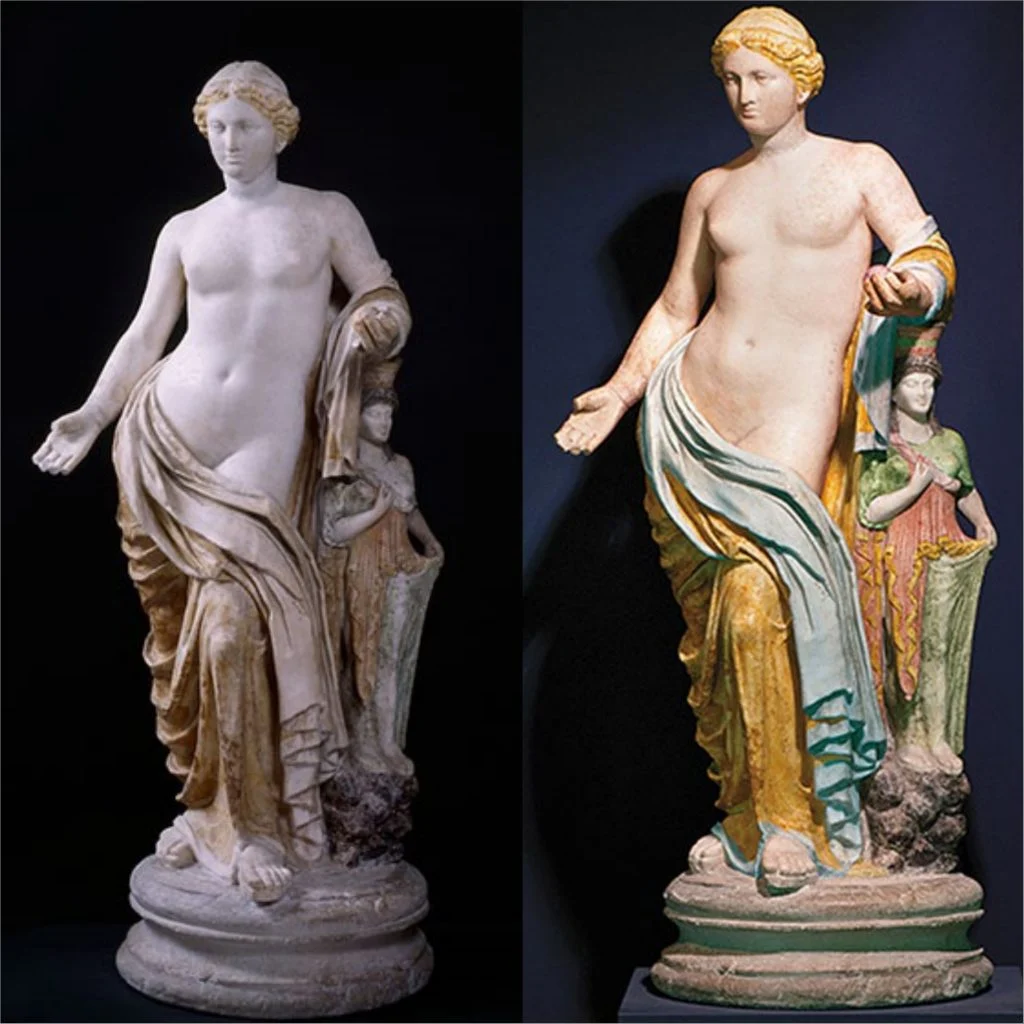
Painters layer paint, starting with a saturated base color. These archaeologists are simply looking at the paint that was left in the crevices.
The article suggests they obstinately do this because they know it creates a spectacle.
I think there's another explanation - if they use their own judgement to fill in the gaps (making the statues more classically beautiful) then everyone will accuse them of making it all up, even if they were to base it on fairly rigorous study of e.g. the colour pallets used in preserved Roman paintings etc.
However, I did a tiny bit of investigating, and according to this write-up it does seem like Brinkmann presents his work as resembling the originals
https://www.smithsonianmag.com/arts-culture/true-colors-1788...
But they still don't add anything without direct evidence - where there's evidence in later statues for more subtle colouring, they include that.
Can't find the better source on that specifically now but this is a nice article about the Roman trade with India and mentions the coins found in Vietnam and even Korea about half way down
https://www.thecollector.com/why-was-the-roman-indian-ocean-...
On the other hand, it's not implausible that maritime societies come up with their own fish sauce independently
I think the Augustus statue is a good example of that: Part of the garish effect comes from the contrast between the painted and nonpainted areas. The marble of his face and harness work well if everything is marble - but in contrast to the strong colors of the rest, the face suddenly seems sickly pale and the harness becomes "skin-colored". The result is a "plastic" or "uncanny valley" effect.
If the entire statue were painted, the effect would be weaker.
they should use "green screen green" and give you viewing glasses that fill in the colors to your own historical preference (e.g. rose colored? blood-soaked?). then if you point a finger with your "anhistorical" complaints, there will be 3 fingers pointing back at you!
This gives you a general trend of how brightly underlayed statues tended to be painted afterwards to finish them, and lets you infer how other statues without surviving coloured pictures of them would have appeared based on the likely prevailing style at the time
When you are instead putting together a museum exhibition intended for the general public, and you observe over and over again that they will interpret your work as representing what the statues actually looked like, it is irresponsible to keep giving them that impression.
It's not an either/or question. They could do some of the statues with just the pure archaeological approach of only using the paints they found in the crevices, and do others in a layered approach that is more speculative but probably closer to how they actually looked. If they did that, this article would not be necessary.
Dinosaurs in the first Jurassic Park were fairly well represented considering what we knew in the late 80s. But our knowledge of dinosaurs has grown, with feathers being the most emblematic change. Yet the Jurassic Park movies steadfastly refuse to put feathers on their 3D monsters in the current movies, because viewers do not expect feathers on the T-Rex.
We might be at that point with repainted statues. Museum visitors are now starting to expect the ugly garish colours.
They seem to have moved on a bit, they're balancing audience expectations with latest research, I expect.
I could imagine there's some great videos out there? I'd be keen to have scientific basis given rather than speculative artwork.
No way. When they engage the public, they are not longer exclusively scholars. They responsible for conveying the best truth they can to non-experts.
A journal paper can be misunderstood when the reader lacks the context to interpret it. Out in the public square, that is not the reader’s fault anymore.
You generally can't hold someone responsible for what someone else says about them.
You can do both: prove the base case and reach across the aisle to the art college next door to see if someone is interested in the follow up "creative exercise". You can present both "here's what we can prove" and "here's an extrapolation by a skilled artist of what additional layering/contouring might have done".
Likewise archeologists will classify finds as tools when they don't have nearly enough knowledge about the craft in question to be able to do this properly (see the extensive mis-classification of weaving swords/beaters as weapons [0], but there are many other cases).
So I'm a little reluctant to cut them some slack and say "this is how scholarship" works when they get all petulant about including colours that we know the ancients had, in ways we know they used them, for this kind of reconstruction.
[0] https://www.academia.edu/67863215/Weapon_or_Weaving_Swords_a...
>As a result, we internalized a deep-seated attachment to an unblemished white image of Greek and Roman art. We became, to use David Bachelor’s term, chromophobes. It is this accidental association between Greek and Roman art and pristine white marble, we are told, that accounts for the displeasure we feel when we see the statues restored to color.
And there's indeed been quite a bit of push-back since the story first broke. Unspoken is the reason. Primacy bias is probably a part of it, but what really accounts for the intensity of the attachment to the idea of white marble finishes? I'm sure you can imagine.
>Bond told me that she’d been moved to write her essays when a racist group, Identity Evropa, started putting up posters on college campuses, including Iowa’s, that presented classical white marble statues as emblems of white nationalism. After the publication of her essays, she received a stream of hate messages online. She is not the only classicist who has been targeted by the so-called alt-right. Some white supremacists have been drawn to classical studies out of a desire to affirm what they imagine to be an unblemished lineage of white Western culture extending back to ancient Greece. When they are told that their understanding of classical history is flawed, they often get testy.
https://archive.is/qTreQ#selection-1695.0-1695.693
So, yes, it was important to categorically falsify the notion that the statues, frescoes, etc., were unpainted. Anything that left it open would have been something for the worst sorts of people to latch onto. Now that that's out of the way, possibly even more accurate explanations can be given the time of day, instead of being stuck having to hash out, "Oh, but were they even colored at all?"
>Folks closer to center see it as controlling the narrative, lies, and conspiracy when the full truth comes out.
And this, I reject. The people who think this way aren't in the center, and they were never interested in the truth. Their aim has always been promoting the primacy of Western classical art (often as part of larger notions of white supremacy). They fought hard for the debunked no-chroma interpretation until another angle presented itself: that the chroma scientists were trying to purposely make the statues seem ugly, in order to devalue Western classical art, or to dictate its value outside of their control and terms. It's the same tack as right-wing gamers claiming that female characters are being made purposely "ugly" in order to alienate male heterosexual gamers.
And while the reason for changes in female representation in games are less objective and more complicated than the scientific inquiry that produced the knowledge of painted statues, most of the people driven to the fringes by the evolution of these topics, as knowledge and circumstances develop, are people who share their fringe (and incorrect) ideas. Implicit there is that there's no "full truth coming out", just a developing collective understanding.
If you want narrative control, lies, and conspiracy, look at Wall Street.
i.e. is there evidence that there is comfort in trolling using Roman or Greek vs Assyrian, Nubian etc. Or do they just like to make everything bright and blocky.
And if one wants to add fake detail, why should archeologists be involved? Just have AI generate them
Reconstruction, (similar to translation) is an art that combines carefuly study of evidence and craftfully filling in gaps and adding in detail where necessary (or leaving details unfilled and ambiguous to communicate the impossibility of total translation or reconstruction!) to present some communicable form of the original that gives the viewer some closer but imperfect access to it.
Here's an article with one picture I could find, along with a few of the more saturated ones (NSFW artistic nudity): https://www.euronews.com/culture/2022/07/14/visit-the-exhibi...
Why do they even bother with the "reconstructions" if they know that they are inherently inaccurate, though
The article points out that the garish underlayer reconstructions have (maybe accidentally) been successful at correcting the widely held misperception of bare marble.
There’s also something in… the bare marble reconstruction maps somehow to our idea of sophisticated. Garish underplayed reconstruction, our idea of silly, frivolous, or childish. There were a lot of Greeks, they didn’t all live on one end of that spectrum.
And frankly, if I wanted to ridicule the ancients and flatter my own age, I could think of no better way than to make the old stuff look bad.
I would much rather have an exhibit that showed the bare marble, then a conservative reconstruction based on what direct evidence merits (to the degree possible, noting that it is not a complete reconstruction), then more liberal but reasonable reconstructions based on indirect evidence.
Plus there's zero direct evidence for their colours so there's no option but to use guesswork in these cases.
And a lot of dinosaur reconstructions may be more for edutainment value rather than reflecting a scholarly best-guess. There's no uniform methodology across all these disciplines.
This is no longer true! Starting with Sinosauropteryx in 2010, paleontologists have identified what they believe to be fossilized melanin-containing organelles. These organelles, called melanosomes, have different shapes depending on which color they produce, and those shapes are preserved well enough to be visible under an electron microscope.
Would be interesting to see a painted statue that's actually pleasant to look at, rather than these "let's smear this one pigment we found in the armpit all over the face"-style "reconstructions"
In no way would you start with saturated colors. One, they're very expensive, so why would you apply them, just for most to be painted over? Secondly, the more saturated (strong) a color is, the harder it is to paint over. Try painting over a wall painted bright red with literally anything. Paint it over in blue and your blue turns brown. Paint it in yellow and you'll just get red again. That's why we (still) employ a very opaque, white paint to the canvas. Oil paint also becomes more transparent over time, so getting the form right with the earth tone underpainting is crucial for the painting to last hundreds of years.
Perhaps you're thinking of fresco painting? Then, the pigments are added to the medium (plaster) initially, and only very subtle highlights are added afterwards (if at all). This is a very, very difficult technique, and illusions like highlight and shadow are hard to pull off. But the painting over was frowned upon, because it doesn't last nearly as long as the embedded pigment in the plaster (and certainly not after cleaning/restoration). But adding highlight/shadow to a sculpture seems like not the play, as the 3D-ness of a sculpture would imply it brings its own to the table.
Makes more sense just to paint the sculptures the color you wanted them painted, like the (in comparison very contemporary) bust of Nefertiti in the article, which looks excellent. No need for highlight/shadow. I could only see that needed in the face, which would look and act much like makeup.
I have a particular expertise in historical scenic painting, (granted, largely for theatrical and ceremonial practice, but that's where we have the oldest examples of painting a fake thing to look real, see trompe l'oeil https://www.britannica.com/art/trompe-loeil )
In these examples, it's clear that the painters started with relatively saturated midtones, and used washes to take the shadows down and clay filled light colors (think gouache) for the highlights: https://masonicheritagecenter.org/backdrops-gallery/
As to the expense of saturated colors, it's the scholars claiming saturated colors, so the expense was made, obviously. But was yellow the final color, when it is the perfect base coat for a two part skin tone using first yellow, and then pink? In the first image in the article, you can see that half of the face is yellow, but that the other half is light colored skin. This exact theatrical layering practice has been used, first yellow, and then pink.
The fourth and eighth images in the article looks extremely similar to the scenic backdrops I've linked above, but one is from the same time period as these statues, and the other is from hundreds of years later. There is a clear similarity in the final work. I believe it's obvious that both painters used dry pigment mixed down to a thin consistency, and used a series of 5 to 7 quick layers to achieve fast, one session results.
This practice doesn't have anything to do with what we call oil painting today, which can be quite laborious and is normally achieved over multiple sessions. These artists would have wanted to knock out a work and get down off the ladder.
Happy to discuss further, all the best.
I think you are confusing a definition of saturation meaning "unable to absorb more" with the visual perception definition.
Optical Engineer here, but AFAIK artists use the term the same way: "saturation" refers to how the color is free of both white- and black-shading, "degree of non-grayness" if you will.
The outer ring of this image is fully saturated; you'll see that "muddy" colors like ochre and sienna don't occur there.
https://blogger.googleusercontent.com/img/b/R29vZ2xl/AVvXsEi...
Example: https://www.dailyartmagazine.com/wp-content/uploads/2022/09/...
The author suggests that this minimizes the opportunity for mischief, but tbqh it's likely that the ancients were simply much better artists than the people carrying out these reconstructions today.
I'd love to see a modern artist attempt one of these reconstructions using original materials but with greater artistic freedom.
"The paints used in the reconstructions are chemically similar to the trace pigments found on parts of the surface of the originals. However, those pigments formed the underlayer of a finished work to which they bear a very conjectural relationship. Imagine a modern historian trying to reconstruct the Mona Lisa on the basis of a few residual pigments here and there on a largely featureless canvas.
How confident could we be that the result accurately reproduces the original?
This point is not actually disputed by supporters of the reconstructions. For example, Cecilie Brøns, who leads a project on ancient polychromy at the Ny Carlsberg Glyptotek in Copenhagen, praises the reconstructions but notes that ‘reconstructions can be difficult to explain to the public – that these are not exact copies, that we can never know exactly how they looked’."
Georg Dehio’s principle of "conserving, not restoring" is often invoked as a synonym for this self-conception. Old and new need to be clearly separated.
It is a counter-movement to the 18th century historicism which ”destroyed” a lot of old monuments beyond repair.
Personally, I think we went too far on the conservation angle (at least in Germany, not sure about other countries), and should restore a bit more again with the knowledge we have. But much more intelligent people have debated that for centuries, so I guess their answer would be the same like https://askastaffengineer.com/.
Meaning that these "reconstructions" are a pretty pointless and have no real purpose.
First, the original, untouched (preserved but not restored?) sculpture.
Second, the reproductions highlighted in the article. With appropriate notations about "these are the base layers, not complete, etc"
And third, a best-guess at what the original could have looked like, based on the first two. Yes, this might be wrong and need to change over time.
It may be an academic point. But they are academics.
(and half the objection to the paint jobs comes from the fact we've come to incorrectly associate decorative elements from the classical period with the colours of bare stone)
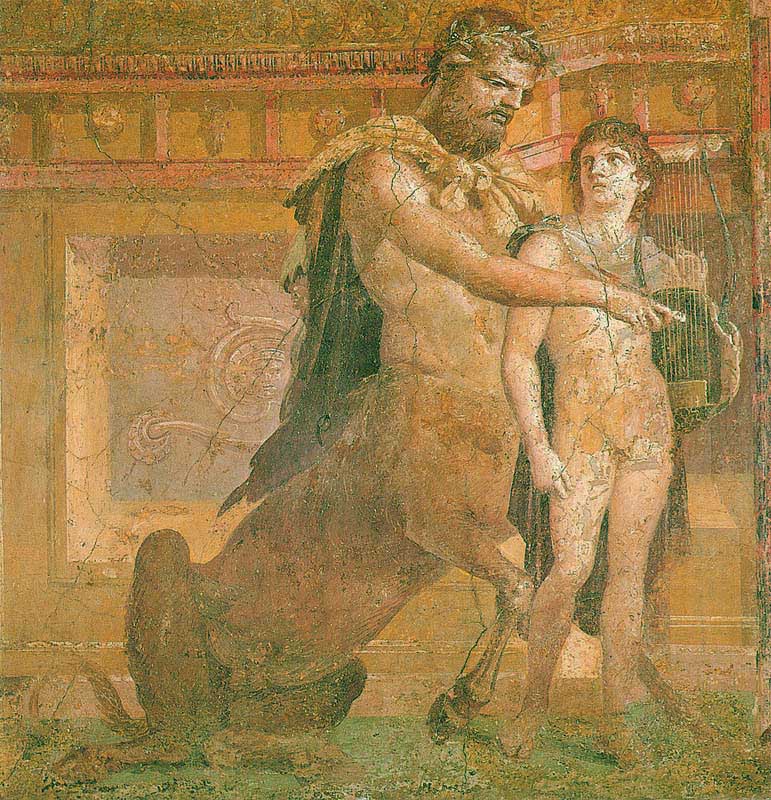
Like we know from Roman frescoes[1] and mosaics[2] that they were pretty skilled painters and solving the problem of how to paint something to have more hues than a King's Quest 3 sprite is unlikely to be an unsolvable aesthetic problem.
[edit] Changed from Secret of Monkey Island since that game has too many versions and remakes.
[1] https://upload.wikimedia.org/wikipedia/commons/6/6e/Chiron_i...
[2] https://en.wikipedia.org/wiki/Plato%27s_Academy_mosaic#/medi...
Exactly. I takes years of really hard work to get good at this stuff. Decades.
I do realize research budgets are not that awesome, but when claims are of aesthetic in nature (explicitly and implicitly) and deal with human craftmanship there should definetly be collaboration with also craftsmen subject experts.
A good example where this was executed really well was the Notre Dame reconstruction (I _guess_). Craftsmen and academic diligence hand in hand.
Not everyones archeological reproduction has such a budget unfortunately.
Do we know for a fact this didn't happen in this case?
They just look ... bad.
While photography destroyed academic art almost to extinction, thank heavens it's still trained and you can find practicing artists. Finding good ones might be a bit hard though.
So you could find a _bad_ artist to help you in your reconstruction project.
But finding an incompetent accomplice probably is not in anyones best interest.
So while hiring _anyone who claims to be an artist_ might be procedurally and managerially an approved method, it really is not the outcome anyone actually woudl want to have. So whatever happened here ... it does not count as professional reconstruction.
You don't need to be an art historian or an artist to recognize this.
You just need to compare them to other art from the period and the frescoes, and consider which one you find more appealing. And once you do this, there is a fair chance you will recognize the "good" art feels like an order of magnitude more appealing to you, even if you don't have the training to recognize the exact features that cause this appeal.
I'm sure you're right that reconstructions of painted statues are inaccurate. But I'm not sure that a good-looking reconstruction would be any more authentic. Cultural tastes vary a lot. I suspect that if we ever do get enough data for a valid reconstruction, I won't like it any better.
Perspective wasn't developed! The Greeks and Romans used it just fine, for example.
What was lost was artistic training because there wasn't sufficient economic market for it. As soon as you got sufficient economic incentive, art magically improves again. This is stunningly obvious if you look at Athens and then Pompeii and then Rome and then the Vatican (with the attendant backslide until the Renaissance as you note).
Interesting parallel to modern--will AI cause a huge backslip in art since the economic market for artists is being destroyed?
I don't see it being destroyed. I mean the market for art. That's a market for tangible things made by specific humans, pieces that are unique.
Very hard to see how AI will affect that since the market is dominated to large extent by the need by the art salespeople, art institutions, and art collectors to sustain prestige and investment value.
If it just about volume, China would have destroyed it decades ago. Clearly adding even more volume will hardly put a dent to it.
Sure. But if have a chance to visit Pompeii, the author’s argument will land. The Romans made beautiful art. It seems odd that they made beauty everywhere we can find except in the statues we’ve reconstructed.
I agree that I, personally, do not consider them painted in a way that is pleasing to me. But is that what the reconstruction project is meant to achieve, i.e. a painting style that is pleasing to current audiences? Or is it about reconstructing the bare minimum that can be asserted with some degree of reliability that is actually supported by the physical evidence?
Again I must ask: do we know decent artists weren't involved in the reconstruction project? Remember, the goal is to use their artistry to achieve scientific results, not just do whatever they find pleasing.
> You just need to compare them to other art from the period and the frescoes, and consider which one you find more appealing
I get this is the most compelling part of the argument TFA is making, but to be honest I don't find it all that compelling. Surely the people involved in the reconstruction considered this, and there's a reason why they still produced these reconstructions, and I don't believe that reason is "they are incompetent or trolling".
> Cecilie Brøns, who leads a project on ancient polychromy at the Ny Carlsberg Glyptotek in Copenhagen, praises the reconstructions but notes that ‘reconstructions can be difficult to explain to the public – that these are not exact copies, that we can never know exactly how they looked’.
Consider that had they gone wild with creativity, they would have been criticized for it. Apparently the current overcautious trend is an (over)reaction to previous careless attitudes in archeology.
This is my uninformed take, anyway. I think TFA's author should have engaged more directly with researchers instead of speculating about their motives; the article -- while making some interesting points -- reads a bit snarky/condescending to me. Why not go straight to the source and ask them?
Now, was it possible that, given the pigments available, they were better off just going with the most saturated thing they could possibly have, and then work from there? Absolutely. But the right argument here isn't that "Painters layer paint this way", but that, as the article indicates, they are unlikely to be unsophisticated artists that don't believe shadows and highlights. So the highlighting and the shading must be in the place where we can't see, because we assume they must exist.
Armor historians from the 1960s, all the way back to Victorian age, sat in their offices smoking pipes and imagining what purpose the armor served, and and what constraints molded it.
Then the SCA and Renaissance Faires sprang up, and it was no longer purely theoretical. Recreationist research became a thing. And historical analysis became practical.
The most glaring example are the rectangular epaulets on funereal brasses and sarcophagi. Historian used to claim they were used to deflect blows from the shoulder.
Nothing is flat after a blow. All real armor is built on pressure-spreading arches, often first two-dimensionally, but ultimately in three dimensions (the armor over a 16th-century knight's legs are never conic sections, but more fluid curves).
So, those rectangles? Not defensive metal, but purely decorative, and probably leather or paper-mache. (None survive, and in fact there's some argument they exist only in art.)
Any historian who tried to make one and use it would learn this in a short exercise. But the fallacy survived for decades, because the people were operating outside of their area of expertise, while falsely claiming otherwise with no criticism.
Another example is the still-pervasive myth that medieval people used spice to mask the flavor of spoiled meat; I've heard it used by academics a couple decades ago at a conference presentation. Ever eaten spoiled meat? Ever think to yourself, this bellyache wouldn't be so bad if I didn't taste the source of my poisoning? That myth was tracked back to a singular author in the 1950s, IIRC, and copied without any rational criticism ever since.
> Another may be that they are hampered by conservation doctrines that forbid including any feature in a reconstruction for which there is no direct archaeological evidence. Since underlayers are generally the only element of which traces survive, such doctrines lead to all-underlayer reconstructions, with the overlayers that were obviously originally present excluded for lack of evidence.
Most Greek and Roman statues had lost their paint long before the Renaissance. Early modern artists held up those paintless statues as the ideal form, which is why nobody from Michaelangelo to Bernini even tried to paint their sculptures. Instead, Bernini learned how to make marble itself interact with light to look alive. For centuries afterward, the purity of raw marble became the one true ideology. Diversity in this area collapsed, and took a long time to recover.
Even today, most people who are used to Western classical art will probably agree that marble statues look better without paint. We've been conditioned for generations to believe so. The ugly reproductions of painted statues aren't helping, either.
The point the author made in the article is that the reconstructors are well aware of this, and are, in a way, trolling the masses to raise awareness and attract attention to the classical art and museums.
Keeping history alive generally isn't a profitable enterprise.
"Since underlayers are generally the only element of which traces survive, such doctrines lead to all-underlayer reconstructions, with the overlayers that were obviously originally present excluded for lack of evidence."
They also had a significant disadvantage in pigment availability. Chances are that there's a whole lot of modern, synthetic pigments among the colors you use regularly. Pyrrole Red is from 1974, for example.
We know that painters were well aware of things like how many good, natural pigments get different outcomes when diluted (go see what happens as you thin ultramarine), so it's not as if they had no technoology. But something like mica vs aluminum vs just gold leaf is a budgetary issue, both today and back then. You will find that good metallics are more expensive and avoid mica. But for an important statue, I suspect they'd take fewer cost cutting shortcuts, just like we can tell in renaissance and medieval art that got to us in relatively good shape. This is the kind of thing some people spend their lives studying.
(And lest someone be inclined to downvote because I'm suggesting an AI, the real sarcastic core of my message is about our faith in computers still being alive and well even after we all have decades of personal experience of them not being omniscient infalliable machines.)
So, we are extrapolating from a very, very, very spotty data set.
Latest excavation: https://www.pbs.org/video/episode-1-eyvf5d/ (Also on Apple TV)
> Why, then, are the reconstructions so ugly?
> ...may be that they are hampered by conservation doctrines that forbid including any feature in a reconstruction for which there is no direct archaeological evidence. Since underlayers are generally the only element of which traces survive, such doctrines lead to all-underlayer reconstructions, with the overlayers that were obviously originally present excluded for lack of evidence.
That seems plausible -- and somewhat reasonable! To the credit of academics, they seems aware of this (according to the article):
> ‘reconstructions can be difficult to explain to the public – that these are not exact copies, that we can never know exactly how they looked’.
Have you seen medieval art though? https://www.artistcloseup.com/blog/explaining-weird-mediaeva...
The technique is quite different from the "old masters" of later periods that we often think of as fine art.
Compare the damn cave paintings of buffalo to most medieval European art. Some of the 10k-year-old stuff is much better observed. Europeans between about 500 and 1300 mostly couldn't paint. I'm sorry about that.
It's just not always taste. Sometimes it's taste. Sometimes people are bad at making art.
For example, most of the examples given in that article are illustrations from manuscripts. This was something (as far as I know) that was new in the western world. The idea that books should be illustrated. And being before the printing press was introduced, each illustration (of which there were often many per page) was hand made. This added a substantial amount of time to an already labor-intensive process. And each image was not intended to be a standalone work of art.
Also, some of the other examples are of iconography. That style remains, largely unchanged to this day. If you do an image search for "religious iconography", you will see plenty of examples of sacred art that are not visually realistic but are meant to be metaphorically or spiritually realistic.
I'm not particularly basing my opinion on the examples in this article. It's easy to see that a lot of surviving European medieval art sucks. Maybe "surviving" is the problem. Maybe the good stuff got all smokey from being displayed and only the leftovers and student paintings, in storage, have survived.
On illustrations, everybody can see the difference between Durer and most medieval stuff. It's not simply style or taste.
Illuminating…
——
For anyone who’s interested in a slightly more nuanced take on how people in the Middle Ages perceived of “art” — and how different that notion was to how we perceive it today — Forgery, Replica, Fiction by Christopher Wood [1] is a really interesting read.
Here’s the last sentence of the Goodreads summary, which describes the major transition in thinking:
“… Ultimately, as forged replicas lost their value as historical evidence, they found a new identity as the intentionally fictional image-making we have come to understand as art.”
[1]: https://www.goodreads.com/book/show/3921524-forgery-replica-...
Besides the comment started by saying that "medieval European art generally sucked", so it covers the work I mention.
That's if you want to nitpick. If you don't, both those works are hallmarks of medieval art and while they're not necessarily exemplars, it is important to remember that there were still artists who knew their stuff in and out in medieval times and the Renaissance didn't come out of nowhere.
Edit: I travel through Europe by train a lot (mainly France and Italy but also Switzerland and Germany occasionally) and I visit museums, cathedrals, and art galleries in every city I stay. I have seen a lot of medieval art because those places just seem to have it lying around by the bucketload. There is a broad range in quality, but I have seen some very high quality woodcuts and, indeed, paintings, although those tend to be religious icons. Sculptures also, but mainly in statues of saints on the outside of cathedrals (see e.g. the Rouen cathedral). I'm trying to say that I'm not some kind of art authority or expert on medieval art, but I have seen my fair share of it, and no, Europeans didn't just suck at art in the medieval. I think what happened is there was a lot of mostly religious art that was lower quality, sort of like you can find plenty of slop on the internet today, but there were still skilled artists that created shockingly good art. You'd be more likely to find it in the palaces of the rich and powerful, I reckon, because they were the ones who could afford/support talented artists, as opposed to more ordinary craftsmen, who would be paid less. For the same reason you might find less of the good art lying around than the rougher, cruder kind, because the former was more expensive and thus harder to obtain. This also goes for religious art, which tended to include a smorgasboard of art forms, from painted icons and sculptures to reliquaries and liturgical equipment like communion chalices. But good medieval art existed, I've seen it, and it wasn't that rare.
I put the cut-off at 1300 very intentionally. As soon as you go much past 1300, you start to see stuff like this https://en.wikipedia.org/wiki/Andrei_Rublev#/media/File:Rubl... That's some good shit. I see this in Wikipedia dated 1338: https://en.wikipedia.org/wiki/File:Lorenzetti_amb.effect2.jp... Not bad at all. They're already creeping up on or El Greco or Da Vinci or something.
And if we move the cut-off all the way to 1450, fuhgeddaboudit. You have freaking Albrecht D\:urer by that time. No fair. I'm sorry. The challenge concerned a particular 800-year period, which I chose carefully.
Yes I hear you about the range of quality. You're right. Many of the best pieces may have been "exhibited to death." There was presumably lots of student art and whatnot, probably not considered very good at the time, but it happened to survive. I accept that. But I'm only asking for a single counterexample in an 800-year block of time. I think that's fair.
If you like, though, I'm happy to amend my claim to this: "No, medieval European art did not suck. European art between 500 and 1300 sucked. But from 1300 until whenever the Renaissance starts, watch out. Those folks did some really nice work."
It doesn't matter. There was plenty of good art between 500 and 1300 too. I mentioned the Rouen cathedral, whose west front, the one with all the statues of saints and the hyper-detailed architecture wikipedia tells me was "first built in the 12th century, entirely redone in the 13th century, and then totally redone again at the end of the 14th century, each time become more lavishly decorated" (https://en.wikipedia.org/wiki/Rouen_Cathedral#West_front). That's just one example that fits your spec, that I have personally visited. As I say I'm no expert.
Here's another: the sixth-century basilica of San Vitale in Ravenna, Italy, with some of the most famous mosaics ever, including those depicting emperor Justinian, his wife, empress Theodora, and his court, which again Wikipedia tells me were completed in 547.
With a cursory look online I can also find a bunch of other famous art pieces from your chosen period that I haven't seen myself, like e.g.the Diptych of the Virgin and Child Enthroned and the Crucifixion (https://www.artic.edu/artworks/16241/diptych-of-the-virgin-a...) which however is very typical of the ecclesiastical art I've seen in many museums and art galleries I've visited.
So I do think your claim is a bit exaggerated, even if you try to limit the time period carefully. There was always good art made in Europe.
Btw, I'm Greek so I'm not offended by your claim about Europeans, in case there was a lingering doubt about that. The Greek middle ages (i.e. Byzantium) are usually not included in the European middle ages but Byzantium produced absolutely gobsmacking art throughout the medieval so leaving it out is also a bit arbitrary (but that's not your fault).
San Vitale is also so impressive that I think it heralds the end of that golden age. Nothing will be like this for 800 freaking years In contrast, that diptych from 1275 looks like it heralds the end of the dark age and it do looks like it (starting to be good but nothing like what'll come after it). So if we cherrypick again a little bit, 550-1250 is quite a long dark age.
Regardless of definition of "medieval" here, there still seems to be a very long contiguous era where there is dearth of good European, especially western/northern, art.
Yeah, why sacrifice dignity by providing a counterexample? Dignity is important.
Paintings used to be better, and before that they were worse.
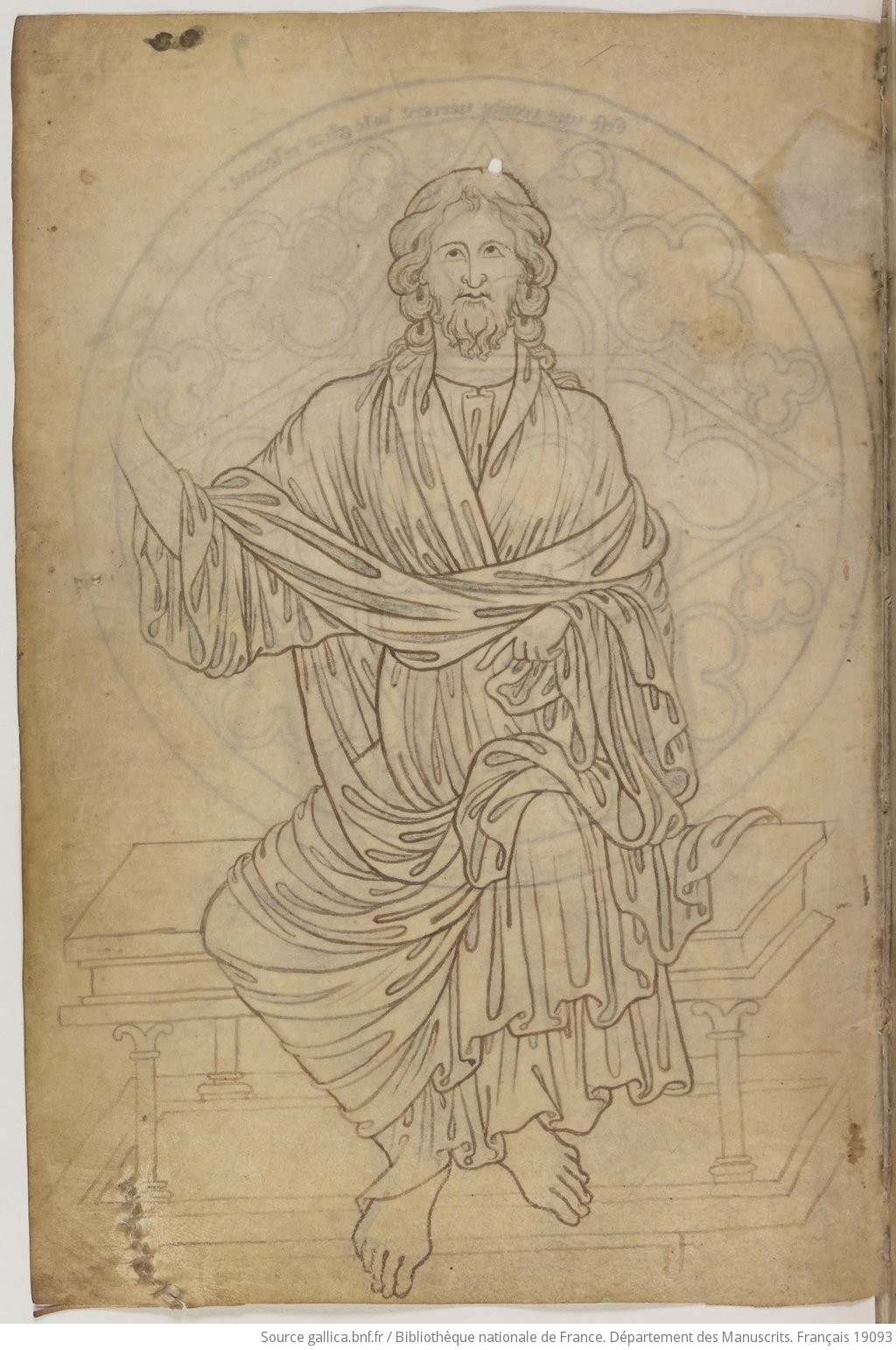
https://www.medievalists.net/2024/12/sketchbook-villard-honn...
Medieval art is very stylised, but the quality of the lines, the details in the clothes, the crispness of the composition, all that requires a lot of skill. Check out Jean Bondol’s work for instance https://artsandculture.google.com/asset/tapisserie-de-l-apoc...
You may not like the style, but being able to produce works like that requires you to be good at art on some level.
In general, though, yes, I think medieval European artists were short on skill compared to artists from Europe in pre-medieval and post-medieval times, and art from other places between ~500 and ~1300. They had some skill, but not as much.
Artists with limited technique are a real thing. Not everything is taste or style.
The clothing does often look good. In folio 16v ( https://www.medievalists.net/wp-content/uploads/2024/12/Vill... ), it's been overdone and appears to be far wrinklier than fabric could support, suggesting that Jesus is embedded in some kind of strange plant.
The faces are terrible in all cases.
In general, perspective is off, anatomy is off, and you get shown things that aren't physically possible.
The Honnecourt illustrations strongly suggest that (a) photorealism is the goal, but (b) Honnecourt doesn't know how to draw it. He does things like place a person's right eye at a different angle to the rest of the face than the left eye has. But hey, how likely is it that viewers will notice a malformed human face?
(warning, NSFW)
> Europeans between about 500 and 1300 mostly couldn't paint.
They could. And they had wide variety of what they painted and how.
This is a question for an art historian, not some anon on a tech forum. (For what it’s worth, I find Medieval and Renaissance art to be about equally tepid despite the difference in execution. And plenty of people non-ironically enjoy Medieval art despite its supposed deficiencies.)
Don't sell yourself short. Post some art from those 800 years that doesn't suck, and I'll change my views.
Sure, there's plenty of crap in 20th century art. I've seen examples of that. But that's a different subject.
If you're looking for art with an impact, the iconography of Andrei Rublev (and other icon painters during this period) is still massively influential in the Russian Orthodox Church today. 600+ years of direct use and inspiration! The lack of naturalism is not a deficiency.
Not to mention, Rublev lived at the end of the Medieval period, and well into the Renaissance - the period where painterly skill in Europe was revitalized.
Andrei Rublev, 1360-1430? This dude? https://en.wikipedia.org/wiki/Andrei_Rublev#/media/File:Rubl...
Yeah he's good, that's obvious. Klimt cribbed from Rublev I bet. Naturalism was never the topic. But note that Rublev didn't do much work between AD500 and AD1300. Because not born yet. This is precisely why I wrote down dates, and why I am insisting on counterexamples instead of vague generalities.
And there is another element to consider, which is the purpose of the art. Medieval art was not concerned so much with realism, but with the symbolic.
I wonder: do you think Byzantine icons "suck"? I suspect you do.
What would be the point? Any example given will be met with some snarky and ignorant remark. Veit Stoss's Krakow triptych? Gentile da Fabriano's "Adoration of the Magi"? Byzantine art, like Monreale Cathedral? The Christ Pantocrator icon from St. Catherine's Monastery? Romanesque and gothic cathedrals? Ornate illuminated manuscripts? Shall I continue? You don't have to like medieval art, but claiming it "sucks" is not only generalizing (your very accusation in this thread), but it is boorish and ignorant. You've already gotten more "discussion" out of this topic than you deserve.
So, go troll somewhere else.
Adoration of the Magi, 1423. https://en.wikipedia.org/wiki/Adoration_of_the_Magi_(Gentile...
People flatter themselves.
13th century. Not just the art, but for the content. Truly ahead of its time.
And the Space Age is really the tail end of the Steam Age. Human history doesn't have any sharp divisors, aside from total genocides or the even rare natural disasters on the scale of Pompeii's demise.
The admittedly artificial definition of the start of the Renaissance, however, does help frame an explosive growth of useful new tools in art (and other endeavors), like perspective, oil paints, and so on.
Obviously, there is no sharp line. That is too trivial to mention. But the distinction is made, because it captures something about the characteristic spirit of an age.
In the received black legends of whig history, the Renaissance is typically presented as some kind of enlightened rift with and rebellion against the supposedly dark and evil Middle Ages, but in some sense, it is more accurate to view it as a culmination of the Middle Ages or something continuous with it.
You will find great rifts later on with the rise of modernism.
“On the other hand, at a time when trust in the honest intentions of experts is at a low, it may be unwise for experts to troll the public.”
A more modern example might be that recently discovered Babylonian Lamb Stew [0]. Most of the scholarly reconstructions of the stew follow the recipe very literally, and the result is, frankly, awful, because ancient readers would probably have made cultural assumptions about certain steps in the recipe. Meanwhile, some internet cooks who take a stab at the same recipe come up with something arguably much better, because they're applying their knowledge as cooks to guess what might have been stated or unstated by the recipe. [1]
Makes you wonder why no one thought to just take a copy of one of the statues to a modern artist and say, "Hey! How would you paint this?" I'm willing to bet that, even now, it would be reasonably close to how an artist 2000 years ago might have approached it.
[0] https://eatshistory.com/the-oldest-recorded-recipe-babylonia...
[1] https://www.tastinghistory.com/recipes/babylonianlambstew
It's the difference between "a chicken stew flavoured with turmeric and cumin, then rice enough to cook in and fully absorb the broth" and "first, take 500g of boneless skinless chicken thighs..."
That's going too far. The person recording them might be the same person who is used to making the food, or might be taking literal dictation from that person.
Knowing how to make food isn't the same skill as knowing how to explain the process in a way that someone who isn't already trained to make the food can follow.
https://classics.rutgers.edu/the-hair-archaeologist-janet-st...
There are folks that will insist that we don't know at all what Roman garum really tasted like or everything involved in its preparation, and they're not exactly wrong since Colatura di Alici can only be traced back to the middle ages, but it's also oddly obtuse. I think it was probably like modern fish sauces but Roman garum could have been as different from Colatura and Asian fish sauce as those are from Worcestershire.
Careful. What we refer to as "tomato ketchup" has been bowdlerized and degraded by being made shelf stable.
"When Every Ketchup But One Went Extinct" https://www.atlasobscura.com/articles/history-of-heinz-ketch...
Wikipedia: https://en.wikipedia.org/wiki/Shrimp_paste
Also, even if the Roman Empire had wool knitting a lot of it wouldn't have survived archaeological records (textiles rarely do, which is a shame in general, and also arguably why there is so much bias against certain types of textiles in "historical records") and it seems hard to entirely dismiss the Roman Empire from having wool knitting given the extent of the Empire and how deep the history of wool knitting in the British Isles goes, at the very least, to which the Roman Empire had contact and trading.
Why speculate from that outside perspective when you could talk to people who worked on them and the decisions they made. I think that would be very interesting. As is that‘s completely missing and it feels a bit like aimless speculation and stuff that could be answered by just talking to the people making those reconstructions. My experience is that people doing scientific work love talking about it and all the difficult nuances and trade offs there are.
If I'm understanding you right, you're suggesting the author thinks that researchers are intentionally doing poor constructions to undermine public perception of classical art as part of some sort of culture war? I don't see anything in the article to suggest this
It's towards the end of the article. He doesn't directly mention culture war stuff but he does talk about it being "iconoclastic." I think it's a reasonable interpretation of what he was saying.
By claiming our ancient predecessors had terrible taste you can make them look like primitive fools, and make our own modernity appear superior in comparison.
When boiled down to culture war brainrot the poor coloring in the reconstructions becomes a woke statement that the brutish patriarchal empires of antiquity have nothing to teach our sophisticated modern selves and that new is good and old is bad. A progressive hit-piece on muh heritage.
Anything you don’t like is a purple haired marxist if you squint hard enough.
Idk why my brain went there. I’m guessing the years of daily exposure to engagement-farming ragebait had something to do with it.
https://journals.openedition.org/techne/2656?lang=en
https://www.smithsonianmag.com/arts-culture/true-colors-1788...
https://www.npr.org/2022/07/12/1109995973/we-know-greek-stat...
https://bigthink.com/high-culture/greek-statues-painted/
https://www.newyorker.com/magazine/2018/10/29/the-myth-of-wh...
https://steemit.com/news/@beowulfoflegend/greek-statues-were...
I know that many scholars have an uncomfortable relationship to the PR work their research institutions are doing, but they themselves don’t strike me as unapproachable or closed to nuanced discussion. Seems weird to ignore that perspective and wildly speculate from the outside.
It could just as well be said that a bunch of scholars disconnected from the culture, history, and technique of fine arts (except as objects of scholarly interest) are wildly speculating from the outside about the nature of the objects, and people interested in these things are starting to ask "Why are these silly things being said about the topic I'm interested in? Are the people behind this pranksters?"
Anyways, if there is a misunderstanding here, which I don't doubt is the case for at least some of the people involved, why can't the discourse be had in public about it? The question has been asked as you suggest...publicly. Polychromic revivalists are free to respond in public, and we can all benefit from hearing the more nuanced perspectives get expressed.
I merely would have expected some humility when you characterize the work of other scholars from the outside without even talking to them. (Outside here is relative. Whenever you talk about scientific of scholarly work without talking to the people who do the work you are on the outside.)
If those scholars don’t want to talk to you, fair enough, probably no humility needed. If you don’t want to talk to them (which, fair enough, not everyone is cut out or wants to do journalistic work) you better be humble and maximally charitable, though.
You are ignoring what I said and just reasserting your hegemonic view of scholarly institutions / scientific work. On the contrary, if you zoom out it becomes obvious that our academic research in these matters is ephemeral heat and noise that gets rolled into the dustbins of time.
That seems like a wild and weird take to me, contradiction everything I know about how the world works. But if that is your hypothesis then I don’t know how you can answer ist without actually engaging closely with those who you say are disconnected.
It's an unsubstantiated theory, but the author does go out of their way to say that this might not even be objectionable, if it happened at all
In architectural design I think it’s rather pronounced. We already know how to design great buildings for the human environment. There ain’t anything new to learn here, so in order to stand out in the field you have to invent some bullshit.
Well, you do that, you create Brutalism or something similarly nonsensical, and in order to defend your creation you have to convince a lot of other academics that no, in fact, buildings that look like bunkers or “clean lines” with “modern materials” are the pinnacle of architecture and design.
And as time has gone on we still go and visit Monet’s Gardens while the rest of the design and art world continues circle jerking to ever more abstract and psychotic designs that measurably make people unhappy.
Not all “experts” in various fields are weighted the same. And in some cases being an expert can show you don’t really know too much.
In fact you can find a question to this very answer with a quick search: https://www.reddit.com/r/AskHistorians/comments/1nfz67t/comm...
Experts are also not a monolithic block. Within architecture and arts you can find many people who agree with your aesthetic preferences.
It is like claiming that there is a "curly-braced" orthodoxy in programming when you just haven't engaged deep with modern varieties.
There's a lot of ugly brutalist buildings, but there's a lot of ugly buildings in every style. At lot of them look cheap because they were supposed to be cheap; to a certain extent looking inexpensive was intended. In some cases the hostile nature of the institutional building was part of the point, conveying strength unstead of offering a pleasant experience, but there's also some quite pleasant brutalist buildings that have a lot of nature integrated into the design.
> They are scientists and conservators doing their best
Even if tastes have indeed changed, something that matches our current taste will reproduce the impact of the statues better than a scientifically meticulous and factually accurate depiction that misses the emotional truth.
The end result would surely look better, but how would we be assured it resembled historical reality?
Do we know for a fact in these reconstructions there is no input whatsoever from artists? I know, for example, that paleo-artists are responsible for the reconstruction of what dinosaurs are currently thought to have looked like, and they are mostly artists that work in collaboration with scientists directing their work. Why do we think this is not the case for the reconstruction of colors of Roman statues?
You can be fairly sure that no reproduction would literally resemble the reality, _including the existing reconconstructions_, but you can certainly produce a range of possible reconstructions which would have produced the same evidentiary record, and which would be at least inspired by what we know about contemporary taste that we can derive from surviving paintings and the textual record.
I think the article is mostly begging the question, and is not particularly rigorous. At most it's appealing to some sort of common sense, and we know how tempting but unreliable common sense can be in science and history.
To me TFA reads mostly as "this reconstruction looks bad, I refuse to believe ancient Romans painted statues like this, therefore it must be an incorrect reconstruction."
This is just an argument against doing reconstructions at all. Which I am also okay with. It's not a defense of the existing reconstructions because they have the same problem. You don't want to assume additional layers. The existing reconstructions are assuming there were no additional layers. Neither are valid assumptions, but they are both possible. So present multiple possible alternatives without stating that any of them are accurate reconstructions, only that they are constructions which are consistent with the available evidence.
Surely, if one wanted to produce a "reconstruction" of the Venus deMilo, it would have arms. Even if you don't know what the arms would have looked like. And that you would not reconstruct the arms as just straight lines projecting from the stump and would make some attempt to make them realistic and aesthetically pleasing, even if the end result almost certainly does not look much like what the original arms would have looked like, exactly, it would be more like it in spirit than either the statue with stumps or with some sort of vaguely armed shaped cylindrical attachments.
> To me TFA reads mostly as "this reconstruction looks bad, I refuse to believe ancient Romans painted statues like this, therefore it must be an incorrect reconstruction."
Which I agree is not a reasonably view IF we had no other data. Imposing the garrish 5-yeard old colouring book style is no less biased.
I don't think they claim this is what the statues actually looked. In fact, the article quotes an expert saying the opposite: "we can never know what they looked like".
These are conservative but incomplete "this is the part we have strong evidence for".
Yesterday’s kids are today’s scientists. You what the most popular archeological student prank is? - It’s for a team to bury a modern piece of pottery in another team’s site. So I am not at all surprised if they wanted to play a few practical jokes on the public’s ignorance.
Trolling here means that they followed the tradition of restoring the items - use just the materials they found on the statues. Well the materials found were the base layers - so that’s what you restore. You don’t go adding shading or fades or iridescent paint because it looks cute. They create art that looks like an 8 year old painted it, then laugh at the public “ooh-ing and ah-ing” over the “beautiful” restorations.
And for that matter, people who admire Sparta and like, eventually end up doing nazi salutes.
1. The professional qualifications of the people doing the actual work should be taken seriously. But the professionals have no control over the people who dictated how the work should be done, or the people who thought out the marketing. I hope this point is clear to engineers.
2. Even if the "trolling" sentiment is both incorrect and "terrible" ... ok. Noted. That doesn't destroy the value of the whole article.
Screed:
Many of us have reached the point where we throw away the baby if we find the slightest imperfection in the bath water. This now includes medicine, values, science, and (at least in the US) our freedom and our functioning society.
We need to grow up. Another example that many modern folks cannot handle is errors in the scientific literature. The scientific literature is incredibly valuable, despite also containing a lot of errors. That's life. Reading the literature is like fixing a car or playing an instrument. It works fine if you know how to use it. We need to grow up and deal.
I do not think tastes can change to such a degree that that first link would ever be pleasant to listen to, though that itself could be intentional for theatrical, theological, or other such purposes. Music seems innate to humanity - children generally start 'dancing' of sorts to music, 100% on their own, before their first birthday, long before they can speak or usually even walk!
The thing is that even if we do not personally like some form of music, I think we can still appreciate it. The Chinese guqin [3] is my favorite example - it goes back at least 3000 years, is played in a fashion completely outside the character of modern music - to say nothing of Western musical tradition as a whole, and yet nonetheless sounds amazing and relaxing even to a completely foreign ear.
Culture and tastes may change, but I think our ability to appreciate (or be repelled) by things is fairly consistent.
[1] - https://www.youtube.com/watch?v=4hOK7bU0S1Y
One way to close that gap would be to offer interpretations to be painted by modern artists to show what was possible and a viewing public could view a range of the conservative evidence based looks, and maybe a celebration of what human artistic ability can offer.
That said -- I think we actually do have more indirect evidence than what the reconstructions used -- in fact 3 separate lines of evidence A) paintings of statues B) contemporary descriptions of statues and C) contemporary paintings in general. All of which suggest that the coloring would have been more subtle and realistic.
I think if we had contemporary paintings of dinosaurs with feathers and contemporary accounts in writing that dinosaurs had feathers, but no feathers in the fossil record, you would still be fairly justified in saying that dinosaurs probably had feathers.
Humans?
Has he ever met people doing this stuff?.. Why write about something you know so little about? Why do people think that they can talk about things without experience, based on abstract reasoning?
Bare brick as an aesthetic choice did not emerge until the late 19th century.
We are hampered even more today because blues and greens tend to be sourced from organic materials that decay quick, while reds and browns are from minerals that don't decay (but flake off). Even in the best preserved art that we have there is still likely significant differences between what we see and what they saw because of this color change.
You don’t need to believe me. Look at Egyptian sculptures that have survived fairly well in the tombs. Or Greek and Roman paintings, some of which have survived quite well and shown in the original article. I spent 3,5h cgoing through the collections of The Archeological Museum of Napoli, and there’s plenty of them. They used muted earth tones like most skilled modern painters would.
The large plain panes of boldly coloured stained glass probably looked particularly magnificent when coloured glass was rare and expensive and achieving consistency very difficult. They look somewhat less sophisticated in an era in which the multiple bright coloured translucent pane aesthetic is more often seen in cheap children's toys.
If it was a restoration job, many people who love the sombre wall colours and intricate decoration of Mughal architecture would be sure to insist they'd got it horribly wrong...
(Other aspects of the article's argument also apply here. Very different culture but theres a lot of aspects of the Hawa Mahal that look fantastic to modern Western tastes, the architects clearly valued detail in their carvings and painting of other items, they surely had the technical ability to produce stained glass in a way modern Europeans familiar with different approaches to stained glass windows in their own cathedrals consider to be tasteful and skilful. But there's no missing layer of subtle decoration that's been lost to the years: they just thought combining boldly coloured panes of glass looked fabulous)
Oerhaps they indeed are that garish as in your example, but simple image search shows plenty of examples that seem to suggest the image you posted is simply a very amateurish photograph. After all, European churches are full of glass windows with very strong contrasts of primary colours and they are very pretty indeed.
Shockingly, some of the windows look different from other windows and some of the colour combinations and pane shapes look better than others! They also have more effect when the light catches them directly. But yes, they're big plain panes of chunky glass (impressively big and impressively consistently plain at the time) which don't resemble the painted detail and tiny leaded panes of European churches at all, as I mentioned, and I suspect the author of TFA would be unimpressed.
Some more https://en.wikipedia.org/wiki/Hawa_Mahal#/media/File:Hawa_Ma... https://www.alamy.com/hawa-mahal-lit-up-at-night-in-jaipur-i... https://thrillingtravel.in/wp-content/uploads/2016/06/Ratan-... https://www.dreamstime.com/royalty-free-stock-photography-tr... https://theyoungbigmouth.com/wp-content/uploads/2014/04/stai...
And some stained glass windows from some village churches, for comparison http://www.tournorfolk.co.uk/stainedglass.html




.jpg)
.jpg)

