Posted by rwoll 12/21/2025
The Waymo's were just going really slow through the intersection. It seemed that the "light is out means 4-way stop" dynamic caused them to go into ultra-timid mode. And of course the human drivers did the typical slow and roll, with decent interleaving.
The result was that each Waymo took about 4x as long to get through the intersections. I saw one Waymo get bluffed out of its driving slot by cross traffic for perhaps 8 slots.
This was coupled with the fact that the Waymos seemed to all be following the same route. I saw a line of about a dozen trying to turn left, which is the trickiest thing to navigate.
And of course I saw one driver get pissed off and drive around a Waymo that was advancing slowly, with the predictable result that the Waymo stopped and lost three more slots through the intersection.
On normal days, Waymos are much better at the 4-way stops than they used to be a few years back, by which I mean they are no longer dangerously timid. The Zoox (Amazon) cars are more like the Waymos used to be.
I expect there will be some software tweaks that will improve this situation, both routing around self-induced congestion and reading and crossing streets with dead lights.
Note that I didn't see any actually dead Waymos as others have reported here. I believe this is an extreme failsafe mode, and perhaps related to just too much weirdness for the software to handle.
It would be interesting to see the internal post mortem.
Is there a name for this (and related) effects? Obviously, in a group of several hundred thousand people, there will always be at least a few people that complain about something for the exact opposite reasons. That's not a signal of usefulness. I feel we need a name for the some-rando-has-an-opinion-that-gets-picked-up-and-amplified-by-"the algorithm" phenomena. And the more fringe/out-there, the more passionate that particular person is likely to be about this issue, when "most" people feel "eh" about the whole thing.
when a waymo can get a traffic ticket (commensurate with google's ability to pay, a la the new income-based speeding ticket pilot programs in LA and SF), and when corporate officers down to engineers bear responsibility for failures, i think a lot more people will stop seeing these encroachments onto our commons as a nuisance.
story time: i've literally had one of those god awful food delivery robots run straight into me on a sidewalk. once, one of them stopped in my way and would not move, so i physically moved it myself and it followed me to my apartment. i'm about to start cow-tipping them (gently, because i don't want a lawsuit alleging property damage, even though they're practically just abandoned tech scrap without a human operator nearby to take responsibility).
And if you’re Waymo, it’s a short-term reputation hit but great experience to learn from and improve.
I suppose if you lower the standards for what you hope AI can accomplish it wouldn't be considered a failure.
Just because no integer lives were wasted doesn't mean we can't sum the man hours and get a number greater than 1
That's a repulsive argument... Just because some argument is logically sound doesn't mean it's rational or reasonable.
Also, when attempting that math, make sure you account for the buffer that everyone already builds into their life. No sense in double counting the extra 10m I'm angry in traffic, instead of angry sitting at home because I'm doom scrolling some media feed with that extra 10m I saved because the robotaxi was faster.
Whenever we do something "good" at societal scale be it build ADA ramps or engage in international trade of consumer goods or in this case, have transportation infrastructure, there is always some tradeoff like this. We can either do the thing in a safer to life and limb manner, but that almost always has tradeoffs that make the thing less accessible or worse performing. We could have absurdly low maximum vehicle speeds, that would save lives, but the time and wealth (which are convertible to each other on some level) renders the tradeoff not worth it (to the public at large).
You can value a whole life loss higher than man hours. You can value a child more than the elderly. You can make all sorts of adjustments like that but they do not change the fundamental math of the problem.
It's not a feel good attitude. I'm only objecting to your shallow take arguing that the commoditization of human life is reasonable. (i.e. touch grass) Similar to how you're concerned, exclusively, with the numbers you think you can count. That attitude of dehumanization has never resulted in good things things for society and humanity. That's the trade off I'm suggesting is important to consider when trying to make up numbers as you are. I'm not arguing that an absurdly low max speed is better. I'm arguing that it's small minded to try to count like that.
> You can value a whole life loss higher than man hours. You can value a child more than the elderly. You can make all sorts of adjustments like that but they do not change the fundamental math of the problem.
I wouldn't make any adjustments like that. The value or importance that exists with a human life, the case example, being a person that cares for others, and is cared about by others. Can't be reduced into a value that's translatable to man hours. I'd trade hours with some people for minutes with others. Just because time is something you can quantify, and you like that you can count it. Doesn't make it more better or important.
To be clear, I'm not saying your math is wrong, I'm saying you're wrong to believe it applies. (in such a simplistic manner.) You can use the math to decide how you're going to make tradeoffs given known input values; how much can my city pay for safety equipment to protect people. But you can't make up some adjacent math and say, this car's design is wrong because it didn't kill the correct number of people... err I mean, the correct number of man hours.
Okay, let's see if they actually do it this time.
[1] https://www.nytimes.com/2025/12/05/us/waymo-kit-kat-san-fran...
A human driver, she believes, would have stopped and asked if everything was OK after seeing a concerned person kneeling in front of their car and peering underneath.
“I didn’t know if I should reach out and hit one of the cameras or scream,” she said of the perilous moment. “I sort of froze, honestly. It was disorienting that Waymo was pulling away with me so close to it.”
But I'll bet I already have a mode that makes me want to drive away from people I don't know who are acting weird around my car.
I mean: I've got options. I can fight, flee, or hang out and investigate.
But I'm human -- I'm going to make what ultimately turn out to be poor decisions sometimes. I will have this condition until the day I die, and there isn't a single thing I can do about it (except to choose to die sooner, I guess).
So to posit an example: I'm already behind the wheel of my fleeing-machine with an already-decided intent to leave. And a stranger nearby is being weird.
I've now got a decision to make. It may be a very important decision, or it may instead be a nearly-meaningless decision.
Again, I've got options. I may very well decide that fighting isn't a good plan, and that joining them in exploring whatever mystery or ailment they may perceive is also not a great idea, and thereby decide that fleeing is the best option.
This may be a poor choice. It may also be the very best choice.
I don't know everything, and I can't see everything, and I do not get to use a time machine to gain hindsight for how this decision will play out.
(But I might speculate that if I stopped to investigate every time I saw a nearby stranger act weird at night in neighborhoods with prominent security gates that I might have fewer days remaining than if I just left them to their own devices.)
There remains some reason for the businesses and residents of the neighborhood in which Kit Kat was run over to have spent money to install and maintain things like security gates and iron pickets in front of the glass and entryways of their buildings.
When I find myself in such a neighborhood at night and am already intent upon leaving, is not my intention to stick around and maybe find out what that reason might be.
It is instead my intention to simply leave.
What post mortem? The whole fleet reverted to it's "baseline" of acting like a hysterical teenager on day 1 of driver's ed. Obviously there's serious collateral damage to overall system performance when you just create thousands of those people out of thin air but that's "other people's problem" as far as waymo is concerned.
In addition, there are 4-way stop signs all over SF and tourists regularly comment on how they work here.
The law is clear - yield to the right, but that is a pretty slow system in congested roads.
The local custom in SF is that someone is usually obviously first, rightmost, or just most aggressive, and opposing pairs of cars go simultaneously, while being wary about left turns.
Of course pedestrians have right of way in California, so someone in a crosswalk gives implied right of way to the road parallel to the person's crosswalk.
The result is 2x or better throughput, and lots of confused tourists.
So ... with the lights out on a Saturday before Xmas, there was a mess of SF local driving protocol, irritated shoppers, people coming to SF for Xmas parties, and just normal Saturday car and foot traffic.
I thought Waymo did pretty well, but as I said, I didn't see any ones that were dead in the middle of the street..
But in practice what happens is an unscripted ballet where other things happen instead, like: Like, 4 cars can turn right simultaneously, and this works fine.
People know it's "wrong," but they also know it works. It's normal, expected, and a bit weird.
The weird part is something I've only ever really observed when I've driven cop cars around the block and had to traverse a 4-way stop. Other drivers stop the ballet immediately and get all timid and stuff -- like they're waiting for me (just someone being a lowly radio tech today, not a cop at all) to give them direction or something. It's bizarre.
He had funny stories about people slowing down to the speed limit and pulling over to the right lane on the freeway.
I can personally attest as to why I suddenly get weird when at a 4-way with a cop: I don’t remember exactly what the rules are, what’s “ok” as in not technically illegal (ie 2 cars crossing at the same time?), etc, and the panic of getting pulled over because of some minor detail makes me just wait however long I need to to get a clear turn. It’s silly, I know how it works, and when that authority figure is present I just want to avoid any and all interaction.
This is how it works in most of north america.
Those confused tourists are just making up excuses for being poor drivers.
Yes, I feel the same way about driving in NYC thanks for asking.
Keeping track of which cars entered at what time was kind of stressful and I’m pretty sure I didn’t do a good job of it.
I have seen an increased number of drivers have no idea how to handle 4-way stops, but the rule is relatively simple in practice.
Why are you saying they got pissed off? Going around another vehicle that is blocking the road sounds like basic driving to me.
One of the biggest issues with current state of tech I see is, where these cars usually are. They're in cities, and most often in very dense ones, and ones in the south. These are effectively perfect conditions.
From my perspective, I wonder how these cars will behave with ice on the road, with snow, or a typical Montreal Wednesday of "It's a blizzard, you can't see 10 feet, there is snow on the road and ice, it's slippery, all the lines and street markings are obscured completely, oh and the power is out and there are no traffic lights."
Some of this can be resolved by snow tires, or even studded tires which are legal in Quebec. It should be noted that Quebec plows the roads less, and uses less dirt and salt on the road, and also enforces a law that snow tires are on cars in the winter. Of course studded tires give insane grip on ice, but have reduced grip on rain.
And it can 10C and rain, then freeze, then be a blizzard, then move to -40C, all in a few days.
But anyhow, my point is if a Waymo is slow with a missing traffic light, how will it act with a missing traffic light, and 10ft visual range of reflective snow in the air, no ability to see lines on the street, and so on. Humans are great at peering and seeing mostly obscured indications of an intersection, but this is still challenging for a car with a top priority of safety.
Here's another example. The cameras in my car are constantly obscured by slush, dirt, and such on the windshield and all over the car. All the roads are coated with dirt to help with slipping on ice. I often have my car absurdly complaining that cameras are covered, and there's no assist this and that, just because the entire car is coated in dirt.
How will a Waymo operate with all sensors covered in dirt?
There are probably solutions. But it feels like it will be a long while before such cars treat a normal day in winter, as usual.
It should be noted that I've simply discussed downtown Montreal. What of a rural area? And by rural, I mean houses 1 km apart, also with a blizzard, all lines obscured on the road, and meanwhile Canadians just intuitively know where and how to drive it. We just slow down a bit (from 120km/hr to maybe 70km/hr) and just drive on our merry way. If we try to stop, distances are greatly extended, and of course in some places without care you'll just slide into the ditch.
Of course that's just a Wednesday, and you can read the 'signs of the road', and sort of tell where to slow down more. Where to take more care.
Sometimes, you'll see a bunch of cars in the ditch, and think 'Ah, must be particularly slippery here', and slow down a bit more.
https://ieeexplore.ieee.org/document/9835037
Everyone except Elon Musk think LIDAR helps in severe weather conditions. The level of impairment depends on who you read.
“Thought of the day, and I wish there were a way to get this to legislators:
Come the next Big One earthquake, all of San Francisco’s emergency services will be blocked by Waymos.”
I’m AMAZED they’re not designed to handle this better. This does indeed seem like a massive problem. “Oops we give up” right when things get the worst? How is this OK?
I’ve been very impressed by Waymo’s more cautious approach. Perhaps they haven’t fully thought through the ramifications of it though.
There is a chorus of voices here on HN that have tried to do this openly, obviously, myself included. It seems to be almost universally derided by people who apparently assume that we're just trying to hurt a start up out of anti-environmental sentiment and jealousy.
There are more ways to get "self-driving cars" wrong than there are to get it right. Driving is far more complex than the hackers here on Hacker News seem to want to concede, and even if that wasn't the case, I'm not sure where the sentiment that a trillion dollar corporation is naturally going to implement this system with the best interests of society in hand comes from.
It's a genuine frustration here.
I believe the answer is far more complicated than it seems and in practice having the cars stay still might have been the safest option any of the parties could agree on (Waymo's office, the city traffic people, state regulators, etc).
There are people thinking this stuff out and those cars can 100% pull over automatically but an explicit choice was made not to do so for safety.
Look I like Waymo. I think they’re neat and I trust them far more than any of the other companies. But in my mind being able to handle stuff like this is just a requirement to be on the roads in any non-trivial number. Like if they had two vehicles in this happened then OK that’s a problem but it was two vehicles in an entire city.
When you have enough on the road that you can randomly have six at one intersection you should absolutely be able to handle this by then.
I want them to do good. I want them to succeed. But just like airliners this is the kind of thing where people’s safety comes first.
What we saw happen looks like the safety of the Waymo and its passengers came above everyone else despite having no need to do that. There are certainly some situations where just staying put is the best decision.
The power went out and there are no other hazards on the road is not one of them. They made things worse for everyone else on average in a foreseeable situation where it was totally unnecessary. And that’s not OK with me.
This feels like the kind of thing that absolutely should’ve been tested extremely well by now. Before they were allowed to drive in large volumes.
One driver doesn’t know how to handle a power outage? It’s not news. Hundreds of automated vehicles all experience the same failure? National news.
I wish the Waymos handled it better, yes, but I think that the failure state they took is preferable to the alternative.
And "don't blow through an intersection with dead lights" is super easy to program. That's not enough for me to forgive them of all that much misbehavior.
What?!? We’re talking about autonomous vehicles here.
  1: streetlight with no lights
  2: streetlight with blinking red
    2.5: streetlight with blinking yellow
That is to say, they are not edge cases.
Dealing with other drivers in those settings is much harder to do but that's a different problem and you should be simulating your car in a wide variety of other driver dynamics. From everyone being very nice to everyone being hyper aggressive and the full spectrum in between.
It's a tough question. The entire reason I'm defending this shortcoming is exactly that I prefer the fail-safe shutdown to any attempt to navigate bizarre, barely conforming to traffic code, blacked out intersections that are inherently dangerous.
Compared to the overall self-driving problem which is very much not a super easy problem.
That's not how any of this works. You can anthropomorphize all you like, but they don't "know" things. They're only able to predictably respond to their training data. A blackout scenario is not in the training data.
And the usual setup of an autonomous car is an object recognition system feeding into a rules system. If the object recognition system says an object is there, and that object is there, that's good enough to call "knowing" for the purpose of talking about what the cars should do.
Or to phrase things entirely differently: Finding lights is one of the easy parts. It's basically a solved problem. Cutting your speed when there isn't a green or yellow light is table stakes. These cars earn 2 good boy points for that, and lose 30 for blocking the road.
Is there anyway to read more about this? I'm skeptical that there aren't any human coded traffic laws in the Waymo software stack, and it just infers everything from "training data".
I don't know if waymos are programmed for that and it could very well be that there were so many pedestrian crossing it wouldn't apply it anyway.
No one was injured this time but that's a huge assumption on your part
I honestly wish the human drivers blowing through intersections that night would have done the same. It's miracle no one was killed.
>I honestly wish the human drivers blowing through intersections that night would have done the same. It's miracle no one was killed.
A bit deflective, huh?
Imagine a model that works real well for detecting cars and adults but routinely misses children; you could end up with cars that are 1/10th as deadly to adults but 2x as deadly to children. Yes, in this hypothetical it saves lives overall, but is it actually a societal good? In some ways yes, in some ways it should never be allowed on any roads at all. It’s one of the reasons aggregated metrics on safety are so important to scrutinize.
Whatever, it happens.
This was a (totally unintentional) coordinated screw up causing problems all over as opposed to one small spot.
The scale makes all the difference.
Eg. if they see 5 cars going around them and "solving" the intersection, do they get empowered to do the same? Or do some annoying honkers behind them make them bite the bullet and try their hand at passing it (and not to worry, other drivers will also make sure no harm comes to anyone even if you make a small mistake)? Human drivers, no matter how inexperienced, will learn on the spot. Self-driving vehicles can "learn" back in the SW department.
Yes, driving is a collaborative activity which requires that we all partner on finding most efficient patterns of traffic when traffic lights fail. Self-driving cars cannot learn on the spot, and this is the main difference between them and humans: you either have them trained on every situation, or they go into weird failure modes like this.
How many non-Waymo accidents happened at intersections during this time? I suspect more than zero given my experiences with other drivers when traffic lights go off. Apparently, Waymo's numbers are zero so humans are gonna lose this one.
The problem here is that safety and throughput are at odds. Waymo chose safety while most drivers chose throughput. Had Waymo been more aggressive and gotten into an accident because it wouldn't give way, we'd have headlines about that, too.
The biggest obstacle to self-driving is the fact that a lot of driving consists of knowing when to break the law.
Did they? They chose their safety. I suspect the net effect of their behavior made the safety of everyone worse.
They did such a bad job of handling it people had to go around them, making things less safe.
We know what people are like. Not everyone is OK doing 2-3 mph for extended time waiting for a Waymo to feel “safe”.
Operating in a way that causes large numbers of other drivers to feel the need to bypass you is fundamentally worse.
There is no viable choice other than prioritizing the safety of your rider. Anything less would be grounds for both lawsuits and reputational death.
The fact that everybody else chose throughput over safety is not the fault of Waymo.
Will you also complain when enough Waymo cars start running on the freeways that a couple of them in a row can effectively enforce following distances and speed limits, for example?
Something I had pounded into me when I drove too slowly and cautiously during my first driving test, and failed.
Those Waymos weren't moving which is a pretty egregious example of obstructing traffic.
An old rule of thumb is every time a service expands by an order of magnitude there are new problems to solve. I suspect and hope this is just Waymo getting to one of those points with new problems to solve, and they will find a way to more graciously handle this in the future.
In my state, that would itself be a traffic violation, so yes I would. The leftmost lane on an interstate highway is reserved for passing. An autonomous vehicle cruising in that lane (regardless of speed) would therefore be programmed in a way that deliberately violates this law.
Enforcement is its own challenge, whether robots or humans.
Sadly, in most states, this is not true anymore. Most of those laws have been repealed.
I was very pleasantly surprised when I was in Colorado that they had explicit signs saying that if you had 5 (I think) or more cars behind you that you were supposed to pull right and let them pass.
However, I wasn't really thinking about a Waymo cruising in the left lane but simply 4 or 5 Waymo's in the right lane going right at the speed limit with proper following distance. That's going to effectively lock the right lane to the speed limit which then means that even a single other car would lock the left lane to the speed limit as well. Basically, even a couple of Waymos in the right lane would drop freeway speeds dramatically.
Surprisingly it seems to even be moderately enforced these days even in Minnesota, which I’d have bet money on never happening since it’s a state pastime to play passive aggressive traffic cop for many.
https://www.reddit.com/r/coolguides/comments/1fuw97s/a_cool_...
Perhaps not the most trusted source on the matter, but at a glance it seems more or less the vast majority of states have laws that effectively “ban” slow moving traffic in the left lane from impeding traffic. Enforcement I’m sure will be all over the map - likely down to even a county level within individual states.
While I do wish all states were “purple” or above in that map, the situation seems largely up to how state patrol and other agencies want to enforce it.
I’ve seen it enforced now with my own two eyes in KY, WI, MN, and IL.
So, you're saying Waymo can't handle a regular 4 way stop sign given how everyone else on the road drives? That's not a problem?
When traffic lights go out, that is supposed to be a 4 way stop with appropriate yielding of right-of-way. The problem is that most human drivers can't deal with even a simple, low-traffic stop sign 4-way-stop reliably, and these are complex 4-way-stops with lots of right-of-way changes when power is off.
For example, navigating intersections in San Diego during the blackout was a disaster with lots of accidents and that long predated Waymo.
It's all a careful risk calculation, those self driving cars need to determine if it's safe to continue through an intersection without the traffic lights their computers spent millions of hours to train on (likewise with humans). That's a tough choice for a highly regulated/insured company running thousands of cars.
If anything, their programming should only take such a risk to move out of the way for a fire truck/ambulance.
Would would they do that? It's a hive, isn't it?
Self-driving cars should (1) know how to handle stops, and (2) know that the rules for a failed traffic light (or one flashing red) are those for an all-way stop.
Humans, luckily, never follow the rules to the letter, which made it reasonable to put them down like this: some will be more impatient/aggressive, others will establish eye contact and wave one another through, etc.
In a situation like this where you've got "drivers" who can't collaborate and learn on the spot, the rule does not make sense.
The first arrived rule (which applies before yield right) is usually unambiguous in a traffic jam situation (since it will also be the position where the last car went the least recently, and everyone at the intersection will have been close enough to see through the prior cycle.)
I apply the alternating pattern even when I have right of way to keep the traffic flowing.
Just pulling over and getting out of the way really would help. There's no reason a human couldn't do the same safely. Not beta testing your cards on public roads would really be ideal. Especially without human drivers ready to take over.
Unfortunately HN is still not ready for that discussion despite the year being 2026 in a few days.
> but an explicit choice was made not to do so for safety.
You know this how?
However even if that’s not true if they have more cars than human drivers there’s gonna be a problem until they work through the queue. And the bigger that ratio, the longer it will take.
Maybe I'm reading things wrong, but it sounds like the top comment wants waymo to be better, and you want waymo to be off the roads. You're not talking about the same kind of "thinking through the ramifications".
The sentiment comes from the corporation itself. With this much money at stake you know they have a hand in steering the conversation and that includes on sites such as this.
I feel like self-driving cars are, pretty objectively, the single least environmentally friendly mass transit solution (more cars being made and using more rare-earth minerals to produce them, more cars being driven rather than increasing public transit usage). What's the argument that not liking self-driving cars is "anti-environmental"?
Decades ago I recall talking to a fireman expressing a question of what happened if there was a car blocking their access in an emergency and he made it clear that the bumper on the front of the truck and the truck's healthy diesel engine would usually take care of the problem very quickly.
This has been the MO for "tech companies" for the past 20 years. Meanwhile I'm told I'm paranoid when the industry of "move fast or break things" decides to move into mission/safety critical industries and use its massive wealth to lobby for deregulation to maintain its habits.
We certainly have BS regulations done to constrain competition. But I'd wager a good 80% of them exist for good reason.
Not because a bunch of cars that are perfectly capable of moving are just sitting there blocking things purposefully waiting for the driver in the sky to take over.
And what if, due to $BIG_DISASTER they won’t be able to for a week?
(Not an argument against Waymo doing better in this situation though!)
Not so much police cars, anymore.
Back in the time of the B-Body Caprice and the Crown Vic, sure. These days with the exception of the Tahoe the most common police vehicles are all unibody platforms. Charger, Durango, Explorer, Taurus, and the rare Australian Caprice
You can still bolt a push bumper to them and most departments do, but they have to be used with a lot more caution and a lot less aggression to avoid damaging the vehicle than in the days of body-on-frame sedans.
Fire trucks on the other hand, yeah they're basically the opposite in that there might be a couple of Explorers or Durangos in the fleet but most everything else is a medium duty truck or a custom chassis specifically for fire service.
Pretty sure that's always the expectation? It's typical to tow illegally parked cars, smash windows to run hoses through cars blocking hydrants, etc.
The only unusual thing here would be holding a corporation to account the way we hold individuals to account.
Chances are the damage will be solely on your vehicle, as fire trucks and police vehicles are equipped to push stuff off the road without damage to their equipment.
don't be a dick, don't block the road
Yes that’s the correct decision when those are the only options, like if a car has stalled or the driver just got out and ran away.
In this case there’s a third option: the computer that’s still perfectly functional should have been able to get out of the way on its own. And legally all drivers are required to.
I assume that applies to robots as well, if it doesn’t it absolutely should.
Were any emergency vehicles actually blocked?
We have an actual failure here–step one is identifying actual failures so we can distinguish what really happened from what hypothetically could.
They need to drive or pull over. Never just stop there in the road and wait.
They're not. But it's also not a disaster. Pretending it is on Twitter is pandering, not policymaking.
> They need to drive or pull over. Never just stop there in the road and wait
Agreed. Waymo has a lesson to learn from. Sacramento, and the NHTSA, similarly, need to draw up emergency minimums for self-driving cars.
There are productive responses to this episode. None of them involve flipping out on X.
Because it’s a power outage. If we instead learned about this during a real disaster people could have died because these things were let on the road without planning what they should do in abnormal circumstances.
We’re lucky it’s not a disaster.
This is universally true. The question is how bad could it have been, and in which cases would it have been the worst?
> We’re lucky it’s not a disaster
This is always true. Again, the question is how lucky?
We have an opportunity to count blocked emergency vehicles and calculate a hypothetical body count. This lets us characterize the damage. But it also permits constraining hysteria.
I'm sure that if this was something predictable like a cyclone or wildfire, Waymo would still have 100% of their nightly traffic on the road, right? And SFFD would not be able to do what they normally do when they can't get support, which is hop into the car and use the controls to manually move it?
Or... maybe Waymo HAS considered what their cars should do in abnormal circumstances and this kind of outcome was considered acceptable for the number of cars and the nature of the "disaster"?
They are. I did myself yesterday because one was sitting at the front of a turning lane at a dead light, just waiting there forever with the blinker on.
At what point can we be spared from having Waymos lessons inflicted upon us
Until "Waymos lessons" are killing people at that rate, I am 100% OK with a Waymo making my trips an extra 5 minutes longer every 50th trip or whatever else the real stat is.
I was curious if Waymo has even been involved with a crash that killed someone, so I looked it up. The answer is yes - there was a Tesla going 98mph in SoMa whose driver died after hitting a Waymo. Clearly the Waymo's fault!
Again, we had a real event happen. Not hypothetical. What was the actual cost inflicted?
Sure, but it would be notable if one had to. If none had to, we have a problem to solve, not a catastrophe.
The basic thing is to treat everything like a four-way stop sign.
And I believe Waymo remote access only allows providing high level instructions (like pull over, take the next right, go around this car, etc) precisely because full direct control with a highly and variably latent system is very hard/dangerous.
And in an emergency situation you’re likely to have terrible connectivity AND high level commands are unlikely to be sufficient for the complexity of the situation.
Perhaps in such cases they can pull over in a safe place, or if they have an occupant ask them if they wish to continue the journey or stop.
Perhaps they already do this, I have no experience with autonomous vehicles.
Presumably Waymo will make sure they can handle this situation in the future, but I'm not sure there's a really satisfactory solution. The way you're supposed to handle an intersection with no lights (treat it as a stop sign intersection) doesn't work very well when no one else is behaving that way.
There was a lot of confusion, and some people took advantage of it to rush through, but for the most part it was pretty orderly. Which makes sense because in many parts of the world where there are no traffic lights or stop signs, people get on just fine.
The Waymo’s, on the other hand, were dropping like flies. While walking from Lower to Upper Haight I spotted a broken Waymo every handful of blocks. The corner of Haight & Fillmore was particularly bad, with 3 of them blocking traffic in both directions — in the path of both the 7 and 22 bus lines.
Well, sort of. Road injuries / fatalities in countries without these kinds of regulations are about an 3-4x higher than in those that do have them.
wow, cascading failures. I'll bet this is the tip of the iceberg.
Herd mentality also helps here. We see the first few people do this and we will follow along pretty quickly.
My own experience has given me a somewhat more-nuanced take.
At first, it's akin to the path of evil. Way too many people just zoom through intersections with dark traffic lights like they're cruising unimpeded down the Interstate, obvious to their surroundings. Some people get grumpy and lay on the horn as if to motivate those in front of them to fly through themselves.
But many people do stop, observe, and proceed when it is both appropriate and safe.
After awhile, it calms down substantially. The local municipality rounds up enough stop signs to plant in the middle of the intersections that people seem to actually be learning what to do (as unlikely as that sounds).
By day 2 or 3, it's still somewhat chaotic -- but it seems "safe" in that the majority of the people understand what to do (it's just stop sign -- it may be a stop sign at an amazingly-complex intersection, but it's still just a stop sign) and the flyers are infrequent-enough to look out for.
By day 5 or 6, traffic flows more-or-less fine and it feels like the traffic lights were never necessary to begin with. People stop. They take turns. They use their turn signals like their lives depend on it. And the flyers apparently have flown off to somewhere else. It seems impossible to behold, but I've seen it.
But SF's outage seems likely to be a lot shorter than that timeline, and I definitely agree with Waymo taking the cautious route.
(but I also see reports that they just left these cars in the middle of the road. That's NFG.)
In absence of priority roads there is also the "right before left" rule which means that the car coming from the right if they would conflict in time is the car that has priority. It's also always illegal to enter an intersection if you can't immediately clear it; that seems to work better when there are no green traffic lights to suggest an explicit allowance to drive, though.
In the States (or at least, every US state that I'm familiar with -- each one is free to make their own traffic rules, similar to how each EU member state also has their own regulatory freedoms), a dark/disabled/non-working traffic light is to be treated as stop sign.
For all drivers, in all directions of travel: It functionally becomes a stop sign.
That doesn't mean that it is the best way, nor does it mean that it is the worst way. It simply is the way that it is.
How does "you can only piss with the cock you've got" translate to German slang?
In contrast many years ago I lived at an intersection that had almost no pedestrians back then and a few times for a power outage limited to our building and that intersection. I enjoyed standing on my balcony and watch traffic. It mostly worked well. Cars did treat it like a intersection with stop signs. There two issues happened though. One was when there was no car already stopped and about 10%-20% of drivers didn't realize there was an intersection with lights out and just raced through it. The other ironically were bicyclists. 90% of the just totally ignored there was an intersection. That was especially scary when they arrived at the same time as one of those cars who didn't realize it either.
I’ve long been curious if people in S.F. who are used to Waymo “behavior” – including myself – behave differently when a Waymo is involved. For the most part, Waymos are extremely predictable and if you’re on the road as a pedestrian, cyclist, or car, are you more aggressive and willing to assert your turn in the road? Curious if Waymo has done a psychological study of how we start to think about the vehicles. I know many runners, for example, that’ll stride right into the crosswalk in front of a Waymo but wouldn’t dare to do that in front of other cars. Similarly, anecdotally people treat public transit vehicles differently than a civilian car: folks are more willing to let them drive even if out of natural turn.
One interesting effect is that there are also often pedestrian crossings that have priority over everyone. Normally those are limited by lights, but without lights a steady stream of pedestrians stops all traffic. Seen that happen in Utrecht near the train station recently, unlimited pedestrians and bikes, so traffic got completely stuck until the police showed up.
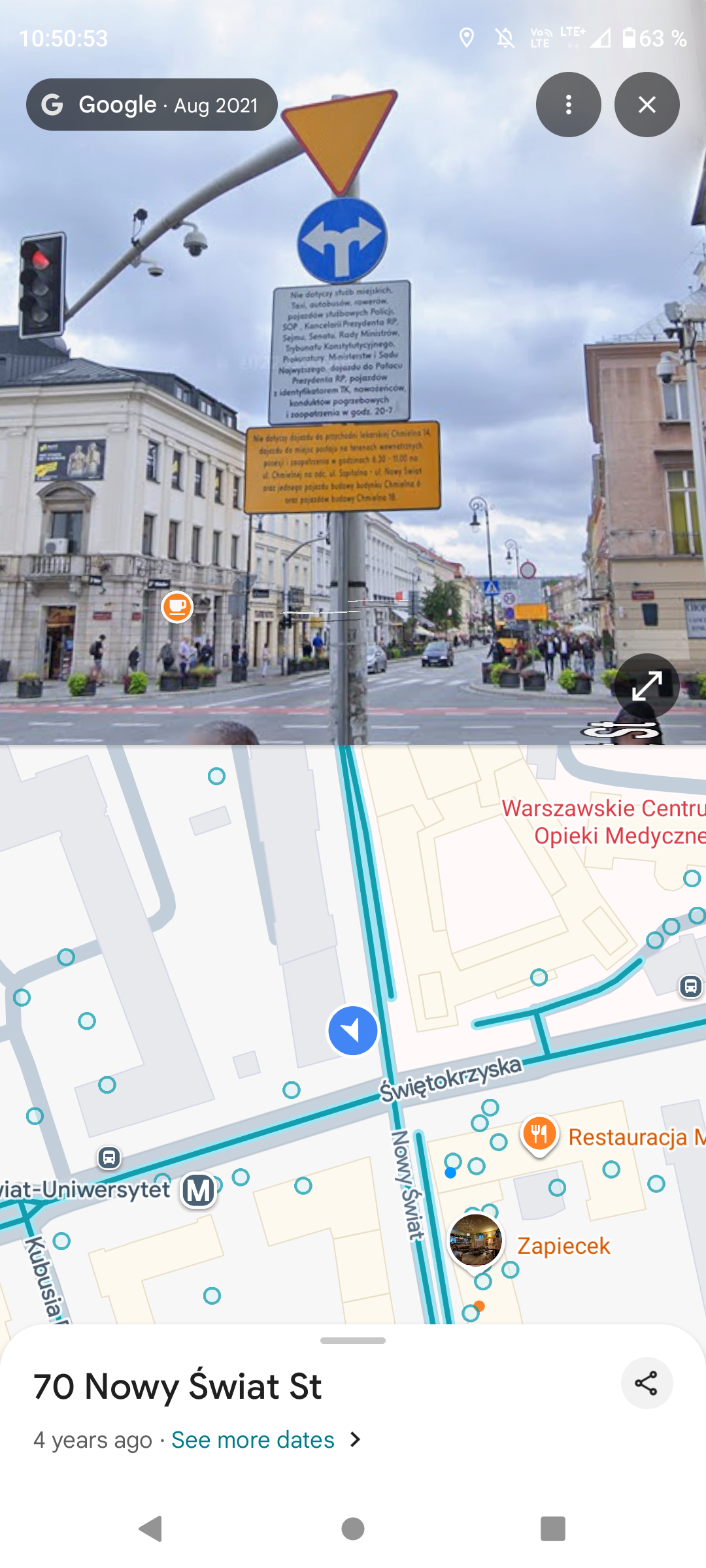
Most places in Poland have this exact setup. And I say most because I have not seen one that does not, but I am guessing they exist. Maybe some of them have bad visibility even?
If one does not respect the yield sign that does not seem a signaling problem.
Average signaling in Poland be like
What I've recently found troubling is the places that use similar signs for emissions controls. With a rental you usually have a recent enough car that you can ignore those.
Being able to distinguish between “low emissions zone, but any car from this decade can go in” and “local traffic only, you need to live in this neighborhood to enter” in a foreign language, bit me a couple of times while traveling.
My purely anectodotal experience is that the response is variable and culturally dependent. Americans tend to treat any intersections with a downed stoplight as a multi-way stop. It's slow but people get through. I've experienced other countries where drivers just proceed into the intersection and honk at each other. (Names withheld to protect the innocent.)
It seems a bit like the Marshmallow test but measures collaboration. [0]
[0] https://en.wikipedia.org/wiki/Stanford_marshmallow_experimen...
> Traffic Light Not Working
When a traffic light is not working, stop as if the intersection is controlled by STOP signs in all directions. Then proceed cautiously when it is safe to do so.
https://www.dmv.ca.gov/portal/handbook/california-driver-han...
Rural drivers will know to turn right and make a u-turn, but city drivers may not know that trick.
But those complex multiple lanes in all directions + turn lanes...
They do break down. I think they are a breeding ground for confusion and frustration.
Actually there are times of day when I find it preferable that the traffic lights are down.
In Ireland, there are precisely two passenger routes still operated with locomotives, and there’s a tender offer out to replace one of them with a (really wacky; diesel, battery, _and_ overhead lines in two voltages!) multiple unit.
https://evmagazine.com/articles/tesla-launches-first-all-ele...
But the linked article is pretty light on info, so I'll reserve judgement till more info comes to light.
They’re also useful as a transition technology. The DART+ project in Ireland will use them for one line which will have the frequency for electrification (8 trains per direction per hour) and is already partially electrified, but is going to take a while to fully electrify (due to low bridges etc); once it’s electrified they’ll then likely be used in low-frequency regional routes.
(The realised project will use 750 uniform cars, about 200 of which will have batteries.)
It's not the best way to go for mainline track and not suitable for long distance high speed trains.
Why did India build a high speed freight corridor with overhead power when they could have used batteries instead? Because the quantity of battery to power the trains doesn't exist, and overhead wires do.
When you link the cars together, they usually switch to a hub that's a 10-15 minute walk from your destination instead of your destination and the compartments are occasionally shared with unstable and violent people, which while possibly "efficient" in some metrics, are downsides that many people would rather avoid. Personal compartments are a real differentiating advantage.
A quaintly American complaint. A 10 minute walk being an issue is very a learned helplessness my fellow Americans suffer from.
But unfortunately the 10-15 min walk is only possible in a couple cities. most Americans day to day experience of public transit is spaced out buses that don’t work well for single family sprawl and strip malls parking lots where walking is treated as undesirable. Car oriented rather than people oriented urban planning (or lack thereof) is the original cause.
Door to door shelter and climate control >>>>>>>>>>>
I even got a heated jacket this year! Talk about climate control.
Buses in Paris run with IIRC 60kWh battery and pantograph charger at every other station. Packs (not cells) recently dropped to below $100 kWh. At $6k thats probably what city pays for couple of replacement seats (gold plating et all).
If you're rural - of course this probably doesn't apply.
If you're suburban - "park and ride" type of thing solves a lot of problems in western Europe already. Drive to nearest hub, hop on a train (that is included in your parking ticket) that has bigger bandwidth comparable up to a 30 lane highway[1], also don't worry about parking in dense downtown as a benefit.
If you're urban, city planners should plan public transport network dense enough so you could walk - at worst do "park and ride" thing again.
Of course there are cases where car still may be fastest and most convenient way to reach your destination (e.g. if you're suburban and need to go to other suburban town), but in big cities (individual) car travel should be a minority.
Compare Japan's, China's mega cities. Whole countries like Netherlands, Denmark, Belgium, to LA, SF or other USA's mega cities. It just falls to the Onion trope of `'No Way to Prevent This,' Says Only Nation Where This Regularly Happens`.
[1] https://en.wikipedia.org/wiki/Route_capacity#/media/File:Pas...
Street cars are a red herring anyway. Because street cars don't maintain anywhere near the same number of routes as free-form roads. It is a routing problem still, and railed vehicles perform much, much worse at it, which is why they need to be time multiplexed with rail schedules.
Streetcars?! In San Francsico?!?
Better leave now for you doctor’s appointment tomorrow and I hope you scheduled three days off from work.
Public transport for things like metro/trains/trams/buses are honestly underrated.
But even without them getting better, as far as I know there were zero waymo fatalities due to this.
That's more than I can say about Helene, where there was at least one fatality due to traffic light outages.
Lets not forget that a big part of why we want Waymo is that it has already lead to a dramatic decrease in fatal accidents. They are a great company that will do a lot of good for the world. One bad night (in which noone was hurt, in part because of their cautiuosness) shouldn't negate that.
I was curious if Waymo has even been involved with a crash that killed someone, so I looked it up. The answer is yes - there was a Tesla going 98mph in SoMa whose driver died after hitting a Waymo. Clearly we should shut down Waymo until they can handle that situation!
Even if every US city had Waymos blocking the street for every single disaster, as they did here. I find it extremely unlikely that even the indirect deaths would come close to that number. And that's assuming Waymo learn from this lesson. Which they will.
[1] https://www.nhtsa.gov/press-releases/nhtsa-estimates-39345-t... [2] https://storage.googleapis.com/waymo-uploads/files/documents...
Eh, I don't know. ~40 people die from traffic collisions each year in San Francisco, so about one every nine days. People would be driving more cautiously without traffic signals or street lights, and most collisions at intersections would occur a relatively low speed assuming drivers treat the dead signal as a stop sign. The risk of death for drivers might be higher during a power outage like that, but I doubt it would be 9x (and the outage lasted less a full day).
A human can combine a ton of context clues. Like, "Well, we just had a storm, and it was really windy, and the office buildings are all dark, and that Exxon sign is normally lit up but not right now, and everything seems oddly quiet. Evidently, a power outage is the reason I don't see the traffic light lit up. Also other drivers are going through the intersection one by one, as if they think the light is not working."
It's not enough to just analyze the camera data and see neither green nor yellow nor red. Other things can cause that, like a burned out bulb, a sensor hardware problem, a visual obstruction (bird on a utility cable), or one of those louvers that makes the traffic light visible only from certain specific angles.
Since the rules are different depending on whether the light is functioning or not, you really need to know the answer, but it seems hard to be confident. And you probably want to err on the side of the most common situation, which is that the lights are working.
My approach was to get closer into the intersection slowly and judge whether the perpendicular traffic would slow down and also try to figure out what was going on or if they would just zip through like if they had green.
It required some attention and some judgement. It definitely wasn't the normal day to day driving where you don't quite think consciously what you're doing.
I understand that individual autonomous vehicles cannot be expected to be given the responsibility to make such a call and the safest thing to do for them is to have them stop.
But I assumed there were still many human operators that would oversee the fleet and they could make the call that the traffic lights are all off
Not sure what about this isn’t funny. Nobody died. And the notion that traffic lights going down would not have otherwise caused congestion seems silly.
Did they have documented problems?
This is akin to the Waymos honking at each other at 3AM. Annoying. Potentially dangerous in various circumstances. But ultimately just destructive in a way unlikely to repeat.
At the least we will fall back to incentive/disincentive social behavior. People will supply ample friendly and unfriendly advice to try to unwind the knot.
Waymo should lose their operating license based on this experience. It's self-evidently dangerous to everyone to be incapable of basic iteration. There's a whole set of law driver's are supposed to follow for handling failed traffic lights. Why have lower expectations of an anonymous car than a human?
Then everyone should lose their licenses as well by your draconian reasoning. Because…
> There's a whole set of law driver's are supposed to follow for handling failed traffic lights.
And they don’t, it’s chaos.
> Why have lower expectations of an anonymous car than a human?
You obviously have higher expectations for autonomous cars than humans, it is not the other way around for those of us who disagree with you. The only difference is that Waymo can get better with experience and humans generally don’t.
> And they don’t, it’s chaos.
Do you live in areas where traffic lights go out regularly?
Because for human driver it is a non-issue. It becomes an all-way stop and you take turns, it is easy. Traffic throughput slows down a bit, but nothing approaching chaos about it. If waymo can't deal with this, that's a problem.
Genuine question, do we have data for accident rates in traffic-lights-out intersections?
In south africa, traffic lights not working is a daily occurrence. And we've all learned how to navigate a dead intersection wit zero casualties.
Massive 6 way intersections with 2-4 lanes per direction worked perfectly with everyone taking turns to go.
I am pretty sure Waymo does not disclose how many human interventions they get. It would destroy their magic aura. A fancy RC car with self-driving experimental features is not very futuristic after all. By all the evidence, that’s what we observed when the internet went out. I don’t buy the 4-way stop explanation. Waymos handle 4-way stops just fine on an average day. I drive alongside them daily.
I’ve long suspected that they get many human interventions on the road, frequent enough that when the internet connectivity slowed down to a crawl across the city, Waymos could not get themselves unstuck from a variety of situations and simply just blocked the roads. That’s not a paragon of safety, nor is it “self-driving”. Self-driving cars were 10 years away in 2015, and in 2025, they are still 10 years away.
Makes me think there are likely other obvious use cases they haven’t thought about proactively either.
We have zero evidence a power outage wasn't foreseen. This looks like a more complex multi-system failure.
Once you’re on public roads, you need to ALWAYS fail-safe. And that means not blocking the road/intersections when something unexpected happens.
If you can physically get out of the way, you need to. Period.
Yes. OP is inferring Waymo's internal processes from this meltdown. ("Makes me think there are likely other obvious use cases they haven’t thought about proactively either.")
If Waymo literally didn't foresee a blackout, that's a systemic problem. If, on the other hand, there was some weird power and cellular meltdown that coïncided with something else, that's a fixable edge case.
> Yes. OP is inferring Waymo's internal processes from this meltdown. ("Makes me think there are likely other obvious use cases they haven’t thought about proactively either.")
No, I'm not inferring internal processes.
I'm guessing level of critical thinking.
When you are creating autonomous vehicles, one of the things that you want to risk assess and have mitigation for is what you want the vehicles to do in case the systems they depend on fail (e.g. electricity, comms).
Now, it could be that the team has anticipated those things but some other failure in their systems have caused vehicles to stop in the middle of intersections, blocking traffic (as per article).
I'm super curious to learn more about what Waymo encountered and how they plan to up their game.
Genuine question: how do these differ? Isn’t the level of critical thinking of Waymo’s employees internal to it? (What’s the mens rea analogue for a company?)
What they need is a "shit is fucked fallback" that cedes control. Maybe there is a special bluetooth command any police or ambulance can send if nearby, like clear the intersection/road.
Or maybe the doors just unlock and any human can physically enter and drive the car up to X distance. To techies and lawyers it may sound impossible, but for normal humans, that certainly sounds better. Like that Mitch Hedberg joke, when an escalator is out of order it becomes stairs. When a Waymo breaks it should become a car.
Do the even have physical controls to do that at this point?
I’ve never been in one so I don’t know how different they are from normal cars today.
Here is their instructions for law enforcement in the Waymo Emergency Response Guide:
https://storage.googleapis.com/waymo-uploads/files/first%20r...
Didn’t Google have little self-driving vehicles without controls that were limited to pre-planned routes on non-public roads on their campus?
Obviously a hugely different problem domain.
I agree with this bit
> If, on the other hand, there was some weird power and cellular meltdown that coïncided with something else, that's a fixable edge case.
This is what I have a problem with. That’s not an edge case. There will always be a weird thing no one programmed for.
Remember a few years ago when a semi truck overturned somewhere and poured slimy eels all over the highway? No one‘s ever gonna program for that.
It doesn’t matter. There has to be an absolute minimum fail safe that can always work if the car is capable of moving safely. The fact that a human driver couldn’t be reached to press a button to say to execute that is not acceptable. Not having the human available is a totally foreseeable problem. It’s Google. They know networks fail.
> Remember a few years ago when a semi truck overturned somewhere and poured slimy eels all over the highway? No one‘s ever gonna program for that.
While the cause is unusual, this is really just three things that everyone absolutely should be programming into their autonomous vehicles: accidents, road debris, and slick conditions.
It just happens to make a fantastic example of “thing no one is ever going to foresee“.
If there wasn’t footage how many people would even believe it happened?
It’s a bit like designing an electronic lock that can’t be opened if the power goes out. If your recourse to exiting a dangerous situation becomes breaking the door, then the lock is unsafe.
The alternative here, is a protocol that obviously hasn't been tested. How on earth are you going to test a Waymo in blackout conditions? I would rather have them just stop, than hope they navigate those untested conditions with vulnerable pedestrians and vehicles acting unpredictable.
In a very local sense, this is true. In terms of the traffic system, this can create a systemic problem if the stoppage causes a traffic jam that creates problems for emergency vehicles.
Thus it is a _different_ failure mode.
If someone stops in the middle of traffic because they’re lost, their GPS went out, or they realized that they’re unsafe to drive, we don’t celebrate that as the driver entering a fail-safe mode. We call that “bad judgment” and give them a ticket.
If it precipitates a larger problem where lives are lost, they may be in considerable legal or financial trouble.
I don’t see why we should treat Waymo any differently.
Would I preferred that they had a light turn on that was flashing "An unknown emergency is occurring, please park me"? Yes, I think that would be a better solution. I would have preferred better performance from Waymo. My entire point here is that I'm happy that in my neighborhood, the Waymos were acting in a fail-safe manner, rather than just winging it.
You don’t need to wait for a city blackout to actually test this kind of scenario.
The thing still has cameras. And LIDAR. It should be fully capable of pulling over on its own safely. Why would not having a traffic light prevent that?
Humans are expected to negotiate this. The robots should be too. That’s part of driving. If the lights fail, the law tells you what you’re supposed to do. And it is not stop the intersection.
Yes, what’s the worst that could happen… oh wait… people literally getting killed.
Even at a normal four-way stop with stop signs people sometimes blow through it. The Waymo has to handle it.
That’s part of driving.
It can creep through at 3 miles an hour if it thinks that’s what’s safe. All it has to do is get out of the intersection.
Waymos know how to handle 4 way stops.
Yes.
> And that means not blocking the road/intersections when something unexpected happens.
No. Fail-operational is not the only allowable fail-safe condition for automobiles. For example, it is acceptable for loss of propulsion to cause stop-in-lane — the alternative would be to require high-availability propulsion systems, or to require drivers to always have enough kinetic energy to coast to side. This just isn’t the case.
One can argue that when operating a fleet with correlated failure modes the rules should change a bit, but that’s a separate topic.
Waymo operates in more places than the Bay Area. Phoenix, AZ, for example, had widespread power outages in Aug 2025 due to Haboob and Monsoon.
Certainly a better way to handle this would have been to pull over. I think stopping where ever it happened to be is only acceptable if the majority of sensors fail for some reason
I being the hero I was, wanted to keep the show running, bought some candles, ovens worked fine, water worked fine (for now). I wanted to charge cash. But eventually big boss came and shut us down since light wasn't coming.
And he was right, cooking and working under those conditions is dangerous for the staff, but also for the clients, without light you cannot see the food, cannot inspect its state, whether stale, with visible fungi, etc...
Yes, the perfect worker would still operate under those conditions, but we are not perfect, and admitting that we only can provide 2 or 3 nines, and recognizing where we are in that 0.01% moment, is what keeps us from actually failing so catastrophically that we undo all of the progress and benefits that the last bit of availability would have allowed us.
...I have to say, I'm pretty skeptical of this one. I've eaten in lots of dark restaurants, sometimes lit pretty much just by candles on the table. Seems to work fine.
AIUI, it was the irregularity of the uncontrolled intersections combining with the “novel” (from the POV of the software) driving style of the humans. In dense areas during outages signaled intersections don’t actually degrade to 4 way stops, drivers act pretty poorly.
The normal order and flow of traffic broke down. The software determined it was now outside its safe parameters and halted.
Certainly not ideal, and the should be a very strong regulatory response (the gov should have shut them down), and meaningful financial penalties (at least for repeat incidents).
And my question is why did it halt instead of pull over?
Perhaps traffic lights being out is what caused the cars to stop operating autonomously and try to phone home for help, or perhaps losing the connection home is itself enough to trigger a fail safe shutdown mode ?
It reminds a bit of the recent TeslaBot video, another of their teleoperated stunts, where we see the bot appearing to remove a headset with both hands that it wasn't wearing (but that it's remote operator was), then fall over backwards "dead" as the remote operator evidentially clocked off his shift or went for a bathroom break.
Things go wrong -> get human help
Human not available -> just block the road???
How is there not a very basic “pull over and wait” final fallback.
I can get staying put if the car thinks it hit someone or ran over something. But in a situation like this where the problem is fully external it should fall back to “park myself” mode.
Barring everything else, the proper failsafe for any vehicle should be to stop moving and tell the humans inside to evacuate. This is true for autonomous vehicles as well as manned ones–if you can't figure out how to pull over during a disaster, ditching is absolutely a valid move.
The not-quite-final fallback should be to pull over.
I wasn’t considering people taking it as a given that any time the car gives up the doors should be unlocked for passengers to leave if they feel it’s safe.
And as a passenger, I’d feel way safer getting out if it pulled over instead of just stopped in the middle of the street and other cars were trying to drive around it.
No one should ever be trapped inside by the car.
https://waymo.com/blog/2025/12/autonomously-navigating-the-r...
"Navigating an event of this magnitude presented a unique challenge for autonomous technology. While the Waymo Driver is designed to handle dark traffic signals as four-way stops, it may occasionally request a confirmation check to ensure it makes the safest choice. While we successfully traversed more than 7,000 dark signals on Saturday, the outage created a concentrated spike in these requests. This created a backlog that, in some cases, led to response delays contributing to congestion on already-overwhelmed streets."
1. Nobody at Waymo thought of this,
2. Somebody did think of it but it wasn't considered important enough to prioritize, or
3. They tried to prep the cars for this and yet they nonetheless failed so badly
Human drivers can use hand signals to resolve it, but self-driven vehicles may struggle, especially if all four lanes happens to have a self-driven vehicle arrive. Potentially if all vehicles are coordinated by the same company, they can centrally coordinate out-of-band to avoid the deadlock. It becomes even more complex if there are a mix of cars coordinated by different companies.
Also I'm not sure it's entirely AI's fault. What do you do when you realistically have to break some rules? Like here, I assume you'd have to cut someone off if you don't want to wait forever. Who's gonna build a car that breaks rules sometimes, and what regulator will approve it?
I think too many people talk past each other when they use the word common, especially when talking about car trips.
A blackout (doesn't have to be citywide) may not be periodic but it's certainly frequent with a frequency above 1 per year.
Many people say "common" meaning "frequent", and many people say "common" meaning "periodic".
People get promoted for running DiTR exercises and addressing the issues that are exposed.
Of course the problem is that you can't DiRT all the various Black Swans.