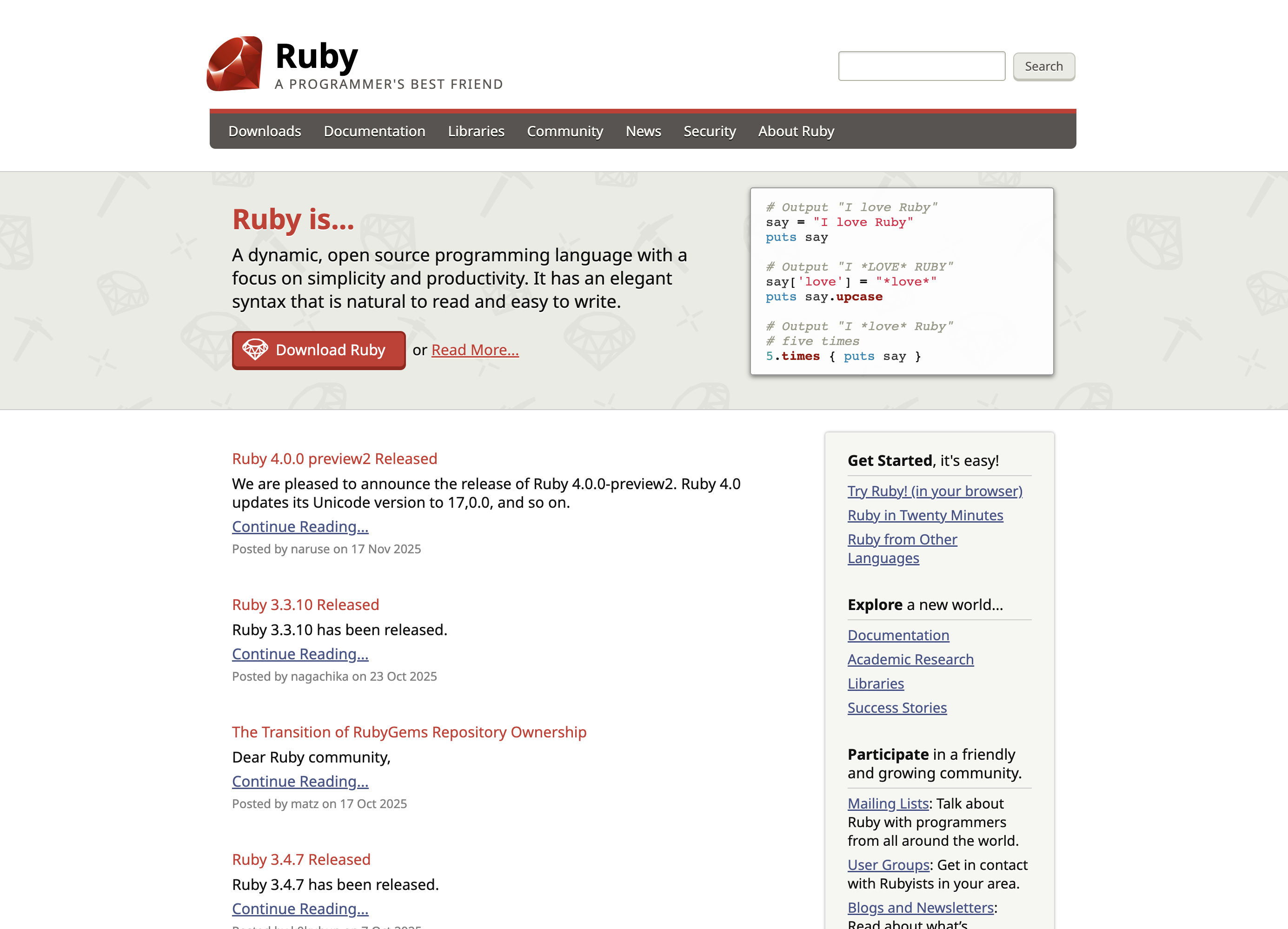
It’s been a real pleasure getting back into Ruby after so many years in typescript, python, and rust.
Happy to see the update. Real shame about the haters here, the Ruby community is a supportive and positive bunch that has shipped real products while others seem to worship at the altar of computer science alone… that’s about as counter snarky as I want to be here
A side effect is an increased intolerance to agony, boilerplate verbosity, complexity. I look at the JavaScript world and shudder.
Also, Ruby being as expressive as it is, describing things to an LLM is not really a timesaver over writing the code myself.
They aren't native american of course. That's a silly dishonest argument based on wordplay.
If so, is it racist to assert or assume that ethnic Europeans exist?
True believers have created a largely arbitrary grouping called “white people”, assigning it the “oppressor” label.
If a favored group’s nation were flooded by “white people”, that would be seen as an emergent situation requiring remedy; the opposite is what we’re seeing play out in societies like Britain, and is Not a Problem. I’m committing an act of violence by even describing it in this way.
How or when a disfavored group is restored to neutral or favored status is undefined; one would presumably have to consult a head priest of the movement for an answer (and I wouldn’t expect any coherence or clarity).
"Native brit" does not identify a people the way "native american" does.
There is no entry in the dictionary for "native brit".
This is all I'm talking about.
Quit trolling.
"[White Brits] is an ethnicity classification used for the White population identifying as English..." [1]
The English are the native and indigenous ethnic group to England (London). White Brits are a category that includes the English.
QED.
None of this has anything to do with being white, it's the language that defines belonging to these groups.
False. The English are the extant indigenous people to England, and descend from ancient populations: "The English largely descend from two main historical population groups: the West Germanic tribes, including the Angles, Saxons, and Jutes who settled in eastern and southern Britain following the withdrawal of the Western Roman Empire, and the Romano-British Brittonic speakers who already lived there." [0]
QED.
>The best case for an indigenous culture is the Celts, Cornish, and Welsh.
Those are also "White Brits" who are indigenous to their respective areas.
>None of this has anything to do with being white
Glad you finally agree and admit to this.
>it's the language that defines belonging to these groups.
English language and culture is the current indigenous, native culture to England.
Nowhere in his post does he mention "White person." He specifically mentions "native Brits." The only indigenous Brits native to the Britain are White Brits.
The only groups who could call themselves indigenous to Britain are the Celts, the Cornish, and the Bretons. The English (Anglo-Saxon) culture is foreign to the British isles.
Even then, none of this is related to skin tone. It's the culture that defines these potentially indigenous Celtic groups.
White Brits are the only indigenous, native Brits to Britain.
>The only groups who could call themselves indigenous to Britain are the Celts, the Cornish, and the Bretons. The English (Anglo-Saxon) culture is foreign to the British isles.
False. The English are the extant indigenous people to England, and descend from ancient populations: "The English largely descend from two main historical population groups: the West Germanic tribes, including the Angles, Saxons, and Jutes who settled in eastern and southern Britain following the withdrawal of the Western Roman Empire, and the Romano-British Brittonic speakers who already lived there." [0]
QED.
>Even then, none of this is related to skin tone.
Glad you finally agree and admit to this.
>It's the culture that defines these potentially indigenous Celtic groups.
English culture is the current indigenous, native culture to England.
Please do the minimum effort and connect the quote you did to what you claim it states. This does not contradict anything in my previous post. QED? Nothing was demonstrated. Demonstrate, please.
It is funny, because I did not introduce the term indigenous to this discussion, you did (for some strange reason). The term "indigenous" refers to a non-dominant, often colonized group of people with a connection to the land and traditional living on that land [1]
The English are neither. The Celtic people, if anyone, has a claim to this status on the British isles. They were living on the land for hundrds of years before they were colonized by the Romans (and other groups later, including the English).
I think it's sweet that you're trying to muddy things up by claiming I "finally agree" about skin tone being unrelated to culture or the adjective native. That's been my argument the whole time. You are the one stating that "White British" is the same as "Native Brit".
Your failure to understand basic anthropology does not constitute a contradiction. There is not contradiction.
>You say the English are descendants of west germanic tribes from the continent, and "Romano-British" groups (do you think the Romans were an Indigenous people? of the British isles?)
It arose as a fusion of the imported Roman culture with that of the indigenous Britons, a people of Celtic language and custom. [0]
>then you say this proves they are indigenous.
"Indigenous Britons" QED.
>Please do the minimum effort and connect the quote you did to what you claim it states.
I just did and have, multiple times.
>This does not contradict anything in my previous post. QED? Nothing was demonstrated. Demonstrate, please.
It directly contradicts your erroneous claims. Everything has been demonstrated with facts and links. You have nothing.
>It is funny, because I did not introduce the term indigenous to this discussion, you did (for some strange reason).
I did, what's your point? You failed and making any claim to the contrary.
>The term "indigenous" refers to a non-dominant, often colonized group of people with a connection to the land and traditional living on that land [1]
Hilarious because White Brits are no the dominant group of people in London, foreigners are. The English are the "people with a connection to the land and traditional living on that land."
Oops, you just proved my point for me! QED!
>The English are neither.
The English are both, native and indigenous, as proven above.
>The Celtic people, if anyone, has a claim to this status on the British isles.
The English descended from the Britons, they're literally British.
>They were living on the land for hundrds of years before they were colonized by the Romans (and other groups later, including the English).
This is hilariously incorrect. As proven above, the English descended from the Celtic Britons. It's quoted directly above.
>I think it's sweet that you're trying to muddy things up by claiming I "finally agree" about skin tone being unrelated to culture or the adjective native.
Glad that you agree DHH isn't a White supremacist since it has nothing to do with skin color.
>You are the one stating that "White British" is the same as "Native Brit".
From your source that defines " indigenous people":
"peoples in independent countries who are regarded as indigenous on account of their descent from the populations inhabited the country, or a geographical region to which the country belongs, at the time of conquest or colonisation or the establishment of present state boundaries and who, irrespective of their legal status, retain some or all of their own social, economic, cultural and political institutions."
That is literally the definition of the English people, in England, which is part of Great Brittan.
They are by definition indigenous.
QED with your own source.
You seem to love to write QED after a quote. That makes you look dumb. The English did not "fuse" with an indigenous people, they colonized or dominated an already colonized people, and in the process removed their "social, economic, cultural, and political institutions" [1]. This in turn does not fit in with the definition of Indigenous people. No scholar would ever claim that the English are indigenous to the British isles. That would be absurd. The same is true of the Romano-British. Whenever settlers "fuse" with an indigenous culture by importing their customs, the result is not an indigenous culture, it's a settler-colonial one.
Did you see the part underneath what you quoted in the UNESCO definition?
"According to the UN Permanent Forum on Indigenous Issues, the system has instead developed a modern understanding of this term based on the following:
    Self-identification as indigenous peoples at the individual level and accepted by the community as their member.
 - Historical continuity with pre-colonial and or pre-settler societies
 - Strong links to territories and surrounding natural resources
 - Distinct social, economic and political system
 - Distinct language, culture and beliefs
 - Form non-dominant groups of society
 - Resolve to maintain and reproduce their ancestral environments and systems as distinctive peoples and communities"
And, again, skin tone does not relate to culture. Which is why the fact that DHH tries to claim it does makes him an ethnonationalist, a fringe far-right position.
It is funny to see you fail to argue like an adult. All the "QED"s and "erroneous claim" make you sound like a tiny Ben Shapiro in my mind. I wonder why you would subject yourself to this kind of humiliating self-own. You are constantly misinterpreting terms, simply saying "No" or "False" without ever citing anything but wikipedia. It's obvious you have no understanding of either anthropology nor of where to find information or how to interpret it. Thank you. It heartens me to get to confirm that racists are idiots.
[1] https://en.wikipedia.org/wiki/Anglo-Saxon_settlement_of_Brit...
No one made this claim. White Brits (The English) are the native inhabitants of London, and are no longer the majority there. The definition you provided literally describes the exact scenario of the English in London.
>Who's running the country? Out of the last twenty PMs, how many have been people of color? One?
The current Mayor of London is a person of color (non-native ethnicity). Once again, you're doing all the work for me, proving my point.
>You seem to love to write QED after a quote.
Because I have shown and proven my points.
>That makes you look dumb.
Don't interpret your inability to understand something as "dumb."
> The English did not "fuse" with an indigenous people, they colonized or dominated an already colonized people, and in the process removed their "social, economic, cultural, and political institutions"
You are categorically false. Your source links to the Anglo-Saxons, not the English. "The English largely descend from two main historical population groups: the West Germanic tribes, including the Angles, Saxons, and Jutes who settled in eastern and southern Britain following the withdrawal of the Western Roman Empire, and the Romano-British Brittonic speakers who already lived there."
QED.
Your poorly constructing a straw man, possibly unknowingly, because you're out of your league here.
>This in turn does not fit in with the definition of Indigenous people.
Yes it does, not that the definition of indigenous people is something that you can claim. There is no singularly approved definition: "There is no singularly authoritative definition of indigenous peoples under international law and policy, and the Indig- enous Declaration does not set out any definition." [1]
>No scholar would ever claim that the English are indigenous to the British isles.
No scholar would ever claim that the English are not indigenous to the British isles. That would be absurd.
>The same is true of the Romano-British. Whenever settlers "fuse" with an indigenous culture by importing their customs, the result is not an indigenous culture, it's a settler-colonial one.
Of course it is, especially considering English culture was created in, developed, and is indigenous to... England. It's literally in the name. English culture wasn't created outside of England, it was created in England.
>Did you see the part underneath what you quoted in the UNESCO definition?
The part that literally proves my point, yes? Also, UNESCO definition isn't authoritative as shown above. Even then, English people/culture in London is indigenous considering the definition.
>Does that sound like the English to you?
That is exactly what the English in London are. Every point can be applied to the English in London.
>And, again, skin tone does not relate to culture.
No one made this claim.
>Which is why the fact that DHH tries to claim it does makes him an ethnonationalist
DHH did not make that claim either. You have poor reading comprehension if that's what you took away.
>a fringe far-right position.
There's nothing wrong with promoting or protecting the interests of native or indigenous people over those of immigrants or foreigners. This is not a fringe far-right position. Countries like Turkey, Japan, Palestine, South Korea, Israel, China, etc. all share this position.
>It is funny to see you fail to argue like an adult.
It's funny to see me eviscerate you. You're flailing around like a child that can't swim. You thrown insults out, share sources that prove opposite of what you're proposing, and don't understand basic anthropology.
>All the "QED"s and "erroneous claim" make you sound like a tiny Ben Shapiro in my mind.
All the nothing you've provided makes you sound like Trump in my mind.
> I wonder why you would subject yourself to this kind of humiliating self-own.
"I'm getting destroyed by this guy. Quick! Let me pretend like he's humiliating himself and not me!"
>You are constantly misinterpreting terms, simply saying "No" or "False" without ever citing anything but wikipedia.
"He has sources that correctly backup his statements. The sources in Wikipedia are right there, but I'm going to ignore them."
>It's obvious you have no understanding of either anthropology nor of where to find information or how to interpret it.
"I know you are but what am I?" Are you a toddler LOL?
>Thank you. It heartens me to get to confirm that racists are idiots.
Thank you. It heartens me to get to confirm that (anti-White) racists are idiots.
[0] https://en.wikipedia.org/wiki/English_people [1] https://www.ohchr.org/sites/default/files/Documents/Publicat...
That said, it's cool seeing some of those samples, because they're honestly not really what I expected. For example, I didn't expect the list subtraction to work at a set operation, so seeing that example gives me a feel for what sort of things I can do with Ruby code.
I don't know the exact numbers, but the figures show you lose a high percentage of viewers with each click. So if you have 100 people who view the first page, 10 of them might click the link to the second page, and only 1 of them might click the link to the third page. If having customers view the running code is crucial, you'd want it on the very first page, above the fold.
Low bandwidth, minimal in an artistic way.
I wish less sites would try to make them look like a wordpress from the early twenty aughts.
What if I told you that you don't need javascript?
The UI, the minimal buttons, the tight paddings, the lack of pop-in, the complete lack of animations; these have all been essentially unchanged for the past decade. Even the dark mode colors look exactly as it did the first time I switched it on.
Speaking from experience (recently we rebuilt https://raku.org), I am sure that they will come back and optimize, but tbh this is not the priority with a new site where the hits will top out at ~ 10k / hour.
I am no great fan of animations, simpler is better imho - and I have resisted requests to add a sandbox to the Raku site since https://glot.io/new/raku does such a good job anyway... but I think Ruby is likely to appeal to a wider audience via a cool design vibe, whereas Raku is still in the early adopter / geek phase of adoption.
btw Ruby is a fantastic language!
You don't need to "come back and optimize" if you don't start with needing a progress indicator for a "transform: scale" animation to display a single static download link. The number of hits is not relevant.
Neither do you need to do three separate fetch requests for static plain text examples that you then laboriously dump into the DOM by creating dummy elements, putting content in there, then looking up and cloning `code` tags to then dump those code tags on the page.
The website looks cool to me, makes me want to try Ruby.
So what do you expect? People ignoring the frankly idiotic choices made that you now defend with "they will come back and optimize it"?
> HTPP/2 parallel requests aren't that big a deal, all things considered.
I literally see a progress counter that is for some reason required to display the most trivial animation to show ... a single static link. On a gigabit connection. All that takes up to two seconds.
On that same connection the same thing happen to three purely three static examples of code that somehow need up to two seconds to appear and to shift the entire content of the page.
Both are especially jarring on mobile.
That said, I've no reason to defend the page. It just didn't strike me as bad, but I can see how others are experiencing a bad page.
The same is on desktop Firefox. For some reason youtube can't process the screencast for that :)
Clicking through the code examples on your new website, I kept being amazed at some of the great things Raku does. It's night and day in understanding the uses and purpose of the language! Thank you.
Unfortunately, as soon as I click into the "introduction" section of the docs I'm abandoned to a wall of links and am once again lost. I'll try persevere this time, but I think you could do adoption of Raku a great favour by working on organising your docs site a bit more clearly. Astro's docs are an amazing case-study on best-in-class docs layout and writing: https://docs.astro.build/en/getting-started/
FYI, front-page has a lot of examples, that I assume change when switching tabs, e.g. "multi-paradigm" "strict-gradual" "interactive-mode", etc.
But nothing happens, neither Safari 18.6, nor Chrome 143.0, on macOS 15.5.
It is part of what distinguishes actually good web devs from move fast and break everything kind of people.
I guess I thought of noscript due to other cases I had recently, where I noscript-ed a whole workflow and displayed elements, that should never appear, when JS is running.
Knowing ruby I can tell that the relaxed approach to the website does not correspond with sophistication in the language itself. If I wouldn't know ruby, that would be a put off for me, thinking that if they don't want to convince me tech-wise by their site, it might be similarly annoying to deep-dive into the language.
care to elaborate?
- images: none are visible above the fold - all should be lazy loaded (like it is done with all conference images) and the pragdave.jpeg one does not need to be that large;
- JS: navigation toggle, including chevron rotation can be done in CSS using :has combined with checkbox/radio input. Similarly for header-navigation and theme-toggle (here combined with cookie store). Then toc.js - seems like something easy to do in the backend. Hero-animation - I haven't looked much through it but seems like at least some parts can be done in CSS;
- CSS/tailwind - well it would probably take less typing to do it just in CSS, the site does not seem to be that much componentized to benefit from tailwind.
Instead, for a brochure site like this, I'd rather have the links just always visible, because this is the reference site for Ruby and I imagine a lot of people find them by searching "Ruby", coving l clicking the homepage, and scanning for the link to the docs/downloads/etc.
Alternatively, if the show/hide feature is really that important, right now I would (a) explore whether it can be done accessibly using the new invoker API, so you don't need JavaScript at all (with a JS fallback), or (b) just do it in JavaScript directly, but with an accessible default if the JS doesn't get loaded properly.
But yeah, the rest I largely agree with. There's a bunch of stuff here that would have been simpler, and arguably also easier, if they'd taken a slightly different approach.
The theme toggle has three states. How do you model this with a checkbox?
(Also, technically, alternative stylesheets can be defined in HTML, except every browser except Firefox removed it: https://developer.mozilla.org/en-US/docs/Web/HTML/Reference/...)
Good question, especially since the Ruby site already does this by default. Perhaps the argument is that one of the two color schemes may be designed so poorly that the user may want to manually switch to the other one.
I agree that using radios would be better. Or just prefers-color-scheme, which sidesteps the FOUT issue that often occurs when storing theme settings in localStorage.
Amateur hour.
ruby-lang.com stood out with a text in a big font:
Ruby is...
Followed by a paragraph about what makes Ruby special. I think that was an exceptionally simple and natural way of introducing something as complex as a programming language.
For reference this is the old one, which is much better: https://www.ruby-lang.org/images/about/screenshot-ruby-lang-... From: https://www.ruby-lang.org/en/about/website/
The old one was better because it said something about what the language is and how it benefits the user. "Best friend" is not descriptive. "dynamic language with minimal syntax that is easy to read and write" at least tells me something about Ruby, its priorities, and value proposition. I'm very concerned about a language that claims it wants to be my friend.
What does it do exactly? It just fetches[1] to another part of site and retrieves static text[2] to be displayed. This part could've been kept as part of the html, no need for this artificial loading. It's not a webapp, it's a website.
1. https://www.ruby-lang.org/javascripts/try-ruby-examples.js
2. https://www.ruby-lang.org/en/examples/i_love_ruby
In this day and age, it is possible to have an appealing, responsive, lightweight website with no JS (maybe except for darkmode toggle).
The homepage loads 9.7kB of JS. Navigating to every single link in the main nav results in no additional JS being loaded.
The site is fine.
Right, but I do not think this is the case here
For instance, here's Python's 144kB JS-powered homepage mid-load: https://imgur.com/a/OvYVAMS
And theirs doesn't even have any pretty images! That said, Ruby really ought to give those images a compress.
But you can have a button that saves your state when you enable javascript, and doesn't save your state (but still works) when you disable javascript.
edit: I think it is possible to save your state on the second click. So the UX is: you have 3 options with a slide. You click one of them, the page theme changes, and the option icon becomes a padlock. You click on it again, and the option is saved.
It seems to be a limitation that without javascript a single click can't change a switch and do something else--make a request to set a cookie. But you can do changing style on first click, then setting a cookie on the second. Here's a demo (written by Claude) (it doesn't work without server, just the HTML part) https://jsfiddle.net/r134vgo7/3/
[1] https://github.com/ruby/www.ruby-lang.org/graphs/contributor...
  - https://glot.io/snippets/he42jpfm27
  - https://glot.io/snippets/he42trx6w6
  - https://glot.io/snippets/he434b6ryj
Ex 1
    let say = "I love OCaml"
    let () = print_endline say

    (* Requires linking in the 'str' library *)
    let say = Str.replace_first (Str.regexp {|\(.*\)love\(.*\)|}) {|\1*love*\2|} say;;
    let () = print_endline (String.uppercase_ascii say)

    let () = ignore |> Seq.init 5 |> Seq.iter (fun () -> print_endline say)
    module StringSet = Set.Make(String)

    let cities = StringSet.of_list [
      "London";
      "Oslo";
      "Paris";
      "Amsterdam";
      "Berlin";
    ]
    let visited = StringSet.of_list ["Berlin"; "Oslo"]

    (* Requires the 'fmt' library *)
    let string_set fmt v = Fmt.Dump.list Fmt.string fmt (StringSet.to_list v)

    let () =
      Format.printf "I still need to visit the following cities: %a\n"
        string_set
        (StringSet.diff cities visited)
  module Greeter : sig
    type t

    val make : string -> t
    val salute : t -> unit
  end = struct
    type t = { name : string }

    let make name = { name = String.uppercase_ascii name }
    let salute t = Format.printf "Hello %s\n" t.name
  end

  let g = Greeter.make "world"
  let () = Greeter.salute g
my Cro $service; # geddit?
Also, if you want a more opinionated, HTMX centric web application library, then https://harcstack.org was used to make the new https://raku.org site