Posted by mrtksn 1/15/2026
They wanted to aggressively support technological advances to reduce the dependence of transportation on petroleum, giving examples of making cars more efficient (they mention doubling gas mileage) and developing more flex-fuel and electric vehicles. They talked about honoraria of many millions of dollars for technological developments that could eliminate the need for gas powered cars.
They also mentioned promoting wireless communication to increase telecommuting options and reduce business travel.
All that was gone by 2012. I'm not sure what caused the change.
The longevity of this plus the “no anthropogenic climate change” nonsense is astounding. Armchair climate sceptics are happy to seriously stick to talking points that are so out of date that even the oil industry doesn’t use them anymore.
Sorry I don't believe your paraphrasing of this person's real thoughts and ideas. I'm sure these people exist, but it doesn't mean anything. I could equally go find someone crazy saying the world is going to end this year.
One of those people is the current President of the United States.
Given current events, one doesn't have to be crazy to believe this
But yeah, I guess your answer still applies indirectly: Fracking -> stronger interests by US oil companies -> money to the Republican party -> fossil fuel friendly regulations.
In a very myopic way.
It's useful for the plastics and petrochemical industry, but it's not going to make the country energy independent, even including battery costs wind still trounces.
The largest LNG gas fields currently producing are not being "fracked", eg:
https://en.wikipedia.org/wiki/South_Pars/North_Dome_Gas-Cond...
Also, I'd say McCain's policy was more based on a national security argument than a climate argument. As others have pointed out, fracking changed everything. In 2008 we were a huge net importer of oil. Now we're a huge net exporter.
Mines (including oil wells) are huge wealth concentrators. A handful of very wealthy people benefit hugely from resource extraction. And the US government, as a whole regardless of party, represents the interests of large corporations both domestically and overseas.
Anyway, Bush (either one) didn't run on renewable energy. Neither did the candidates that came after. 2012 was just a reversion to mean.
> Here’s John Boehner, the likely speaker if Republicans take the House, offering his plans for Obama’s agenda: “We’re going to do everything — and I mean everything we can do — to kill it, stop it, slow it down, whatever we can.”
> Senate Minority Leader Mitch McConnell summed up his plan to National Journal: “The single most important thing we want to achieve is for President Obama to be a one-term president.”
Sure Trump took everything to an absurd level of "do the opposite of biden no matter what", but it started back then.
[1] https://www.politico.com/story/2010/10/the-gops-no-compromis...
I remember that day vividly.
It was the middle of the Great Recession, it was the worst our economy was doing in a long time. Millions were out of work. People were looking to the government to see what the plan was to get the country back on track.
A reporter asks McConnell what the senate’s number one priority was.
The answer? Not fixing the economy, not helping out every day Americans. Not finding the root cause of the crash and making sure it doesn’t happen that way again.
No, the answer was “make sure Obama is a one term president.” That’s all we would expect from the senate for the next 6 years.
The day McConnell said that, I said out loud: “I will never vote Republican again for the rest of my life.” (Prior to that point I mostly voted D but not 100% of the time.)
And I plan to keep that promise until I die.
Trump is well outside the norms of POTUS's through history.
Shows how poorly those politicians understood the constituency they were fomenting. He was boo'd for it by people that had come to see him specifically, and about 15 years later, republican voters built a scaffold outside the Capital they were breaking into while chanting about hanging the Republican vice president.
I feel like American politicians often play with fire without understanding its nature as something that burns.
They hated him for what he was.
color bait.
Obstructionism as a core tenet of the (former) Republican platform is reprehensible, and retrospectively probably led to quite a bit of discontent with the government’s inability to address problems that Americans face. That same discontent fomented the current reactionary swing, so in the end maybe they really got what they wanted. Shameful.
It was all lies to try and win elections.
In a word: Greed. In two words: Crony Capitalism. The spend on “non-renewable“ energy is significant to the domestic economy. In 2023 (most recent year I could find), consumer spend on energy in the US was $1.6T (https://css.umich.edu/publications/factsheets/energy/us-ener...) with at least 82% of that being fossil fuels - the remainder being “renewables” and nuclear energy (https://www.eia.gov/todayinenergy/detail.php?id=62444). This does not include billions in subsidies and infrastructure investment.
“Going green” would threaten the American Greed Machine by cutting upwards of $150B in taxes annually, interfering with the individual, corporate, and government gains from the stock and commodities markets, causing short-term inflation due to commodity value spikes, and long-term deflation due to renewable energy being relatively very low cost to generate after the infrastructure is in place. Last, but certainly there is more, the US exports a massive amount of oil and gas. Divesting from fossil fuel production would have a significant impact on GDP (find your own source).
This is why the US doesn’t invest in infrastructure that doesn’t generate significant ongoing income like it once did - it simply doesn’t make enough money. We only act once it is falling apart.
It is all about the money, man. That money is power. It keeps the Corporatocracy and those at the top of it in charge, the US as the primary reserve currency and allows the US to have a huge, formidable military.
Unlimited spending from the fossil fuel industry basically standardized Republican candidates on climate denial talking points. Plus whatever bizarre fetishes random Republican billionaires had, like Adelson keeping Gingrich's primary campaign on life support for months. That fucked up Romney's pivot to the general election for no perceivable gain to any of them. According to Wikipedia Adelson spent over $90 million on losing candidates in 2012!
All of that was through Super PACs.
"Grr greed" is an easy answer that's popular these days but by itself it can't explain a change as it's a constant factor in us as a species.
His "win" might be one of the most impactful sliding doors in the human history.
It's manufactured grievance. Opportunists politicize losing positions for political gain because they're inherently anti-elite, anti-establishment and upset experts and the informed.
Upon this antagonization is conflict which brings on drama, eyeballs, and advertisers.
It's an attention flywheel that brings loyalty, builds a moat, and sets a differentiator...
[1] https://www.sciencedirect.com/science/article/abs/pii/S23527...
Except, that's not even true. Some existing wind turbines are not recyclable.
Except that's not entirely true either! The tower portion of the turbine is usually steel, and easily recyclable! The nacelle, too. It's the base and the blades that can't be recycled.
Except that's not entirely true either! Existing turbine blades are made (mostly) of fibreglass, which is made of the fibre and the resin. The fibres aren't reliably as strong when recycled (which makes them not-very-useful when recycled), but the resin is just fine. And of course, if the blade is e.g. carbon fibre, then you can either re-use it or just burn it.
So, you statement should be that some (components of) existing wind turbines cannot be profitably recycled with current technology.
The wind turbine's concrete base doesn't need to be smashed up or ignored, incidentally - it can be re-used. Concrete is much sturdier than the e.g. gearbox.
Also sorry but I would require a citation for "new wind turbines are recyclable". That the tech exists doesn't mean that all installed turbines have it.
Two points regarding blade recycling techniques taken straight from the top of the article:
- Cement co-processing and chemical dissolution are primary viable methods, yielding $27.57/ton and $199.71/ton returns respectively.
- Chemical recycling achieves top circularity (PCI=0.7) and notable carbon reduction (−0.475 t CO₂/ton).
Chemical recycling is not yet ready for industrial use; cement co-processing is.
One could also say that they change heavily natural landscapes, but this is a matter of taste.
Do you also lead a zero-plastic, zero-waste lifestyle?
> are intermittent, require fossil fuels for when the wind doesn't blow
Batteries.
> are not profitable.
Let the businesses worry about that.
The materials for renewable energy are still in a usable form.
The globe burnt about 8.8 billion tons of coal in 2024. Which is a huge amount. This is the peak, most estimates are that we will reduce from there.
Australia alone estimates that it has 147 billion tons of economically recoverable coal. That is Australia alone could supply the entire globe at peak usage for over 16 years. And Australia only has about 14% of the globes coal reserves, we can keep burning coal at this pace for at least the next hundred years. And it a hundred years the scope of what we consider to be economically recoverable will have expanded greatly, further increasing our supply.
We will cook ourselves before we run out of fuel.
But because they take so long to form, stumbles along the path of energy advancement mean a planetary civilization could run out of fossil fuels before reaching the level of advancement necessary to move beyond them. At that point, the civilization is essentially doomed since they lack the technological ability to move beyond fossil fuels and they lack the energy resources necessary to develop that technology.
That doesn't contradict your statement, of course. But in the long term the fossil fuel niches will start looking more like today's rocket-fuel niches.
It's durable energy storage and can be easily moved around like liquid fuels.
It also would remove CO2 emissions from things like airplanes, which won't be able to be battery powered in the near future, and could renewably replace chemical feedstocks in lots of industrial processes.
But this requires immense industrial capability, probably some serious innovation in absorbing CO2 from the atmosphere because that's basically an unsolved problem right now, and a massive oversupply of solar power which cannot happen under market systems because nobody builds infrastructure to sell power at below market rates.
It might be a 50 year plan.
You're right, it's not infinite, but we are in no crisis now or in the foreseeable future.
Have you not heard of climate change influenced by fossil fuel burning, or are you a climate change skeptic?
The general consensus is that climate change is a crisis, now and in the foreseeable future.
Every time someone uses the term “renewable” they are providing coverage to this notion.
It is deeply bizarre you can think otherwise.
The user was arguing that the materials to exploit them are renewable too.
Recycling now recovers >95% of raw minerals (and will continue to improve).
The learning curves for battery and solar tech will more than make up the for the shortfall.
Meaning at some point in the near future (2050 IIRC), humanity will have mined all the lithium it'll ever need.
Also, in the same time frame, it'll be economical to mine our garbage dumps. Further reducing the need to extract raw materials.
Not of plastic - recycling rates are decreasing. This is largely due to the excess ethane begin produced as a by-product of US fracking.
The ethane is converted to ethylene, then to polyethylene as a cost below that of collecting, cleaning, and processing used plastic.
Sorry for being vague; I was only referring to economically valuable minerals used in electric batteries.
Aqua Metals has previously said they'll be able to reuse battery quality graphite (from batteries) as well (vs releasing it as CO2). But my recent scan of their progress wasn't very encouraging.
Learning more about Redwood Recycling stack is on my to do list.
This is Big Oil propaganda. The impact from this is massively less than the horrific damage caused by every part of the fossil fuel industry.
And our lovely tailings: Syncrude Tailings Dam
https://www.sciencedirect.com/science/article/abs/pii/S03062...
Also focusing on only carbon footprint is misleading. EVs pollute far less overall, even on the 2015 electric grid.
https://www.eia.gov/state/?sid=WV
Looks like west virginia is still a state where hybrid-electric vehicles have lower emissions than all-electric ones. Who knew.
Note: I'm not suggesting China is not doing better here. Rather, I'm going off the title "Photos capture the breathtaking scale of China's wind and solar buildout" and I'm not seeing anything in those photos I haven't seen in the USA.
Driving down the 580 from SF to Tracy you pass several hundred windmills. Driving through Mojave the same. Also solar. Driving toward Vegas as well. And those are just the ones I've seen with my own eyes. There's many others.
https://www.google.com/search?udm=2&q=altamont+pass+windmill...
https://www.google.com/search?udm=2&q=mojave+windmills&sa=X&...
https://www.google.com/search?udm=2&q=palmdale+solar+farm&sa...
https://www.google.com/search?udm=2&q=desert+stateline+solar...
https://www.google.com/search?udm=2&q=barstow+solar+plant&sa...
https://www.politico.com/news/2025/12/11/how-the-wind-indust...
https://www.politico.com/news/2025/12/22/trump-leaves-wind-i...
And the Mojave solar concentrator is being shut down, from what I've heard.
The article here starts with: Last year China installed more than half of all wind and solar added globally. In May alone, it added enough renewable energy to power Poland, installing solar panels at a rate of roughly 100 every second.
Is the US anywhere in this ballpark?
https://docs.cpuc.ca.gov/PublishedDocs/Published/G000/M586/K...
https://www.latimes.com/environment/story/2026-01-11/trump-b...
A graph comparing China to the US would have been better.
The difference is just scale, China has 3x our population but very many of them had little or even no electricity available so they’re playing catch up. Americans are functionally all served by the power grid already. So of course they’re building more of it as an absolute number.
But I’d also bet they built more coal plants last year than the entire world built in a decade.
Meanwhile what doesn't get captured in accounting is US increasing fossil exports (crude, lng etc), and PRC exporting renewables. Assuming 25 year lifecycle, PRC exports solar last year displaces ~5 years worth of US fossil exports in barrels of crude equivalent (400 GW of solar = 14000TWh electricity, or 8B barrels of oil, i.e. 22m barrels per day). TLDR PRC is reducing absolute fossil use, MASSIVELY increasing global renewable use. US is simply increasing net fossil use, much of it hidden from domestic balance sheets because it's exported globally.
Meanwhile, China has made the obvious realization that independence from oil and gas is economically, geopolitically, and environmentally beneficial.
1. Fission: TMSR-LF1 (a thorium breeder, molten salt research reactor)
Based on US work in 1960s and independent Chinese Sinap work in 1970s. They recently published that they had detected Protactiunium in the salt - a new milestone.
2. Fusion: EAST tokomak
https://www.livescience.com/planet-earth/nuclear-energy/chin...
We would all be better off if the US and China just collaborated.
Republicans on the other hand are hoping somehow that a gutted NRC will pave the way for looser regulations that will help ramp up conventional nuclear fission and nuclear fusion timelines (all efforts invested into by the current president's family and his fellow cronies of course), while abjectly gutting down any progress in renewable energy in the present moment.
[0]: https://www.canarymedia.com/articles/clean-energy/us-new-win...
China being so big and populous makes it hard to make simple comparisons.
edit: looked it up, US is still ahead of China as of 2024:
https://ourworldindata.org/grapher/renewable-electricity-per...
Bear in mind that pre 2000 is likely hydro, in the early years of solar and wind that confused matters if lumped in together but I think it's now obvious when the new tech kicks in.
People regularly talk about how much new coal capacity China has been building.
Quite often this is followed by "capacity, sure; they're not using all that capacity, those plants exist and are mostly not running", or some variation thereof. I've never bothered fact-checking the responses, but this conversation happens is most of the Chinese renewables discussions I've seen in the last few years.
Nuclear capacity: +2GW in 2025 (https://world-nuclear.org/information-library/country-profil...)
Solar capacity: ¬300GW capacity
https://english.www.gov.cn/archive/statistics/202512/26/cont...
It looks like you've been misled but are having trouble admitting that to yourself?
https://www.canarymedia.com/articles/fossil-fuels/chart-the-...
This also happens in China. With better ratio for renewables but still. Globally there was more energy from coal than before. Much more was from renewables but in context of climate change absolute numbers of CO2 are what matters.
EU is also reverting it's green targets because of this new situation. So near future does not look good.
For a brief window of time our consensus for decarbonization extended all the way to (the most) popular media.
It should be _every_ thing that isn't a bad idea.
Solar
Wind
Geothermal
Tidal power?
Got a way of using that tasty oil cleanly? Maybe we want to reserve those complex hydrocarbons for some other use like growing crops, making solid rocket fuel, or some other national priority.
Nuclear - Yes, craft regulations that make sense and squeeze all the damned energy possible out of that 'waste'. No, I don't mean burn the fuel the easy way only - I mean send it back to military run reprocessing centers to concentrate the power and make the (effective) half life of the waste decades rather than civilizations of time (yes, concentrating it, there will also be some super mild things that decay slowly enough to be useful in other applications rather than waste).
We want to maximize energy in the long, medium and short term. Try Everything.
Honestly, I think building regulations should mandate solar energy for homes.
Anecdotally, a ton of solar has gone up in the last four years here in Germany, both rooftop and, increasingly, in what were likely canola fields for biodiesel along highways - at first driven by Russia's invasion of Ukraine and the need to reduce natural gas consumption, but now by how absolutely cheap those panels are. Too bad they're not being made here...
My favorite installation so far: a large field in SW Germany, with the panels high enough for cattle to wander and grass to grow under them. The cattle were almost all under those panels, munching away - it was a hot day.
So i would have to disagree. We are significantly far ahead from the initial “idea”.
It happens all the time...
People have home solar, but it's hardly widespread. It's still a "fancy" thing to have.
I had solar installed last year, at the end of the summer, it cost roughly £14,000 for a system that can produce 6.51kWp and with 12kWh of battery storage (about 10kWh usable).
The 465W all-black panels (14 of them) I had installed are a little under £100 each to buy off-the-shelf, that accounts for 10% (£1400) of the cost of my system.
The batteries and inverter together another roughly £3.5k, so, about £9k of that cost was not for "solar and battery tech", a good chunk of it, somewhere around 40% of the total was labour, and the rest in scaffolding. Even if we allocate say another £1k to "hardware"; rails, wire, switchgear etc, that's still £8k easily.
Even if the hardware was free, £8-10k installation costs seems prohibitively expensive for the average UK household, unless you were totally wiping out your monthly bills and could pay it off over the lifetime of the system.
I suspect part of the issue in Australia is the same; I believe (perhaps incorrectly) you have a lot more sun down there so I'd expect the scale of (number of) installations to be higher.
My system is larger than typical for a UK home, I also paid a premium to have it installed by a company with an excellent reputation for their work, I'd had a new roof the week before and wanted a high quality installation.
I also went with a company that let me decide how I wanted it installed; other companies wanted to put the batteries in my loft or under the stairs which was an absolute no from me, I don't want them inside my home, and I had them install the batteries and inverter in a brick out house on the opposite end of the property to where the consumer unit is, again, at a premium.
I had per-panel optimisers and monitoring hardware installed, and because I wasn't aware of it until later, I added the bird-mesh on after signing the contract and did get ripped off on that part (NOTE: if you get solar in the UK, and have ever so much as seen a pigeon, get bird mesh).
It's also worth noting that checking today, all of the hardware has dropped in price, my panels are now 20% cheaper, batteries are 15% cheaper, inverter is 10% cheaper, and I imagine installations and labour might be cheaper in the winter than the peak of summer like I had mine installed.
All of that said, the total cost of installation doesn't really matter so much as the ROI, which for me works out at most ~6 years, if none of the hardware fails in the meantime.
EDIT: There's a mistake in my previous comment which I based all of the subsequent numbers on; the cost of 2 batteries + inverter was closer to £5k not £3.5k.
What size inverter? Is it a hybrid inverter? 10kWh of Storage is 8-9kWh usable because batteries are only warrantied to 80-90% depth-of-discharge, is that enough?
Since there's only ~5.6kWp of panels in that quote it's probably over-provisioned, and it will likely come with a smaller inverter, say 3.6kW, which is what a lot of these cheaper companies will do, and export will be limited under G98 to 3.68kW.
That also means that in peak sun, your 5.6kW of panels are going to clip at the inverter capacity and you won't be able to access more than that limit in power.
£200 per extra panel isn't bad, the company I went with charged £300, but mine came with per-panel optimisers (at my request, mainly for the monitoring functionality rather than optimisation). If I wanted to add an additional elevation though, that would be per-panel cost plus ~£2000 for the additional elevation of scaffolding.
If you're going for one of these installations and haven't already, ask these questions, and if you can get a decent price that's great, I wish you luck. I'm not on reddit so I can't comment on the quality of that sub.
https://en.wikipedia.org/wiki/Solar_power_by_country#Global_...
https://elements.visualcapitalist.com/top-20-countries-by-ba...
Australia > all of Europe (yes all of Europe, not just EU) combined on that one.
Despite Australia's high solar and battery penetration Australia's electricity generation is fairly high emissions.
https://app.electricitymaps.com/map/5y/monthly
France and Sweden have considerably lower emission electricity generation than Australia does.
https://www.aemo.com.au/energy-systems/electricity/national-...
But also, due to infrastructure. Everyone who could afford it has had a battery and inverter in our homes since forever. Hooking up some solar panels to it is relatively straightforward.
I think there are also some state sponsored subsidies involved although I couldn’t tell you how much.
In the last year, 2.11% or 308 MWh of our electricity came from solar: https://app.electricitymaps.com/map/zone/GB/12mo/monthly
By way of comparison, that same source shows Germany generating 2.16% (527 MWh) of its electricity from solar so its pretty similar: https://app.electricitymaps.com/map/zone/DE/12mo/monthly
They had a huge specially-made array of lead acid batteries, a backup wood-fired stove for cooking when their power went out, a refrigeration setup where they had to child-lock the fridge during an outage so visitors wouldn't open it and spoil their milk, and no grid connection (which wouldn't have easily allowed residential exports until the late 90s anyway). They also had no cooling other than a fan and windows, and wood heating.
It's honestly pretty impressive how far we've come. Particularly in Australia, where we're world leaders in home solar capacity but are lagging behind in utility-scale renewables, it's really breathtaking to see the country go from 44kWh to 1880kWh per capita capacity in 15 years based mostly off incentivised rooftop solar.
[1] https://www.greenlancer.com/post/california-solar-mandate
[2] https://www.energy.ca.gov/programs-and-topics/programs/calif...
You can go out and buy solar panels to cover your roof for a few thousand dollars/pounds/euros. You could definitely not do that in 1999.
That's insane. I cannot fathom how anyone with a home isn't doing it ASAP.
Even here in Maine, a smaller system will pay for itself rapidly and offset the high energy costs.
https://minimallysustained.substack.com/p/beyond-the-greenho...
wars / empires etc are built on mastering an energy source
the Brits on Coal
the US rose on Oil
China is rising on renewables
my worry is can renewables be quickly brought online to power industry / power hungry Data Centers etc at a reasonable cost
Good luck to them, because someone has to.
I mean, clearly the answer is yes. The problem is political, not economic.
Over 90% of new power generation being built (both domestically and globally) is renewables. We do it for the same reason China and everyone else is: it’s just cheaper now.
That’s the best reason because it’s the one that gets the job done. Renewable energy prices will keep falling while fossil fuel prices rise, widening the gap.
In 25 years there will be little fossil fuel generation left.
I'm not against nuclear per se, but it's like this part of italians don't realize that:
1. if you decide to make a power plant today, it won't be online before the 2050s, in the best case scenario. It's very difficult to bring nuclear plants online, especially in the west. Even the countries with the capital and know-how (US and France) see more projects cancelled than brought online. I think US has put online a single nuclear plant in 20 years, France not a single one.
2. Nuclear needs tons of water, we have less and less of it as it rains less and global warming doesn't accumulate enough snow in the alps (which generally melts in the summer), our rivers are literally dry stone most of the year.
3. Renewables can be attached to the grid (or close to where they are needed) in the span of few months and with very little know-how required.
4. Money isn't limitless, building a 20B+ nuclear plant (realistically 50 knowing these projects + Italy) means this budget won't be available for the next decade on projects that could bring benefits immediately.
I'm sure that Italy and Germany, which are manufacturing heavy countries that need lots of energy cannot rely renewables alone, of course nuclear should be considered, but hell, in my region (around Rome), 95% of our energy comes from imported natural gas, I'm sure we could invest some more in that.
Your 2050’s comment assumes a level of dysfunction that’s presumably exaggerated. Averaging 10 years puts you at 2036 and is itself somewhat pessimistic.
The cost of canceled nuclear projects is generally quite low compared to lifetime subsidies of nuclear. Nuclear may be an inefficient use of government resources, but it’s also offset a staggering amount of emissions and the subsidies tend to end back up in the local economy recuperating some of the expense. IMO, there’s probably dumber things your government is doing that are worth fighting instead.
The average time globally is 14 years. The latest point of reference in the west, Vogtle was announced in 2006 and came online in 2025, 19 years later. It took 7 years alone just to start building it.
There's no chance this would take less time in Italy, where you need to also find a suitable place, you don't have the know-how and there's an anti-nuclear referendum that's been voted 3 decades ago. So there is a lot that needs to be changed, starting from having a public voting.
Hinkley Point C, in UK, has ballooned it's cost from the planned 18B pounds to a 43B pounds in the span of a decade. These projects always go overbudget, badly.
Until there’s actual funding talking about nuclear doesn’t really mean anything. Vogal was a boondoggle but it didn’t get construction approval until 2012 and like many projects ran into COVID delays on top of everything else.
> These projects always go overbudget, badly.
Using the worst examples means there’s something very wrong with each of them.
Well there you are, then: projects experience delays in construction approval and run into other unexpected delays, which extends a ~10yr estimate.
You can always pick worse numbers by using a smaller sample of projects, but it isn’t necessarily meaningful to do so. California’s high speed rail has gone far worse than Italy’s projects, America is currently comically bad at large construction projects.
Detail and detail on cost benefit analysis https://www.csiro.au/en/news/All/Articles/2024/December/Nucl...
Needless to say not at all cost effective to go nuclear at this point. There's no reason that wouldn't hold similarly in other nations since the scale of the difference in costs are so huge too.
Worst part is, even if price comes down I think they further poisoned the idea of nuclear in Australia because their plan was brazenly to keep the coal & gas plants running in the meantime rather than spend money on wind/solar. They didn't even make an effort for their timelines and costs to be remotely believable.
Arguably the US is energy independent. It has Texas, Canada and Venezuela.
They never did discover any large oilfields in China despite decades of frantically searching for it.
The amount of hard, soft and economic power that are being burned for the bedtime stories of one person is unreal. As are all the cooperators and lobby harnessing conspirators whose actual dreams are getting implemented.
It isn't the fall of the USSR, but it is still a dramatic ceiling bounce.
I don't blame them.
However, it's also true that if the US builds a new pipeline to the Canadian border, Canada will happily fill it with heavy crude.
Gas still dominates but wind and solar are both increasing
https://www.canarymedia.com/articles/solar/chart-solar-is-fi...
Our elites refuse to concede dominance of the affairs of the world, so they will never allow the fossil fuel infrastructure to decline unless forced.
By contrast, China has every incentive to do the right thing.
The US has been pushing toward something blending corporatism and kleptocracy under Trump II, but I suspect that people using "corporatism” to refer to a longer-term effort of the US are misusing "corporatism” (where the body—“corpus”—actually refers to the aggregate of government, business, and social institutions, all of which are interlocking and working together, with interlocking formal control structures for that end) to mean “capitalism oriented specifically around the interests of corporations”, i.e., "corporate capitalism”.
And regardless of whether it's beneficial for humans, it's still changing the local ecosystem.
China is also building unfathomable amount of coal plants as well.
The Chinese grid isn't renewable or non-renewable. It's built to keep the lights on for anything short of a thousand year catastrophe.
Their 2060 plan has enough non intermittent base load that they can run the whole country off it for a decade.
That half of your grid capacity is there 'just in case' is something no one in the west can wrap their head around. China building out massive solar and wind farms isn't because wind and solar are the future. It's because they can tick off their 30 year plan 25 years ahead of schedule and focus on the hard parts next.
The reality is that they don't have a good source of fossil fuels, and energy independence is a core necessity.
IIRC that list of companies that polluted the most on the planet, 1 and 2 were Chinese state owned entities. China Coal and China Petroleum from memory.
OFC they are dwarfed IIRC by the US Military.
Noone has done more for global clean energy, and its not even close. Sure they polluted a lot up until now, but honesty who cares about the past, times change fast.
A. Where would we be without China, well with a significantly reduced problem. But they are doing their part and doing it well.
B. That list gets used as a bludgeon against free enterprise and a great deal of the entities on the list dont represent free enterprise.
The elites are pinning us to fossil fuels and driving up the cost of necessities.
But coal is the worst fossil fuel from a practical stance. It's really only good for energy generation. You can't really power tanks or warships with it.
https://en.wikipedia.org/wiki/Bergius_process
https://en.wikipedia.org/wiki/Fischer%E2%80%93Tropsch_proces...
China has been building 5% extra nuclear capacity every year for the last 30 years. On target for making up 24% of their energy mix in 2060.
Like I said in the original post:
>Even the people who understand the scale don't understand the purpose.
>The Chinese grid isn't renewable or non-renewable. It's built to keep the lights on for anything short of a thousand year catastrophe.
Only capitalists are so penny wise and pound foolish to bet their civilization on the lowest bidder while hoping the inevitable doesn't happen in the next quarter.
Also, they're soon going to run out of women, so they need to perfect artificial wombs.
The few remaining party elites will want to live practically forever, so biology will be on the programs once fusion and robots have been cracked.
And it doesnot even seem like china will make ussr-level mistakes.
Our only hope for beating China, at this point, would be to recreate an "opium wars" situation where the whole population becomes dumb and stop caring. (A bit like what tiktok and X are doing to use at the moment, but with much more social control.)
Might be more accurate to say that the PRC has successfully done an opium wars situation to the USA with e.g. fentanyl precursors.
Compare that to something like the California High Speed Rail, or our every 4 year tug of war for elections (and mid term elections). Everything is short sighted "wins" for the next reelection, of one party vs another party, instead of making actual progress.
Its almost like when there is a good benevolent leadership in charge, for a long term, then progress comes much faster. (Singapore, China, ?)
They could preserve all that scenery by just building out nuclear. That's without mentioning the horrible ecological impact of blanketing an entire ecosystem in panels.
Still impressive for a country of that size, but "world leading" is technically no longer correct.
[1] https://www.renewableuk.com/energypulse/blog/uk-wind-and-glo... [2] https://www.statista.com/statistics/1489147/uk-offshore-wind...
ps.: Per capita it's also not #1 — Denmark and the Netherlands both have higher offshore wind capacity per person.
You also have situations, like today, where a German developer has handed back a seabed lease for 3GW of offshore power because they didn’t get a contract for power from government (CFD) and their lease fees are approx £400m/yr if they want to continue developing the windfarm. This is after spending £1B already on lease fees with nothing to show for it.
Leasing the seabed before you win a CfD auction is a commercial risk but they probably didn't win because their bid price was too high
(TBF Irish standards have gotten much better for airtightness)
7 days ago, 93 comments https://news.ycombinator.com/item?id=46536866
You may never see them. Not because we aren't adding renewables, but because South Australia was at about 80% renewable last year (average, not peak) so if you were going to get those sort of pictures anywhere in Australia, you would be getting them from SA now.
You probably don't see them because while the countries are about the same size in land area, but China has 50 times the population so it needs about 50 times more power.
However, we could also build out more green energy technology to become a large energy exporter. (You could argue we are kind of that now, with the amount of coal we export.)
Especially given we have strong but complicated geopolitical ties to both China and the USA, it feels like guaranteeing our own energy sovereignty, plus gaining the ability to export power directly, would be a strong political as well as environmental move.
I'd also love to see solar panels on top of every Bunnings, Westfield, and other warehouses/complexes, as well as above every outdoor carpark, which would have the added bonus of preventing hand roasting in summer.
"The US Geological Survey estimates that onshore northeast Greenland (including ice-covered areas) contains around 31 billion barrels of oil-equivalent in hydrocarbons – similar to the US’s entire volume of proven crude oil reserves."
Source: https://theconversation.com/greenland-is-rich-in-natural-res...
Denmark does not (since 2009) control Greenland's minerals, nor take revenues from resource extraction[0,1]; and Greenland's democratic government has in fact totally banned oil exploration[2].
[0] https://www.politico.eu/article/europe-neglect-greenland-min... ("In 2009, Denmark handed Greenland's inhabitants control of their natural resources...")
[1] https://english.stm.dk/the-prime-ministers-office/the-unity-... ("Revenues from mineral resource activities in Greenland are to accrue to the Self-Government. Such revenues will have influence on the size of the Danish Government subsidy, cf. section below on the economic arrangement.")
[2] https://news.ycombinator.com/item?id=27871672 ("Greenland bans all oil exploration (cbc.ca)" (2021))
> "Global warming means that retreating ice could uncover potential oil and mineral resources which, if successfully tapped, could dramatically change the fortunes of the semi-autonomous territory of 57,000 people."
> ""The future does not lie in oil. The future belongs to renewable energy, and in that respect we have much more to gain," the Greenland government said in a statement. The government said it "wants to take co-responsibility for combating the global climate crisis."
Regardless, the US isn’t taking over Greenland for its oil. That is just ridiculous and there would be far easier targets to go after if that was the case.
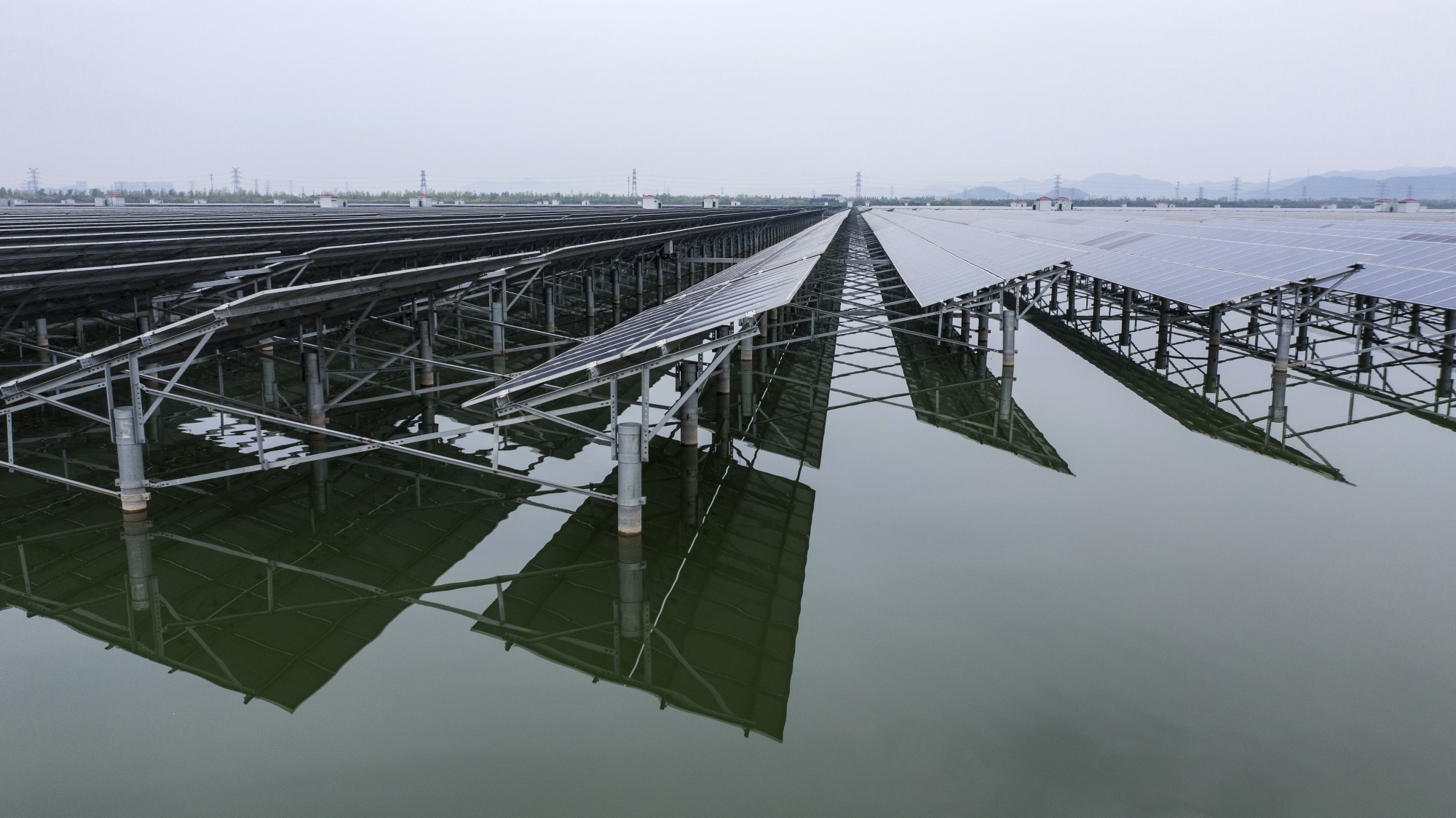
This is how floating solar is a thing.
(direct link to image: https://assets.bwbx.io/images/users/iqjWHBFdfxIU/iy93Jvbye2e...)
Solar panels are meant to be water proof, after all they are meant to survive rain storms and melting snow and coastal weather.
Seems like a weird location to me, but what do I know.
My experience is that the UK (for example) doesn’t really know why it is building offshore wind. Is it to reduce bills to consumers (OFGEMS remit), is it to create local jobs in manufacturing (Clean Industry Bonus Scheme), is it to stimulate national wealth by ownership of projects (British Energy). It’s a mess unclear picture for me.
It would be nice if politicians could spend some time trying to work together, cross parties a come up with some sensible resolutions and long term plans instead of trying to score points for soundbites and clips.
Got a long way to go as electricity is only a portion of our energy consumption - heating and transport are still largely fossil fuel based ATM
The cfd auctions are competitive on price, but things like clean industry bonus and supply chain plans expect some local content. You can’t compete on price and also use expensive UK suppliers.
Battery storage isn't quite where it needs to be, yet, so there's still some need for fossil and nuclear power, but when it is, decommissioning the remaining fossil power system is a no-brainer, and those with the biggest existing solar and wind estates will benefit most, and fastest.