Posted by sseagull 1/30/2026
I can imagine a number of reasons, but this is all I found in the article:
> If I’m a company considering making strategic investments... I don’t want my competition to know where I’m going, what I’m doing, what pace I’m doing it at... You want to make sure everything is buttoned up and bow tied before that type of information is put into the public realm.
I'm having trouble with this. Is the worry that Amazon will outbid or outmaneuver Meta? How does this work in practice?
Whereas everyone here seems to assume it's to avoid NIMBY. I can see how a Meta spokesperson won't say "if we told you we're trashing your land you'd object" but I'd hope they could come up with a better argument than "your community is a pawn in a 5d chess game, better that you don't know".
They were living in "benevolent feudalism" when GM, Ford, etc all had factories there. The problem is that these companies effectively owned the cities in which they operated. And then they left.
Since the Reagan years we decided to export everything that built our economy so the landlords in power could have even more profitable quarters in the short term. What this did however is destroy the economies of the non-software states.
The rust belt states are currently being subsidized by the rich states. This has been going on for decades. This vacuum of power has allowed the new landlords in power to swoop in and play city governments against each other with impunity.
The negotiating power of these states is so poor that they present an opportunity for the Metas of the world to make them even worse while becoming the new "benevolent" landlords. There doesn't need to be an NDA and secrecy, and in theory the city could get a good deal out of it, but realistically their utilities will just be abused because the words "civil rights" and "justice" have exited the lexicon.
That’s the problem. Suburban infrastructure is wildly expensive. A return to dense walkable villages would, in large part, fix the problem.
It's what they're familiar with, and any suggestion that it could be improved by catering less strongly to individual vehicles and with a stronger emphasis on public transport, bicycles, walking etc. is automatically resisted. The conspiracy theory fits this bias perfectly.
It's not so much that they have "opposition to livable cities," it's that they have different beliefs about what's livable.
Whether the people who believe it are going to experience consequences in future isn't relevant to that.
I'm an immigrant to the US - currently looking to emigrate again for obvious reasons! - and I've done a good amount of walking or taking public transit. Walking on the shoulder of strips (i.e. highways with traffic lights and shopping) is not pleasant, but it's doable. Crossing those strips is usually possible at traffic lights.
The wildest thing is that even in smallish towns where you might expect that walking would be supported, it isn't. Town planners generally seem not to consider it at all, at best you get some sidewalks outside shopping areas and then everything else the best you get is a shoulder, and the worst is nothing at all so you're just in the road with the cars.
The US is literally, collectively insane, and what it's going through now is just a natural consequence of that.
https://www.pecva.org/work/energy-work/data-centers-industry...
https://www.forbes.com/sites/kensilverstein/2026/01/11/ameri...
You also want cheap, reliable power. Ideally eco-friendly. And you want backbone connectivity, of course. Local suppliers who know the construction and maintenance needs of a data centre. No earthquakes, hurricanes, wildfires, flooding, or tornadoes. A local government that won't tax you too much, and that won't get upset when you employ very few people.
Most large companies impose certain costs on society, and have to manage their reputation. Often it's cheaper to improve public opinion in a peripheral area than to address deep-seated problems.
Putting a data centre close to a hydroelectric dam helps offset your product's impact on users' mental health, your disregard for competition law, etc.
[1] https://datacenters.google/operating-sustainably/ [2] https://sustainability.atmeta.com/data-centers/
Those lists are the companies marking their own homework and congratulating themselves as PR, AKA "greenwashing". They can do that just fine by spinning a single metric of their choice where they do less-badly than their pick of mean, median, and mode of whoever else they want to compare themselves against, they don't actually need to be genuinely eco-friendly at anything.
There's also network (pun intended) effects. Northern Virginia has been a major internet hub for a long time, with the first non-government peering point and a bunch of telecom companies, including AOL.
The data center land isn't that expensive anyway. Northern Virginia can be tremendously expensive, but the data centers are built out in the relative sticks. I'm sure the land would be cheaper in Wyoming, but it's cheap enough.
No well educated highly paid person wants to live in the middle of nowhere. Wisconsin will never be Seattle, Boston or NYC.
When the city council first heard that Facebook wanted to build a data center, they shot it down solely because of Facebook's reputation. A year or two later, Facebook proposed the exact same project to the city council, while keeping their name secret under an NDA. Then, when the city council was only considering the economics of it, they jumped at the chance for the tax revenue and infrastructure investment. With essentially the same exact plan as before, one of the council members who rejected it before the NDA said "this is exactly the kind of deal a city should take."
I think in many ways, these companies are fighting their own reputations.
I think "reputation" is absolutely critical to functional societies, and this feels a lot like putting a mask on and hiding critical information.
If Facebook got rejected because people hate Facebook, even when the economics are good... that's valuable to society as a feedback mechanism to force Facebook to be, well - not so hated.
Letting them put a legal mask on and continue business as usual just feels a bit like loading gunpowder into the keg - You make a conditions ripe for a much larger and forceful explosion because they ignored all the feedback.
---
Basically - the companies are fighting their reputations for good reason. People HATE them. In my opinion, somewhat reasonably. Why are we letting them off the hook instead of forcing them to the sidelines to open up space for less hated alternatives?
If I know "Mike" skimps on paying good contractors, or abuses his employees, or does shitty work... me choosing not to engage with Mike's business, even though the price is good, is a perfectly reasonable choice. Likely even a GOOD choice.
See the popular vote results of Nov 2024 US presidential election. Reputations were on full display.
But we see from the Nov 2024 elections (and others, but most glaringly that one), that that is, sadly, not true.
So the people rejecting Facebook because of Facebook's reputation tells you nothing about whether Facebook is bad, because the people could have just as easily been bad.
The problem is that many people liked what they saw. Reputation was still important, but there were different beliefs about what reputations were desirable.
Just think at how much extra money would start coming into the state, if they just allowed $company to build an orphan grinding machine!
> why it was needed in ...
"Needed"
I willingly pay more to participate in the economies that behave ethically. If you have to hide who you are, and by proxy, how you behave, to get what you want... It's exhausting listen to people advocate for, or be apologists for people who are intentionally ignoring consent.
It probably varies from state to state, I don't know.
Whether or not it’s legal is another question. And NIMBY and… and… there are lots of potential concerns. But this article is about Wisconsin, where the question is really what are we going to do with this land and how are going to power it.
Your post mentions a lawsuit near you. This is a feature, not a bug. Even if the city is unlawfully denying an application, the denial still has the desired effect — a de facto denial for the length of time it takes to resolve in the courts. By dragging out the time for a lawsuit to be resolved, the city hopes that the developer will just go away and find someplace else.
Cities are bound by laws, and not complying opens them up to lawsuits which the taxpayers pay for. Sure, maybe that's in the best interest of the community in some cases. However, I think it usually happens because people have feelings and biases rather than as a calculated move.
It’s evaluating proposal by the words of the applicant alone.
In addition to exaggeration on resumes, people tend to not include inconvenient stuff. Reputation is definitely part of the merit.
They absolutely can and do this. Ask to put an adult entertainment store next to a school/church. Ask to put a liquor store next to a school/church. The city will say no.
https://www.sltrib.com/news/politics/2018/05/22/utah-county-...
> In 2016, West Jordan City sought to land a Facebook data center by offering large tax incentives to the social media giant. That deal ultimately fell through amid opposition by Salt Lake County Mayor Ben McAdams and a vote of conditional support by the Utah Board of Education that sought to cap the company’s tax benefits.
> That project went to New Mexico, which was offering even richer incentives.
> Three months after the Utah negotiations ended, state lawmakers voted in a special session to approve a sales tax exemption for data centers. The move was seen by many as another attempt to woo Facebook to the Beehive State.
So basically they first said "No", lost the bid, had FOMO so they passed new laws to attract this business.
>Asked about the identity of the company, Foxley said only that it is “a major technology company that wants to bring a data center to Utah.”
>And that vision could soon be a reality, after members of the Utah County Commission voted Tuesday to approve roughly $150 million in property tax incentives to lure an as-yet-unnamed company — that sounds an awful lot like Facebook — to the southern end of Pony Express Parkway.
Seems like a pretty open and obvious secret.
> It takes twice as long to build bridges you've burnt
> And there's hurt you can cause time alone cannot heal
The local residents, if not the public at large, should have a right to know. If not, then it should go both ways and grocery stores shouldn't be allowed to use tracking because my personal enemies might discern something from the milk brand I'm buying
This is the enabler of pure NIMBYism and we have to stop thinking this way. If a place wants this kind of land use and not that kind, then they need to write that down in a statute so everyone knows the rules. Making it all discretionary based on vibes is why Americans can't build anything.
> Wisconsin has now joined several states with legislative proposals to make the process more transparent.
But it is a reactive measure. It has taken years for the impacts of these data centers to trickle down enough for citizens to understand what they are losing in the deal. Partially because so many of the deals were done under cover of NDAs. If anything, this gives NIMBYs more assurance that they are right to be skeptical of any development. The way these companies act will only increase NIMBYism.
> Making it all discretionary based on vibes is why Americans can't build anything.
Trusting large corporations to provide a full and accurate analysis of downside risks is also damaging.
Ironically this is a recipe for how you get nothing built. Zoning laws are much more potent than people showing up at city council meetings.
It's good and proper for the government to consider the impacts on a local community before approving a big construction project. That process will need to involve some amount of open community consultation, and reasonable minds can differ on when and how that needs to start. The article describes a concrete proposal at the end, where NDAs would be allowed for the due diligence phase but not once the formal approval process begins; that seems fine.
It's not good and improper for the government to selectively withhold approval for politically disfavored industries, or to host a "bidding war" where anyone seeking approvals must out-bribe their competitors.
Yes some people see the datacenters as part of an ethical issue. I agree its not proper for permits to be withheld on purely ethical grounds, laws should be passed instead. But there are a lot of side-effects to having a datacenter near your property that are entirely concrete issues.
Also, we don't live in a world adjudicated by machines, there will always be discretion and the potential for special favors. No matter how much you tie the hands of regulators there will be some actor who will have the power to extort. Not to mention that regulation is not opposed to due process and the rule of law, but is the most important component of both.
Imagining a world without discretion is imagining a world where corporations can do as much irreparable harm as they want as long as there isn't a law against it.
There's a reason for that: they compete for resources but contribute relatively little back to the local economy. In that sense they're quite different from previous large corporate investments in a local area.
If anything these should be examples on the failure of how these resources are being sold and good opportunity to build a better system.
Unless the residents have a strong enough chance to veto, they’re just speaking into the void as far as the company is concerned.
It’s usually an indirect vote with your voice. To be frank, people don’t have that much of a role in what business gets built if it aligns with the states economic goals and zoning is not being critically changed.
I think the bigger discussion is if resources are going to be constrained can we make sure the use is being properly charged for resource buildout. It’s the same problem with building sports arenas or sweetheart tax deals for manufacturing plants, they often don’t pan out.
But this is, in theory, why we have laws: to fight power imbalances, and money is of course power.
Tough for me to be optimistic about law and order right now though, especially when it comes to the president’s biggest donors and the vice president’s handlers.
Point kind of proven, yeah? One more argument for the “return to the gilded age” debates.
Edit: you’re speaking kind of authoritatively on the subject though. Care to share some figures? The AI bubble is definitely measured in trillions in 2026 USD. Was the railroad buildout trillions of dollars?
By 1900 the united states had 215 thousand miles of railroads https://www.loc.gov/classroom-materials/united-states-histor...
Depend on you value land mileage and work this could easily be north of 1T modern dollars.
But railroads kind of fail with this because you might have a landowner who prices the edge of their parcel at $1,000,000,000,000 because they know you need that exact piece of land for your railroad, and if the railroad is super long you might run into 10 of these maniacs.
Meanwhile the vast majority of your line might be worth less than any adjacent farmland, square foot by square foot, especially if it’s rocky or unstable etc.
Having a continuous line of land for many miles also has its own intrinsic value, much more than owning any particular segment (especially as it allows you to build a railroad hah).
Anyway, suffice to say, I don’t think “land value underneath railroads from the 18th century” is something that’s easily estimated.
> AI infrastructure has risen by $400 billion since 2022. A notable chunk of this spending has been focused on information processing equipment, which spiked at a 39% annualized rate in the first half of 2025. Harvard economist Jason Furman commented that investment in information processing equipment & software is equivalent to only 4% of US GDP, but was responsible for 92% of GDP growth in the first half of 2025. If you exclude these categories, the US economy grew at only a 0.1% annual rate in the first half.
https://www.cadtm.org/The-AI-bubble-and-the-US-economy?utm_s...
In the US neither of those are generally made public per se. They are made public when the thing actually passes testing or certification.
This is likely a misdirection. The "competition" is for the water and power, ie the local communities. This is a NIMBY issue with practical consequences. That's how it has been used in one part of North Dakota. Applied Digital is building in a town (~800 ppl) named Harwood after being unhappy with Fargo tax negotiations. The mayor of Harwood abused an existing agreement with Fargo, which will have to meet the water and power needs of everything in Harwood.
Find a small town politician, bribe them. Corruption pure and simple with no chance for accountability. The economically strong predate on the economically weak.
If course its not ideal for the company investing. Then the question becomes if rights/wishes of people are above of those of companies. Often, in Europe they are not, and often in US they are, exceptions notwithstanding.
The US seems to have a "tragedy of the commons" problem when it comes to NIMBYism. Everybody wants X to exist, but X causes some negative externalities for the people living close to it, so nobody wants X build specifically in their back yard, they want it but built somewhere else. Because the US seems to delegate these decisions to a much more local / granular level than Europe does, nobody has the courage to vote "yes", so X never gets build.
Who should decide whether E.G. an airport or a datacenter gets build? Should it just be the people living next to it? Should it be everybody in the relative vicinity who would use its services? Should it be everybody in the country (indirectly through the elected representatives)? I think those are the right questions to ask here.
Who gets to decide if an airport or data center gets built is a complicated question. But there are other options to keeping one party in the dark via NDAs. On one extreme we have eminent domain, on the other there's just buying out the local community transparently.
[1]: https://en.wikipedia.org/wiki/Tragedy_of_the_anticommons
Also, in a remote area, the third parties the owners require for continual maintenance will be fewer, take longer to respond, likely cost more, and may be less qualified than those you can find in a more populated area.
EDIT: https://youtu.be/t-8TDOFqkQA?si=Qa9ot70MylFp6qkE
Just watch that and not get hoppin' mad.
Hardly "everybody" wants AI to exist.
There is a component of not wanting the competition know exactly what your doing but also it’s usually better for most parties including the constituents to not know about it until it’s at least in a plausible state. Thought differently, it’s not even worth talking about with the public until it’s even a viable project.
When Foxconn made a deal with the state to build a factory for large screen TVs, water was a major part of the deal. They were given an exemption on obeying state environmental laws. They also condemned farms and properties in order to buy the land from owners who didn't want to sell it.
A potential further reason for secrecy is that water use in the Great Lakes watershed is governed by a treaty with Canada, and the people in the Great Lakes region are quite united on being protective of our water even when we disagree on a lot of other political issues.
So it depends on the game theory but with coordination on the municipalities doing it in the open should generate higher demand.
If Walt Disney wants to buy a bunch of random houses in Florida I think most people would sell them for market price. But if they all know that their specific house is an essential part of a multi-billion dollar plan, you're liable to have holdouts.
That's what happened after his shell companies were exposed.
This is literally called arbitrage, were there is a price difference between the the people pricing it and what the benefit is to the people buying it.
If I have information that you do not have, that indicates that underneath your land there is a gold mine, then I’m going to offer you whatever you think you’re value of your land is worth without telling you that there’s a gold mind underneath it so that I can exploit the difference in information.
That’s the entire concept behind modern economic theory, specifically trade arbitrage. That’s precisely what it is and that’s exactly the point from Meta.
I'd be willing to bet it's largely driven by NIMBY concerns as this type of stuff can end small-time political careers.
* noise pollution, infrasound from HVAC travelling long distances making people sick
* power outages priorizing data centers at the expense of residentials
* rising electricity bills
* rising water bills
Data centers use little water. Less than using the same land for anything involving agriculture, for example.
The idea that a data center uses too much water is recently invented propaganda that is readily verifiable as fiction. Cui bono?
The fundamental problem here is municipalities getting into cozy, sweetheart deals with corporations.
These data centers do come at a real environmental cost. I don't think cherry picking water usage is really helpful here.
> Please don't post insinuations about astroturfing, shilling, brigading, foreign agents, and the like. It degrades discussion and is usually mistaken. If you're worried about abuse, email hn@ycombinator.com and we'll look at the data.
> Please don't comment about the voting on comments. It never does any good, and it makes boring reading.
Datacenter demand has simply brought demand forward a bit. This was always coming for us.
So long as they are paying market rates like any other power consumer of their size I see zero problem with it. If they are getting sweetheart deals and exemptions from regulatory rates then there would be a problem.
The issue is lack of building stuff that needed to happen 20-30 years ago when it began to be an obvious critical need. De-industrialization just masked the problem.
If we can’t figure out as a society how to come out ahead with a much more robust electric grid after this giant investment bubble we have utterly failed at a generational scale.
Discovering good locations for data centers is genuinely a difficult problem. They're relatively scarce. Bidding wars seem completely plausible.
Still, if the prospecting is the bottleneck there could be 3rd parties (or even the tech companies themselves) entering into agreements with towns which allow both a finders fee and open bidding for the lot.
Literally every data center project that gets announced near me gets protested at council meetings, petitioned, and multiple series of reddit/bluesky posts about the project.
It's hard to put into words for HN how deeply locals resent tech companies and AI. You could call it NIMBY, but the hatred is deeper than that.
The sentiment is "you have enough money, go away. Your business is fundamentally bad."
Ironic.
- Avoid the large and well-funded network of professional activists in the US from sabotaging the property and injuring locals - Avoid local political actors from spreading fear and misinformation just for the sake of grandstanding. - Avoid activist attorneys and judges from across the country, some paid by competitors, to create endless frivolous legal obstacles
We need an acronym like NIMBY but when it’s obnoxious progressive hedge fund managers and tech-rich psychopaths who live in some toxic coastal city who don’t want it in your own back yard a thousand miles away.
There is nothing grass roots about “AI will cause drought and famine” nonsense coming from the infotainment content mills. I don’t blame anyone for keeping their work out of the hostile press.
For extra fun today the WI Realtors Association and other groups are suing the city to stop an upcoming vote from an accepted petition that forced approving projects over tax financed projects $10 million dollars get voter approval.
https://biztimes.com/mmac-sues-city-of-port-washington-over-...
Everyone likes to complain about politicians, with good reason) but we don't talk enough about the people who are trying to buy them as a means to cut out the voters.
The buyer bought all the farms and homesteads in an 160 acre parcel (a quarter section, in surveying terms) and paid well above market rate for a lot of it. This year is a re-valuation for property tax in my county and we've seen massive valuation increases. There is speculation that the valuation algorithm is using these "motivated buyer" sales to inflate other property values even though the likelihood of similar sales occurring in the future is very slim.
Like, you go with friends to a bar, do you want your check equally split or based on drinks had?
The infrastructure when exponentially above the norm should be paid by the heavy user. Currently, most utilities dont do that.
If a facility is somehow getting subsidized by the rest of the ratepayers then it’s a pricing problem that needs fixing.
The issue is that we collectively decided to stop investing in energy infrastructure for 50 years or so, and now all that capital investment needs to happen at once. You can’t even build a transmission line in a reasonable timeframe due to the insane NIMBY veto we have given everyone.
Typically industrial consumers of electricity with predictable 24x7 demand are a good thing for an electric grid. They actually subsidize the rest, and that’s reflected in the lower cost per watt they tend to pay the utility.
If the entire interconnection is simply out of generation capacity that’s a much larger failure further upstream by regulators and voters who wanted their cake and to eat it too for many years. It’s coming for us either way if we want to remain a viable competitive economy on the world stage. You can only maximize financialization for so long until you need to start actually making stuff again.
Yes, a portion of power is metered costs. Often times (though I am not certain about this case), there are fixed costs that everyone pays a chunk of. If these sorts of projects aren't handled well, the fixed cost that a massive data-center pays may be disproportionate to he cost they incur on the system.
To install thd infrastducture everyones bill goes up.
I can't wait until OpenAI, NVIDIA and Microsoft all go belly up.
But the negatives are spiraling out of control. Pollution and energy and the amplification of structural social problems like wealth stratification, authoritarianism, media manipulation...
With great power comes great responsibility, and we're living in an era in which our culture has shifted dramatically towards accepting immoral, short-sighted, and reckless behaviour.
always easy to talk about concerns.
Yeah, I completely agree AI is fantastic with no downsides; as long as you ignore all of it's down sides.
Do you think it's a good thing to ignore the downsides when advocating for something?
AFAICT, fears of the marginal costs of LLM inference being high are dramatically overblown. All the "water" concerns are outlandish, for one—a day of moderately heavy LLM usage consumes on the order of one glass of water, compared to a baseline consumption of 1000 glasses/day for a modern human. And the water usage of a data center is approximately the same as agriculture per acre.
> The water usage of 260 square miles of irrigated corn farms, equivalent to 1% of America’s total irrigated corn.
https://andymasley.substack.com/p/the-ai-water-issue-is-fake...
Roughly 1% of corn is used for actual food consumption btw.
Somebody get daily value from rising food prices, isn’t as good for humanity
Sure you can look away from child labor providing you the latest iphones or lithium mines for the same or electric cars destroying pristine tropical jungles and entire ecosystems, many folks do so very comfortably. Then some others don't.
Different moral values and such.
Surely you use things with negative externalities because you get value from them.
I would get value from stealing, I don't steal from people. The argument or question isn't about if it has value to some people, the question is, does the value to some people outweigh the costs that are imposed on others.
It's possible to imagine LLMs implemented responsibly, but our ruling class has decided against that.
Bitcoin—>Altcoin—>NFTs—>StableCoin—>AI—>They'll just invent something new to over-hype and spend billions on.
It won't end until we reach the Shoe Event Horizon.
https://www.thenerdreich.com/network-state-comes-for-venezue...
> Wisconsin has now joined several states with legislative proposals to make the process more transparent.
Legislative or constitutional, good democratic government really needs limits on how much its supposed officials can do in secret.
Secret deals with corporations is corruption.
But yeah - honest uses are pretty limited. Which limits we can hope will be tightly enforced by new legislation.
OTOH, if Smallville seems too unfriendly to developers, the latter may decide to build outside the city limits. Which might become a problem over time, by holding down Smallville's commercial tax base. Forcing the voting citizen to make unhappy choices between high taxes on their own homes, and Smallville having too little money to afford nice things that they want.
In public policy, everything is a tradeoff.
There is no reason that McDonald's shouldn't own the risk of developing a McDonalds, and instead make secret deals with local governments to offset some of that risk. Thats a cost that should be borne by the business.
Of course the municipality could just say that they don't want the project and they won't submit a bid. That's fine too.
In the before-AI world, it mattered a lot where data centers were geographically located. They needed to be in the same general location as population centers for latency reasons, and they needed to be in an area that was near major fiber hubs (with multiple connections and providers) for connectivity and failover. They also needed cheap power. This means there’s only a few ideal locations in the US: places like Virginia, Oregon, Ohio, Dallas, Kansas City, Denver, SF are all big fiber hubs. Oregon for example also has cheap power and water.
Then you have the compounding effect where as you expand your data centers, you want them near your already existing data centers for inter-DC latency reasons. AWS can’t expand us-east-1 capacity by building a data center in Oklahoma because it breaks things like inter-DC replication.
Enter LLMs: massive need for expanded compute capacity, but latency and failover connectivity doesn’t really matter (the extra latency from sending a prompt to compute far away is dwarfed by the inference time, and latency for training matters even less). This opens up the new possibility for data centers to be placed in geographic places they couldn’t be before, and now the big priority’s just open land, cheap power, and water.
Cheap for who? For the companies having billions upon billions of dollars shoved into their pockets while still managing to lose all that money?
Power won't be cheap after the datacenters move in. Then the price of power goes up for everyone, including the residents who lived there before the datacenter was built. The "AI" companies won't care, they'll just do another round of funding.
https://www.axios.com/2025/08/29/electric-power-bill-costs-a...
My less snarky answer is -- we've always had data centers all over the place? When I started in web dev we deployed to boxes running in a facility down the street. That sort of construction probably dropped considerably when everyone went to "the cloud".
The other locations like Oracle’s dc in Port Washington or MS in Racine/Kenosha area are located such that they are within the defined boundaries outlined and dc unlike Foxconn are all ‘closed-loop’ which of course isn’t entirely perfect but certainly not on the scale of Foxcon’s 7mil gal/day nonsense.
I mean it seems like there's already avenues to skirt around this compact?
Also, from what I can tell, this isn't some sort of ban on using water from the Great Lakes basin, it's just a framework for how the states are to manage it. It is entirely believable to me that this compact would actually support water being used for developing tech in the surrounding communities (like using it in data centers).
In my mind this is partly due to people not understanding large numbers, and also not understanding just how much water is actually in the Great Lakes. It's a huge amount - Lake Michigan has 1,288,000,000,000,000 gallons in it. Every human on earth could use close to 10gal of water per day for the next 50 years before Lake Michigan would be "dry", assuming it was never replenished. And that's just Lake Michigan. (Obviously environmental systems are more complicated than the simple division I did, and individual water usage isn't simply 10gal a day - it's just to demonstrate a point).
Now, someone else pointed out that the tragedy of the commons is a sort of death by a thousand cuts. And if anyone who shows up is allowed to draw millions of gallons a day, that can add up and certainly have negative effects. It's just important to actually understand the scale of the numbers involved, and to not let legitimate environmental concerns be cross-contaminated with just anti-tech-of-the-year sentiment, or political motivations, or whatever else might cloud the waters (pun unintended).
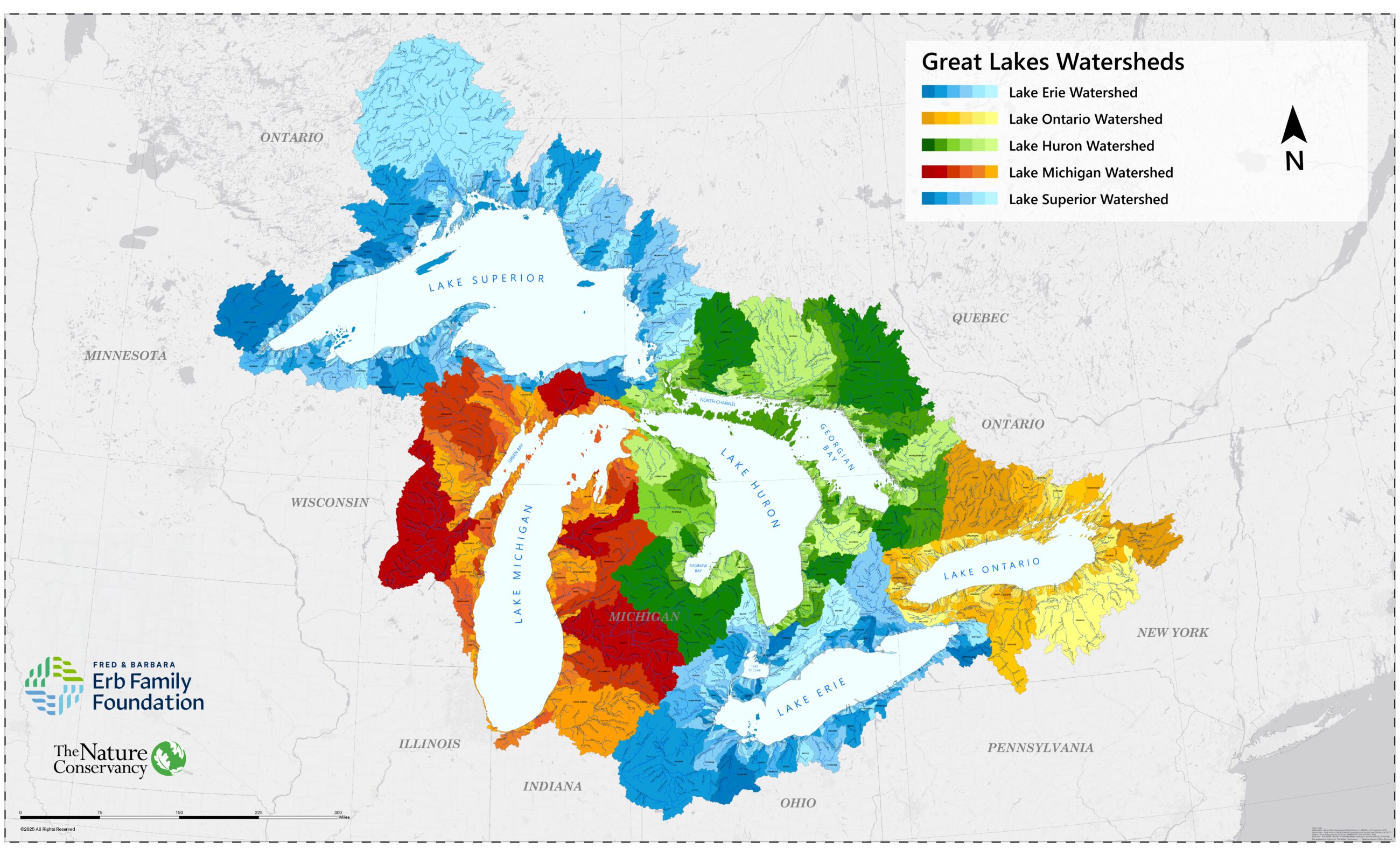
On the southern shore of Lake Michigan, that "few miles" changes the watershed that its part of.
https://en.wikipedia.org/wiki/Great_Lakes_Basin ( https://www.erbff.org/wp-content/uploads/2025/10/10.8.25-Gre... for a high resolution map)
As for diversions that go to evaporative cooling, that's a big question for the data center itself and there are many designs. https://www.nrel.gov/computational-science/data-center-cooli... has some cutting edge designs, but they're more expensive to use for pumping waste heat elsewhere.
Sometimes you get data centers that look like https://www.oregonlive.com/silicon-forest/2021/11/the-dalles... ... and that's not a little bit of water there.
While the Great Lakes are coming off of wet years ( https://water.usace.army.mil/office/lre/docs/waterleveldata/... ) that shouldn't be used as long term prediction of what will be available in another 10 years lest it becomes another Colorado river problem. Currently, the water levels for Lake Michigan are lower than average and not predicted to return to average in the model range. https://water.usace.army.mil/office/lre/docs/mboglwl/MBOGLWL... . You'll note that this isn't at the minimums from the 1960s... and the Great Lakes Compact was signed in 2008.
You can search the database for the authorized diversions of the water. https://www.glslcompactcouncil.org/historical-information/ba...
For example, Nine Mile Point - https://www.glslcompactcouncil.org/historical-information/ba...
Putting them all in one or two places isn’t good for reliability, disaster resilience, and other things that benefit from having them distributed.
Data centers do more than just run LLMs. It’s a good thing when your data is backed up to geographically diverse data centers and your other requests can be routed to a nearby data center.
Have you ever tried to play fast paced multiplayer games on a server in a different country? It’s not fun. The speed of light limits round trip times.
> I guarantee it's not to run LLMs.
Are you trying to imply something conspiratorial?
Likely there's some kind of tax incentive for the datacenter to be built in one place over another, but I have to imagine that the local county is going to net some sort of increase to it's revenue, which can be used to then support the town.
There's also the benefit of the land the datacenter is on being developed. Even if that is done in financial isolation from the town/county, a pretty fancy new building designed for tech is being built. Should the datacenter go belly up, that's still a useable building/development that has some value.
When the tax incentive timelines runs out, the data centers just claim they'll move away and the tax cuts get renewed.
Its happening in Hillsboro, Oregon right now. The city promised some land just outside of the boundary would stay farm land until 2030 or later. The city reneged on that already. The utility rates have also doubled in recent years thanks to datacenters. The roads are destroyed from construction which damages cars, further increasing the burden on everyone else.
And in the same way that construction-damaged roads can lead to costs on everyone else - the development of that land employed people, and that is a positive thing for construction workers and their families (more than just financially).
Just because you can point at negative consequences doesn't mean positive ones don't exist as well. It's rarely black and white as to the net effects of things like this. You could/should even be considering what doing a build-out like this does for the reputation of a city, and the sense of optimism it can bring to a local community that might otherwise be left behind, completely out of the picture. There's another world where a small town appears not in an article about a new datacenter (or the possible ensuing city renege boondoggle) but as a small blip in a story about how small towns in this country have decayed as a result of being passed by during the current tech "boom".
It's also not all that trivial (or cheap) to just transport a datacenter to another state, or even county. You'd have to be pretty sure that whatever tax you're trying to now avoid is more than the (potentially) zero-tax new build or relocation you'd have to do to "escape".
At the end of the day, it's the responsibility of the local government to make sure that the deal is a net benefit to the community. Maybe that is too much to expect lol
Constant additions, reconfigurations, etc.
It’s effectively a full time job for an electrician crew or three.
Of course once the facility goes away entirely the job does too. But so goes a factory or anything else.
The audacity of public officials these days is astounding.
So if someone is even considering buying a big block of land, anyone who knows about it can buy first in the area. That drives confidentiality agreements (which increase the value of being an insider).
Similarly, for large players to make large stock transactions, proceeding through the public markets led to traders seeing the bid/ask volume and act first, making it more costly. That lead to dark pools and off-exchange trading, which has become the majority (in dollar volume) since roughly 2024. So the "public" markets are now just tracking private ones.
Sounds like it’s not something new or reserved for data enter projects only but I agree it sure seems a shady practice.