Posted by tanelpoder 6 hours ago
I think this might be more of an comment on software as a business than AI not coding good apps.
Pre-ChatGPT, in ~2020, there were about 5,000 new packages per month. Starting in 2025 (the actual year agents took off), there is a clear uptick in packages that is consistently about 10,000 or 2X the pre-ChatGPT era.
In general, the rate of increase is on a clear exponential. So while we might not see a step change in productivity, there comes a point where the average developer is in fact 10X productive than before. It just doesn't feel so crazy because it can about in discrete 5% boosts.
I also disagree with the dataset being a good indicator of productivity. I wouldn't actually suspect the number of packages or the frequency of updates to track closely with productivity. My first order guess would that AI would actually be deflationary. Why spend the time to open source something that AI can gen up for anyone on a case by case basis specific to the project. it takes a certain level of dedication and passion for a person to open source a project and if the AI just made it for them, then they haven't actually made the investment of their time and effort to make them feel justified in publishing the package.
The metrics I would expect to go up are actually the size of codebases, the number of forks of projects that create hyper customized versions of tools and libraries, and other metrics like that.
Overall, I'd predict AI is deflationary on the number of products that exist. If AI removes the friction involved with just making a custom solution, then the amount of demand for middleman software should actually fall as products vertically integrate and reduce dependencies.
But I have been absolutely flooded with trailers for new and upcoming indie games. And at least one indie developer has admitted that certain parts of their game had used the aide of AI.
I also noticed sometimes when I think of writing something, I ask AI first if it exists, and AI throws up some link and when I check the link it says "made with <some AI>".
So I'm not sure what author is trying to say here but I definitely feel like I am noticing a rise in software output due to AI.
But with that said, I also am noticing the burden of taking care of those open source projects. Sometimes it feels like I took on a 2nd job.
I think a lot of software is being produced with AI and going unnoticed, they don't all end up on the front page of HN for harassing developers.
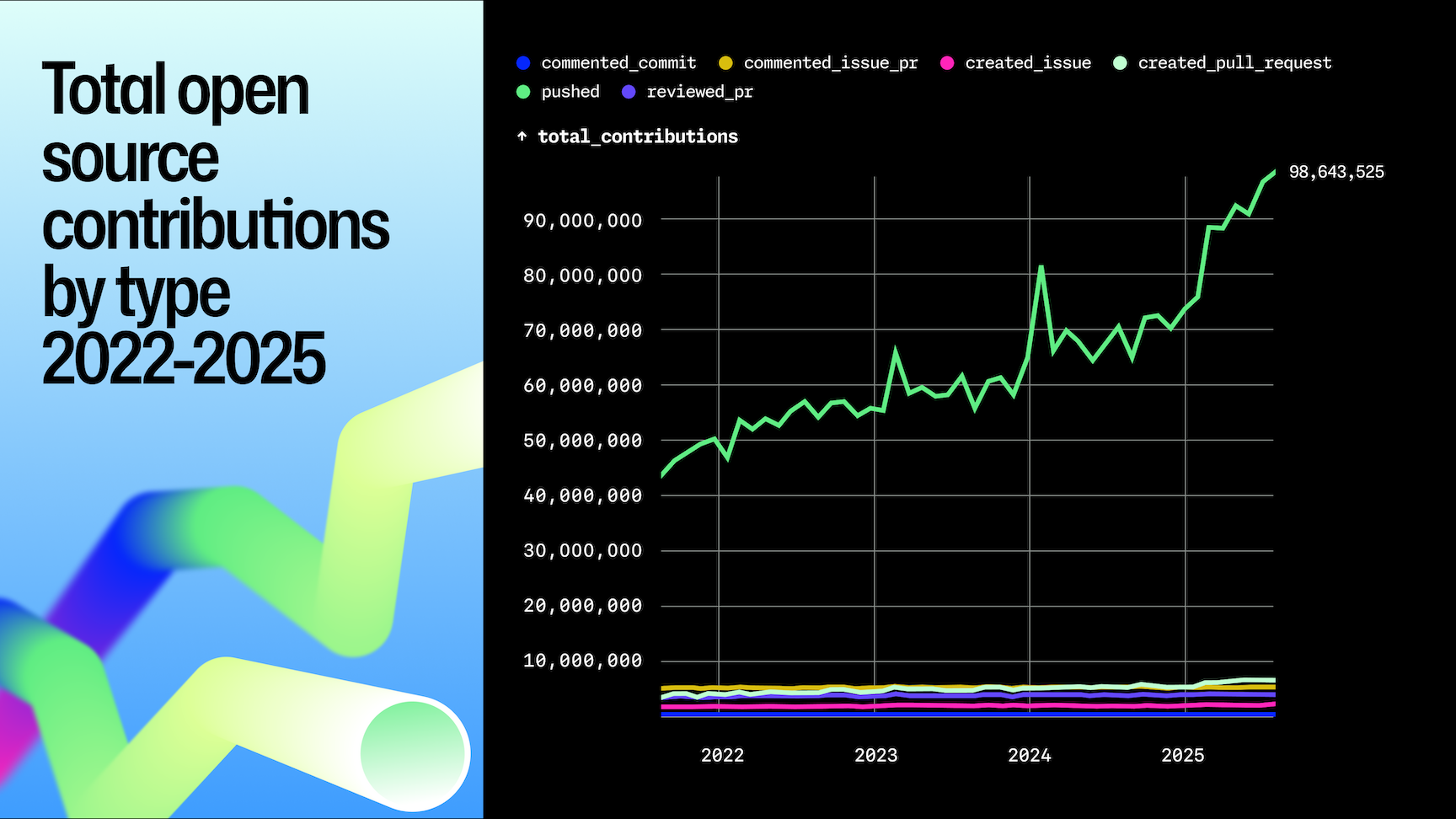
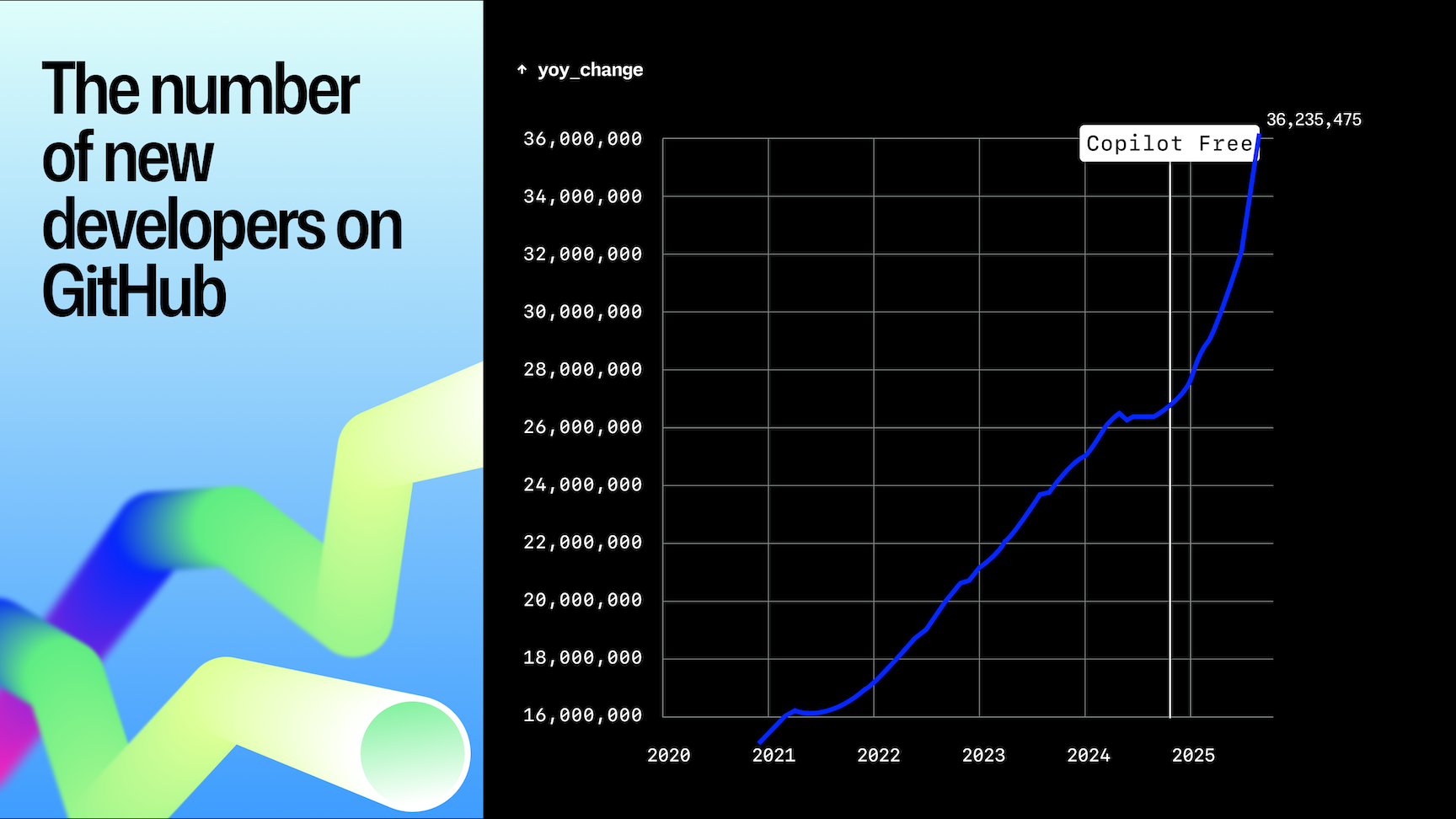
Also using PyPI as a benchmark is incredibly myopic. Github's 2025 Octoverse[0] is more informative. In that report, you can see a clear inflection point in total users[1] and total open source contributions[2].
The report also notes:
> In 2025, 81.5% of contributions happened in private repositories, while 63% of all repositories were public
[0]: https://github.blog/news-insights/octoverse/octoverse-a-new-...
[1]: https://github.blog/wp-content/uploads/2025/10/octoverse-202...
[2]: https://github.blog/wp-content/uploads/2025/10/octoverse-202...
Detractors of AI are often accused of moving the goalposts, but I think your comment is guilty of the same. Before Claude Code, we had Cursor, Github Copilot, and more. Each of these was purportedly revolutionizing software engineering.
Further, the core claim for AI coding is that it lets you ship code 10x or 100x faster. So why do we need to wait years to see the result? Shouldn't there be an explosion in every type of software imaginable?
What's sauce for the goose is sauce for the gander. If you make that argument that 'I don't believe in kinks or discontinuities in code release due to AI, because so many AI coding systems have come out incrementally since 2020', then OP does provide strong evidence for an AI acceleration - the smooth exponential!
Personally, I see the paid or adware software market shrinking, not growing, as a testament to the success of LLMs in coding.
There are many small, different, and one-time tasks that don’t fit full blown apps. Which I would characterize an AI building a novel app as building a house out of random bits of lumber. It will work but will have no cohesive process and sounds like a nightmare.
It seems like all tech executives are saying they are seeing big increases in productivity among engineering teams. Of course everyone says they're just [hyping, excusing layoffs, overhired in 2020, etc], but this would be the most relevant metric to look at I think.
IE, using agents to iterate through many possible approaches, spike out migrations, etc might save a project a year of misadventures, re-designs, etc, but that productivity gain _subtracts_ the intermediate versions that _didn't_ end up being shipped.
As others have mentioned, I think yak-shaving is now way more automated. IE, If I want to take a new terminal for a spin, throw together a devtool to help me think about a specific problem better, etc, I can do it with very low friction. So "personal" productivity is way higher.
In that they obviously have no real utility, sure. There hasn't been a paradigm shift, they still suck at programming, and anyone trying to tell you otherwise almost certainly has something to sell you.
Maybe I should have said "obvious to me," but I guess I just struggle to see how a serious crack at using modern opus in claude code doesn't make it obvious at this point.
I'd really recommend trying the "spike out a self-contained minimal version of this rearchitecture/migration and troubleshoot it iteratively until it works, then make a report on findings" use-case for anyone that hasn't had luck with them thus far and is serious about trying to reach conclusions based on direct experience.
And even “product engineers” often do not have experience going from zero to post sales support on a saas on their own.
It is a skill set of its own to make product decisions and not only release but stick with it after the thing is not immediately successful.
The ability to get some other idea going quickly with AI actually works against the habits needed to tough through the valley(s).
Besides, it's working for me. If it isn't working for others I don't want to convince them of anything. I do want to hear from other people for whom it's working, though, so I'm happy to share when things work for me.