Posted by andsoitis 1 day ago
* https://petapixel.com/2026/04/02/a-nikon-z9-made-it-aboard-t...
They have a thermal blanket for exterior work:
* https://petapixel.com/2026/02/24/artemis-ii-astronauts-will-...
* https://petapixel.com/2025/01/10/the-custom-nikon-z9-and-the...
* Various stories with the "Artemis" tag: https://petapixel.com/tag/artemis/
The D5 has been used on the ISS, including EVAs, since 2017, so they're a known quantity:
* https://en.wikipedia.org/wiki/List_of_cameras_on_the_Interna...
The Mercury and Apollo missions used Hasselblad 500-series-based cameras (modified):
* https://www.hasselblad.com/about/history/hasselblad-in-space...
Modern tech allows more people to capture more things more easily, but when the automation fails there aren't really many manual modes to fall back on.
About 11 years too far back:
> The Nikon D5 is a full frame professional DSLR camera announced by Nikon Corporation on 6 January 2016 to succeed the D4S as its flagship DSLR.
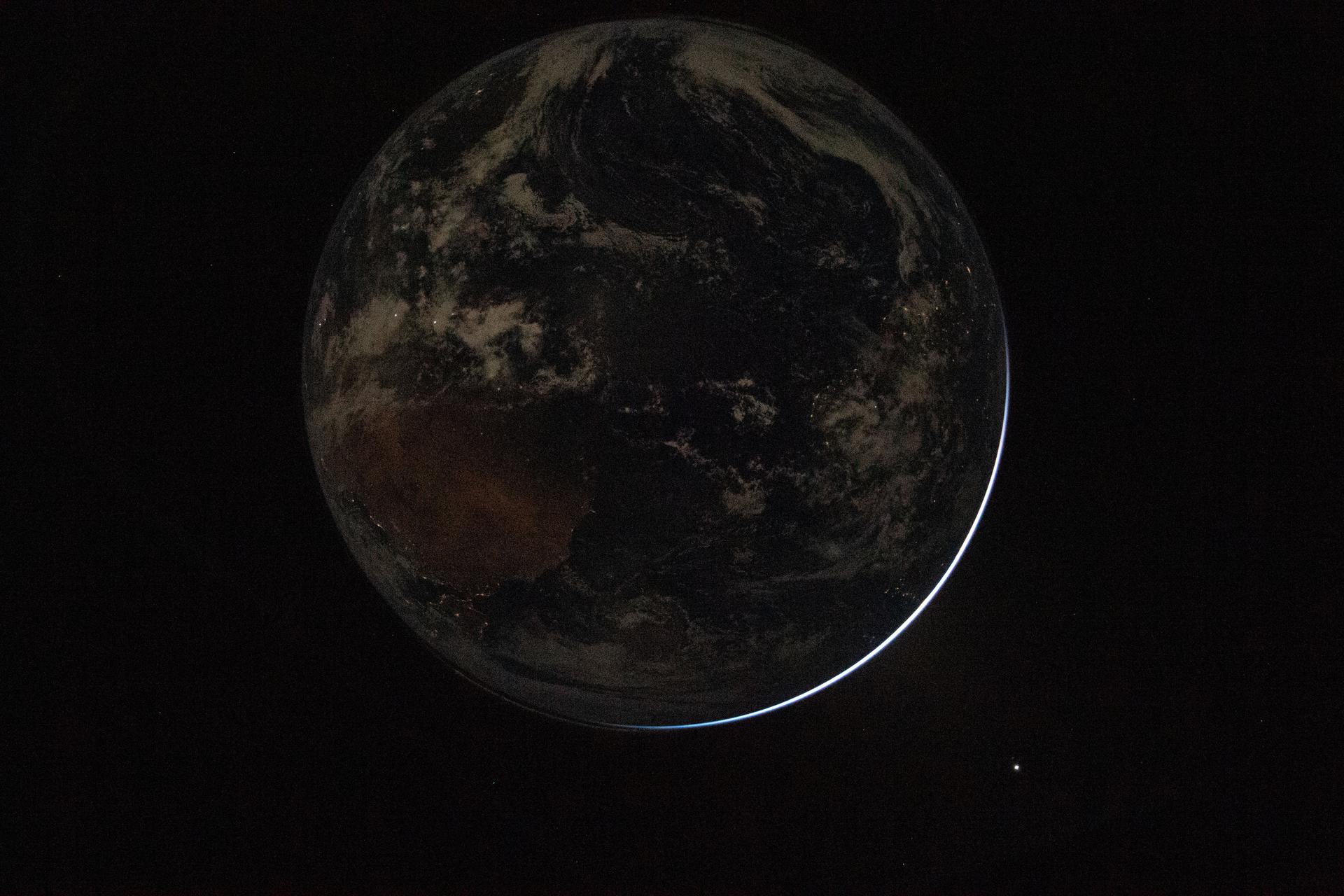
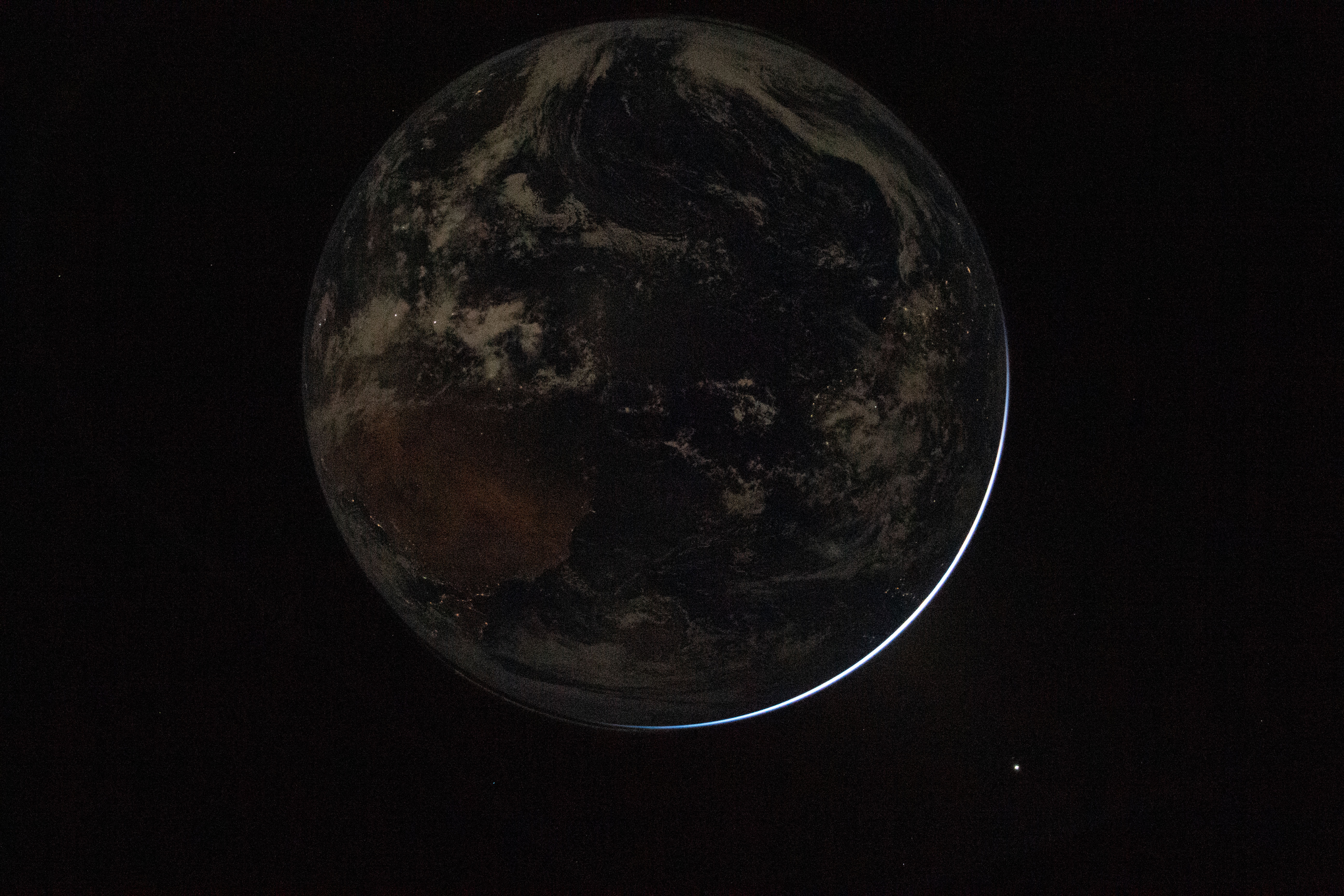
This is exactly what newbies experience when trying to photograph the moon from Earth. It's not intuitively obvious, but the light coming off the moon is essentially full-daylight bright. But the moon is small against a very black background, and depending on how the auto-exposure is operating, this often leads to guessing that the scene as a whole needs a lot more exposure.
I imagine that trying to photograph the Earth when a significant part of what's in view is experiencing daytime, is very much the same thing.
Sheesh, let the lab mice have a breather. Want them to solve physics during the trip?
It's so refreshing to be mesmorised by a picture in the age of shorts and reels.
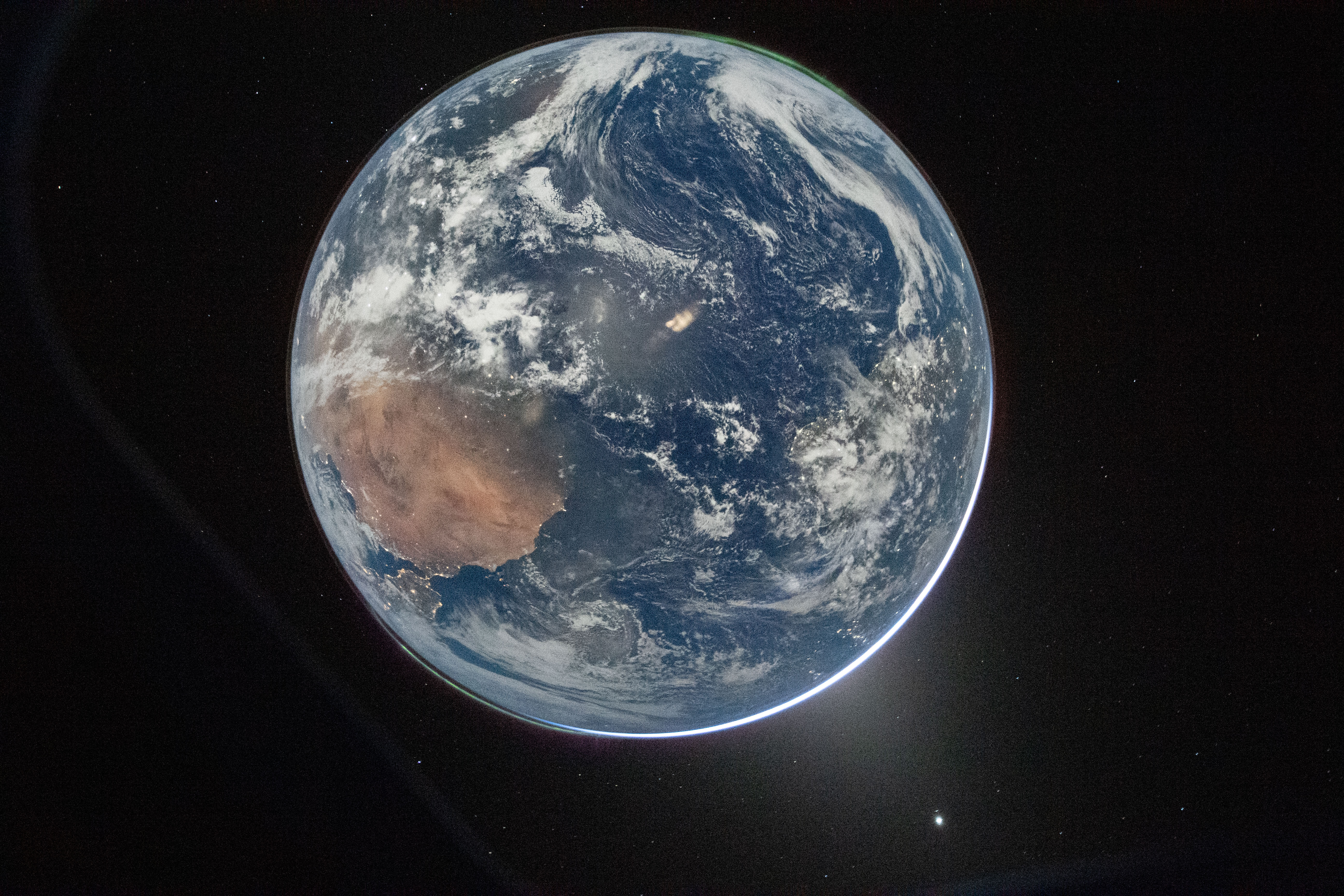
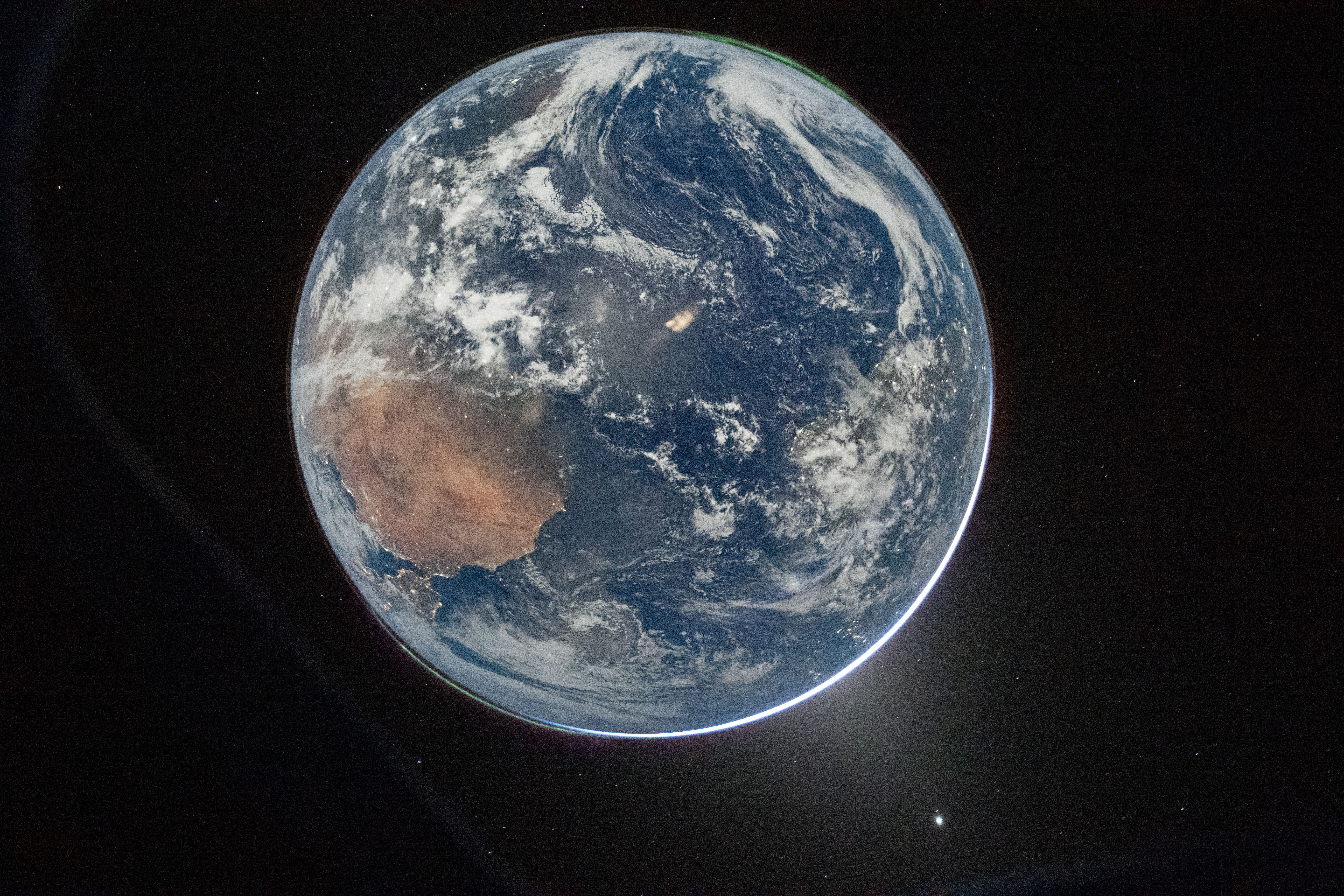
The natural blue light is coming from the oxygen in the atmosphere but it's so overwhelming in that spot that it turns the light pure white. The red/orangish is coming from particulates and the green/red from aurora. My favorite part I think is the very bottom where you can see the blue light taper off and not overwhelm the camera sensor and you can see the aurora with it. I love this photo so much.
Probably my favorite photo ever now.
And all the others are negligible by many orders of magnitude compared to the moon. So it's really just the moon as far as this photo is concerned (except for the small sliver that's still illuminated by sunlight, including refracted sunlight).
This is true for every photo ever taken
That's highly incorrect. I have many lightsources that aren't contributing to any photons in that picture. For example my refrigerator light.
Yes, exactly.
Almost like I ran the grainy-to-real conversion in my mind and I felt like I was imagining seeing this in person. Beautiful image!
For example, if you render Gaussian noise in photopea and export as JPEG 100% quality, it has 9.2MB. If you reduce the exposure by -2 it goes down to 7.8MB. That's partially because more parts of the noise are effectively black pixels, but also I believe because of the earlier mentioned effect.
Also, pulling more data from your 14 bit or 16 bit raws results in more noise in the end compared to the straight-out-of-camera 8 bit JPEGs.
Also possibly different JPEG quality settings.
One of the reasons the D5 supposedly was chosen was because of its high dynamic and good low light performance. It can go up to ISO 3,280,000:
* https://en.wikipedia.org/wiki/Nikon_D5
The D5 has been used on the ISS, including EVAs, since 2017, so is a known quantity:
* https://en.wikipedia.org/wiki/List_of_cameras_on_the_Interna...
EDIT: sorry, it seems I'm wrong. I just checked https://www.photonstophotos.net/Charts/PDR.htm and while the Z9 has the clear edge with 2 more stops of dynamic range at low ISO, the D5 actually pulls ahead at high ISO. Perhaps the technological improvements haven't been that much for the shot-noise dominated regime.
Video alleges people think ISO makes the sensor "more sensitive or less sensitive". (I … don't think this is common? But IDK, maybe this is my feldspar.)
(The video also quibbles that it is "ISO setting" not "ISO" … while showing shots of cameras which call it "ISO", seemingly believing that some of us believe ISO is film speed, in a digital camera?)
Anyways, the video wants you to know that it is sensor gain. And, importantly, according to the video, analog gain, not digital gain.¹ I don't know that the video does a great job of saying it, but basically, I think their argument is that you want to maximize usage of the bits once the signal is digitized. Simplistically, if the image is dark & all values are [0, 127], you're just wasting a bit.
You would want to avoid clipping the signal, so not too bright, either. Turn your zebras on. (I don't think the video ever mentions zebras, and clipping only indirectly.)
The video does say "do ISO last" which I think is a good guideline. Easier said than done while shooting, though.
… also while fact checking this comment, I stumbled across Canon's KB stating to use as low an ISO as possible, which the video rails against. They should talk to Canon, I guess?
¹with the caveat that sometimes there is digital gain too; the video notes this a bit towards the end.
This is because the ADC (analog to digital converter) right after can only handle so many bits of data (like 12-16ish in consumer cameras). You want to “center” the data “spread” so when the “ends” get cut off, it’s not so bad. Adjusting the ISO moves this spread around. In addition, even if you had an infinite bitrate ADC, noise gets added between the gain circuit and the ADC so you want to raise the base signal above the “noise floor” before it gets to the ADC.
Gain is not great — it amplifies noise too. You want as low ISO as possible (lowest gain), but the goal is not actually to lower gain; your goal is to change the environment so you can use a lower gain. If you have the choice between keeping the lights off and using higher ISO versus turning on the lights and using a lower ISO, the latter will always have less noise.
Most photo cameras have one gain circuit that has to cover both dark and light scenes. Some cameras like a Sony FX line actually have two gain circuits connected to each photosite and you can choose, with one gain circuit optimized for darker scenes and the other optimized for brighter scenes. ARRI digital cinema line cameras have both and both are actually running at the same time (!).
...or integration time.
> … also while fact checking this comment, I stumbled across Canon's KB stating to use as low an ISO as possible, which the video rails against. They should talk to Canon, I guess?
Isn't ISO last the same as setting it as low as possible? Obviously it's always set to something, so I thought 'doing it last' means start with it low, set exposure & shutter, increase as necessary?
(Shutter speed being dictated by subject and availability of tripod, essentially it's just exposure & ISO which becomes about how much light there is and how it's distributed, I suppose.)
I'm not really into photography though, so perhaps that's all nonsense/misunderstanding.
Peak sharpness is about f/8. They should have had the D5 on aperture priority auto iso, pushed the exposure comp either way and then just fired at f/8 and let the camera make the decisions.
But they are astronauts not photographers :)
The modern Z lenses are far better and sharper open but much larger generally.
The only real relevant thing for the photograph is rotation though as long as the camera doesn’t float in front of the window frame, and airflow is probably much more relevant for both points than gravity.
To fully answer the question, the moon's gravitational gradient does pull on the Earth, the ocean closest to the moon, and the ocean furthest from the moon differently. But those are objects separated by thousands of kilometers, having hours of gravitational influence acting upon them.
d5 has an actual shutter yeah? not mirrorless? I think the shutter moving will spin the camera.
In this special situation you get as many as you can a few dozen at least. Then only publish the one that looks the best. If it's f4 then f4 worked best.
How did they get the Earth to light up when it is obviously dark outside? Is this fake?
GPS might work out there though: https://www.nasa.gov/directorates/somd/space-communications-...
https://petapixel.com/2026/04/02/a-nikon-z9-made-it-aboard-t...
There are more interesting details in the PetaPixel article, such as: "'That’s the camera that they’ll be using, the crew will be using on Artemis III plus, so we were fighting really hard to get that on the vehicle to test out in a high-radiation environment in deep space,' Wiseman said."
H/t to "SiliconEagle73" who linked to that PetaPixel article in the thread linked below.
https://old.reddit.com/r/nasa/comments/1sbfevm/new_high_reso...
From [0], "The D5 was chosen for its radiation resistance, extreme ISO range (up to 3,280,000), and proven reliability in space." (
But yeah the grainy photo of the Earth with the D5 at ISO 51200 shows the shortcomings of the ancient DSLR. Still, great shot.
This is consistent with good photographic technique that prioritizes "getting it right in the camera."
My only curiosity, and yeah I know orders of significance etc...
Buuuuut I wonder why they didn't consider a Z5[0][1] and the Z mount 14-24, or the Z5 with an adapter for the F mount 14-24....
There's at least a pound of weight savings on the table.
Specifically, I wonder if it's a fun reason? i.e. it would be interesting if there was a technical reason like 'IBIS fails miserbly' or 'increased sensor resolution adds too much noise' (even at that ISO you gave from the EXIF...)
[0] I'm really more of a Sony person but am thus keenly aware about importance of UX feel, so I tried to keep the question apples to apples here.
Edited to add:
[1] Per [0] I may be stupid in thinking the Z5 is a 'at least minimal' substitute so happy to learn something here.
* https://en.wikipedia.org/wiki/List_of_cameras_on_the_Interna...
The ISS now (also?) has Z9s. So they're both generally known-quantities.
However cameras probably fall into the variance in astoraunt weight somewhat.
My understanding is it's on the order of 5-10 pounds of rocket juice to get one pound of something to LEO, thus the question.
1. https://www.nasa.gov/wp-content/uploads/2026/01/sls-5640-sls...
I've also done video shoots with the newer mirrorless cameras and fast lenses shooting wide open again lit with nothing but the full moon. It again looks daylight on the image. As a bit of BTS, I recorded a video of the screen on the camera showing what it was seeing, and then pulled away and reframed to show essentially the same shot as the camera but it's just solid black. One of those videos was fun as we caught a bit of lens flaring from the moon, and you can actually see the details of the surface of the moon in the reflection. It was one of those things I just never considered before as flares coming from lights or the sun are just void of detail.
Something I haven't figured out is: what is that yellow/whitish smudge toward the center of the earth? It looks like camera glare or a reflection?
The same specs, which match star charts, show up in two images taken a few moments apart at different exposures (links were given down-thread).
I did find multiple sources, including TFA, for the brightest being Venus.
Zoom into this higher-resolution version: https://www.nasa.gov/wp-content/uploads/2026/04/art002e00019...
Is that... true? Sunlight is seen as yellow, of course, but the moon is usually thought of as white.
But when the sun does look yellow, its light is yellow too, that’s the definition of "looks yellow". And the golden hour paints everything in very iconic yellow-orange hues. The light as integrated over the whole sky is still white (modulo whatever’s scattered back into space), but the light that comes from the direction of the sun is clearly tinted yellow and the light from the rest of the sky is clearly tinted blue.
Not quite; the sun is far away and is restricted to a tiny portion of the sky, but its light covers half the earth at a time. It is simultaneously true that the sun looks yellow and that the light we receive from it is white. It isn't the case that objects in direct sunlight are yellowed by that light; the yellow appearance when you look at the sun is something of an illusion.
> Even though a lot of the blues are scattered around, the sun still looks just white when it’s high in the sky.
This isn't true.
https://www.tiktok.com/@veryimportantpeopleshow/video/731957...
Dark Side of the Earth: https://www.nasa.gov/image-detail/amf-art002e000193/
Hello World: https://www.nasa.gov/image-detail/fd02_for-pao/
On images-assets.nasa.gov, we can find the 5567x3712 resolution versions of these pictures:
Dark Side of the Earth: https://images-assets.nasa.gov/image/art002e000193/art002e00...
Hello World: https://images-assets.nasa.gov/image/art002e000192/art002e00...
The launch, shot on a Nintendo 3DS.
For those with a gen z-like retro tech streak.
The aesthetic ended up pretty cool but I can’t imagine the thought process that lead to capturing the launch on a 3DS.
Do you understand ISO?
It took me 21 years...
This video explains how ISO is very different to what most people imagine, and how you can use this knowledge to take less noisy photos.
We are not standing on earth looking up at the stars.
We are being held by earth as we look down into an infinite abyss of death.
Everything we are depends on that fragile bubble holding us.
That tiny translucent band…
The total mass of Earth’s atmosphere is about 5.5 quadrillion tons
https://www.britannica.com/story/how-much-does-earths-atmosp...