Top
Best
New

Posted by 01-_- 8 hours ago

FBI used iPhone notification data to retrieve deleted Signal messages(9to5mac.com)
508 points | 259 comments
upofadown 3 hours ago|
Putting on my user hat...

"OK. Signal has forward secrecy. So messages are gone after I receive them. Great!"

Oh, you didn't turn on disappearing messages? Oh, right, then forensic tools like Cellebrite can get them. You have to turn on disappearing messages. The default is off.

Oh, you did turn on disappearing messages? We send the messages in notifications. So the OS can keep them. Turns out Apple was doing that. There is an option you can turn on to prevent that. It is off by default.

"I'll just delete the entire app!" No, sorry, the OS still has your messages...

At what point does the usability get so bad that we can blame the messaging system?

This same app had a usability issue that turned into a security issue just last year:

End to End Encrypted Messaging in the News: An Editorial Usability Case Study (my article)

https://articles.59.ca/doku.php?id=em:sg

microtonal 1 hour ago||
I think one of the main issues is that end-to-end message encryption is a sham as long as backups are not encrypted. I could have good device security, but if the person I'm talking to does not use ADP, iMessage and WhatsApp messages get backed up with only at-rest encryption (I think Signal opts out of standard iOS backups) and possibly the same for backups of the iPhone notification database (which the article suggests as a possibility).

Similarly on Android, WhatsApp suggests unencrypted backups to Google Drive by default.

Putting on my tinfoil hat, I am pretty sure that Google/Apple/Meta have some deal (successor to PRISM) where end-to-end encrypted messaging is tolerated as long as they have defaults that make it possible to access chats anyway. Apple not enabling ADP by default and WhatsApp doing Google Drive backups that are not end-to-end encrypted is the implementation. Since most people just use the defaults, it undermines security of people who care.

It's a 'win-win', the tech companies can wash their hands in innocence, the agencies get access to data, and phone users believe that they are chatting in a secure/private manner.

AJ007 1 hour ago|||
"end-to-end message encryption is a sham as long as" -- I agree with that but would add even more caveats. If someone can't list those caveats off the top of their head they shouldn't be pretending they aren't able to communicate securely.

Just look at Salt Typhoon, every single person should be way more paranoid than they are, including government & agency officials. The attach surface and potential damage - financial and reputation - will only get worse with AI automation and impersonation, and that's for people who are doing nothing interesting and are law abiding citizens.

sph 44 minutes ago|||
Given the shoddy state of network security at large, especially on infrastructure projects (power plants, hospitals, dams, etc.) I always feel like major governments sit on so destructive potential to disrupt communications and anything connected to the Internet of its adversaries to have mutual assured destruction potential of a nuclear bomb.

No one’s crazy enough to push that button, because once you do there is no turning back.

microtonal 1 hour ago|||
I mean the Hungarian minister of Foreign Affairs briefed Lavrov on internal EU matters and there are recordings of one or more calls. It seems that opsec is bad at pretty much every level.
alfiedotwtf 6 minutes ago||
We’re already forgetting when the Secretary of War invited a journalist to the secret SIGNAL group chat
tapoxi 1 hour ago||||
Signal data is not backed up, they have a local backup solution and an in-app e2e cloud backup for $2/month.
alfiedotwtf 8 minutes ago|||
This is what I’ve always hated with Apple Time Machine, which I think MUST have been deliberate:

    - create an encrypted disk
    - install Mac OS on the encrypted disk
    - use Time Machine to back it up with encrypt turned on
All good so far. Ok, time to restore:

    - Restore from Time Machine
    - enjoy your PLAIN TEXT install :poo:
jacquesm 2 hours ago|||
People keep pushing signal because it is supposedly secure. But it runs on platforms that are so complex with so much eco system garbage that there is no way know even within a low percentage of confidence if you've done everything required to ensure you are communicating just with the person you think you are. There could be listeners at just about every layer and that is still without looking at the meta-data angle which is just as important (who communicated with who and when, and possibly from where).
dingaling 1 hour ago|||
I've raised concerns about the Signal project whitewashing risks such as keyboard apps or the OS itself, and the usual response is that it's my fault for using an untrustworthy OS and outside Signal's scope.

At some point there need to be a frank admission that ETE encrypted messaging apps are just the top layer of an opaque stack that could easily be operating against you.

They've made encryption so slick and routine that they've opened a whole new vector of attack through excessive user trust and laziness.

Encrypting a message used to be slow, laborious and cumbersome; which meant that there was a reticence to send messages that didn't need to be sent, and therefore to minimise disclosure. Nowadays everything is sent, under an umbrella of misplaced trust.

OutOfHere 1 hour ago|||
There is nothing secure about sending encrypted content to notifications. If it were secure, it would only notify that there is a message, with no details included.
david_shaw 29 minutes ago|||
> If it were secure, it would only notify that there is a message, with no details included.

You're right. This is configurable via settings, but is not the default state.

That said: if I can get friends and family to use Signal instead of iMessage, that gives me the opportunity to disable those notifications and experience more security benefits.

But I agree with your point: most people think that Signal is bulletproof out of the box, and it's clearly not.

anon84873628 1 hour ago|||
Once again there is a trade off between security and user convenience.

If security is the main differentiator then app should start in the most secure mode possible. Then allow users to turn on features while alerting them to the risks. Or at least ask users at startup whether they want "high sec mode" or "convenient mode".

As the app becomes more popular as a general messaging replacement, there will be a push towards greater convenience and broad based appeal, undermining the original security marketing as observed here.

GeekyBear 18 minutes ago|||
> Oh, you did turn on disappearing messages? We send the messages in notifications. So the OS can keep them.

Worse than that, they did not take advantage of the ability to send that message data as an encrypted payload inside the notification.

Either do not include the message data inside the notification by default, or encrypt it first.

DevX101 3 hours ago|||
The median user isn't going to change default settings, so your app is as secure as whatever the default it.
stvltvs 1 hour ago||
Even if I change the setting, my messages aren't truly secure against this unless all recipients do the same on all of their devices.
ransom1538 10 minutes ago|||
0) send a public key. 1) encrypt the file with your private key 2) send file.

WTF. This is super simple stuff.

dist-epoch 2 hours ago||
Use SimpleX if you really want a secure messenger. Endorsed by Whonix, which in endorsed by Snowden.

https://www.whonix.org/wiki/Chat#Recommendation

jonpalmisc 7 hours ago||
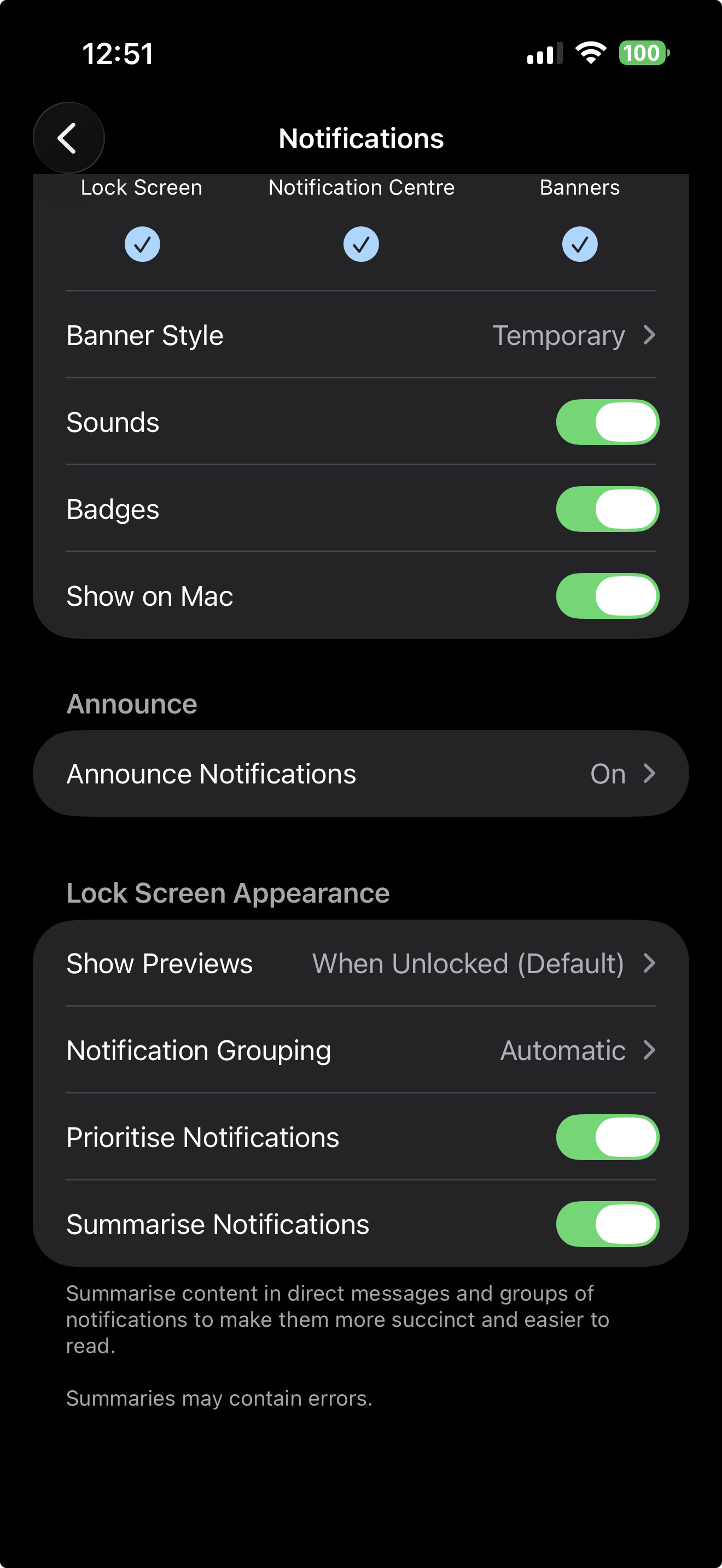
Settings > Notifications > Notification Content > Show: "Name Only" or "No Name or Content"

I've had this enabled to prevent sensitive messages from appearing in full whilst showing someone something on my phone, but I guess this is an added benefit as well.

nickburns 7 hours ago||
Just to clarify, this is within the Signal app settings—not the OS (iOS or Android) system settings.

Critical distinction, as merely changing OS notification settings will simply prevent notification content from being displayed on-screen.

hammock 6 hours ago|||
Wait so if I do iOS setting notifications > never show previews it’s still caching them in the background? Unencrypted?
nickburns 6 hours ago|||
Yes. And technically, from a privacy perspective, it's even worse than that. What's additionally happening is they're still 'syncing' back to Apple servers via APNS (and to Alphabet servers via Firebase on Android)—even with notifications completely disabled, that's correct.

If the app generates them, the OS receives them. That's why the Signal app offers this setting.

gruez 6 hours ago|||
>it's even worse than that. What's additionally happening is they're still 'syncing' back to Apple servers via APNS (and to Alphabet servers via Firebase on Android)—even with notifications completely disabled, that's correct.

Source? I don't think either OS implements notification syncing between devices, it's only one way, and as others have mentioned, the actually push notification doesn't contain any message content, only an instruction for signal to fetch and decrypt the message.

pxeboot 3 hours ago|||
> I don't think either OS implements notification syncing between devices

iOS does. This is how you can receive Signal notifications on your Apple Watch and other Apple devices that don’t have the app installed.

dataflow 5 hours ago||||
> I don't think either OS implements notification syncing between devices

Can't speak for iOS and no idea if this relates to the above functionality, but Pixel lets you deduplicate notifications across Pixel devices.

schrodinger 6 hours ago||||
This sounds correct. When I implemented push notifications for an iPhone application, I remainder needing to obtain a store a separate token for each device a user has, and subscribing to a feed of revoked delivery tokens. Seemed like an interesting design intended to facilitate E2E encryption for push notifications.
jerlam 3 hours ago|||
I do wonder how notifications that are synced/mirrored to the Apple Watch and newer versions of Mac are handled.
aftbit 5 hours ago||||
Wait... why does Signal need to send notification content to Firebase to trigger a push notification on device? I would instead expect that Signal would send a push to my Android saying nothing more than "wake up, you've got a message in convo XYZ", then the app would take over and handle the rest of it locally.

I also didn't realize that Android stores message history even after I've replied or swiped them away. That's nuts - why!?

llacane 5 hours ago|||
Signal does NOT send notification content througth APN/Firebase, their push notification is literaly a ping as you expected.

Source: https://mastodon.world@Mer__edith/111563866152334347 (Meredith Whittaker is the current CEO of Signal)

I can't link you rigth now to the actual code on their repo but it is verifiable.

baby 5 hours ago||
Btw I clicked your mastodon link and it didnt work
opan 5 hours ago||
https://mastodon.world/@mer__edith/111563866152334347
satvikpendem 5 hours ago||||
If your app needs to send a notification while it's not currently a running process, it must go through Firebase on Google's side and APNS on Apple's side. There is no way for a non running app to send a notification entirely locally, this is by design of both companies.
greysonp 5 hours ago|||
Signal developer here. Not entirely sure what you're saying. I'm only an Android guy, but FCM messages are certainly one trigger that can allow an app process to run, but it's not the only trigger. You can schedule system alarms, jobs, etc. And the notification does not need to be provided by the FCM message. In our case, the server just sends empty FCM messages to wake up the app, we fetch the messages ourselves from the server, decrypt them, and build the notification ourselves. No data, encrypted or otherwise, is ever put into the FCM payloads.
satvikpendem 4 hours ago||
Sure but it needs to go through Firebase regardless of the content of the notification message, I do not believe there is a way to use a third party notification service which does not depend on Firebase.
Zak 1 hour ago|||
It doesn't. The API for displaying a notification is purely local.

Receiving a ping from Firebase Cloud Messaging triggers the app to whatever it does in order to display its notification. In the case of Signal, that probably means something like fetching the user's latest messages from the server, then deciding what to show in the notification based on the user's settings, metadata, and message content.

Here's example code for using FCM to show a notification. In this case, the notification content also passes through FCM, but Signal does not do that. https://www.geeksforgeeks.org/android/how-to-push-notificati...

satvikpendem 47 minutes ago||
Sorry I should clarify, by "it" I meant any sort of ping must go through Firebase Cloud Messaging, not that the message content itself goes through Firebase.

Looks like there is a way to bypass Firebase by using something like UnifiedPush which runs a perpetual background process that acts similar to Google Play Services to pick up notifications from the server and calls the local notification API.

Zak 19 minutes ago||
It's theoretically possible to just keep an app running in the background all the time and periodically poll a server.

That's unreliable though since some OEM Android builds will kill it for that even if the user disables battery optimizations. Those OEMs sort of have a point; if lots of apps did that it would drain the battery fast.

satvikpendem 15 minutes ago||
Then that's basically what I said right? That there is in practice no way to opt out of using Firebase if you want consistent notifications.
eptcyka 2 hours ago||||
When running Signal without google play services, Signal reliably received push notifications and with minimal battery drain.
gertop 2 hours ago|||
Any application can send notifications without going through a server.
vlovich123 5 hours ago||||
> this is by design of both companies.

I’ll note that whatever other reasons it’s also the only way to make this battery efficient. Having a bunch of different TCP connections signaling events at random times is not what you want.

Ideally the app also is responsible for rendering rather than having to disclose the message but that can be challenging to accomplish for all sorts of reasons).

9dev 5 hours ago||||
> […] this is by design of both companies.

This is more of a fundamental technical limitation of operating systems and networks; I don't think it is possible to design distributed communication between arbitrary service provider infrastructure and end-user devices without an always-online intermediary reachable from anywhere (a bouncer, in IRC terms) that accepts messages for non-present consumers.

satvikpendem 5 hours ago||
Yes, however the fact that it is not customizable is what is annoying, you are forced to rely only on the OS makers' implementations, which I guess should be expected in the day and age.
fn-mote 2 hours ago||
It sounds like you’re hinting at being unhappy with the lock-in forced by the ecosystem.

The flip side of the coin: any possibly avenue to exfiltrate data and do (advertising) tracking by app developers will be used. The restrictions also protect my privacy.

And my phone battery.

satvikpendem 2 hours ago||
Clearly they don't protect your privacy as evidenced by the post we're commenting on.
OptionOfT 5 hours ago|||
But there is a way to do this encrypted, so that when the notification is received on your iPhone, the process itself needs to decrypt it.

Except you need an entitlement for that, because it requires that your app has the ability to receive a notification without actually showing it (Apple checks this).

Your app gets woken up, decrypts the message, and then shows a local notification.

izacus 42 minutes ago|||
Android doesn't store message history unless you explicitly enable that feature and neither does Signal send message content to Firebase.

You're angry about a huge amount of outright misinformation here.

tayk47999 5 hours ago||||
Any idea if this works the same or differently for Hidden apps specifically?

Normally no notifications are shown for hidden apps, and even if you unhide the apps, prior notifications which were sent do not reappear IIRC. I'm curious if notifications like that are still hitting the phone into the notifications database, or get silently dropped, or something else.

kmbfjr 6 hours ago|||
With notifications disabled APNS push notifications fail for the sending app backend. The device id is rendered invalid if push notifications are disabled at any point. Backends are supposed to handle this and quit sending messages.

Signal has this setting to tell the backend how much information to put into the push message. It can tell the backend to send a simple notification saying “new message” and not send information through APNS or enable it.

I am willing to bet Signal has a notification extension to handle edge cases where there is lag in settings to scrub the message metadata before it dings a screen alert.

namdnay 6 hours ago|||
yes, since apple doesn't control the content of the pushes it is sent by application backends. that can only be controlled within each app
JumpCrisscross 7 hours ago||||
Signal should switch the default to being less verbose.
avidiax 3 hours ago|||
They should also signal your counterparty's security posture.

Basically, give you a heads up that the other side has settings that make the system less secure.

Terr_ 2 hours ago||
I'd prefer the receiving end looks at sender's metadata on the message, and uses that to determine where the line is between recipient-convenience and betrayal.

I suppose you could do both, but "Hey I've got something extra important to send you, but it says need to change your settings first please hurry" seems worse than "sometimes I don't get full notifications on my watch, weird."

nickburns 6 hours ago||||
The default should be "No name or content".
JumpCrisscross 5 hours ago||
Name only strikes me as a fairer compromise between security and usability.
loeg 5 hours ago||
I thought name-only was the default.
JumpCrisscross 5 hours ago||
> I thought name-only was the default

At least for me, it was name and content.

loeg 4 hours ago||
I may be misremembering, or it may have changed; I've been using Signal from the early days.
iknowstuff 4 hours ago||||
Not really, that would discourage use by normies.
fragmede 6 hours ago|||
users should switch to simpleX
wodenokoto 4 hours ago|||
When you put it up against each other it makes perfect sense, but I would never have thought about it in that way!

Thank you for adding this to the conversation.

jhalstead 7 hours ago|||
Fwiw, in my Signal app on Android this setting is in

Settings > Notifications > Messages > Show

wolvoleo 7 hours ago||
My Samsung also keeps a history of notification content. Under Settings->Notifications ->Advanced -> Notification History
tialaramex 6 hours ago||
However, if this is important to you then you want Signal to stop telling Android to make the notifications. If it doesn't exist nobody will accidentally make it available.

Deleting that history is good to know about after the fact, but preferably lets just not create the problem.

wolvoleo 1 hour ago||
I need the notifications though.

But you can set them without content. That actually works with signal because all it sends through Google Firebase is a notification to wake up the app. If you have the content turned on the app basically fills the content in the notification locally. But you can turn that off.

kwanbix 2 hours ago|||
I allway say it: it is the defaults, stupid (paraphrasign).

The Defaults have to be the most sensitive ones.

If you are a supposed super secure app, this should be the default.

cdrnsf 6 hours ago|||
Disable Apple Intelligence summaries for sensitive app notifications too.
huxley 6 hours ago||
Given the quality of the summaries, you might want to keep them just for plausible deniability </s>
embedding-shape 7 hours ago|||
I guess enabling Lockdown mode might avoid this particular issue too, together with a bunch of other stuff?
everdrive 7 hours ago||
Why would lockdown mode prevent this? I have lockdown mode on but that doesn't automatically make my notifications private.
rustyhancock 6 hours ago|||
Lockdown mode would prevent access to the data in theory.

But most likely (pure speculation mind you), this was a case of someone handing over the phone for review and where cooperating.

It might have been that they deleted signal some time ago, or even deleted signal and then handed over the phone.

It's notable that the data wasn't recovered from signals storage (was the data securely erased or that kind of recovery not attempted?).

embedding-shape 6 hours ago||||
It's a mode of the phone that is supposed to prevent cyber attacks, more so than "normal mode" I suppose, since it's supposed to limit features in the name of security. This seems like a variant of such attack, so seems like it should protect against it
jonpalmisc 6 hours ago||
There is a documented list of things that Lockdown Mode affects [1], this is not one of the advertised ones. There are a bunch of other (undocumented) things it affects (some of which are bugs :/), but I don't believe it has any affect on notification storage.

[1] https://support.apple.com/en-us/105120

normie3000 6 hours ago||
Mostly it seems the documentation is vague. Is there anything clearer than this?

> Web browsing: Certain complex web technologies are blocked, which might cause some websites to load more slowly or not operate correctly. In addition, web fonts might not be displayed, and images might be replaced with a missing image icon.

giancarlostoro 7 hours ago|||
Maybe it should.
SwtCyber 3 hours ago|||
Originally enabled it just to avoid awkward moments
echelon_musk 4 hours ago|||
WhatsApp supports this too.

Settings > Notifications > Show preview

Night_Thastus 4 hours ago||
This seems to be the default for me, at least on Android.
izacus 4 hours ago||
Android also supports custom encrypted payloads so Signal doesn't have to give them to Google.
pigggg 5 hours ago||
Just curious, how come at least once a month signal bugs me to turn on notifications? I said no for a reason, every single time - why does it keep asking?

Not implying anything evil but it feels a bit weird esp after this.

greysonp 5 hours ago||
Signal developer here. It's just because notification reliability is always a top support complaint, and a lot of people turn off notifications and don't realize they've done so. Admittedly, once a month is likely too aggressive.
dataflow 5 hours ago|||
How about instead of prompting to enable notifications, you leave a small banner or other unintrusive/non-annoying UI noting that they're off, which users can tap in order to learn more about how to reenable them?

For an app that prides itself on privacy, it's kind of crazy that you're making it so easy to accidentally blow it.

illiac786 4 hours ago||
That would drive me nuts. I do not want a banner permanently on I cannot remove.

And before someone suggests it: If the banner can be removed, you’re back to having lots of complaints for users that did not realise they turned off notifications.

pigggg 5 hours ago||||
Is there some "no means no" additional setting that could be added where someone has to go into settings that would prevent that?

I fear that with the notifications pop up asking me this I might hit the wrong button and woops turn it on.

NAR8789 3 hours ago||
Try from inside the signal app itself instead of system settings? On android Signal has an option at hamburger menu > Settings > Notifications > Notifications (toggle switch)

Oh... hmm, two toggles actually. One at Settings > Notifications > Calls > Notifications toggle, and the other at Settings > Notifications > Messages > Notifications toggle

jacquesm 2 hours ago||||
Any time after a user switches it off on purpose is too aggressive.
elevation 4 hours ago||||
> notification reliability is always a top support complaint

I know octogenarians who use signal daily. "You called me and it didn't ring" or "messaged and it didn't beep" are definitely the top support complaints I receive. Thanks for being sensitive to this use case.

peacebeard 4 hours ago|||
Making the product worse for everybody because a minority can’t manage their own settings is a terrible strategy.
cbg0 4 hours ago||
Do most people keep the notifications disabled for their messaging apps?
pigggg 4 hours ago|||
It's just a mental compartmentalization thing for me. When I want to get into slack/signal chatting mode or read messages I load such an app and look/interact. When I'm not doing that I don't want to be bothered with messages. I'm already sacrificing a portion of my life to work related tasks and being in front of a computer at many hours, when I'm not in that mode I don't want to be interrupted - people who need to reach me in an emergency have other ways to get ahold of me.
pastel8739 3 hours ago||
But maybe _you_ are the minority
peacebeard 2 hours ago||||
Personally, I have multiple messaging apps. I have notifications on for work slack, which is high signal, and I have notifications off for personal discord which is noisy and low priority.
tristor 4 hours ago|||
I disable notifications on every app that is not on the critical path to me earning a living. Notifications are largely unnecessary. Either you are actively engaged with something, in which case you didn't need the notification, or you are doing something else and don't need the distraction, in which case you didn't need the notification. Only my employer gets a right to demand my time during work hours, which is why notifications are enabled during work hours for work apps.

We as a society have gotten way too comfortable expecting every single person to be available at all times to provide us some kind of immediate response. Let people live. If I'm hiking through the woods with my camera doing bird photography, even if you're my best friend you can wait until I get back to my car and manually check my messages, I don't need a notification. If it's an emergency, dial my number and call me, which will make my phone ring. Novel concept, I know.

sneak 3 hours ago||
Signal notifications are the #1 thing in the critical path for me earning a living. Isn’t this normal in our industry?
tristor 2 hours ago|||
Okay, well you should probably have them enabled then. For me, Signal is for personal messaging. My work messages are mostly Slack, Webex, and Teams.
fwip 2 hours ago|||
Nope.
ryandrake 5 hours ago|||
> why does it keep asking?

Why does any software keep asking you to do things you explicitly told them you don't want to do? Because it's in the software developer's best interest to get you to do them, not yours. We've gotten way past the point in software where we no longer expect the software to serve the user's interest and solve the user's problems. Now, the expectation is that the user gets nagged and coerced into serving the software's interest and solving the developers' problems.

EDIT: Looks like a developer confirmed this in a sibling comment already: It nags you because that solves their support problem.

greysonp 5 hours ago|||
We build Signal for everyone, and that includes a lot of people who are not as technologically literate as the average tech worker. For a lot of people, they don't even know they dismissed the notification permission prompt, they were just closing boxes. For them, the reminder is helpful and prevents them from experiencing missing notifications. Striking a balance between helping these people and annoying more technologically-literate users is very difficult, with compromises everywhere. We're just trying to make sure Signal works for people, nothing more.
zarzavat 4 hours ago|||
Ask frequently but add a "don't ask again" option. Then everyone is happy.
iknowstuff 2 hours ago||
Not really. A portion of users will randomly tap that just to get rid of the question. They don’t read.

The easiest way to experience that yourself is to set your device to a language you barely understand. You’ll find yourself dismissing dialogs just like all those illiterate normies.

some_furry 4 hours ago||||
Can you add a "tech-savvy user" mode, off-by-default, that opts out of these sort of reminders?

I think we're capable of finding it ourselves if you do.

snhjsdrhrsh 4 hours ago||||
[flagged]
ryandrake 4 hours ago|||
Thanks for the reply. I know it feels noble to do it that way, and I admit I get dogmatic over this one principle: a computer should first and foremost obey the user. It shouldn't have its own agenda. It shouldn't second guess. It shouldn't "did you mean?" I command the computer, and the computer executes that command and then waits for the next command. If I command it to not display a particular output (notifications), then I expect it to never display them, full stop.

I don't see my computers as partners or helpful assistants or eager interns. I see them as tools for reliably performing computation, and I expect them to operate that way.

I fully understand that this means that fewer and fewer developers are "building their software for me" and I find that pretty disappointing.

shooly 2 hours ago|||
I'm sure everyone loves it when they accidentally press "Delete", and the app instantly deletes a thing forever without showing any confirmation dialog. After all, if the computer asked you to confirm it, it would mean it disobeyed your direct order!

HN truly never fails to make me laugh when it comes to discussing user experience.

dwb 30 minutes ago||||
I broadly sympathise, being a nerd myself also, but this just isn’t a way to build software for a general audience.
azinman2 4 hours ago|||
Have you ever built and distributed communications software? This is a very common problem.
alwa 4 hours ago||||
“Their support problem” is a regular person’s problem getting the software to work how they want. That frustrated them enough to complain about.

I don’t follow how it’s necessarily selfish for the developer to reduce that.

There certainly are selfish ways to reduce support load, like making it harder to ask for help at all. But this way seems like the right way: listen to users’ problems and act to avoid them.

If your remedy causes more pain and frustration than the status quo, you’ll end up with more support load, not less.

Sure it’s greyer when the developer’s trying to sell something, but what does Signal gain from pushing notifications on users?

This seems to be about making the software humane and forgiving—meeting users where they are, not tricking them into something they don’t want.

krunck 5 hours ago||||
The Proton Drive app keeps asking me to turn on backups of photos and video. There is no option to say "don't ask again."

I guess they /want/ more storage to be used? Or is there a support issue they are trying to deal with?

alpaca128 5 hours ago|||
They probably want to avoid situations where a customer turns off backups, then loses data and makes it the problem of support.

But it would be nice to have a "don't ask again" option regardless, even if it's hidden in settings.

pigggg 5 hours ago||||
Yes Google constantly asks me to backup my pictures to their platform No, I don't want this. But regularly when I go to my photos it'll pop up with a box asking and the default option is yes please back up. Sad.
ryandrake 5 hours ago|||
"Consent" has become this mystical foreign concept to software developers. If the world of computing was a night club, "Silicon Valley" would be that creepy guy who goes up to everyone asking "Do you want to dance? [YES | Ask Me Later]".
ethanrutherford 4 hours ago|||
It's pretty shortsighted, bordering on intentionally obtuse, to insinuate that the only person that benefits from solving the support problem is the person on support.. Take the example of automatic backups others brought up in this thread. Are you really going to imply that there's zero benefit to the person who didn't lose their data because the app reminded them to turn backups on? I don't disagree that it could be improved with a simple "don't ask me again" style setting, but that doesn't change the fact that every time someone doesn't issue a support ticket, it's because they didn't run into an issue. Any effective solution to a support problem is mutually beneficial for the user as well as the support staff.
Forgeties79 3 hours ago||
If a person says “no” to a prompt multiple times then either they aren’t reading it and never will or they definitely know they are not interested and at some point it needs to stop.

At some point it is just not beneficial anymore.

mackman 5 hours ago|||
Messaging platforms where people receive and promptly respond to messages are more successful in the long run. That's why SMS overtook email. If you own a messaging platform there isn't anything inherently nefarious about pushing people to enable notifications.
Forgeties79 5 hours ago||
There is if they have repeatedly said no
snhjsdrhrsh 4 hours ago||
imagine someone shows up to your door and tries to sell you garbage. you ask him to leave and he says he'll show up again soon. and these idiots defend this behavior. at the end of the day, the people on this site are muppets, they just dont like facebook is all.
shooly 2 hours ago|||
Does Signal magically show up on people's phones and open itself at random point in time? I have a suspicion, that you might not be too good at this whole "making analogies" thing.
Forgeties79 4 hours ago|||
What I don’t understand is why anyone can’t imagine scenarios where folks don’t want to turn on notifications. Also, why on a site where all I ever read is “users should be allowed to choose, users should be allowed to control their computers, users should have their consent respected,” etc. (especially when Linux comes up) are we seeing “no, users should keep getting nagged to turn on a feature they explicitly said they don’t want to use”? It’s not like it’s hard to go enable notifications. They can easily change their mind.
SwtCyber 3 hours ago|||
Pretty sure that's just iOS behavior + app design. If notifications are off, apps will occasionally prompt again to make sure you didn't disable them by accident or miss something
jshier 1 hour ago||
No, the OS will not do that, nor is the developer able to trigger the system prompt again when they detect the user has notifications off. Only thing they can do is present their own prompt and link out to the Settings app for the app's settings. Can't even deep link to the app's notification settings.
benhurmarcel 5 hours ago|||
Reminds me what Whatsapp if you set up a 2FA PIN, which forces you to type it about every week to check if you forgot it. So annoying.
fn-mote 2 hours ago||
Sorry, I really cannot tell if this is sarcasm or not.

One of the TOTP apps had a periodic test that you still knew the paraphrase. It started frequent and then backed off to like once a month. There’s definitely a benefit even if it’s annoying.

OutOfHere 1 hour ago||
It depends on whether one has it stored in a password manager or not. If stored, there is no benfit. Giving users a choice would be better.
johnnyApplePRNG 5 hours ago||
NSL, perhaps?
chasil 8 hours ago||
First, a critical setting for Signal users:

"Signal’s settings include an option that prevents the actual message content from being previewed in notifications. However, it appears the defendant did not have that setting enabled, which, in turn, seemingly allowed the system to store the content in the database."

Second, how can I see this notification history?

alin23 7 hours ago||
Not sure if it's exactly the same, but I had to add a When notification arrives with <message>, do <action> event trigger in my Crank macOS app (https://lowtechguys.com/crank) so I can show you how to do it on macOS:

      HOURS=6
      EPOCH_DIFF=978307200
      SINCE=$(echo "$(date +%s) - $EPOCH_DIFF - $HOURS * 3600" | bc)

      sqlite3 ~/Library/Group\ Containers/group.com.apple.usernoted/db2/db \
        "SELECT r.delivered_date, COALESCE(a.identifier, 'unknown'), hex(r.data)
        FROM record r
        LEFT JOIN app a ON r.app_id = a.app_id
        WHERE r.delivered_date > $SINCE
        ORDER BY r.delivered_date ASC;" \
      | while IFS='|' read -r cfdate bundle hexdata; do
          date -r $(echo "$cfdate + $EPOCH_DIFF" | bc | cut -d. -f1) '+%Y-%m-%d %H:%M:%S'
          echo "  app: $bundle"
          echo "$hexdata" | xxd -r -p > /tmp/notif.plist
          plutil -p /tmp/notif.plist 2>/dev/null \
            | grep -E '"(titl|title|subt|subtitle|body|message)"' \
            | sed 's/^  */  /'
          echo "---"
      done
Basically, notifications are in an sqlite db at ~/Library/Group Containers/group.com.apple.usernoted/db2/db and are stored as plist blobs.

In recent years, filesystem paths for system services have started to converge for both macOS and iOS so I'm thinking with jailbreak you could get read access to that database and get the same data out of it.

627467 7 hours ago|||
On android there are apps that let you see the history - i use NotiStar occasionally to see if i unwittingly dismissed important notifications. And i believe there are apps/settings that help you clear the history from the device.

But this is a reminder that these centralized notification infrastructure (FCM and APNs) store notification content (if the app is told to send content in it - signal with option enabled wouldn't send content) even if we clear local history these middleman still hold it

chasil 7 hours ago||
On Lineage Android, i see: Settings / Notifications / Notification History.

If you drop a settings widget on your home screen, it will let you choose a specific area, including notifications.

I don't know if the output is the complete database.

commandersaki 5 hours ago|||
So I wonder about this. The quote from the 404 media article [0] is:

“We learned that specifically on iPhones, if one’s settings in the Signal app allow for message notifications and previews to show up on the lock screen, [then] the iPhone will internally store those notifications/message previews in the internal memory of the device,” a supporter of the defendants who was taking notes during the trial told 404 Media

The default setting appears to be to only show notification preview when unlocked. Will that notification still be stored unencrypted in notification storage or is it in an encrypted store because it will preview after unlock?

It makes sense that any notification that previews on the lock screen would be unencrypted (including the case where it is encrypted but the encryption key is adjacently stored).

This all reads to me that this was a user induced OPSEC issue and Signal had the right defaults.

[0] https://archive.is/bSQhD#selection-619.0-622.0

sillysaurusx 3 hours ago||
I think that’s a little nutty. People go to signal for secure messaging. That’s their entire brand. An insecure by default setting is the wrong setting, even if it nets them a lot of tech illiterate users. Compromising the security of the system defeats the entire point of using Signal instead of some other messenger.

By this logic, you, me, and everyone else using the defaults are using bad opsec. Doesn’t that strike you as problematic?

commandersaki 52 minutes ago|||
I posted this elsewhere and I said this in my post, but the default setting is actually not the insecure one: https://files.catbox.moe/3gwjoy.png (supposing that previews are stored encrypted when locked which is what the 404media passage implies and nothing to say to the contrary).

This user went out of their way to show previews on the lock screen, that is an OPSEC failure, even if you do not consider the acquisition of the messages digitally.

amazingman 2 hours ago|||
"Security" is not a binary, but a spectrum along which there are various tradeoffs. The vendor attempts to select the best configuration for its average/median user, and that's almost by definition not going to be the most secure configuration (see: tradeoffs).

I do think there should be some UI somewhere that allows for locking all things down to the most secure configuration possible.

jhalstead 7 hours ago|||
On a Pixel, I can see some history by going to

Android > Settings > Notifications > Manage > Notification History

arvid-lind 5 hours ago|||
Wasn't sure if it was the Pixel or GrapheneOS, but what a relief to actually be covered in one of these weird 0day issues.

Unrelated to the OP, but I bet the thousands of "exploits" that Claude Mythos has identified already are a lot of these kind of things that regular people would never think about.

seb1204 6 hours ago|||
Yes, mine (the history option) is turned off. Nice opt in implementation.
nashashmi 6 hours ago|||
On android its quite easy. There is a page of a protocol address that has all notifications show. I used to have a shortcut to it. It has been years since I was on android.

But it was really useful each time I did not see a notification in time.

Edit: typo

tsimionescu 6 hours ago||
> I used to have a seizure to it.

Hopefully, you meant to write "shortcut"...

nashashmi 5 hours ago||
Yes! Thanks.
SwtCyber 3 hours ago|||
You don't, at least not without forensics tools
benhurmarcel 5 hours ago||
I wonder how long does the system store those notifications
blitzar 7 hours ago||
> testimony in a recent trial

Court cases are the real way to audit security.

Larping about security and complaining about companies responding to court orders only gets you so far. Its way more useful to look at what actually happens in reality.

tclancy 5 hours ago||
I know it’s not germane to the Signal issue, but this caught my eye, “who previously pleaded guilty to providing material support to terrorists”.

The case comes with a long statement about the Antifa “organization”. Just your weekly reminder we are living under an Orwellian administration. https://www.justice.gov/opa/pr/antifa-cell-members-convicted...

bronco21016 5 hours ago|||
Yes and no. Court cases certainly will disclose what capabilities various parties have come up with when it comes to security. However, there are documented cases where the government chooses to abandon prosecution for the sole purpose of preventing disclosure of some of their cyber capabilities.
SwtCyber 3 hours ago|||
True, court cases are one of the few times details actually surface
tbrownaw 7 hours ago|||
The recent Trivy / LiteLLM mess was also a security thing, and seems rather different.
jMyles 5 hours ago||
The problem is that, in the current environment of dishonest and corrupt states, "what actually happens in reality" isn't the same as what happens in court because of parallel construction.
1vuio0pswjnm7 5 hours ago||
"However, it appears the defendant did not have that setting enabled, which, in turn, seemingly allowed the system to store the content in the database."

"[A]llowing the system to store the content in the database" where a third party, such as Apple or a government, can access it is the default

Only a small minority of users know about settings and how to change them. The vast majority of users do not change default settings. Apple knows this

rsync 4 hours ago||
“Only a small minority of users know about settings and how to change them. The vast majority of users do not change default settings.”

Even worse, whatever critical settings you may set as a sophisticated user will frequently be reset, or changed, or re-organized under different settings… And of course, set back to insecure defaults… With subsequent software updates.

This is a regular occurrence with Firefox and privacy settings.

Whatever the actual impetus is, we should act as if this is intentional.

nine_k 5 hours ago|||
If you care about security at all, you disable any previews on the lock screen. The lock screen is by definition visible to anyone without any authorization. Showing anything on it immediately destroys any secrecy. It must be obvious to anyone capable of elementary logic inference.

If you don't know how to disable it, you use your favorite search engine / LLM / knowledgeable relative to find out, and disable it.

But if you just didn't pay attention, "never thought about it", you don't care about security, and no amount of technical means would help, sorry.

loeg 5 hours ago|||
> If you care about security at all, you disable any previews on the lock screen. The lock screen is by definition visible to anyone without any authorization. Showing anything on it immediately destroys any secrecy. It must be obvious to anyone capable of elementary logic inference.

With at least one combination of settings, it shows the message content only when the lockscreen has been unlocked, but not yet swiped away.

nine_k 4 hours ago||
This is insidious indeed. Still I would suggest that any secret message, as it leaves the app that handles secrecy, ceases to be secret. This BTW also applies to copy-paste operations, screen readers, etc.
gertop 2 hours ago|||
Disabling notification preview in the operating system settings doesn't prevent the issue, they're still saved in the database.

The only way they're not saved is to disable name/content in signal itself.

Maybe you're not as capable of elementary logical inference as you thought?

nine_k 59 minutes ago||
Disabling may be not sufficient (which is pretty insidious), but I still posit that enabling message preview is guaranteed secrecy loss.

But indeed, the idea that disabled notifications are still stored, and not directed to /dev/null immediately, cannot be inferred from just observing the behavior of the phone UI.

1vuio0pswjnm7 2 hours ago|||
Imagine a parallel universe where stories about use of personal computers were written from a different perspective. For example,

"However, it appears Apple's system uses a default setting which, in turn, seemingly allowed it to store the defandant's content in Apple's database"

instead of

"However, it appears the defendant did not have that setting enabled which, in turn, seemingly allowed the system to stoire the content in the database"

In the later version, the defendant, namely his inaction in not changing a default setting, appears solely responsible for the outcome. And the actor that placed a copy of his incoming messages in a database that the actor created is referred to as "the system", not the corporation that wrote the system and sold the computer with this system pre-instaalled

esseph 5 hours ago||
> Only a small minority of users know about settings and how to change them.

I couldn't believe this so went to look up some data on this.

Holy FUCK that is bleak. There needs to be way more computer education, not just "how2type" classes.

sillysaurusx 3 hours ago||
Unfortunately, users don’t want to learn. They want the app to do what they want. Anything involving learning is likely to get an instant “screw this” reaction. Seen it firsthand many times, and always found it mystifying.
shooly 2 hours ago||
Maybe if you consider the idea, that other people might have different interests than you, you'll find it a bit less mystifying.
sillysaurusx 2 hours ago||
Mind reading the rules and leaving more substantive comments? Ideally ones with less “you”s.

Obviously the cause is different interests. Different interests can explain everything from a bad decision to going to sleep early. It says nothing useful.

AlBugdy 2 hours ago||
So Signal is sending the notifications through Apple's ecosystem somehow, presumably to save battery life by not having a persistent connection to Signal's servers? That's what I think happens on Android, too. When I had Lineage years ago, I had a persistent connection to Signal as the notifications didn't come through Google. Unfortunately there was a persistent notification for the persistent connection with no way to remove it.

After these news Signal should ask the users ASAP and on new installs something like:

> Do you want the notifications to pass through Apple (no privacy, better battery) or through Signal itself (better privacy, but less battery life due to the persistent connection to Signal's servers.

It should be as part of the setup wizard, not inside the settings.

Correct me if I've misunderstood something.

svpk 1 hour ago||
In my recollection, which may be imperfect:

1. On android if Google Play isn't available (or you install the no Google apk version) it'll use a websocket for notifications. Apple doesn't allow a persistent connection except through their own notification framework.

2. In either case Signal doesn't send message contents through the notification framework (not even encrypted). Once Signal receives a notification the app wakes up and reaches out to the signal service directly for actual encrypted message.

3. Regardless when signal shows the contents of your message in the notification menu of your device your device keeps a record on your device of that message content.

The FBI here didn't get anything from apple, once they had the apple device unlocked they looked at the notification database on the device to get the message contents. This isn't really any different from the fact that if the FBI has your unlocked phone they can read your signal messages. The notable bit is that the notification database retains messages even after the app is deleted.

AlBugdy 34 minutes ago|||
> Apple doesn't allow a persistent connection except through their own notification framework.

How can iOS not allow persistent connections at all? How would a long download work or a call in the background work at all?

> Regardless when signal shows the contents of your message in the notification menu of your device your device keeps a record on your device of that message content.

How is that not treated as a backdoor unless it's explicitly mentioned when someone installs iOS?

0xR1CK 1 hour ago|||
" if the ___ has your unlocked phone they can read your signal messages. "

It's worth noting you can add an additional security check pin/bio/pass to signal that is different from your phone unlock.

The protester had also uninstalled signal from phone (even with access to the phone, they would not have access to signal, if they had reinstalled signal, and some how got the security pin or passphrase, they wouldn't be able to load the prior messages, without either, no messages at all).

jshier 1 hour ago||
There is no other way to send push notifications on iOS, you have to use APNS. When the app is active you can switch to your own local socket connection, but as soon as it goes into the background those connections are lost. Pushes can also start the app in the background if it hasn't been used in a while and has been evicted by the OS.

You can send push notifications with your own encryption on top, which I believe Signal does, so Apple can't see it on the APNS side, but your local extension to decrypt the content is still subject to the user's settings, and part of the notification history if you put message content in the notification.

alsetmusic 7 hours ago||
Original article: FBI Extracts Suspect’s Deleted Signal Messages Saved in iPhone Notification Database[0]

0. https://www.404media.co/fbi-extracts-suspects-deleted-signal...

tbrownaw 7 hours ago|
That's unfortunately less informative if you aren't already one of their subscribers.
gabeio 6 hours ago|||
https://archive.is/bSQhD You can view their link here.
niek_pas 7 hours ago||
I wonder why Apple doesn't 'just' delete the notification data associated with the app from the internal database when the user deletes the app? It seems like asking for problems to just keep old notification content around forever.
alsetmusic 7 hours ago||
It's one of those problems where as soon as someone notices, it's crazy that no one noticed. I can't imagine this not being overhauled going forward. It's just a bad way to operate and now it's news.
bigyabai 4 hours ago||
> I can't imagine this not being overhauled going forward.

On which end, Apple or Signal? Because neither Apple nor Google will overhaul this behavior, the FBI asked for it directly: https://arstechnica.com/tech-policy/2023/12/apple-admits-to-...

ikmckenz 3 hours ago||
This is different than push data, which already does not contain any content or metadata in Signal. This is about local OS caches, whereas for push notifications Signal only sends a push saying “message received” which wakes the device up and triggers the device to pull the message from the server over the regular e2e encrypted path.
gumby271 3 hours ago|||
I think that's how the Android notification history works. If I uninstall an app, the entries in the history aren't shown anymore. You also have to opt in to notification history and toggling it off and back on clears the old entries. There's also a time window that it keeps entries for: https://source.android.com/docs/core/display/notification-hi...
rustyhancock 6 hours ago|||
If it never hits flash that might work, but if it's in flash storage then the block may not be erased by the time its dumped.

I'm not sure precisely how the NAND controller responds to requests for raw data from blocks with "deleted" data. And if this would require decapping the flash.

Some flash will happily let you see the data and delay erasing it.

Generally flash is non deterministic about when blocks even those with entirely stale data are erased . It might be years before the block is reused due to wear leveling algorithms and it might retain data that entire time.

Here's hoping the controller for phones which hold sensitive data are more active

gruez 6 hours ago||
If the "database" works like most other databases (eg. postgres or sqlite), deleting a row doesn't immediately cause the data to be wiped from disk, for performance reasons. Then as others mentioned you have filesystem/SSD logic that does something similar on top of that.
btown 4 hours ago||
But you can do other things to mitigate this. For instance, give each app a set of rolling daily encryption keys, and encrypt new messages at rest. Remove the app, remove all keys. Nightly, remove the oldest key. Perhaps have the entire key database either stored in Secure Enclave, or if there isn't room, have the key database itself encrypted by a rotating single key in Secure Enclave. Now there's nothing that an attacker can do.
6thbit 6 hours ago|
So this is where we find out the one end of e2e is the phone and not the app.

Semi-related, in whatsapp reading the text in the notification doesn't mark the message as read, so the OS is kinda mitm here.

zenoprax 6 hours ago|
Signal creates the notification, does it not? That's like claiming `echo "my_private_data" | notify-send` is insecure.

If piping encrypted content resulted in a plaintext notification then you'd have a right to be concerned.

coldtea 4 hours ago|||
What prevents the phone from taking screenshots of you reading the messages in the app?

The actual one end is the phone, not the app, period.
6thbit 2 hours ago|||
Exactly yes, and that is insecure here because the app relayed the message beyond its layer and ownership. Thus not making the app the end of the communication.
More comments...