Posted by ofrzeta 9 hours ago
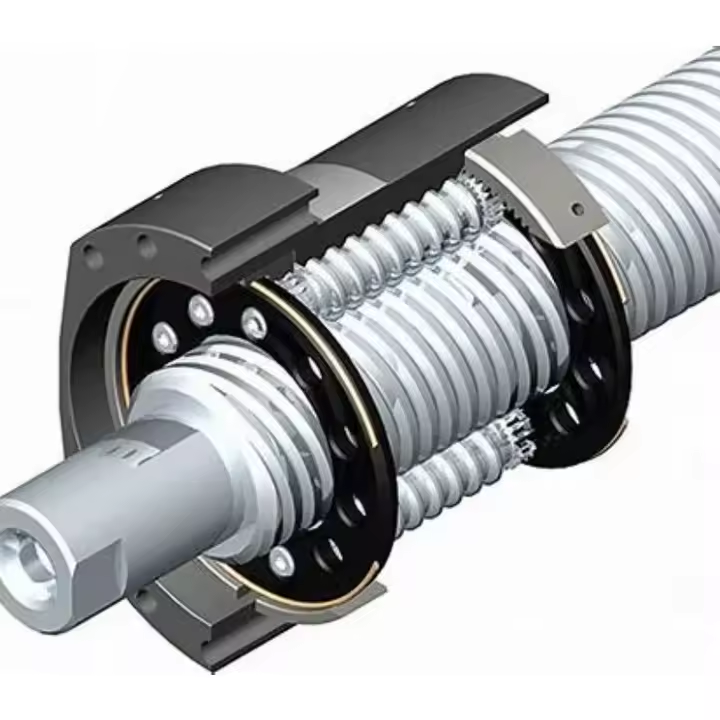
Many figures seem to be either missing key information (e.g. Fig. 5: the elliptical deformation is not shown - a human artist would have created a very different figure to explain the concept) or plain wrong (Fig. 6: the threaded rollers have the wrong orientation, Fig. 7: the ball is much too large for the bearing and the whole figure seems nonsensical at first glance).
And if the author did not spot these obvious problems with the figures, they either have no clue, accept sloppy work, or didn't even read the article they generated. That article is not really good advertising for the company's products.
(That the link behind the author's name leads to their Wikipedia article which seems to be a revised copy of the CV on their website is interesting, too.)
Here's an actual schematic: https://ae-pic-a1.aliexpress-media.com/kf/Sd3fe9841e4ed4871b...
Why these screws are used instead of just threads? Because rolling friction is lower than sliding friction. You can use less or more of them trading friction for shock resistance.
It should be fairly straightforward to control dynamically so you can use pretty much any motor and gearbox.
Put the robot on rollerskates break the wheels for the occasional stair.
Also: something every human actually kind of knows. You need to take impacts on muscles, not on mechanical connections. Even if we had the actuators required, you also need perfect control. The only way actuators can work this well is if they properly predict the impacts so that the power of the motor ("the magnetic field") can absorb nearly all the impact. If you try to take the impacts even on human bones (that are very solid and self-repairing) they will break surprisingly quickly.
My opinion is that the need for high reduction is only because we can't have high voltage on the motors. If we either had very small distances between the magnets and electrical wires (think micrometers), or we have voltages in the 100s to 1000s of volts, we don't have to make this poisoned choice. (in a way, VERY small distances between magnets and wires is how human and animal muscles do it. But they go all the way down to sub-10 nanometers)