I'm telling you this to highlight that volunteers where a huge part of Mozilla.
But on the last day they announced that they were moving the day-to-day conversations from IRC (an open protocol) to Yahoo Messenger (a closed protocol). I felt sort of betrayed in that moment: the company that was all about openness and to which I dedicated countless hours doing unpaid work for and even more years evangelizing for was imposing its volunteers and employees used a proprietary app to coordinate. That didn't sit well with me. At all. I basically lost interest.
This was in 2015. Last I heard MDN introduced ads (I wouldn't know, uBlock is pretty effective) and is not showing contributors to a page on the page itself anymore.
So yeah, the part of OP saying how Mozilla managed to piss volunteers resonated pretty hard with me.
Since 2007 in my case which is when I started using Linux at home. The distributions I use come with Firefox as the Web browser (Ubuntu, Debian and latterly Slackware).
I do find myself turning things off more now than I used to.
Also, I'm afraid that's not sustainable in the long run. How long before Mozilla makes a change so big to introduce some nasty feature that it becomes impossible for forks to stay up to date with upstream? Do they really have the resources necessary to maintain an actual fork and not just a customized version?
Many of Mozillas product decisions prove that the Mozilla corporation is not aligned with the interests of FLOSS. I can't donate to Firefox or Thunderbird specifically, neither at the feature or product level. There is no way to ensure my donations go to enriching these products, instead of profit generating features that benefit the Mozilla corporation. One example is the container VPN proxy, which only allows you to implement a VPN per container if you pay for Mozilla VPN. This is a feature that should be universally available to all users, and all VPN providers, but they locked it behind a paywall for profit.
The is the same (logically analogous) reason I no longer use Reddit after the API changes in 2023, after using the platform for 15 years, and has become common among newer FOSS startups like OpenAI, minio, and bambu; using the philosophy of open source &/or unpaid community labor to achieve a certain level of trust, growth, users, funding, and market saturation, only to screw them all over in the name of profit. This for-profit parasitic greed and corruption in FLOSS is the antithesis to the philosophy of the FLOSS community.
In a sane world this type of community exploitation would be criminally prosecutable. Reddit decision makers would see the inside of a prison cell; the moderators and commenters – as well as the developers who built the 3rd party apps that grew the company from nothing for over a decade – would be given shares/ownership, and paid from the company for their time and labor; same for every other scammer that exploits these "bait-and-switch" deceptive tactics to succeed in businesss. Unfortunately for us all, we live in a world ruled by parasites.
"In 2018 she received a total of $2,458,350 in compensation from Mozilla, which represents a 400% payrise since 2008. On the same period, Firefox marketshare was down 85%. When asked about her salary she stated "I learned that my pay was about an 80% discount to market. Meaning that competitive roles elsewhere were paying about 5 times as much. That's too big a discount to ask people and their families to commit to."
In 2020, after returning to the position of CEO, her salary had risen to over $3 million. In the same year the Mozilla Corporation laid off approximately 250 employees due to shrinking revenues. Baker blamed this on the Coronavirus pandemic"
https://www.jerrypournelle.com/reports/jerryp/iron.html
"Pournelle's Iron Law of Bureaucracy states that in any bureaucratic organization there will be two kinds of people:
First, there will be those who are devoted to the goals of the organization. Examples are dedicated classroom teachers in an educational bureaucracy, many of the engineers, launch technicians, and scientists at NASA, even some agricultural scientists and advisors in the former Soviet Union collective farming administration.
Secondly, there will be those dedicated to the organization itself. Examples are many of the administrators in the education system, many professors of education, many teachers' union officials, much of the NASA headquarters staff, etc.
The Iron Law states that, in every case, the second group will gain and keep control of the organization. It will write the rules and control promotions within the organization."
In the real world, in the same line as the article suggests, there was a brief time when the "puts you back in control" browser needed you to change the following about:config settings to disable the force-pushed ai:
browser.ml.enable, browser.ml.chat.enabled, browser.ml.chat.sidebar, browser.ml.chat.menu, browser.ml.chat.page, extensions.ml.enabled, browser.ml.linkPreview.enabled, browser.ml.pageAssist.enabled, browser.ml.smartAssist.enabled, browser.tabs.groups.smart.enabled, browser.tabs.groups.smart.userEnabled, pdfjs.enableAltTextModelDownload, pdfjs.enableGuessAltText
A bit of community feedback later, and we've got one big "off" button, and me wondering which footgun the executives will shoot themselves with next.
What? They didn't make these 10 distinct features one single all-or-nothing button? They let you switch them on or off individually?? How dare they?!?
What? They shipped new features to the browser...turned on?!? Instead of spending all those development hours and then...hiding them behind a setting by default?
I need "AI" in my browser, so I don't use the AI features. No data was sent anywhere. No 4 GB model was downloaded. Nothing happened, except for a popup saying "hey, by the way, if you want to do X, just press this button here". It's just UI elements. No AI-related code runs, no data is sent to AI companies unless you directly tell the browser to do that.
Imagine if Firefox shipped a brand new GPU-accelerated compositor, improved hardware video decoding and WebGL/WebGPU. You people cry about why they didn't add a big "disable GPU features" button? And that they dared to enable this by default?
The issue was they shipped AI features built into everything and the only way to switch them off was to "about:config" a bunch of settings, they shouldn't have shipped it without the off switch and "Open about:settings and then disable things manually" isn't control for the average user.
The user has the choice to not use these features. It's not like Firefox was sending data to AI companies by default. But if you want to completely make them disappear, so you can live in your fantasy world where LLMs were never invented, then yes, that's a niche personal preference and an advanced customization. That's why it goes under about:config.
Firefox usage has been declining for a decade. Doing nothing, or just doing the exact same as before, is popular with its fans (including me). But wouldn't it perhaps just have lead to an even more rapid decline?
It's obviously impossible to say, but when we look at things that did happen due to Mozilla's financial decisions we have some major disruptions. Besides the already-mentioned Rust and Thunderbird examples we also have the years-long rebuild of the extension system where Firefox, once known as the leader in customization, offered less than 20 extensions for its mobile version and deprecated who-knows how many. I find it hard to believe that these actions didn't affect their market share, goodwill, or both.
I am in favor of Mozilla launching initiatives to support the browser, but right now I think they are using the browser to support their initiatives.
The move to WebExtensions was painful, but it also made it possible to easily port Chrome extensions to Firefox, which was a great boost for the extension ecosystem, as well as being the thing that actually made mobile extensions possible.
I do agree they should've made the transition period longer though. There were like two years in between where some of the big Chrome extensions hadn't been ported yet, but their original Firefox counterparts were already killed. That probably made a few users move ti Chrome, but that was already during the great Chrome migration, so I can't imagine this made a huge difference.
As for the effect of extensions, my feeling is that people care less about them now but used to care more about them back then. I think Firefox main selling point was always "my cousin who works in IT told me to install this instead of that", and once Firefox angered those power users away (at the same time when Chrome was trying to bring them in) the effect compounded.
I don't mind experiments, but if you're the "we put you back in control" browser then please build an "off" switch in from the start.
AI is however a potential avenue for raising money.
I meant to use that as a recent example of the kind of decisions that Mozilla leadership repeatedly makes, that don't match up what their users want.
not at the current employee and costs. But do they need to do that? Do they need to produce new products (and pay the cost to do so)?
Why can't they be lean and mean? Focus purely on browser experience without any BS, without any upsell? And there are volunteers out there that willingly contribute code/fixes for free.
Yeah they have rolled out a lot of nonsense I don’t care for, but they have also rolled out a lot of features I regularly use and enjoy. You can’t please everybody, but ultimately I’m glad it’s not “just a lean browser.”
* Wanting niche features that benefit other people than those in the enthusiast core, thus preventing the company from gaining market share and revenue.
* Ever-increasing expectations in terms of visible feature delivery (e.g. e10s was widely seen as a failure despite being foundational to move off a single thread model and increase browser responsiveness).
* General conservativeness in terms of anything that breaks workflows (famously [1], but also see the criticism of Firefox redesigns over the years, etc.)
* Most importantly, lack of proposals for monetization from said audience (donations do not cut it and smaller and more important projects such as OpenSSL, etc. have also been underfunded from time to time, so nvm funding a browser's development), while also opposing the typical monetization mechanisms, e.g. ads.
These things end up constraining a company from spending more resources to improve a growing product, as they don't have any. While more capital-intensive industries such as phone manufacturers often just choose to appeal to mass market at the cost of giving up their enthusiasts[2], Mozilla always wanted to hedge its bets, and has failed to go in either direction.
Therefore, it is not unexpected that Mozilla is failing, and only survives through whatever meager donations come through, and revshare from Google by placing them as the default search engine.
What users want is a working browser that gets out of the way and them browse the web. That's what Chrom(e,ium) is. It's like air, it's everywhere but you can't see it.
Firefox is not. Every time you open Firefox, there's a new dialog announcing some change or shilling some product. It's cut from the same cloth as that car that Homer Simpson designed. Every time you open Firefox, it works a bit differently, so you have to unlearn some habit and learn a new one[1]. This is friction. This grates. You have some task to perform, which is why you opened the browser, but now you your blood pressure is up 20 points because firefox can't just let you browse, it's always telling you stuff in a dozen different channels, popups, toasts, notifications, there's always something it throws in your face, often multiple calls to action at once. So you say for fucks sake, and go back to chrome which just lets you browse with none of that nonsense.
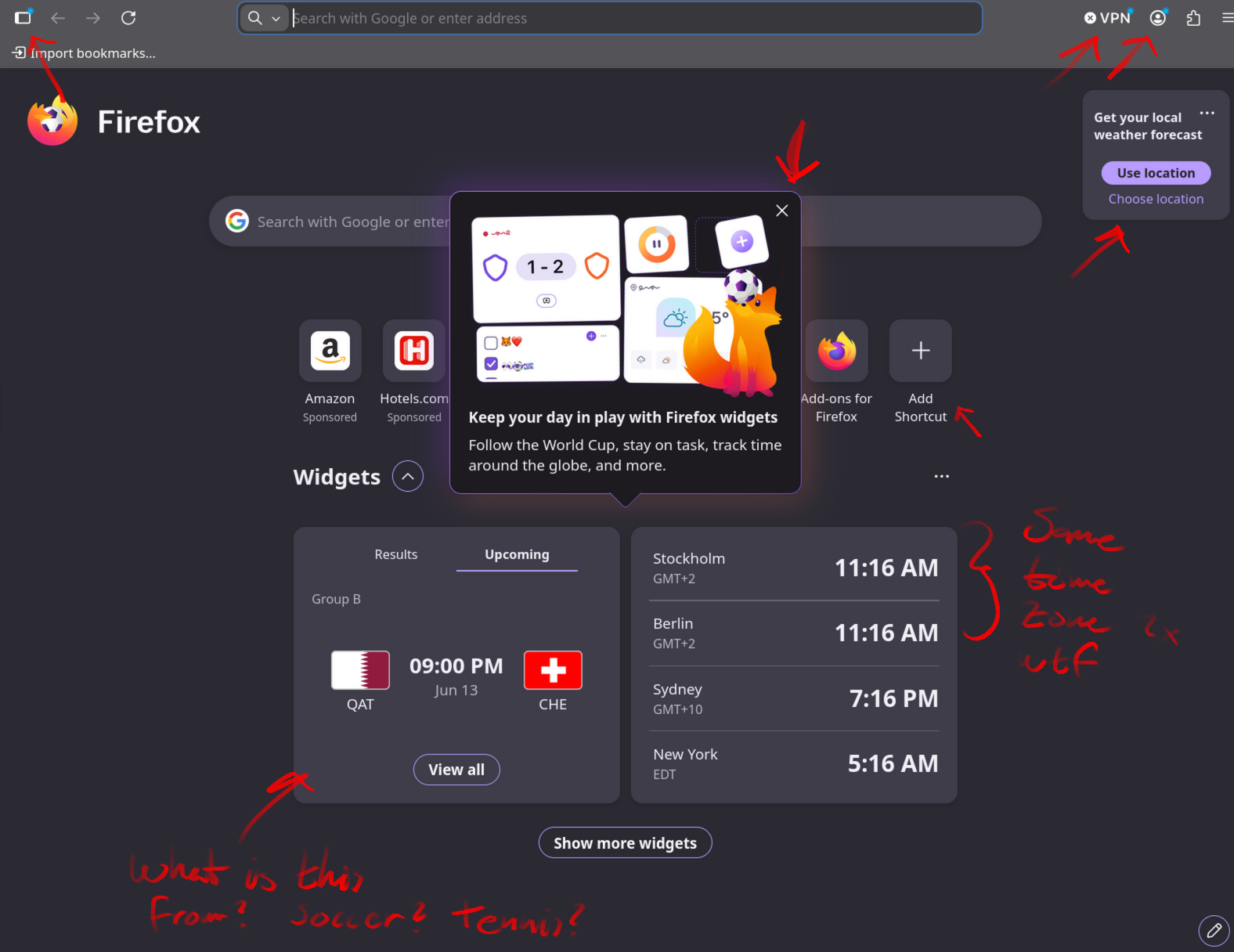
These are all the calls to action I get when I open firefox. Which I opened yesterday as well, so it's not a clean install.
https://www.marginalia.nu/junk/firefox.png
Why is there a dialog announcing widgets, when I can see the widgets already? It's literally telling me what I see on the screen. Why do you need this exposition to inform me of something that is plain to see in front of my eyes? It's like bad fiction writing, except in the form of annoying UX.
Like is anyone working on Firefox actually using the browser, in its vanilla configuration? How can they not see how infuriating it is to be a Firefox user?
[1] 5 years ago we changed which kitchen drawer we keep the cutlery in, and I still reach for the wrong one every time.
Also the context menus are super noisy, I tried cutting some bits out in config, but there's just so much crap in there. Obviously all the AI stuff, but also just the basics; right-clicking on a tab has a sub-menu for "Close Multiple Tabs" which hides "Close other tabs" and "Close tabs to the right" which are probably what I use the most. In Chromium they're top-level menu items.
And it went through a phase a few months ago where the context menus were sometimes offset or goofily sized; I think that's fixed now.
I guess it's easy to criticise, but it just doesn't feel like this stuff is well aligned to actually using the browser, whereas Chromium feels like a solid product.
A product like Firefox depends on word of mouth. There was not a *single* announcement or decision by the Mozilla leadership in the last 10 years or so which would make me recommend Firefox to others, instead every single time it pushed me away a little bit more. I have hardly ever seen such a fundamental alienation of their core audience, even for Silicon Valley standards ;)
On the other hand, part of the struggle was my fight against the web as a """platform""", with its many privacy and security issues that accumulated as W3C APIs were added like hot cakes and websites exploded in complexity. Firefox provided the control necessary through addons, thanks to its vast community of likeminded people. Nowadays, a lot of the privacy controls have landed in firefox proper, in part thanks to the tor browser upstreaming, if you know where to look.
There was once a time where IE was only ever used to download Firefox... Mozilla squandered that.
Book to Gecko is brilliant because honestly most apps today... are Web pages packaged in an "app". Most PWA with desktop shortcuts (and ideally offline responsive mode) show that. Very few "apps" genuinely need to be apps.
Consequently being "just" a phone with basic connectivity and delegating the rest to the browser made perfect sense.
I didn't work because it didn't make sense or wasn't technically feasible. It didn't work because anybody who made a mobile OS wanted THEIR own walled gardens. The fact that today we are stuck with Android an iOS shows how needed it was and still is.
I've been a loyal Firefox user since forever - reading, writing, web dev I do is always in Firefox. It's a first app I always install. I'm grateful Firefox exists, and the world (at least mine) would be much worse if it wasn't around.
I don't like Mozilla is taking money from Google - I'd prefer if it was all community driven, to the point of a community owned co-operative, but I'm probably delusional.
Yet, I'm hopeful for the future.
One of the first betrayals was putting ads in their new tab page, the forced AI comes as a Mozilla tradition now of user respect as marketing only.
At the same time it simply may not be a viable business. Firefox was popular originally because Chrome didn’t exist and Internet Explorer especially 6 back was awful.
The browser is now an OS on top of an OS, it requires massive resources to maintain. So Mozilla has a cursed mission now and related or unrelated in any case they’re full of it and have lost my respect. Open source and user respect still means something to me even if it doesn’t to Mozilla.
I would like to see Mozilla's entire board leave Mozilla... in a PERP WALK.