Posted by ricochet11 18 hours ago
It’s already used in breast imaging (SoftVue) and hasn’t replace mammography. A body part ideally suited for ultrasound.
More compute many minimize some of the fundamental limits of sound waves (bone and gas) but I would be shocked if they have useful images of 90% of the body parts we image with CT or MRI and even beyond that I question how much it’s more useful than B-mode anyway.
Quite slow which means most things abdomen and chest will be motion degraded.
This may be useful in superficial areas but then why do whole body anyway. Might be some new niches and interesting research but hardly revolutionary in my opinion.
There is a part of me that thinks it would be cool to get cheap full body scans. I like being able to see inside of myself. I can think of a lot of situations where the low-fidelity images coming out of this (they're not good compared to real medical imaging, if you've ever looking at MRI/CT up close) could be useful for coarse analysis of certain conditions that come and go or need to be monitored over long periods of time.
What I don't like is the idea of getting people to do full body scans every month just to be safe. This might sound like a good idea if you haven't looked at the literature on preventative full body imaging. Looking for bad things inside the body sounds like a great idea on the surface.
The problem is that imaging, especially when it's as rough as these ultrasounds, and possibly worse when augmented by AI guessing at what it's seeing, can lead to a lot of unnecessary procedures. The net effect can even become more harmful than the number of real problems it catches. There's a long history of research on this as many companies have tried to commercialize full-body scanning in the past. It frequently leads to situations where there's an unknown or ambiguous spot on the imaging that the person reading the scan can't rule out, which turns into a lot of anxiety and eventually more imaging, biopsies, or unnecessary surgeries. It's easy to think "better safe than sorry" until you realize how often these benign but ambiguous findings show up on full body imaging.
So my initial thoughts on this are that it would be good to make cheap ultrasonic imaging accessible as an as-needed service to use for specific conditions. I do not think it's a good idea to go down the road of trying to scan the entire population once a month and then run it through AI to see if anything pops up. The number of false positives would be overwhelming and lead to a lot of unnecessary procedures to calm the resulting anxieties.
For sure, we have to be realistic about what processes will systematically have error, and if we can't stop a doctor from doing bad things with a piece of data we should shield them from it, but the tools to make scalable, calibrated risk estimates based on large data dumps is getting better every year.
There are physical limits to detection and technical parameters that make some situations indeterminate even for the best of the 'gud'. It is frustrating that, hearing an argument from many different individuals over a long time, you assume that each speaker is missing the critical insight that you possess.
> but the tools to make scalable, calibrated risk estimates based on large data dumps is getting better every year.
So your suggestion for indeterminate scans is more scans? There is no 'large data dump' personalized to you except for your own imaging.
> if we can't stop a doctor from doing bad things with a piece of data we should shield them from it
The doctor isn't the problem, it's the people who would be seeking out monthly imaging without symptoms
If the false positive rate is demonstrably low, I can't see the risk. People who think they need a doctor will go to a doctor with or without a fancy scan. People who want to play armchair physician will play armchair physician with or without a fancy scan.
The false positive rate is the entire risk.
When you go to the doctor for a physical they don't run all of the blood tests they can. They only run them for specific symptoms and for specific preventative measures where we've calculated that the benefits outweigh the risks of a false positive.
Some tests have been removed from routine exams, or at least discouraged, because they were producing more false positives and harm than what they were saving.
Full body scans are deep on the end of the spectrum of tests with high false positive rate when ordered without supporting symptoms. That's the risk.
> People who think they need a doctor will go to a doctor with or without a fancy scan. People who want to play armchair physician will play armchair physician with or without a fancy scan.
Not really how it works in real life. When you get a full body scan, especially with ultrasound, there are a lot of benign things that can show up that vaguely look like non-benign things. Even if the interpretation is "probably nothing", many people start worrying and think they need to get more tests just to be safe. Even people who don't see themselves as "armchair physician" will start thinking that they should at least rule out the worst case because they wouldn't want to die of cancer having known that something might have been there.
True to some extent, but you're ignoring the role that costs and insurance play here. Do you really think the personal physicians of billionaires and heads of state are only running a limited set of blood work because they're worried about false positives?
More often it leads to people thinking they have issues when they don't.
The same thing happens with blood tests: You can order all the blood tests you want if you're willing to pay for them. If you order enough, you will get some that show up as abnormal. You can start spending tens of thousands of dollars ruling things out and never catch any real issues.
https://pmc.ncbi.nlm.nih.gov/ Go right ahead!
I actually don't think we have the data available that I want, and even if we do, as many others here have pointed out, intentionally sticking our heads in the sand forever makes no sense.
> I actually don't think we have the data available that I want
I get the sense you haven't looked...
> intentionally sticking our heads in the sand forever makes no sense.
Because you make statements like this instead of citing the extensive literature on this question.
A new chargeable procedure is for for the hospital but maybe not for patients imo.
Many countries with far better outcomes don’t do this, is it necessary, or is it just the product of an insurance-driven health industry which prioritises interventions over health?
Regardless of how accurate a test is, by Bayes Theorem if it's done on enough healthy people the false positives will swamp the true positives.
> So your suggestion for indeterminate scans is more scans?
The solution to imperfect evidence is consistent and calibrated risk estimation of both disease and intervention.
The trick seems like it would be to strongly incentivize waiting and watching any symptomless anomalies if further investigation is invasive. If you're getting 60 second scans every month then something growing will be catchable and something static or that disappears can be ignored until the next scan.
If Midjourney says "maybe you have cancer" but your doctor doesn't take it seriously, you might sue if you do end up with cancer. You might even win, regardless of whether "wait and see" was the right approach.
Meanwhile, if your doctor gives you an unnecessary CT scan that rules out cancer, hospital both earns $$$ and the doctor doesn't face legal consequences. Your increased chance of cancer risk from the radiation isn't something you can realistically sue over.
Exactly this. I mean, even if the scan is really indeterminate, at a minimum you can simply wait, then scan again. If it's truly something serious, it will become determinate at some point. Doing this is still better than nothing and carries no risks of unnecessary procedures.
If the scans are cheap and fast enough, the solution is to not do anything until you’ve observed the mass in question grow over time, not just be there.
With a big enough data set of [all kinds of bio values, including ones considered irrelevant for that disease] labeled with diagnoses, I suspect we could get very fast and accurate automatic diagnoses, even from a limited data set currently considered uncorrelated. Rather than going to your primary care physician, you'd go into the standardized, mass-produced and thus reasonably cheap everything-scanner, and you could likely get a more accurate diagnosis (or at least "things to check") than the average doctor would be able to give you under the practical constraints they typically operate under (time, available information/diagnostics).
This goes in that direction, and I'm really excited to see where it goes. I could imagine that given enough training data, ML models will be able to pick up on minute details that make it possible to diagnose diseases that weren't historically considered ultrasound-diagnoseable from this kind of detailed ultrasound.
I think combining it with gas chromatography/mass spectrometry of e.g. breath or blood/sweat/urine samples would also have the potential to be a cost-effective diagnosis method - lots of data, probably not all too useful for human interpretation, but would open the potential to walk up to a machine, breathe into it, spit into it, pee into it, give it a swab, and have it come up with an accurate diagnosis without invasive testing. If mass produced, the cost of something like this could easily drop below the cost of a typical doctor's visit. (I googled it and it seems like GCMS is already used for some diagnoses, but screening only for a few specific diseases rather than "throw ML at it and try to diagnose everything").
While there are many individual stories of full-body scans detecting early-stage cancer before it became symptomatic, there seems to be a general sense among doctors that implementing full-body scanning on a population level would lead to overall more harm than good. The thinking is that it is better to do regular targeted screenings for diseases that you're in a risk group for (e.g. colonoscopies, mammograms, cancer marker blood tests, etc.) rather than full-body scans.
I'm not a doctor, and I personally do find the idea of full-body scans very appealing, but I also know that if the scan detects a possible cancer, I wouldn't be able to just ignore it if the doctor tells me it's likely ok. Any time I felt any pain or any sort of symptom in that general area, I know I would worry about it. Maybe that's worth it for the potential life-saving results, but it definitely is a cost of this type of scan that needs to be acknowledged.
Then after a routine “heart health” check all my indicators were super out of whack - the doctors thought I was on my deathbed - but I am perfectly happy pain free, in shape, physically active person…
Then _i myself_ had to dig into all these tests and figure out that they were measuring the wrong thing - since they try to time where your body is “just about to eat after a fast” - normally for most people in the morning before breakfast, but since my first meal of the day is usually around 20:00 - my body had adopted to have higher levels of various things just to stay on top of my lifestyle choices.
Anyway I had to educate some doctors since they haven’t really had a case like mine, so they weren’t thinking critically of how to interpret the results…
I imagine an automated test _could_ take these things into account with large enough dataset, but it would need to do a lot more reasoning than statistical correlation.
I do believe current sota models should be good enough to come to the correct conclusions with the right harness though.
He was a firefighter in NY in his youth and had never stopped exercising even after retirement.
He went to his GP explained his workout routine and was basically told there is no precedent for it as people his age tend to not be running 10km a day. In short he was told if you're not in pain or fatigued keep at it.
I think he's nearly 90 now and has cut back the running to only a day or so a week, but last time we went to visit he was in his garage bench pressing 50kg
Now I either do gym before dinner (heavy exercise) or social dance after.
I’ve been given a lot of advice how I “should” be structuring it - like “don’t eat too much before bed” or “never eat before exercise” … but I haven’t had any issues with what I’m doing so far (~2 years)
They have unmatched breadth of knowledge by default, and can maintain attention across entire medical histories.
or
https://www.reddit.com/r/ChatGPT/comments/1oesnix/chatgpt_di...
or if you prefer from this site,
https://news.ycombinator.com/item?id=43171639
and
https://news.ycombinator.com/item?id=42999632
If you were looking for a published paper or something more official though, I don't have one.
There is a selection bias here. Not saying it wouldn’t work, but right now you hear about exceptional cases, not when the LLM wants to amputate for a wart.
We all work with LLMs, right? It hasn’t been long at all since an LLM gaslit me while attempting to recover an unbootable laptop. I should have been recommended a few simple steps to try; instead, it was unable to ignore the irrelevant details and led me on an hours-long chase. To me that means the LLM will also struggle to ignore irrelevant medical information.
But we would have great data over time, both individually (weird tends to only matter if they are changing) and as a population.
It's just hard convince people with a general feeling something's wrong and a specific picture of something wrong that the two are almost certainly unconnected.
Review the numerous comments that address this as a statistical issue -- which it very much is when talking about the scale that Midjourney is claiming.
This is more true for some cancers then other though. Prostate, breast, and maybe melanoma are the worst in this regard. This is why prostate and breast cancer screening programmes are controversial, although the needle is swinging towards them being more useful as surgeries and treatments get better. Some other cancers like pancreatic cancer will always kill you eventually, so it's always good to catch them. It's a nuanced problem.
This whole issue is called "overdiagnosis", and personally I used to be obsessed with it. Being aware of it mostly caused a lot of hand wringing and grief, it's just easier to believe that every cancer you catch is a good thing. However, one of the broader issues is that we will never know what we don't know if we don't look. So there exists another perspective that all the suffering caused by overdiagnosis will eventually pay off in the long term. This is the "collect all the data for science/AI" perspective, and I've personally tentatively adopted it myself, although perhaps that's just because it's nicer to believe that you do some good even when you do harm. I think it's more likely that [novel cancer therapies](https://www.nature.com/articles/s41586-026-10738-7) will solve the "harm" part of treatment before we solve overdiagnosis.
The reality is that important breakthroughs are often entirely unrelated to the data for you are collecting, and even worse that possibly helpful data is locked away due to regulation and never used. This is kinda why I've come to make some kind of peace with private clinics scamming people with whole body MRIs, as I'm sure they're secretly selling the data which might lead to some good. However, they would probably do even more good if they didn't exist so they didn't jack up the prices for MRI machines by inflating demand. The marketing they do is the most morally reprehensible part of the whole deal, as it's usually just lying and creating health anxiety for profit. The fact that midjourney here is marketing themselves in this direction is giving me some serious Theranos vibes. Quick and cheap MRI equivalents would be really useful in the clinic, and it would have to spend a few decades there to prove it is useful before moving on to the "spa" stage. That they are trying to market a render of an idea directly to the wellness crowd firmly puts this in the "scam" folder for me. The fact that midjourney is mostly irrelevant now also fits well with this, making it likely that this is either a marketing stunt or a desperate pivot to get funded. Hopefully there are not that many suckers who will put their VC money down on this loosing bet.
That's a tautology. We already have quite robust methods for detecting developed anomalies, treating every anomaly below standard human-to-human variation effectively raises the noise floor to already developed anomalies, defeating the purpose of population wide routine scans.
The faster and earlier we start to scan everyone regularly, as long as scanning methods aren't invasive, the more certainty we'll have what to warn people about and what not to tell them. Perhaps with the regular screening (imaging quarterly, if the scan is fast) you could see what is growing and what isn't.
You'd have a system where every resource is allocated for diagnostics, but no medical staff to treat it
Also a significant part of population avoids screening even if they are not required to paid anything from their pocket
MRI operators are specially trained technicians, because these are complicated machines. But like, semi trucks and photocopiers are fantastically complicated machines, and we seem to be able to keep a pipeline of people trained to operate and maintain them.
So I don't think there's an economic blocker for giving everyone a full-body MRI scan every year or two.
[0] https://www.blockimaging.com/bid/92623/mri-machine-cost-and-...
I'm saying there's no question that would be economically viable. The reason we don't and shouldn't do it is that it wouldn't be medically valuable, even compared to other cheap interventions.
TBH, this is already a red flag for me, like so many other "tech bro invents X" stories, though I am also aware of stories were "company realises Y is overpriced in medical purchases, makes Y cheaper, finds all hospitals think it is a scam and refuse to buy unless they raise prices".
What makes MRI machines expensive is that they are big helium-cooled superconducting magnets that have to be continuously kept at a few Kelvin.
But even if you disregard that, there's this:
  It starts by stepping into a shallow pool of golden light. You then begin to descend into the water. Your body passes through a ring of underwater sensors, each acting like a dolphin, using its echolocation. The sensors send ultrasonic sound waves through your body from every angle. With enough waves, and enough angles, we form an image of what's happening inside your body.

  The goal is for this process to take no more than 60 seconds.

  You go into the water, you come out of the water, and you're done.
Note this does not mean I think the hardware proposed here is totally impossible*. Sure you could make an ultrasound scanner. Why not? But then, hyperloop was always physically possible, just never turned out to be a good idea to actually build**.
* That said, I am suspicious about the claim in the video "Each sensor resolves motions smaller than the width of an atom - not micrometers or nanometers but picometers!", which does sound impossible to me given the movement of atoms is the sense field itself, albeit I'm not an expert in this domain and may just be wrong like how there's weird tricks for photolithography smaller than the wavelength of light used.
** Back when hyperloop was taken seriously and I was still looking for genius behind things Musk said, I thought hyperloop was an excuse to develop here on Earth a transport system that for a Mars colony made more sense than cars and roads (and indeed I still think that, just there's no evidence Musk ever did).
I thought we were railing against Big Hospital/Big Insurance here? They'd love a cheap diagnostic.
Mammogram screening based on randomized-trial all-cause mortality, has not shown a measurable reduction in total deaths.
Randomized colonoscopy screening has not shown a statistically significant all-cause mortality reduction.
My grandfather went to the doctor complaining of chest pains, they gave him a colonoscopy, and he died of a heart attack a week later! Clearly colonoscopy doesn't reduce mortality!
There's no reason for almost any medical intervention to have a statistically significant effect on all cause mortality. That doesn't mean it doesn't have any effect on mortality of individuals.
You're right that we could take steps to fix it, but unfortunately, those steps involve mass education that every human body has anomalies, and many of those should just be ignored.
We'd get a wave of anxiety, lawsuits, and unnecessary interventions, until humanity collectively internalized this.
The steps to fixing it is to not take the test that takes you from a prior of 1/100000 to a posterior of 1/1000, because you're going to ignore it anyway. And you can't depend on multiple testing because those test results can be correlated.
ETA: I can be convinced that we can collectively get to a place where broader screening would be indicated. But I think it's going to require both of the tests getting better and being better about what we do with (and feel about) the results.
Would this be solved by routine scans, so you have a baseline you can compare against? Ignore anything slightly odd in the first scan but monitor for changes over time?
* Some kind of scans, like CT scans, use ionizing radiation and should not be done too often. * Looking at only imaging scans it is often impossible to tell apart a cancer and a benign growth. (More invasive tests would still be required, which was what the parent posters were warning about)
It might also reveal that every MRI shows ghost artifacts a half a dozen times that make it longitudinally useless, of course. I'm not foolish enough to think that epidemiologists haven't thought of this.
- At 25 years old or whatever you get a FBS. Pretty much no matter what, this FBS will not be used to do more checks, procedures, and so on.
- ... and now we give you another FBS every so-many years, and only those things that are different from the previous scan are investigated.
There's still an issue with needless procedures, but the amount of 'weirdness that are not going to cause an actual issue had the patient never been aware' is significantly reduced by looking only at changes. i.e. most 'weirdness' shows up early and is fairly stable.
The difficulty is the moral issue. You cannot show that first scan to the patient. Even if every soul agrees beforehand that the rule is that nothing on that first scan, no matter how scary it looks, is further investigated... any medical issues raised by patients are used as a major information input for diagnosing issues. If I show a patient a scan that has this tumor looking thing on the left lung, then no doubt a few months later they'll be back complaining about shortness of breath and a pain on the left side of the torso. The mind is a powerful thing. At that point you can do a scan and see... the same nasty tumor looking thing we saw on that first FSB, and we're right back to the issue of these scans doing more harm than good.
Is it morally acceptable to hide that first scan from the patient?
Modern medicine sort of requires us to suspend the idea that we can know everything happening in our body at any given time. If we could develop a diagnostic technique to instantly determine if shapes in our bodies are malignant or benign something like frequent full body scans could be interesting, but they really just introduce noise right now.
The diff can be meaningless as well. All sorts of benign things develop with age.
The resolution is the problem. You can't do the type of cytology and histology needed to understand all disease with just scans.
It is neither controversial nor complicated to detect some cancers by scent.
Taking the "headspace" of something is also not really complicated.
There are people who can reliably smell/detect Parkinson:
https://www.npr.org/sections/health-shots/2020/03/23/8202745...
To work, it would have to be incredibly accurate (specifically, have an incredibly low false positive rate).
The real crux of it remains though: Let's say it finds something that increases your death risk by x=0.1%. Could you sleep? I'm not sure. Let's say the operation has 2x=0.2% risk. What do you do? What value of x makes this a problem for you?
I'm thinking a possible solution to this signal-to-noise problem is to embrace the longitudinal view: instead of comparing each scan with the normal across the population compare only against past self, unless there's a risk factor that warrants it.
This way we could presumably make use of plentiful scan data and mostly look at the stuff that evolves in suspicious ways, not what looks suspicious.
Anything found can be monitored with focused follow up scans. It doesn't have to be immediately biopsied if it's in a location where that would pose a risk of iatrogenic harm.
More generally, no test is perfectly accurate, and for low base rate conditions the vast majority of positive tests will be false positives.
Like, again, as a data person I adore this idea in principle, but there would be a lot of details that we'd need to figure out to make it a reality.
There's a reason why billionaires like David Rockefeller, Larry Ellison, and Rupert Murdoch are able to live much longer lives than average, and having an oncall health team (that I'm sure does frequent testing and monitoring) is a big contributor to that.
More testing and data collection doesn't mean that every single anomaly would need to be investigated or communicated with the patient, but would provide a better longitudinal view that can help with disease prevention and health optimization.
From what I could found, billionaires die on average at ~83 years old. ( https://strygin.substack.com/p/how-billionaires-die )
It's not far off what a decent health care system is able to provide in most wealthy countries. It's even somewhat lower actually.
It's difficult to assess the risk factors, but in the end, I have the feeling their additional medical staff and their ability to "cut the queue" (S. Jobs-style) just barely offsets the additional common risk factors (stress, long hours, segregated life), specially if we compare to the upper-middle class.
In the end, there is no magic $100M pill giving you 10 more years. And in truth, access to food, drinking water, a non-toxic environment and really basic healthcare & medicine (vaccines, antibiotics) probably already brings you at a fairly high life expectancy.
Every system that exists as a black box is more understandable with more sensing, not less. Our bodies are not special.
It's also ridiculous that the proposition goes like:
1. Doctor knows some tests will flag tumors or variations that look weird and that we shouldn't then go investigate all of them
2. Doctor shuts off their brain and will then investigate all of them by doing invasive procedures
Just knowing how many such variations there are and if they grow or not is useful information. But the doctors pretend like they are super smart before the test and super dumb right after.
Ask yourself, do you think billionnaires have yearly MRIs or that they wait for later because the doctor and themselves will be anxious? It's an argument that treats regular people as stupid.
If you are a billionaire you also have a doctor with the time and expertise to properly evaluate the evidence in a Bayesian framework, and you have time to talk to them and understand and implications. That isn’t scalable.
Also, it’s quite likely that billionaires are having lots of unnecessary procedures and that harm is being caused. The mri scans are not the reason they live longer!
> Every system that exists as a black box is more understandable with more sensing, not less.
With perfect humans in a perfect society, maybe. But such is ignoring the elephants in the room here, from the actual experts on the topic.
Case in point, doing that during COVID I think amplified the wave of antivaxxers and medical denialists. Which itself had in my opinion a way worse effect on global health than almost anything else recently because now you have to convince a number of people to trust the medical system again.
sure, and there will be downsides.
But that data will be valuable nonetheless.
Bayes Theorem: https://en.wikipedia.org/wiki/Bayes'_theorem
There’s a very good reason we don’t test asymptomatic people in low incidence populations. Basically all positives are false positives when you do that, no matter how accurate the test is.
When you’re testing healthy randos for everything the odds of a positive being false have so many 9s it would make an SRE weep.
Unless this is accurate to a degree previously unheard of in medical science it’s a boondoggle, and I can’t help but notice there’s no mention of accuracy.
Unfortunately that’s just basic statistics.
But what's the intention? If you do a scan and then try to find everything that is wrong about you, you're 100% right, there will be false positives and unnecessary panic/medication etc.
However if you just collect data for months and years and WHEN you get a symptom you have a lot more data then we should be able to give better diagnosis faster. If we do that for long enough as humanity and there is data sharing the accuracy of the whole thing will increase a lot.
Compare: The placebo effect works (at a reduced rate) even if you tell people they're getting a placebo!
By having a whole slew of test results already, you will have much better priors.
To your point though I think there is a difference between collecting and evaluating additional data sources and using them as diagnostic tools.
I suppose I fundamentally disagree with the implication of your post that there is no value in gathering further data for these reasons, it would seem to suggest we’re already diagnostically optimal and could not do better with additional signal.
> The downside, and the reason why most doctors do not recommend full body scans, is that every human body is a bit weird and there will almost always be something "wrong" that will be visible in a full body scan. This can lead to unnecessary testing, anxiety, and even unnecessary procedures. Many of these oddities flagged by the scan would never have caused any actual issues had the patient never been aware.
The fundamental problem is that you generally can't diagnose simply from shapes. Scans show shapes, shapes cause concern, concern leads to invasive procedures, results are negative.
Also, overdependency on "spas" for health information could lead to an atrophy of other sorts of medical information gathering and diagnosis. e.g., there's no mention in the dreamy description of this spa experience of getting a blood draw or a patellar reflex test.
You [hopefully] won't have to become a rare missed diagnosis because you didn't fit the demographic for this or that screening test.
Cost of genomic analysis is exponentially decreasing, and so much progress is happening so quickly.
Consider for example how in cardiology we advanced from ASCVD's 10-yr prognosis, to the PREVENT 30-yr prognosis. And still most providers are using the ASCVD score for their patients.
The chance a positive is real is so low you may as well just point to a body part and get it biopsied.
A positive from this kind of test is statistically meaningless.
If you let it give out tons of false positives, then patients are trained to ignore it when it cries wolf.
If you dial it back so that it gives out fewer positives, then now it starts giving out false negatives and not helping sick people.
Sadly, there's no perfect threshold when the signal and noise distributions overlap substantially, just different trade-offs.
(Love CI, btw!)
For example, single nucleotide polymorphisms. This way doctors spend less time guessing which medication is likely to work best for you when there are many options available.
I don't know about traditional blood testing, but a permanent implant which checks HR, pressure, glucose, temperature & oxidation would be pretty useful, not necessarily to diagnose anything, but to provide data for doctor when patient has actual symptomps.
https://www.rieti.go.jp/en/columns/a01_0455.html This japanese article found "No clear-cut evidence exists to determine whether undergoing health checks leads to greater longevity and/or lower medical expenditures."
https://pubmed.ncbi.nlm.nih.gov/31642821/
And blood pressure is especially pernicious, basically every doctors office measures it wrong so the results aren’t particularly useful. Many use the wrong size cuff for example, or don’t give people time to relax before a reading. A ton of people have white coat hypertension, high BP only because they’re in a doctors office.
https://pmc.ncbi.nlm.nih.gov/articles/PMC1120072/
I saw a paper that showed only 36% of cardiologists did it right.
And then, even that's not enough. Decision theory needs to be applied to decide what action to take. That means taking into account the expected QALYs, cost and inconvenience across the distribution of possible outcomes. There's a whole spectrum of possible decisions, from immediately performing surgery, performing an invasive test like a biopsy, performing other less invasive tests, scheduling a follow-up non-invasive test at a later date, or just following a regular schedule of non-invasive tests and looking for any evolution along a longer time period.
The real problem is the binary thinking of either "we think you have X" and therefore tests must be performed or "we think you don't have X" and therefore tests shouldn't be performed. If medical organizations adopted empirically grounded decision frameworks, by applying them consistently doctors would be able to see something anomalous, assess that the risk isn't high enough to warrant immediate investigation, and be protected from a lawsuit in the unlikely case it was, in fact, something. And then we could do away with this "if we look we might find something" nonsense, which is pure fallacy.
But what you can do then, is either run a more expensive, elaborate test or one that's proven to be statistically independent on the positive testing population.
FPR can even be a good thing. Let's say you have an expensive test with a very low false positive rate. Then you can mix together 100 samples, and get a test with a much worse FPR 100 times cheaper. Then you can repeat the same individually on the positive population.
This is fully automatic and you don't even think about it. Btw, this is why mass testing, and public healthcare can be better. You can amortize the cost of things across a large number of people for no disadvantage.
Problem is we never know who is healthy. That is why we are doing the test.
If you mean run different tests, where you collect different kinds of data from the same individual, sure but that's not something you can "just do" in the general case.
It's news to no one that tests are imperfect.
Do you have any concrete solution to that? Anything of value?
Diabetes is asymptomatic for years and is prevalent in every demographic. Leaving it unattended it can cause damage to blood vessels, nerves, kidneys, and eyes through chronic high blood sugar, by which time complications may be advanced; detecting it on time can prevent or delay this with treatment and lifestyle changes.
Hyperlipidemia is asymptomatic for years and is prevalent in every demographic. Leaving it unattended it can cause artery blockage through cholesterol buildup, by which time heart attack or stroke may occur; detecting it on time can prevent this with diet and medication.
Kidney disease is asymptomatic for years and is prevalent in every demographic. Leaving it unattended it can cause kidney failure through gradual loss of function, by which time dialysis may be needed; detecting it on time can slow progression.
Glaucoma is asymptomatic for years and is prevalent in every demographic. Leaving it unattended it can cause irreversible vision loss through optic nerve damage, by which time blindness may be permanent; detecting it on time can preserve vision.
--------
I'm SO glad you're not my family doctor!
On the other end of the spectrum, what doesn’t make sense is testing a random person off the street for Ebola. The prevalence approaches zero and symptoms are fairly noticeable, so any positive test is definitely wrong.
Most diseases are in between and have to be evaluated case by case, not buckshot.
You may be particularly interested to hear that there’s little evidence to support regular checkups in most adults beyond blood pressure testing and cervical cytology.
> Given the lack of favorable evidence and the potential adverse effect, primary care providers should consider the fact that general health checks, beyond the screening interventions shown to have benefit, likely have little or no effect on important health outcomes. Some of the interventions with demonstrated benefit have sufficiently large effects that a uniform application is warranted (blood pressure measurement and cervical cytology screening). In others, the trade‑off between benefits and harms is so close that patients should be involved in fully shared decision making regarding their participation (breast and colon cancer screening).
https://pubmed.ncbi.nlm.nih.gov/31642821/
I suspect your doctor would agree with me. See if they’ll test you for Ebola, for instance. Not because you have symptoms but just cuz.
In your list, 1-4 are common enough, the tests are accurate enough, the costs of intervention are low enough and the benefits of early intervention are high enough to justify screening, which is why they do generally screen for them at least in hgiher risk groups. The other two are more mixed, which is why mass screening is less common.
All the evidence for full body scans is that they are not justified for asymptomatic people. The false positives are high, the costs of these false positives are high, and the imporved outcomes are too low to justify them. If you want one, go ahead, but realise that almost anything it finds is likely to be false either positive or not likely to ever cause a problem, and you'd have to deal with the worry and invasive tests and even surgery in aid of something that may never cause any trouble.
Many a dollar is wasted every year on trying to prove population-wide screening prevents mortality or increases patients’ quality of life and every time we don’t cheat with statistics we get the same answer - population-wide screening isn’t effective.
1: https://www.nejm.org/doi/full/10.1056/NEJMoa2208681 2: https://www.escardio.org/news/press/press-releases/No-signif...
This non-invasive everything-scanner sounds more like science fiction.
We already have patients trying to track their own health over longer time which is great. We then just have to make AI good enough to spot warning signs (without patients asking). Or parhaps we need to make those tests easy and cheap and regular.
In general yes, just that "more" is monstrously massive to the point of it being closer to science fiction than reality, IMO.
To reiterate, various assays fluctuate rather wildly over the course of various body cycles. The reason(-s) your doctor should remind to get a blood drawn in the morning after a period of fasting is that the sample is taken at a somewhat steady state and the result is comparable to reference values without too much of a margin.
Anyone with a requirement to manage blood glucose levels will tell you that CGMs are vastly superior to finger pricks first and foremost due to the sample rate available and comfort reasons secondarily. With a finger prick test the patient is only somewhat aware where in the curve they are, which makes the test only a rough estimate due to this temporal error margin. A lot of people do not zero in their readings with finger pricks as they are mostly interested in the deltas.
Suppose you manage to make urine sampling relatively accurate and super cheap (e.g. tens of eurodollars per analyzer or cents per test strip) so you can have poorly-supervised, long-term studies with huge cohorts. However, unless you somehow control for sample collection conditions, all this baseline variability suddenly infects your whole dataset and effectively raises noise floor. It's not unreasonable to expect that whatever was found to be a useful signal under controlled conditions to fall below noise floor under uncontrolled conditions.
That's basically THE problem with the hypothetical test-it-all machine. Again, maybe in some cases that could be extremely useful, but in a lot of cases that would be counter productive. However, what CGMs hint us at is that various kinds of Continuous X Monitors could provide insights into body reactions to things, which is, currently, effectively not a signal in general medicine. Once the test-it-all machine is reframed as an array of continuous monitors and the useful signal is reframed from long-term drifts to short-term deltas it may unlock some additional diagnostic pathways.
> > labeled with diagnoses
I know you’re not suggesting this is easy, but I can absolutely promise that the land of medical reporting, diagnosis and imagery is about a 1000x more complicated and unhinged than you might expect.
There's plenty of room between "go under the knife" and "ignore altogether."
Getting a test good enough to still make it useful (detect enough of the true positives) would of course be a challenge, but the more data is available, the more feasible that might be.
if someone told you, you had a .01% chance of getting a disease for example, aren't you better off with that information? even if it is noisy?
Any test that is approved for use would have a better-than-random outcome distribution. Preconditioned on that, a test result is still useful no matter how uncertain. It is never the case that more information leaves you in a worse position.
I have personal experience here:
Every year I have elected to have ultrasounds done of my major internal organs. In the past two visits, the technicians spotted multiple developing growths in my liver and now kidneys. These are very likely to be benign cysts, but one piece of blood work that could be a marker for cancer is inconclusive. The odds are still high that this is totally benign and will either clear up on its own, or at least stop growing and cause no further issue. Still:
1. I'm getting my blood work done now far more frequently (twice per year instead of every other year), with specialized/not typically ordered screening tests;
2. I am redoing the ultrasound every year to track progress; and
3. I am actually taking advice about losing weight and exercise far more seriously than I otherwise would, as these issues often resolve with weight loss.
I am actually healthier now than I was two years ago, and feel better about my physical and mental well-being. All while staying on top of what could have be a life threatening issue if left untreated and ignored.
I look forward to the day when I can go get a monthly MRI-like scan. That would be wonderful.
No its not. This is extremely paternalistic. Humans know how to understand noise and statistics. You don't get to decide that for me. I want more lives saved with more information.
I don’t think my mechanic is being paternalistic when he talks through my car and what is/isn’t important. I like that helps me prioritize things. Why is this any different? In the end a person can tell a doctor “I don’t care run the test” or whatever so what’s the big deal? You can still do what you want. Get that biopsy if you need the peace of mind.
Like, your mechanic hides the fact that your engine may be broken but he's just 70% sure of it. Since he's not 99% sure, he hides it from you. Do you think its a good thing to do?
the question should be: does cost of obtaining extra information pay off in lives saved. i would say yeah obviously.
During Covid it was useful for improving protocols.
Maybe take it out to dinner first?
Somebody should make a startup based around the idea of diagnosing diseases through eg. a drop of blood. Probably need a bunch of big name investors though
So as opposed to bilking the ultra-wealthy to invest in a bunk idea, at worst this seems to be enticing them to pay for an at-worst expensive and possibly useless service. On that scale, it's downright ethical.
This project seems doable (just with a ton of data). Not sure about MRI level resolution, but CT is definitely not MRI level resolution but still extremely useful.
As a consumer health device, we haven't even gotten the population at large to wear biometrics and the CGM fad is over. Full body scans that cannot be used by a physician are not generally useful. If they aren't targeting FDA approval right off the bat, they are wasting their time. This is not solving any current problem in healthcare- you can get an MRI for $2K cash out of pocket and you get to keep your clothes dry
So, an MRI quality image for less than $2000 and the downside is that you have to use a towel afterwards, and that's not solving a problem?
Oh no, how terrible! I have to use a towel and dry out like when taking a bath or shower...
Now, I have no idea whether this promotional video has any substance behind it, or whether 3D-reconstructed ultrasonic scans are usable by physicians right now. But, come on, your complaint is about getting wet?
Their butterfly chips might be cool, but it's not like the article says anything about that. There's only one other comment in the whole thread that even mentions it.
I don't understand how people are so gullible? How do they keep falling for it?
[0] https://www.theinformation.com/briefings/midjourney-revenue-...
Let doers do.
This community can be much better than that.
Regardless, as a doctor and full stack engineer, I'm looking forward to learning more about their methodologies, their approaches, but I don't think this is going to be displacing MRIs or remotely close, based off the cursory initial glance. If their vision is to be able to provide end users with more actionable data with some kind of "low fidelity" medical imaging data that is somewhere above zero and or standard imaging and high fidelity modalities like CT/MRI, then this could be somewhat interesting.
Not a radiologist and not medical advice. Just my two cents.
I could imagine this getting cheap enough that your local gym has one and you get checked once every 3 months.
Curing cancer is one of the only things I’d take a pay cut to do.
Send an email to this head-and-neck oncologist's lab. I saw a talk he gave at a Chicago-area national lab on open-source models for identifying malignancies in scanned pathology slides, and was smitten.
If it has a 1% false positive rate but the incidence is 1%, the vast majority of the positives are false. Then you have to deal with the consequences, including invasive procedures for further diagnosis.
If you’re searching for tens or hundreds of low incidence conditions in the general population at a time it’s absolutely worthless because basically every positive is a false positive. At that point save the scan fee, spin a wheel of body parts and go get a biopsy of that.
This is why doctors are confused why companies are offering periodic full body scans in normal people. They only test people who are high risk or symptomatic to confirm a suspected diagnosis. That extra signal is what makes the test useful.
Go down to the medical diagnosis section for a worked example.
https://en.wikipedia.org/wiki/Bayes'_theorem
Regarding cancers every human has all sorts of weird lumps that are generally meaningless.
In order for this to not be a boondoggle it would have to be spectacularly accurate to a degree previously unheard of. Just from a statistics perspective.
Biopsies are expensive, waste time, hospital resources and carry risks of infection and scarring that do not net out positively for people who aren’t in your risk group.
Getting a totally random positive doesn’t put you into a higher incidence category so whatever follow up test you take will be just as inaccurate as the first one.
The reason to avoid them is the tests would be a waste of time, statistically, and expose you to a bad risk-reward profile.
If you knew apriori 99% of the positive tests are false positive why are you taking the test?
It’s literally just math. Sometimes the right thing for you on average is to do nothing, which feels bad, but it’s still the right thing to do.
Remember, commercialization isn't the goal. They don't need to make a profit, as a company, they just need to get people to invest in their company and not get charged with fraud for something along the way.
Is this some AI hallucination post?
Their numbers would suggest these 1 billion people, getting scanned by 50k scanners, have each scanner doing 20k scans a month. 31 days, 24 hours, we have 744 hours in which to do these. That's 20k scans/744 hours, giving you 26.8 scans/hour. One scan'll be 2.2min. 2 minutes 14 seconds.
If this machine is 200cm big, lowers at 5cm a sec, that gives you 40seconds to lower. One minute to scan. 40 seconds to get you back up, presumably. Even if we're generous and double that, you're at 2 minutes just to lower, scan, and yeet you back up.
Giving you 14 seconds between scans. To clean, maintain, etc. Seems like this machine will output investor AI hype, bacteria, and false positives.
I linked the spa statistics because there's the question of how they'll even get the room for these machines but whatever.
Now, there's a lot of other reasons to be skeptical (e.g. there's no information on what all of this imaging could actually resolve), but please don't shoot the message.
They're not claiming they'll perform a billion scans. They're trying to build enough machines that if absolutely all of them were run at 100.00% capacity it would be theoretically possible to do a billion scans a month.
Yeah, that's not just 'cart before the horse', it's more like cart before the wheel. They make a bunch of extraordinary claims yet offer zero evidence, info or even a plausible hypothesis on how those claims might be possible at the scale, timeframe (2027) and unit economics implied. Thank goodness they really thought through the accent lighting for a calming user experience though. Otherwise, I might have been concerned they're not serious. </s>
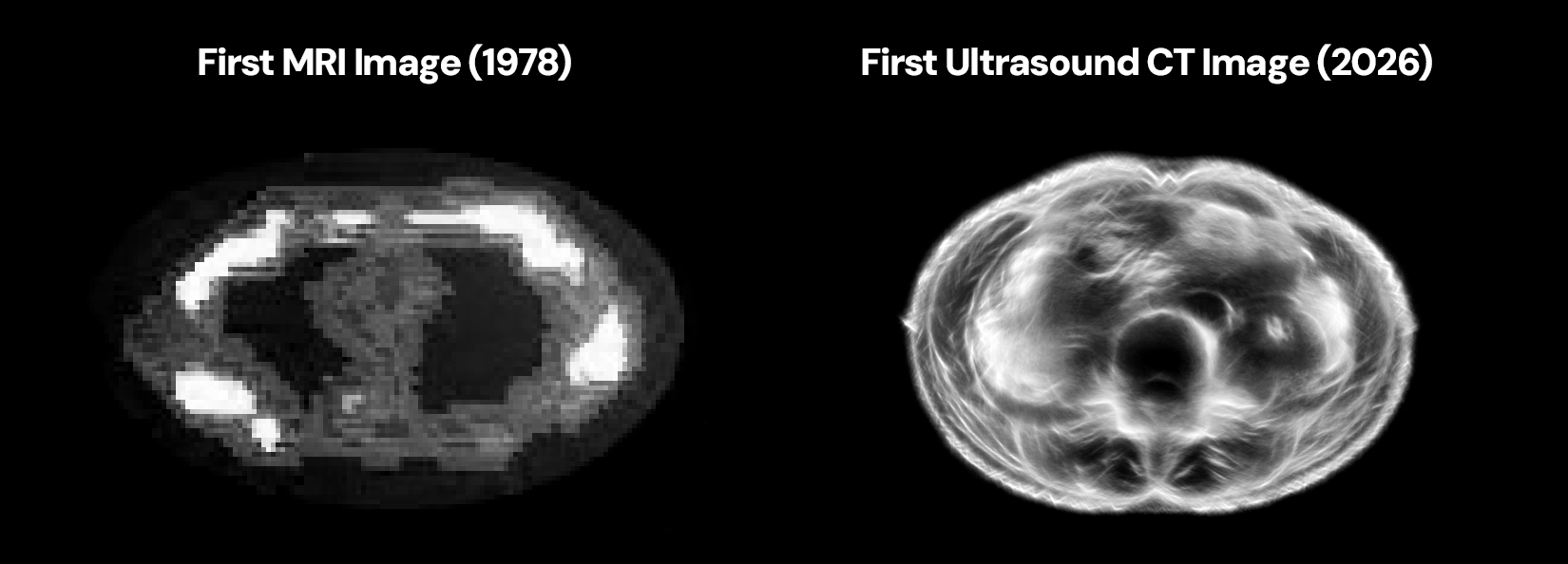
https://cdn.midjourney.com/static/medical/media/first_mri_vs...
More seriously, I assumed that CT Ultrasound image is from Butterfly's actual FDA-approved handheld medical device, not the Midjourney 360 submerged ring - as there's no evidence that is working. Since the Midjourney site has no helpful information, I just asked a friendly AI to do a comparison of what's actually proven to work in the Butterfly chip which Midjourney licensed and this 360 degree, full body, submerged concept - and essentially what's not been proven to work are those three differences: 360 degree ring of 40 butterfly chips, full body at once (requiring solving distance and speed challenges as well as a massive signal processing problem to extract and denoise signal), and doing it submerged.
Inventing new, affordable early detection devices is incredible, but being so misleading in their positioning is going to kill long-term trust in this and other new scanning tech.