Posted by helsinkiandrew 1 day ago
https://ritholtz.com/2008/11/gold-and-economic-freedom-by-al...
The world we are in now, especially in the US, is one where there is near unlimited government credit but it is, according to many, papering over deep structural problems. At some point, these chickens will come home to roost in some way or another. But it is hard to predict when.
So he was in favour of the gold standard because it prevented massive unconstrained expansion of credit and that seems sensible.
The Gilded Age, which had quite high levels of inequality, occurred when the gold standard was active:
* https://en.wikipedia.org/wiki/Gilded_Age
It should also be noted that the gold standard did not bring any kind of price stability:
* https://archive.is/https://www.theatlantic.com/business/arch...
Further, sticking to the gold standard made the Great Depression worse as it reduced flexibility and options of central banks had, and made deflation worse:
* https://www.nber.org/papers/w3488
The sooner countries left the gold standard the sooner they started recovering from the Great Depression:
I've got some news for you about modern levels of inequality.
If we want to talk about the causes of the 'New Gilded Age' that's something else. As a general starting point I'd begin with:
* https://en.wikipedia.org/wiki/Friedman_doctrine
Is there evidence for this?
During the Gold Standard era there were many periods of deflation, which is bad for people with debt: back in the day this was often farmers, nowadays it'd be anyone with student loans or a mortgage.
1) Deflation causes debt to become more expensive. Inflation causes your money to become worth less. There's a simple solution to debt becoming more expensive, but no practical solution to you getting a pay-cut every year, especially when a sizable chunk of people don't even realize they're getting a pay-cut and don't want to be unthankful for a "raise." That issue alone already causally explains much of the rise in inequality. Cut people's wages in a stable or deflationary system and there will be hell to pay. Cut them in an inflationary system and they say thank you.
2) Changes in the past are exaggerated. The Fed did a study some time back estimating CPI levels since 1800. [1] They found that from 1800 to 1950 the CPI never shifted more than 25 points from the starting base of 51, so it always stayed within +/- ~50% of that baseline. That's through the Civil War, both World Wars, Spanish Flu, and much more.
It's even more interesting to contrast this from 1971 onward. 1971 is when Bretton Woods ended and the government was given a free hand to start 'printing money' so to speak, and inflation became the new policy. Since then the CPI has increased by more than 800 points, 1600% more than our baseline. So if the 'Gilded Age' saw deflation of ~30% over some decades, what will historians in the future call an era of thousands of percents of inflation over some decades?
[1] - https://www.minneapolisfed.org/about-us/monetary-policy/infl...
You don't cut people's wages in a deflationary system, you just cut people.
That's true even in the short term, but if the deflation is expected to be sustained, you might as well cut all of them, because if you turn all your assets into hard currency your purchasing power increases every year, whereas if you take the risk of actually hiring people to make stuff during a period of sustained deflation then it might not and on average you have to get them to make more stuff for less money simply to maintain the amount of money you started off with...
There is a simple solution to debt being expensive, but that simple solution involves paying wealthier people a greater proportion of their income to have somewhere to live. Remarkable how people can act like this is favourable to workers and yet pay rises (an inflationary phenomenon!) are bad for them....
One fundamental difference is that inflationary systems incentivize the hoarding of 'things', like housing, as a means of escaping inflation. This is because the price of 'things' will always increase with inflation. But in stable or deflationary systems there's no inflation to hide from and the price of 'things' is stable or can even decrease over time, so there's no longer a hoarding incentivization for 'things.'
So you can see a visible impact of this in housing prices. In the 50s a typical house used to cost about 2 median salaries. [1] Go further back in time and you're down to 1 median salary. In modern times, we're at historic highs of a median home costing 5x a median salary, and in desirable locations like western California it even gets up to 12x local median salary for a median home. [2] That's median, not Beverley Hills.
So yes, in modern times you need endless funny money to do achieve even basic societal things, like owning a roof over your head. But that's because of the funny money. And this is before we get into realities like the fact that when the government 'prints' a trillion dollars, most all of that is going to end up in the pockets of the wealthiest of society giving them even more money to speculate with, driving prices up even more. And much more, there are endless self feedback mechanisms that have left us in a vicious cycle that's probably inescapable at this point.
Real wages are up 14% over the past 47 years [3], and we now have a trillionaire. That's inflation for you. What do you think they'll call this era in the future?
[1] - https://www.huduser.gov/portal/sites/default/files/pdf/Housi...
[2] - https://www.jchs.harvard.edu/blog/home-prices-surge-five-tim...
Here's how things worked in the early 20th century: Let us say a farmer had taken out a mortgage in 1928, and let us say his mortgage payment was US$20 (equivalent of 1 oz. of gold). In May 1929 he would have had to have sold 114 pounds of cotton to earn $20 (or 18 bushels of wheat, 23 of corn, 44 of oats). By May 1932 he would have had to sold 369 pounds of cotton (or 38 bushels of wheat, …):
* https://www.sciencedirect.com/science/article/abs/pii/030439...
* https://econbrowser.com/archives/2012/02/why_not_abolish
If he had 4 farm hands and paid each $5 (total $20), that's a lot more crops that need to be sold to cover payroll.
And it would have been the same for selling any good or service: a company that makes widgets needing to pay the same wages: sell more widgets to cover payroll, or reduce payroll (per head, or total heads).
Falling prices may seem good from a buyer/consumer point of view, but there's also the seller/supplier side of the equation.
It would incentivise the hoarding of currency instead. Holding or investing in anything else is, on average, a losing bet in a sustained deflation.
By definition, deflation is people choosing not to contribute to production obtaining increasing returns on doing and risking absolutely nothing at the expense of those who do contribute to production working harder or taking more risks to serve them. You're accusing me of "engaging with a pretty common fallacy" whilst arguing against a tautology.
> So you can see a visible impact of this in housing prices. In the 50s a typical house used to cost about 2 median salaries. [1] Go further back in time and you're down to 1 median salary. In modern times, we're at historic highs of a median home costing 5x a median salary, and in desirable locations like western California it even gets up to 12x local median salary for a median home. [2] That's median, not Beverley Hills.
That's the supply and demand of housing, as well evidenced by the large disparity of house price changes. Deflation does not incentivise building more houses (quite the opposite actually). In practice, it just means you pay higher mortgage rates and end up with a house that isn't worth anywhere near as much as your mortgage repayments, or you rent - both of which involve more of your lifetime income being transferred to richer people.
> Real wages are up 14% over the past 47 years [3], and we now have a trillionaire.
The trillionaire is arguing the same position as you on currency. I'm sure he and the other billionaire funded think tanks attacking "fiat money" almost as strongly as they attack tax and regulation on billionaires and services for the poor do so because they care about giving the little guy more...
Deflation results from not printing money. When the growth in the amount of stuff in the economy exceeds the growth in the amount of money in the economy - each dollar becomes worth more over time. That is deflation. Yeah you can sit on it and take it as passive gains. You can also use those gains in your spending power to achieve even greater things. It's up to the person.
As for the past having higher mortgages, this provides data on such from 1950. [1] "...the typical monthly mortgage payment [of] $54.31 for principal, interest, FHA mortgage insurance premium, hazard insurance, taxes and special assessments, and any miscellaneous items such as ground rent." 1950 median personal was $3300, so a house mortgage cost 20% of that. Current median personal income is $45k, so that'd be a mortgage on a new house of about $750 with tax/insurance/assessment/etc included in that. We can safely reject the claim that mortgages were higher.
However, your critique that your house would not be worth as much as you paid is 100% true. When things do not endlessly increase in value, going into debt to purchase them comes with a real cost. That is one of the many reasons prices were able to be kept in check. Housing becoming a vessel for speculation just inevitably drives their prices endlessly up while people actually trying to find a place to live and raise a family suffer for it all. This is all only magnified when you add the surplus of funny money. It being speculation or supply and demand are not somehow different things as you seem to be implying.
---
Basically I find most of all arguments about the past tend to be false or exaggerated, and not at all intentionally. We're all taught that economic policy in the past primitive and misguided, as true as the sky is blue and grass is green. Yet when you look at what people could buy in the past on a typical median salary, or the lifestyle it could provide - it almost sounds like make believe, and is way more than enough to make one wonder what went wrong? And I think currency policy is largely the answer to that question.
[1] - https://www.huduser.gov/portal/sites/default/files/pdf/Housi...
It is, indeed up to the person. But if you offer billionaires risk free gains from turning their billions into cash and burying it in the ground (quite literally at the expense of everyone else having to work harder to make up for it), even the ones that are willing to invest or lend need to extract more out of the poor to make it worth their while.
Again, when it's tautological the policy you are advocating gives the idle rich risk free real gains at the expense of the working poor, it is impossible to argue with a straight face that the implications are beneficial for equity and growth...
> As for the past having higher mortgages, this provides data on such from 1950. [1] "...the typical monthly mortgage payment [of] $54.31 for principal, interest, FHA mortgage insurance premium, hazard insurance, taxes and special assessments, and any miscellaneous items such as ground rent." 1950 median personal was $3300, so a house mortgage cost 20% of that. Current median personal income is $45k, so that'd be a mortgage on a new house of about $750 with tax/insurance/assessment/etc included in that. We can safely reject the claim that mortgages were higher.\
I am not sure why you are pretending that this was a period of sustained deflation though. Au contraire, the large increase to housing supply in the 1940s coincided with CPI being much higher than recent averages, driven in part by a relaxation in monetary policy to support war financing and full recovery from the Great Depression.[1]
We're not interested in reinventing the 1950s though, we're interested in how to achieve deflation. Since monetary base growth has an inverse relationship with interest rates, eliminating it implies structurally higher base interest rates, which implies homebuyers pay more money to the bank for the same house (which is almost guaranteed to be worth significantly less than its financing costs). No amount of inaccurate historical claims is going to dress that up as a progressive move that will make housing more affordable.
> Yet when you look at what people could buy in the past on a typical median salary, or the lifestyle it could provide - it almost sounds like make believe, and is way more than enough to make one wonder what went wrong?
Seriously, you'd rather live in the 1950s where according to the report there's a 5% chance you don't have a toilet, never mind extreme luxuries like a toilet or television. Well I guess at least aspiring to that lifestyle is consistent with your enthusiasm for policies that enrich the haves at the expense of the have nots...
[1]A Great Depression which is the last period to actually sees sustained price falls for more than a quarter or two, which was also the last period to see free convertibility of the USD to gold. It was a period of 25% unemployment...
The 'Gelded Age' where the average man had his balls cut off by inflation?
I think there's a lot merit to Gold is a bit better for equality - but it probably holds us all back in the aggregate.
Elon Musk could not be a Trillionaire in the highly speculative cash-flush situation we have today.
The 2008 crash and the current boom are happening only because of alot of extrea money in the system, and it's going to one group, not the others.
The 2008 bailout was to the 'open secret upper class' aka home owners.
If we 'let the cards fall' in 2008 the banking system would have crashed but it's home prices that would have crashed harder.
A 'stricture monetary system' would have forced people to pay the price. Though it would have had devastating consequences as well - it's possible that with stricter lending, the 2008 crisis would have never happened.
FED sets rates that generally favour the GDP, the growth of which is mostly captured by people with more equity. The more loose money for equity etc the more likely it is to be concentraed.
This is all 100% solvable.
There is no ideological debate needed.
A 'relatively strict' Fed, with rules that favour consumer surplus and that is not fully oriented around equities or some 'outside cause' - that's really truly like 'Gold but with some expansion' ... aka a very small-c conservative approach would be a solution that should be acceptable by pretty much everyone except for the MMT people.
I think it would bode better for 'equality' because money means something known, and large enterprise, financiers can't leverage their influence and scale into making it mean something more for them.
A simple and logical pattern.
1) Unconstrained spending without commensurate taxation leads to a required inflation of the money supply
2) An inflation of the money supply with increase the price of assets relative to the value of the currency.
3) Asset owners thus become "more valuable" by measure of currency.
4) Renters / non-asset-owners have to eat the costs of inflation while benefiting by none of the inflationary pressure on assets.
ergo - a gold standard is just a proxy for "constraints on debt" is a force that acts against inequality between asset owners and non-asset owners.
> 3) Asset owners thus become "more valuable" by measure of currency.
Under the Gold Standard the currency itself is also an asset, much more so than under (so-called) fiat.
In a supply-demand situation where supply is finite, and demand is potentially limitless, then the suppliers can charge higher prices. When the demand is for money itself, the price is the interest that is charged by the suppliers (lenders, financiers) can be higher.
And not just in good times when everyone is trying to get a piece of the action: the historical records shows interest rate hikes during major economic events (e.g., 1857, 1873, 1893, 1896, and 1907) when risk was higher.
> 4) Renters / non-asset-owners have to eat the costs of inflation while benefiting by none of the inflationary pressure on assets.
Inflation helps debtors:
> If wages increase with inflation, and if the borrower already owed money before the inflation occurred, inflation benefits the borrower. This is because the borrower still owes the same amount of money, but now they have more money in their paycheck to pay off the debt. This results in less interest for the lender if the borrower uses the extra money to pay off their debt early.
* https://www.investopedia.com/ask/answers/111414/does-inflati...
* https://www.noahpinion.blog/p/so-why-did-us-wages-stagnate-f...
* https://www.noahpinion.blog/p/at-least-five-interesting-thin...
The recent Iran-Hormuz oil shock notwithstanding, the major affordability issue in recent years has been housing, and that's more of a land-use policy issue.
You know what would fix a distributionary problem? A (re)distributionary solution.
The most obvious one is progressive/wealth taxation (a ceiling) and UBI (a floor).
Keep competitive market dynamics, narrow the window in which they're allowed to operate and add some hard constraints.
Tax, and hire millions of people for a good living wage to do things that either need to be done and aren't (infrastructure repairs and improvements, inspections of all flavors, etc), or that don't really need to be done but make some fraction of the population happy (unnecessarily beautiful post offices).
Well, that's good because that's not what limiting the money supply does. It _acts as a force against inequality_. It doesn't _fix_ or _prevent_ inequality that already exists and doesn't claim to stop organic inequalities from arising - but it does put a limit on inequality resulting from an inflation of the money supply.
In all cases where inequality went down, it was helped by inflationary spending.
Yet Gold Standard (and its intellectual descendants) directly led to several examples of stagnation. The most recent one was in Europe, it lost a decade of growth after 2008 by insisting on austerity.
bro your argument hinges on "probably" and then completely ignores it
I feel like the existence of endless almost-free credit rewards gamblers, and when they win, they win big.
Tbf it was proposed in a time where globalization was a good thing and there was naive optimism about international organizations!
Which saw 40% increase in median real wages over 30 years. [1]
> It should also be noted that the gold standard did not bring any kind of price stability:
Prices are *475%* what they were 50 years ago, far exceeding price changes under the gold standard.
> Further, sticking to the gold standard made the Great Depression worse as it reduced flexibility and options of central banks had, and made deflation worse:
It did make deflation worse. Deflation = Bad is an assumed tenant of modern economics.
> The sooner countries left the gold standard the sooner they started recovering from the Great Depression:
By a certain definition. The US did not really leave the gold standard until 1971 (which coincidentally, is when inflation really started to take off).
Which occurred in spite of the Gold Standard, rather than because of it:
* https://econbrowser.com/archives/2012/09/the_gold_standa_1
There were major periods of instability during that period. Growth that is unlikely to be repeated:
* https://en.wikipedia.org/wiki/The_Rise_and_Fall_of_American_...
> Prices are 475%* what they were 50 years ago, far exceeding price changes under the gold standard.*
And wages would have been worse under a Gold Standard:
* https://econbrowser.com/archives/2012/09/return_to_the_g
> It did make deflation worse. Deflation = Bad is an assumed tenant of modern economics.
It is not an assumed tenant, it is (or was for many millions) a lived experience.
Let us say a farmer had taken out a mortgage in 1928, and let us say his mortgage payment was US$20 (equivalent of 1 oz. of gold). In May 1929 he would have had to have sold 114 pounds of cotton to earn $20 (or 18 bushels of wheat, 23 of corn, 44 of oats). By May 1932 he would have had to sold 369 pounds of cotton (or 38 bushels of wheat, …):
* https://www.sciencedirect.com/science/article/abs/pii/030439...
* https://econbrowser.com/archives/2012/02/why_not_abolish
And it would have been the same for selling any good or service: to pay whatever debts you had (mortgage, car/business/student loans) you would have to work more to earn the same amount of money. Is that good?
That’s not apples to apples.
Deflation (or at least reduced inflation) means reduced interest rates.
If it was "just" a slow down, maybe interest rates were lower, but during times of uncertainly lending is risky and so higher return is asked for that risk.
The historical records shows that interest rates spiked during major economic events (of which there were more off, more often, and tended to last longer):
* https://econbrowser.com/archives/2012/02/why_not_abolish
* https://econbrowser.com/archives/2012/09/the_gold_standa_1
https://www.mediamatters.org/fox-nation/fox-cites-ownership-...
The trope is that having any store of value makes you wealthy; not the case : wealth is generated through financial value
Bill O'Reilly is just a pundit, not some maker of policy or human truth. He's a talking head, and not a particularly eloquent one.
The great depression was triggered in part by imbalanced gold flows when we returned to gold back currencies.
https://explaininghistory.org/2025/06/12/golden-fetters-the-...
We are essentially replaying the greenback inflation of the 1860's and have been doing it since 1971.
” The Wall Street Crash of October 1929 precipitated a U.S. recession, but it was the gold standard that converted this into a worldwide depression. With currencies locked to gold, there was little scope to ease monetary conditions. When the U.S. economy slumped, its import demand plummeted and it exported deflation to the rest of the world. Gold-standard countries could not respond by cutting interest rates or letting their currencies depreciate to stimulate exports – their priority was to defend the peg. As a result, economic downturns spread rapidly.”
So-called fiat money didn't become a thing until after FDR became president, which was after 1932.
What "rapid industrialization" is happening today?
Inequality (at least in the US) started growing in the 1980s, after Reagan got elected. For causes I'd start with these:
https://en.wikipedia.org/wiki/Club_33
Frankly, my grandfather is dead now, but I did have one or two conversations with him about how equal society was before the Friedman doctrine, and, certainly for the first 30 years or so it was definitely more equal, not less.
Which isn't to say that now the Friedman doctrine is causing a problem too. I just don't think the solution lies in turning it back. Economic arguments are so shallow these days. Even early communists pointed out that some functions in society will have unequal access to resources. This is not something that can be prevented while maintaining the use that that has. The means of production have a purpose and confiscating and redistributing them will do nothing but cause a disaster. It very much will not get everyone an iPhone and an apartment. And, the part communists forgot (and "forgot" in many cases) is that confiscating them simply creates a new upper class, it doesn't solve the class difference.
The only non-sponsors allowed in were those who paid for the individual memberships. Currently, those memberships get you "free" VIP access to the Disney park where you have a membership, but the membership fee is $25,000 and the annual dues start at $10,000. These prices don't include food or beverage.
Cite? I'm pretty sure that the 1920s, $20 was literally a gold coin of a certain size.
Semi-ironically France was the reason the US fell off the dollar standard after it panic hoarded gold AGAIN when the French government made one last, massive purchase of gold from the US using US dollars, paying $35/oz. A French warship arrived in New York in early August 1971 to load the gold and bring it back to France.
Reckless spending post WW2 was the main reason the US shot itself in the foot and got into this position where they couldn't reasonably pay most clients back and France saw this developing.
All in all France managed to deal massive blows to the US economy covertly TWICE within the same century.
https://scholarship.law.columbia.edu/cgi/viewcontent.cgi?art...
France was not panic hoarding anything. It was converting its UK pound-sterling holdings to gold so that it could be more independent of other countries by having its own currency better backed without an 'intermediary' conversion through London.
There was no "panic" involved, just simple fairness: if the UK and US could have physical gold in their vaults, why couldn't France?
(Don't get me wrong I am grateful that America spent billions on the CIA fighting commies and launching rockets to the moon but in hindsight that party was never going to last)
And now it seems to be the US' turn in returning the favor. First 2007ff (caused by irresponsible actors in the financial world), then the lackluster response to Covid and Russia's invasion against Ukraine, and now we're set to look at the AI bubble collapsing, a bubble much much larger than Lehman Brothers ever was.
> The Gilded Age, which had quite high levels of inequality, occurred when the gold standard was active:
And the Gilded Age [1] ended long before the gold standard. Which makes sense since the Gilded Age is a political issue not a monetary one; how will the productivity from railroads be redistributed?
> It should also be noted that the gold standard did not bring any kind of price stability:
A comparison of 35 years against 4?
That's like bragging about how smart private credit is by showing the low volatility in it's price over the past year.
The large concern from gold bugs is that by printing money we just make the next crash even larger. But of course we just print more in the next crash so it doesn't happen. Take a look at the fed balance sheet [2]; under Kaynsian ideology you were supposed to sell that off during the boom years so you can take on debt during the busts but politicians are not disciplined enough to do that so the Gold Standard would've never let them.
---
IMO, the real argument against the Gold Standard is that the US left it is because we spent more money than we made to finance the Vietnam War. If we returned to it, then we'd just leave it again when it became inconvenient. It's not the Gold Standard that needs fixing in the country.
[1]: https://en.wikipedia.org/wiki/Progressive_Era
[2]: https://www.federalreserve.gov/monetarypolicy/bst_recenttren...
* https://en.wikipedia.org/wiki/Cross_of_Gold_speech
> A comparison of 35 years against 4?
* https://en.wikipedia.org/wiki/Great_Moderation
Panics and economic downturns during the Gold Standard period were much more frequency. The term "Great Depression" used to refer to something else besides what happened in the 1930s, and the gold standard was a contributing factor to that as well:
* https://en.wikipedia.org/wiki/Long_Depression
> Take a look at the fed balance sheet [2]; under Kaynsian ideology you were supposed to sell that off during the boom years so you can take on debt during the busts but politicians are not disciplined enough to do that so the Gold Standard would've never let them.
On the Gold Standard the flexibility of emergency spending during bad years would not be possible: see 1930-1932, and then again in 1937–1938 when FDR tried to go back to balanced budgets through austerity.
* https://en.wikipedia.org/wiki/Recession_of_1937–1938
The politicians that tend to talk about "hard money" and responsible spending are the GOP—but who only seem to talk about it when a Democrat is in the White House. When their guy is in then it's all tax cuts, which do not pay for themselves:
* https://en.wikipedia.org/wiki/Kansas_experiment
and spending (see >$1T Pentagon budget(s)). They're mostly trying to roll back the New Deal (and later Great Society) and cut social programs:
The U.S. officially left the gold standard on August 15, 1971.
https://blog.swissamerica.com/glossary/gold-standard/
> many progressive elements rallied against it when it was in effect:
Bryan wanted a gold and silver standard, not fiat currency. There was also the Greenback-Labor Party who wanted to get off both gold and silver standard. They favored inflation because the gold and silver backed currencies were causing deflation.
You seem to be cherry picking in hopes that people do not know the history of the time.
Farmers and regular people were drowning in debt while the money shortage created a deflationary cycle.
Silver is more plentiful and more volatile - Bryan wanted a fixed 16:1 ratio with gold.
The magic of fiat is that as long as you have working governance, modest inflation and plentiful credit equals prosperity.
Yes, but what does "bimetallism" mean?
> The Cross of Gold speech was delivered by William Jennings Bryan, a former United States Representative from Nebraska, at the Democratic National Convention in Chicago on July 9, 1896. In his address, Bryan supported "free silver" (i.e. bimetallism), which he believed would bring the nation prosperity.
* https://en.wikipedia.org/wiki/Cross_of_Gold_speech
> Free silver was a major economic policy issue in the United States in the late 19th century. Its advocates were in favor of an expansionary monetary policy featuring the unlimited coinage of silver into money on demand, as opposed to strict adherence to the more carefully fixed money supply implicit in the gold standard.
[…]
> While all agreed that an expanded money supply would inevitably inflate prices, the issue was whether this inflation would be beneficial or not. The issue peaked from 1893 to 1896, when the economy was suffering from a severe depression characterized by falling prices (deflation), high unemployment in industrial areas, and severe distress for farmers.[1] It ranks as the 11th largest decline in U.S. stock market history.[2]
[…]
> As a result, the monetary value of silver coins was based on government fiat rather than on the commodity value of their contents, and this became especially true following silver strikes in the West, which further depressed the silver price. From that time until the early 1960s the silver content in United States dimes, quarters, half-dollars, and silver dollars was worth only a fraction of their face values.[10] Free coinage of silver would have amounted to an increase in the money supply, resulting in inflation.[3]
* https://en.wikipedia.org/wiki/Free_silver
Hard and soft money exists on a spectrum, and it seems to be that "free silver" is a move away from hard and towards soft/fiat, and more monetary flexibility.
You don't credit an arsonist with "keeping a homeless person warm" when they set a homeless person on fire...
I don't think anyone really holds him responsible for the dotnet crash of 2000 as that was a market issue and irrational exuberance issue and not a monetary one.
And 2008 was similar. The Fed doesn't control or have any responsibility for lower lender standards or ARM mortgages.
Congress was responsible for the GSE's that bought any mortgages and wrote insurance on those mortgages, so you can't blame the FED for that.
Wallstreet are their regulators were responsible for the securitization of mortgages that went bad in 2008, not the FED.
At worst you can say they had the wrong monetary policy but that's an opinion and not something that can be said as a fact.
Can you flesh out how you feel Greenspan is responsible for 2008?
As for the Great Recession, taking the Fed Funds rate from 6.5% to 1.0% and holding it there for a year was the catalyst for driving everyone into the mortgage market looking for returns. And then did not regulate subprime lending or the shadow banking market:
"As the housing market boomed, subprime mortgage originations skyrocketed from 8.2% of all mortgages in 2003 to 23.5% in 2006. The Fed possessed the authority under the Home Ownership and Equity Protection Act (HOEPA) to crack down on predatory lending and loose underwriting standards but chose not to act aggressively."
"The Fed failed to properly monitor off-balance-sheet vehicles, investment bank leverage, and complex derivatives like mortgage-backed securities (MBS) and collateralized debt obligations (CDOs). Because these instruments developed outside traditional commercial banking oversight, a highly leveraged 'shadow banking' system grew completely unchecked under the Fed's watch."
So yeah, the Fed has its fingerprints all over the scene of the crime. Lots of blame to go around though..
Greenspan felt Greenspan was responsible for 2008.
https://www.nytimes.com/2008/10/24/business/economy/24panel....
He set the stage for the financial crisis that started crumbling a year after he left the fed chair. It wasn't all his fault (politicians lost any spine and bankers any sense), but he was the conductor.
Shortly after he left a bank with over 150 years of history collapsed due to exactly that sort of mismanagement, triggering a crisis for the entire banking sector.
Congratulations on your new job. To help you out, I've enclosed three pieces of advice to follow when you encounter an intractable problem. Open them in order.
The next day in the meetings he blamed it on his predecessor and told of all the things that weren't done right... routine patching left undone, documentation in disarray. Upper management grumbled but agreed to give him the time to fix it.
Two years later there was another outage. This one went on for a day or two and management was once again getting angry about things and so he went to his desk and pulled out the second letter. "Blame it on the hardware."
With that, he went in pointing out that they were years behind on keeping the hardware itself up to date. Upper management grumbled again but agreed to a budget that allowed him to update the hardware.
For a while, everything was smooth and then it hit... another outage. He went to his desk and opened the third letter. "Prepare three envelopes."
means testing kills the usefulness of these kinds of stimuli. I completely disagree with your point here and the people buying Gucci/LV are a drop in the bucket compared to, say, Wal-Mart's yearly wage theft statistics.
There is no simple means of identifying who is in need and if people get the help who don't need it they can redistribute it if they are morally inclined or do hoarding or w/e; who cares?
We "printed" a lot of money to stop the economy from seizing - the opposite problem - but kept going past what everyone was calling a "soft landing":
https://fred.stlouisfed.org/series/M2SL
Inflation hit pretty bad as a result:
I have homeowners insurance, but if my home burns down today I won’t have any reasonable assistance deposited this week. There’s a claim process and I need to have an emergency fund to get my immediate needs met.
Everyone should care. The national debt and eventually the nation will crumble based on these decisions to just print massive amounts of money with no real need.
I didn’t qualify for any stimulus after that one in 2001 so they are filtering it down and putting up some guardrails. They just need to give this some intent and pre thought. You can claim it’s too difficult when you didn’t even try to have a plan or come up with something that was actually going to good use to assist those in need.
Another way to think about it, if Covid was more severe than it was, we’d have wanted those payments to continue for twice or more longer to those in need. But if we were tapped out and had to stop them early, then those in need ultimately succumb to whatever and all the money was spent in vain.
I personally believe we shouldn’t socialize every blip. We are just perpetuating this “who cares” mentality and a welfare mentality. Why even have savings or an emergency fund, the government should step in at every turn. It’s a ridiculous stance in my view.
On the contrary, all public experience shows the opposite. The administrative costs of actually checking if only the right people are receiving a benefit very quickly start out weighing the cost of just paying everyone - especially if you don't want to make the process very onerous for the people who need it (and thus ensure that many who are entitled will not actually be able to receive this).
Don't let perfect be the enemy of good, nobody expects perfect checks but at least some sanity is much better than nothing. Also, it makes it much harder to shoot down by opponents rather than blanket money hose.
In a lot of cases, getting the money out there quickly matters a lot and taxing it back 1-3 years later is fine.
> if my home burns down today I won’t have any reasonable assistance deposited this week
It’s Monday. I’d wager that if I had that type of loss on a Monday, that I’d have $10K or so in my account from my insurance before Saturday.
Now imagine you're homeless. You don't apply for assistance.
OTOH, there was a lot of pain iny the subsequent expansion leading up to the 2008 , but that was all the fault of fiscal (eepecially tax) policy of the Bush Administration and thei Congressional allies, not Fed monetary policy. While Greenspan clearly ideologically supported the people doing that, it wasn't him and the Fed causing the problems.
We deserve what we get if we don't act on the obvious pattern, at this point. We've spent half a century throwing the public under the bus just so that a few oligarchs don't have to pay out for their bad bets, and Greenspan was absolutely their man for a significant portion of that campaign in the class wars.
It is hard to ask Greenspan to have super natural powers of foresight beyond just about everyone else.
It described the dotcom bubble, but I seem to recall people were applying it to the 2000s housing market too. Tldr it was not a totally uncommon opinion during either of these bubbles to say there was a bubble going on.
From a person in his position the baseline is "more foresight than just about everyone else". That's why they get the big bucks.
If you build something grand on wooden legs and massive debt for the next guy to deal with, or drive into a failure mode even if that's not super obvious, it's not high praise.
- spending cuts
- stopping fraud
- figuring out how the net worth of people in Congress increases from hundreds of thousands of dollars to 10s or 100s of millions of dollars
- addressing wasteful and ineffective programs
Given those issues, the only solution will be inflation. The circling the drain moment will hit with the associated welfare programs get a direct staple to inflation itself, so we will spend more to combat inflation, causing more inflation faster.
It's not going to be fun.
https://inequality.org/article/11-charts-tax-wealthy-corpora...
This is really ambiguous:
"- stopping fraud"
And can mean many things. On the right, it often means Somali daycares, on the left it means the underfunding of the IRS so that it doesn't do audits of rich people.
I find this to be mostly a distraction:
"- figuring out how the net worth of people in Congress increases from hundreds of thousands of dollars to 10s or 100s of millions of dollars"
We should ban stock trading by members of the government, the Ro Khanna bill, but while it can be a source of corruption, it isn't a major source of inequality in the US.
This is unclear, can you be more specific as it has different answers based on one's partisan leanings:
"- addressing wasteful and ineffective programs"
I think a lot of the distortion of US policy towards the rich is a result of Citizens United and similar unrestrained lobbying funds.
This is basic economics.
Yes, excessive federal spending is bad.
Good to know that this will be an evergreen argument despite an extremely well-supported project to do just that taking place in the last two years with nothing to show for itself other than hundreds of thousands of deaths.
> Good to know that this will be an evergreen argument despite an extremely well-supported project to do just that taking place in the last two years with nothing to show for itself other than hundreds of thousands of deaths.
Not to mention the most prominent example of this this year sidestepped the Congressional stomach completely. An order of magnitude larger budget than all of the NSF grants combined spent on the war with Iran over 100 days.
Both wasteful and ineffective: it failed to achieve any of its goals and had a massive negative impact on the US economy that will continue for some time.
Does it count as fraud, though, or just gross negligence when experts had already warned that this would be the exact outcome ahead of time but were ignored?
a weird extremely small executive branch task force with pretty much zero power is not what i would call a well supported project in the context of the trying to reduce spending in the american government.
Congress controls the purse, doge had nothing to do with congress.
No reports have substantiated this talking point to my knowledge.
The federal budget over time...
2026 - $7.5 trillion
2020 - $4.8 trillion
2015 - $3.9 trillion
2010 - $3.7 trillion
https://fred.stlouisfed.org/series/FGEXPND
We do not have a tax problem, we have a spending problem. There's no reason that the US federal government shouldn't be able to operate on a budget equivalent of about $4 trillion which was just about the average from 2010-2020. There seems to be quite a lot available to cut.
Another ~$0.5 trillion is from higher interest payments.
A large fraction of the budget consists of wages and actual spending. Inflation is 25–30% since 2020.
Then there is healthcare spending, which can be expected to grow faster than inflation, as the population is growing older.
The US is basically running into the same issues as European welfare states. While government spending remains qualitatively the same, demographic changes make it grow faster than tax revenue. Those who couldn't maintain a balanced budget in the past are finding the situation particularly difficult. In some sense, the situation is even worse in the US. Healthcare (old age spending) is particularly expensive, while individuals have greater responsibility for childhood expenses.
If we account for only these two things, it is catastrophic.
1. Interest on the debt when we don’t have a balanced budget to stop growing that debt will spiral out of control.
2. When any part of that spending which is creating inflation already must then increase to pay for the inflation that it is causing, we are circling the drain. That is a death spiral.
We need extreme, Javier Milei level cuts to the federal government.
The benefits agencies that make up the bulk of the spending have very low overhead and are run very efficiently. The vast majority of funds go directly to beneficiaries.
Balancing the budget will require massive cuts to very popular programs.
For inflation to have an impact on the US debt, it has to be approaching the level at which the US debt is increasing. In the last year, the US debt increased by 7.6%, much higher than inflation.
https://usafacts.org/government-spending/
https://usafacts.org/answers/how-much-debt-does-the-us-have/...
Hmm.... I found this, I wonder if there is any way this line item in the budget could be reduced, it looks sort of big:
https://www.usaspending.gov/agency/department-of-defense?fy=...
The only branch of government I have faith in at the moment is the bond market.
Pentagon fails financial audit for 8th year in a row - https://www.militarytimes.com/news/pentagon-congress/2025/12... - December 19th, 2025
Fact Check: Has the Pentagon failed its 7th audit in a row? - https://econofact.org/factbrief/has-the-pentagon-failed-its-... - December 20th, 2024
Thoughts From the Bond Vigilantes - https://www.pimco.com/us/en/insights/thoughts-from-the-bond-... - December 9th, 2024
Maybe the ENTIRE defense budget would cover it.
(for comparison, the DoD consumes ~$1T of spending, and debt interest costs ~$867B, annually as of this comment)
Citations:
https://usafacts.org/answers/how-much-does-medicare-cost-the...
https://www.citizen.org/news/fact-check-medicare-for-all-wou...
https://www.crfb.org/papers/choices-financing-medicare-all
https://www.rand.org/pubs/research_reports/RR3106.html
https://www.pgpf.org/programs-and-projects/fiscal-policy/mon...
https://fiscaldata.treasury.gov/interest-expense-avg-interes...
So the entire defense budget would not cover it.
The average federal budget from 2010 to 2020 was $4 trillion. This year it is $7.5 trillion. There's quite a lot to cut.
> The US government spent $6.2 trillion in total in 2023, with $1.7 trillion on discretionary spending, $3.8 trillion on mandatory spending, and $659 billion on net interest. Discretionary spending includes funding for defense, education, transportation, and scientific research. Approximately half of federal discretionary spending is allocated to defense.
So I suppose I would agree with your assertion that there is a lot to cut if we're talking about cutting defense spending and interest on the debt via more taxes to pay down the debt (to reduce forward debt servicing obligations). Can't keep cutting taxes for the wealthy with the expectation that is going to reduce spending or increase overall federal tax income, as the evidence shows it will not.
2024 - $6.8 trillion in spending
$1.3 trillion Defense, $323 billion of which is veteran support (pensions, retirement, medicare, etc).
Discretionary spending is a misnomer that assumes all of the other spending levels just have to be maintained as is, are without fraud, run efficiently and impossible to reform.
Cut 20% across the board from every agency for starters (including Defense). That gets us back from $7.5 trillion to $6 trillion. Then do it again 2 years later and get us back to $4.8 trillion. Then do it again.
States have limited budgets and must balance it all the time. Companies as well. There's no reason the federal government cannot do exactly the same thing.
"Wealthy people" didn't cause the US government to spend an extra $3.5 trillion a year over a decade ago and this idea of raising taxes more on those people wouldn't even begin to address the spending problem.
We disagree on the fundamental problem, and I believe your solution is wildly irresponsible to "just keep cutting 20%." You say fraud; prove the fraud. DOGE couldn't find any, so "extraordinary claims require extraordinary evidence." Fraud has a very clear definition versus "spending I do not like or approve of."
The $21.7 Billion Blunder: New PSI Report Reveals Billions in Taxpayer Dollars Squandered by DOGE - https://www.blumenthal.senate.gov/newsroom/press/release/07/... - July 21st, 2025 (Report [pdf]: https://www.hsgac.senate.gov/wp-content/uploads/2025-07-31-M...)
The reality of DOGE's mediocre savings - https://fordschool.umich.edu/news/2025/reality-doges-mediocr... - February 25th, 2025
DOGE and “Waste, Fraud, and Abuse” - https://www.cato.org/blog/doge-waste-fraud-abuse - February 20th, 2025
> "Wealthy people" didn't cause the US government to spend an extra $3.5 trillion a year over a decade ago and this idea of raising taxes more on those people wouldn't even begin to address the spending problem.
I mean, this is the government they created over decades, including influencing elections through dark money spending, and they have all the wealth. Tax cuts for the wealthy are a material component of the debt the US carries today. Where else would we get it from? More tax and spending cuts? This is very unlikely, feel free to confirm with an NGO like USAFacts or Brookings on the topic.
How four decades of tax cuts fueled inequality - https://publicintegrity.org/inequality-poverty-opportunity/t... - November 29th, 2022
Popular support is very high for taxing the wealthy more, ~80% as of this comment in some cases.
Most Americans continue to favor raising taxes on corporations, higher-income households - https://www.pewresearch.org/short-reads/2025/03/19/most-amer... - March 19th, 2025
But... They did. Who do you think wanted Trump's tax cuts on wealthy businesses?
Who do you think pushed for Reagan's tax cuts on wealthy businesses while also drastically increasing defense spending?
Who do you think still is pushing reduced taxes for wealthy businesses?
"We've cut all taxes from the wealthy and the tax number keeps going down, what can we possibly do?"
Spending is the only problem.
At the height of the Great Depression (1936), some economists proposed The Chicago Plan to separate the provision of credit from the money supply by eliminating fractional reserve banking, giving better control of the increases and contractions of credit, the elimination of bank runs, and a dramatic reduction in debt. There was a recent (2012) paper from the IMF [1] that seemed to find this actually is pretty sensible, although I do not claim to be smart enough to understand all of the implications.
[1] https://www.imf.org/en/publications/wp/issues/2016/12/31/the...
Prices should get cheaper. That's a progress dividend. We get better at growing food every year, why shouldn't food get cheaper? Imagine a world in which prices regularly go down. You're a passive beneficiary of technological progress.
The argument that prices can't get cheaper or [bad thing will happen] was never very convincing to me. Prices already do get cheaper for large swaths of the economy that have technological progress grow faster than money supply. Cell phones are rapidly depreciating. You can wait 6m to a year and get a significant discount on the latest iPhone version. People don't stop buying iPhones, and Apple doesn't stop investing in iPhones. This is even more true w/ AI models. Investors/companies are burning billions to build tech that will only get cheaper and obsolete in years if not months.
So if you were to try to convince me that deflation would reduce investment or spending, tell me why this doesn't apply to tech products that get cheaper every year.
That world results in a lot of people individually deciding "why buy now, when I can buy for less later" and sitting on their money.
That in aggregate makes the economy much worse.
You're up against human nature here. Money may be an arbitrary numerical denomination of value, but people's behavior around it and how that affects the economy at large need to be accounted for. Having prices slowly creep upwards over time (low inflation) tends to result in more, better things sooner.
Why do people buy iPhones today knowing that they can get a significant discount in 6-12m for that same iPhone
The price is dropping over time because you're getting something literally less valuable. The analogy would be, would you pay the same for a bag of rice expiring in 2 years, as one expiring in 2 months?
The argument you're trying to make, would be valid and convincing if Apple lowered the price of a new iPhone with each subsequent release.
The "fashion" element is BS. Almost no one can tell what iPhone is which.
It's literally the same phone now or 6 months from now. It doesn't "expire". You're really stretching here.
Same thing is true for Android and pretty much most electronics or TVs.
Other people value those things, and can in fact tell the difference, and thus buy full price iPhones.
Does it really? A lot of our problems seem to stem from conspicuous consumption. People will still need things (food shelter clothing) and that will motivate purchasing. "Oh n0es people won't buy flavor of the month consumer garbage, what ever will we do" just doesn't track.
It does, really.
Conspicuous consumption is a miniscule part of the economy, and for every person whose conspicuous consumption drops, you'll have 5 people who can no longer afford food and shelter.
If you'd like to learn more, I'd encourage you to take an economics class at any local community college. Intro level should teach you about lots of new things including this, much more than you'd learn reading HN comments.
Those who refuse to learn from history are doomed to repeat it. History spent a lot of time being deflationary, and most of that time had abysmal economies for anyone who wasn't nobility.
This can only really happen if the rate of efficiency gains consistently out pace resource and labor costs, such that the marginal cost of delivering produce to market is flat or decreases for the farmer over time.
Does that include the price of labour? Are you okay with your salary going down? Because the historical record shows that's what happens during deflationary periods: producers of good/services see the price that they can sell things for goes down, and so they insist on their suppliers and inputs—including labour input—reduce their prices as well.
Again, tie it to things that decrease in price over time.
* https://www.sciencedirect.com/science/article/abs/pii/030439...
* https://econbrowser.com/archives/2012/02/why_not_abolish
If he had 4 farm hands and paid each $5 (total $20), that's a lot more crops that need to be sold to cover payroll; or he could cut staff.
And it would have been the same for selling any good or service: to pay whatever debts you had (mortgage, car/business/student loans) you would have to work more to earn the same amount of money. Or a company that makes widgets needing to pay the same wages: sell more widgets to cover payroll, or reduce payroll (per head, or total heads).
Gimme all the gold contacts in all of your electronics please, we shouldn't be using gold for those I guess....
It has gotten cheaper, as a percentage of people's income and spending.
Also - I think if you look at the data you’ll find periods off the gold standard where food prices grew more slowly than inflation and even wages, ie food becomes cheaper. 80s and 90s for example.
Because a lot of people earn their living by producing or selling food. Your other necessities don't become more affordable just because food prices go down, but if that's your livelihood it becomes at risk. Food was incredibly cheap during the great depression. There's an amazing quote from the PBS documentary series on it; "A sack of flour cost a nickel, but where were you gonna get a nickel?". Steady, controlled inflation via fiat is the only way to keep a capitalistic economy functioning, because you can't micromanage or control the price of everything, and people need money to live. The real issue is stagnation of wage growth while assets explode. It's the transfer of real wealth from earners to owners that has put us in the current position, not absolute prices.
What happens in practice is that you set a conversion rate to account for this, and basically immediately things start to drift further and further out of whack leading to massive distortion. There's a reason the gold standard era was a cycle of big swings of inflation and deflation, with panics, recessions, crashes pretty continually.
It's the same with fixed or pegged exchange rates - you can set it to something reasonable at the start but it will always drift, usually until things are distorted that the system fails. That's why we don't have a gold standard anymore and why fixed exchange rates have all mostly failed and gone away too.
There's just no reason to believe that pegs to commodities or other currencies would ever correspond to the amount of money that the economy needs to be in circulation, so they always fail.
I tend to think the benefits of unbacked currency exceed the downsides, but it’s not exclusively upside.
That’s why stocks go up, spending goes up and the asset class gets richer. When you peg these to an arbitrary “value” you can see, companies aren’t getting trillions of dollars more efficient, the government isn’t delivering more services and the utility of a business or property hasn’t increased.
That's because it permanently cripples economies by creating an artificial constraint and pretending it's useful. All it does is create another speculation market in gold and cripple credit markets.
As I understand it, all the gold that has ever been mined would fit in a cube the size of a baseball diamond.
https://www.businessinsider.com/warren-buffetts-lesson-on-go...
Nixon was responsible for ending the silver standard.
https://www.usmoneyreserve.com/news/executive-insights/when-...
It's worth reading all of them, even if you disagree with most of it.
I hated the system but it's fair. English and the allied forces inherited the western world and nobody was willing to claim it, the king of England gave it to his daughter.
Gold should be revalued but we're entering a phase where America is leaving law and order for law and equity. Essentially WW2 is ending but most never bothered to consider if there's a goal to all the chaos.
Basing currency on a shiny rock is the stupidest idea ever, that only happens to work because it plays into the worst of human convictions, which is egosim around fraud and debasement of currency.
Gold Standards are like very strong medicine with bad effects.
Notably, they would almost assuredly hold back the economy and cause deflationary traps.
The economy needs a bit more currency as it expands and that's that.
I feel like the problem that Greenspan, Bernanke, and friends have found is that the problem with capitalism is that you never run out of the government's money.
I don't understand why people keep banging about the theoretical advantaged of a gold standard whan it was the default monetary system for centuries and we have firsthand evidence of the problems it causes (and certainly not more equality in the world!). It has been tried by the whole Earth during several generations.
If you think, like Greenspan and others, that there ought to be a mechanism to force some monetary restraint on governments, try to think of a new mechanism, because the "old way" wasn't better. We know it. Move on.
>near unlimited government credit
Really? How do we get some? And, beyond that, what do YOU think the limits should be on increasing the money supply by a sovereign nation?
A nation becomes wealthy by producing things to sell. Nothing else matters, including debt. But, we live in a world where people want to be rich, but also don't want to use resources, or build, or manufacture things, or run an empire. It's contradictory, and we are starting to see the effects.
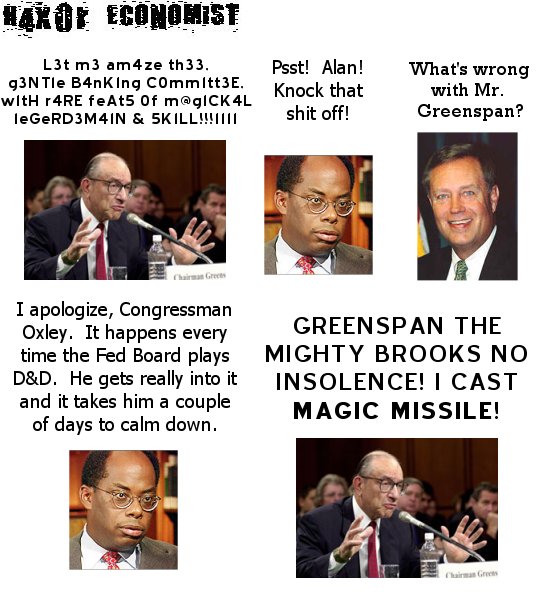
After going through I came back to this tame comic which was the one I remember I actually got a kick out of as really funny back then: https://www.rdwarf.com/users/kioh/haxorec47.jpg (Theme: Greenspan n DnD)
Texas Senator Phil Gramm (pretty sure it was him) was a prominent GOP member of the Senate Banking Committee. Of course, Greenspan often testified there.
Gramm would always ask Greenspan, along with his other questions, “Mr. Chairman, what’s the ideal capital gains tax rate?”
Greenspan never missed a beat: “Zero.”
Agree or disagree, you always knew where he stood!
This is always such a weird phrasing to me. We collectively praise politicians for this (and admittedly, many of them will just say anything to get elected), but the phrase discourages the idea that learning and changing your mind is valuable.
(Not trying to single you out, just writing about how we collectively do this. I'm sure I've done it in the past.)
The anecdote was intended to highlight the directness of his answer rather than the constancy of his position.
Don’t worry, wealthy drug addict pedophiles in Silicon Valley are carrying that torch now.