Posted by bauc 2 hours ago
The other side of this seesaw is: Games are fundamentally in the novelty business. Players like some amount of familiarity, but they want new experiences. Every game engine has a sort of "grain" to it where it tends to produce games with a certain look and feel. The flat-ish shading and floaty physics of Unity is a particularly visible example of this. So using a widely used game engine can put you at a disadvantage if you're trying to make a game that doesn't go with that grain and offers players something different.
As more studios consolidate on the same engine, more players will get tired of that sameness and reward other studios more. As more studios do their own thing, players will become saturated with novelty and the benefits of not using an engine will go down. There is no stable equilibrium.
There's a lot of money in gaming but the workers are treated like shit, as you pointed out.
Also, no union employees at Blizzard were impact by Microsoft's Xbox layoffs/restructuring.
Goes to show, Unions are important and work. The best time to unionize was several years ago. The next best time is now.
Unions also many times (especially with "guild" type unions) can serve other valuable functions like guaranteeing a higher minimum quality of work (generally).
It might have to do with the unionisation, but I wouldn't be surprised that its just that Blizzard is like one of the like 4 money makers that MS still has in the gaming division and that is why they were spared.
Working in games I thought working for a bit 'straight' corporation would be literal hell, I was very very wrong.
Just to say, if they haven't organized by now I'm not sure what it would actually take.
That's what happened here: they just released the big DOOM DLC today. Chop!
Now I'm 40+ years old and my job has morphed from designing systems and writing code to sweet-talking LLMs into staying within my guardrails, or something. Whatever it is, it is very much *not programming*.
Obviously unions would be in a position to limit the software engineering wrecking ball that is AI, but I pushed against that and now I have to sleep in the bed I made.
If its any consolation, its the bed we made collectively. It was easy to push back against unionization early on, we were likely better off individually. I too am self taught, although I went the ops route, and enjoyed making more money than I thought I deserved from basically a hobby, and a skill so in demand that I could effectively just go to any company I wanted at any time.
I'm also turning 40 this year, and can look back and wish we all did things differently but the wild west nature of early tech that allowed a self taught college dropout to build a successful career was too good, beneficial. It was one of the rare times that true upward class mobility was possible for anyone with a little bit of tech aptitude, so I think it can be forgiven that we didn't unionize or push for it back then.
I do feel bad for anyone graduating right now or just trying to enter the field though. The ladder has been pulled up.
Germany has very strong labor protecting laws.
Replacing line engineers and operators is very difficult.
Volkswagen is firing 100k employees in Germany none the less.
The idea that you can successfully unionize in software..in US..Where you could simply retain a small number of staff key members pay them very well and put them on a mission of outsourcing and milking the IPs..I don't see it.
The best moment to unionize wad 20 years ago.
Now there's not enough leverage by the staff.
The scabs who don't strike?
I'm pro-union and unlike the person you are responding to I'm not sure things are "dead in the water", but I do think software developers had a much better leg to stand on to push for unionization a few years ago than they have now (and, probably, going forward).
Longshoremen literally retired early and were paid pensions out of corporate profits from container related productivity increases.
What comes to mind is whole towns made of dockworkers which disappeared, and some places like Manchester lost their port and their industry died too, and it took them decades to recover.
Of course, some other like Rotterdam flourished.
I do recommend the book, but I think it shows many sides of what happens when a large change happens.
- Someone in the early 19th century
You _can_ do computer-based work anywhere, anytime. People working in software have no leverage at all, between India and AI. Software unions will kick the race to the bottom into overdrive.
"The International Workingmen's Association (IWA), commonly known as the First International [...] was founded in 1864 [...] The preparatory Address of English to French Workmen, drafted by trade union leader George Odger, articulated the need for international cooperation to prevent the importation of foreign workers to break strikes:
A fraternity of peoples is highly necessary for the cause of labour, for we find that whenever we attempt to better our social condition by reducing the hours of toil, or by raising the price of labour, our employers threaten us with bringing over Frenchmen, Germans, Belgians and others to do our work at a reduced rate of wages [...]"
Software work appearing to be extremely fungible with offshoring and AI is all the more reason to unionize. It doesn't matter to the employer who is doing the work, so the union is the only leverage to truly saying, "hey as the person actually doing the work, I would like to be treated better, and you can't just ignore me, fire me, and replace me".
The race to the bottom already started as soon as companies saw more fungibility where there was less before. Software unions won't kick that into overdrive, they'll slow it down.
So, you know, do that. <insert "c'mon, do something" meme>
I have seen a number of projects go from
'We're building our own engine'
To
'we should have just gone with $engine_of_the_day'
To
'We were so lucky we chose to make our own engine'
If you want to make a game like fortnight, the Unreal is your pick. If you want to try something that hasn't been done before you could do worse than rolling your own engine.
Especially if you are looking for where the fun is, the idiosyncrasies of your own engine gives you a world with it's own flavour if you incorporate that flavour into your design process you could create a feedback loop that turns into something special.
Engines has been (And is to a large extent) bad business because unless you really do something _really special_ it's way expensive for little gains (especially if you're targeting realistic games since there is so much to focus on before even considering portability).
And I say this as someone who started out working on custom engines (but am out of the business outside of hobby stuff).
I loved the old STALKER games, and the wackiness of their engines was a lot of the charm. I ended up buying the new one out of nostalgic dedication and it's probably the worst example of "Unreal slop" I've experienced, having not bought many newer games. I'm sure the butchers running Xbox have run the numbers and think they'll make even more money throwing armies of contractors with allegedly fungible skills at the next Doom games, but I'll leave others to bankroll that while I enjoy games I don't need frame generation for.
Where they actually messed up was not licensing it more aggressively to other companies like Epic has been with Unreal.
Doom was absurd in the capability of squeezing terrible machines for high framerates and great visuals.
There are very few games where the engine is what made all the difference. Maybe something like Half Life 2 with the source engine is the exception, but ultimately, what makes a game good are traits that can be universally applicable to any engine.
Truth is, it’s not that 90s anymore. Hardware has advanced to the point that you can have general purpose game engines that can be molded to any type of game. You do not need purpose built engines anymore.
And someday, if you can imagine, we’ll just have AI churning out visual representation of game state, turning game development purely into a declarative data driven exercise.
UE5 games are manifestly lower quality than games built on custom engines. Optimization is especially worse. UE5's performance baseline _requires_ the use of upscalers (DLSS/FSR, fake/AI frames) in order to hit basic targets like 1080p@30fps.
I won't buy games built on Unreal Engine. Homogeneity of this type is horrible for customers of the gaming sector.
You're in an extreme minority. Also, unfortunately, Unreal is popular with indies who probably have (in general, relatively) more ethical staffing practices.
The FSR/DLSS upscalers are typically superior to TSAA and are a reasonable replacement.
This has been the objective of the tech industry for years
We've optimized our own destruction.
Can we extend this elsewhere? Are tech companies' decision to use popular programming languages (eg. python) or software (eg. postgres) part of some dastardly ploy to make programmers "a replaceable commodity ... rather than a cohesive team of skilled artisans"? Should all programmers push for having bespoke tech stacks at their companies so they can be "skilled artisans"?
On the opposite side, startups building on difficult languages like Haskell, Elixir, Erlang have a built-in bias towards hiring a team that can get a lot more done with a lot less people. Great for startups. Terrible for enterprise.
Having had to work with these guys, and then maintain their software when they inevitably get bored and/or leave for more money elsewhere, no. Usually when these guys leave, their stacks/projects are the first to get rolled into the monolith and/or rewritten in the company's lingua franca (python)
It's a fallacy to extrapolate that into calling a team structure completely fungible. Throwing away an effective team that was able to ship a game is an incredible waste.
For most of the 90s and 00s, your game engine, specifically idTech in this case, was a competitive advantage. Doom and Quake/2/3 all represented massive technological jumps over their predecessors and were way ahead of their competition in terms of looks. Games like Unreal (Tournament) and Tribes competed using their engines' strengths; those engines didn't look as good but were capable of rendering much larger spaces than idTech, and those games emphasized that, e.g. Tribes' massive multiplayer maps with vehicles, or classic UT maps like Facing Worlds and Lava Giant.
Then in the late 00s to 10s, things started to hit a wall. Probably peaking with Crysis in 2007, which is likely more remembered for its engine, graphics, and system requirements (all of which were truly mind-blowing at the time) than its actual gameplay. After that, games' graphics improved at a much slower rate; it started to be less about the engine's capabilities, which were increasingly homogenized, and more about art direction.
Now in the 2020s, we have UE5 for AAA games with high-fidelity graphics and Unity for everything else... what is the competitive advantage in maintaining your own engine? As you mention, you have to have internal expertise, which is less well-documented than UE5/Unity because you don't have dedicated documentation staff; you have to maintain your own tooling, which is likely worse because you haven't invested as much in it. From a ROI perspective, unless you're planning on investing so you can license out the engine and become a UE5/Unity competitor, it doesn't make sense to maintain your own engine.
And looking ahead, frankly, consumer GPUs are now so expensive that game graphics have likely peaked for at least a decade. There will simply not be better hardware available to gamers for the foreseeable future. Games "looking good" will be more about art style and direction, and you sadly do not need a team of game engine programmers for that.
Python? => Data science. Sure, python is just importing the C tools that do the heavy lifting, but look me in the eye and tell me R, S, SAS, or SPSS won.
C? => I mean, everything? But what happened in the first 10 years? Proliferation of operating systems and linear algebra libraries?
So, generally, the grey beard talent consolidates their intellectual contributions and uplift everyone else. Is that true? -ish? Missing the mark?
Guys, I'm a knuckle-dragger, I genuinely don't know what I'm asking. What are the tech stacks that were held constant (by whatever factors) for a decade, and what came out of it?
Is this the decade where art directors takes over gaming?
The build vs. buy calculus in game dev has been steadily shifting over the past 15 years, and when CD Projekt Red announced they were adopting UE5 for their next Witcher game, the writing was on the wall.
That said, Id could make a bold "commoditize your complements" move and open-source the latest, now last, IdTech. What Godot is to Unity, IdTech could be to Unreal Engine.
After entering games with naive expectations of the wild west of the 90s, I would recommend other programmers not enter the AAA space, if compensation and job security are concerns. Indie game development looks like great fun, but don't expect any low-latency programming.
Also there is obviously a massive gap between how games look and what the hardware is capable of. Cyberpunk runs better than total war attila on my computer as an example.
Don’t write a database, don’t write a compiler, don’t write an os, don’t write a game engine… are we all supposed to write web apps at this point?
This mindset didn’t create what we have today and won’t create what we will have tomorrow. I recommend people that like building these things to ignore this pov as much as possible
That can be true for any commodity software though. Designing something inhouse means you inherently will have engineers and experts with better low level understanding. It doesnt mean it will be better (could even be much worse) but theres a tradeoff there.
Both can be true.
Just because it's becoming more common doesn't mean it's not bad.
There was a lan gaming place back when people had dial up... and that place had a T1 to the store that had double low double digit ping times when triple digit was common.
Tribes was one of the games installed and this also had the advantage that when a few people in the store were playing it they could coordinate playing a tank much better than other players on the server.
MissionForce: CyberStorm is over on GOG for another game from that publisher from that timeframe.
Jane Street hires devs at high salaries and makes them use OCaml rather than a more mainstream language. The company makes more money trading than traditional giants like JP Morgan do.
So just depends on if your strategy is right. I blame Microsoft incompetence.
George Fan created "Plants vs. Zombies". After the success of PvZ (the first one) PopCap fired him and replaced him with someone much cheaper. PvZ2 was horrible. All subsequent games (the ones I've played) have been awful. So, money was saved. Money was probably made by microtransactions. But no one talks about PvZ anymore. The magic was torn out for profit.
If there are few downsides to centralizing game engines, and the need for engine work is inherently cyclical, why should we want engine work to be internal and non-cyclical?
I really don't know much about game engines so maybe there are real downsides to that approach, but the way you've laid it out makes it seem as if Microsoft made the right decision here.
And the thing is they’re not unprofitable. Gutting their studios and technology development isn’t going to help growth, it’s going to contract the business.
The only thing that truly counts, for her.
2) ...
3) profit!
We do not have a market designed to reward these things, at least not for the likes of Microsoft. For them, it's far easier to simply cut people while collecting on their previous labor. Once the product of that previous labor is no longer as valuable, it can then simply be spun off or shut down permanently.
In the meantime we haven't seen a new Quake, Fallout, Elder Scrolls, Perfect Dark, Fable, Banjo, Conker, or the myriad of other mainstream IP they owned in decades. Most of these franchises have lost a ton of value after sitting on the shelf for so long without releases.
Note that this is different in gaming than film because of technical progression. But also Nintendo are very good at "same charm, familiar characters and plot, different feel".
The usual tricks of "noise signals how many are really upset in absolute terms, not the relative popularity", "people will still make noise about what they don't like regardless if that's more popular overall", and "people who hate one attribute of the product can often still like it enough to buy overall".
Disney + Marvel offers a roadmap for extending existing IP. (Keep in mind that the Marvel acquisition was in 2009.)
Sure, you can do well: Skyrim was a big step up from Oblivion, for example. But you can also screw things up (see: Halo), or fall into the trap that Valve has fallen into with Half-Life 3 where the expectations of the public can never be truly met.
I think what they want to do is make the next WoW. Low-risk, customer lock-in, people identifying themselves with their consumption of the IP to an almost ludicrous degree. You see that already in some ways with Fallout 76.
I think the entire content production industry, no matter the medium, is aware of the risk/reward of rerunning existing IP vs creating new IP. There's a reason we get retreads of retreads elsewhere, existing IP is lower risk, higher reward, pretty much always.
Halo is a good example - they fumbled with Infinite. It just wasn't very good. Yet the remake of Halo: Combat Evolved is getting a ton of attention from the fanbase and broader gaming community. If the next Halo is good, that fanbase will come back around.
> I think what they want to do is make the next WoW. Low-risk, customer lock-in, people identifying themselves with their consumption of the IP to an almost ludicrous degree. You see that already in some ways with Fallout 76.
This is what they now want from Mojang and Minecraft. Asha even called it out in her letter.
Sure, who doesn't want that? You don't get there by gutting the veterans who can rapidly iterate and know the technology and gaming landscape well. In my eye these kinds of layoffs are simply their giving up.
Agreed. If you are looking at a chart of performance and it's flat or slightly increasing year over year for a few years, you're not doing great. You need to see some dips which means you tried and failed. Without those, you won't ever see the big jumps.
Their MO will always be EEE and they'll always (attempt to) abuse their monopoly power, while giving corpos and consumers just a glimmer of hope to keep them strung along...
Also any company they acquire will be gutted until it looks like the rest of the org.
I'm trying to think of a Microsoft acquisition which has been a success. Nothing comes to mind.
If you input $1000 into process A which returns $20, and inputing $1000 into process B returns $30, you'd be insane to invest in process A and not process B, right?
I can't help but think the industry will be better off in a few years after this Xbox "restructure." That's a lot of knowledge and talent that's no longer stuck in 14 layers of middle management hell.
I hope the industry will be in a better place in a few years. There is this recurring theme of big companies rolling up little developers and destroying their development culture.
I have near zero hope we'll see any meaningful antitrust action in the future either without a complete overhaul of the incentives in politics.
Xbox div's annual revenue is $23 billion. Its big enough to be its own company and sit upper-mid pack of the F500 on its own. It'd be the number 3 or 4th top gaming company globally, beating out Nintendo even. No reason for Microsoft to not have been broken up by now, let alone have been allowed to buy all the studios they did. Don't forget they also mislead the FTC to convince them to allow the Activision/Blizzard acquisition to go forward, and then once allowed laid off 1900 employees, mostly admin/HR & support, forcing it to integrate into Microsoft gaming and operate less independently.
Why are the little devs selling to the big companies in the first place then? If you’re crushing it as an Indie studio why wouldn’t you stay that way knowing how big tech acts?
If a big company decides to make a game very similar to yours, they can make theirs win by throwing more money into marketing than you can. Do you want them to spend that marketing budget on your competition or on you?
Looking at LinkedIn, I see mostly people from tech (design tooling, game AI, QA), art (modeling, mats, UI, character), design (levels, gameplay), and production roles in DFW being cut, but haven't seen engine roles or Frankfurt-based employees.
ZeniMax's QA team was notably unionized in 2023: https://cwa-union.org/news/releases/quality-assurance-worker...
Scott Miller said it himself:
> Big day today at Id Software [...] today, Microsoft/XBOX decided half the team was deemed USELESS and needed to be let go [...] With literally the best of the best coders in the industry.
https://bsky.app/profile/jasonschreier.bsky.social/post/3mpy...
https://www.reddit.com/r/Doom/comments/1up5pta/95_reportedly...
And I'm not sure I share your optimism that the industry will be better. It might not be worse, because it's possible that Microsoft is just so dysfunctional that id would never be allowed to produce another good game anyway. But the people losing their jobs here might be financially better off just leaving the game industry entirely. In particular, if the engine devs were totally cut, it's not clear to me that there's room for a studio to differentiate itself with a custom engine in the modern day.
If they were smarter about this, they would commoditize their compliment and open source the Doom The Dark Ages engine just like John Carmack did with the Quake 3 engine.
A few mid-size studios pitching in to fund continued development on a Blender model could turn IdTech into a major competitor to Unreal Engine in a relatively short timeframe, ultimately costing them a lot less than licensing.
The last non-Id release on IdTech was Brink in 2011.
Microsoft's game divisions make money through making games, so opening up the engine itself would've been conducive to their goals (cultivating an ecosystem of devs and even contractors familiar with the tooling).
idTech rendering is more competitive with Epic's Unreal technology than Unity and Godot.
They should simply open source it if they fire the devs. Else the engine and future support for the games built on it are essentially being tossed into the trash.
Microsoft needs to be split, it should been split years ago, but now more than ever.
This looks more like simple corporate incompetence. They never should have made those very expensive acquisitions.
"Embrace, Extend, Extinguish" isn't applicable at all in this context though?
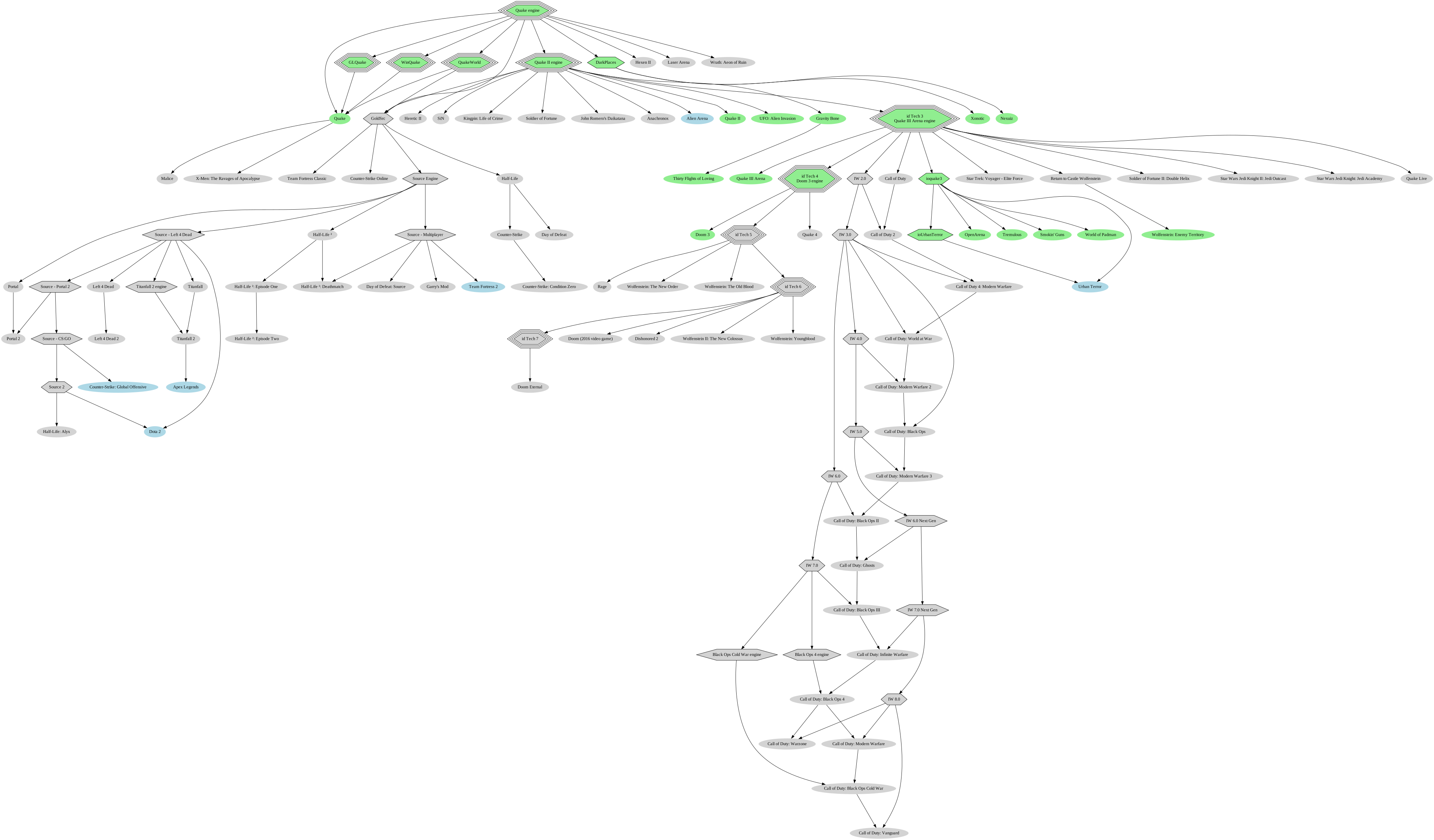
Was IdTech used outside of Id? Or was it just a Doom series thing as of recently?
Wikipedia actually has a family tree that's broader than I remembered: https://upload.wikimedia.org/wikipedia/commons/8/85/Quake_-_...
The CoD series, Source games (Half Life, Portal, Left 4 Dead), Titanfall, etc.
Huh? They were made open source when they were obsolete, Valve did license ID IP for the first Half Life but they paid for it. And that evolved indeed in Source.
I wonder what's happening to MachineGames...
Sure the Xbox division wasn't doing amazing but still had $24B of revenue in 2025. For reference PlayStation made $30B that same year.
So, I'm guessing internally there were some leadership hopes that IdTech would help support IVAS and related professional AR systems and when those failed to be adopted at scale, IdTech lost a key sponsor. I'm guessing it's been a rough year of internal advocacy since.
And tbh I'm not sure it was ever a plausible contender for commercial success, more like Carmack wanted to play with rockets. But that might be unfair; I would happily accept a correction.