Posted by chmaynard 22 hours ago
Well, one party gives away free walls if you agree to fill your castle with surveillance cameras you don't control.
> Many providers build their proxy pools by partnering with device owners who agree to share their bandwidth, while others use embedded SDKs in free apps or VPNs.
WTF. That's just botnets.
Source: https://www.fbi.gov/investigate/cyber/alerts/2026/evading-re...
If they have consent, they're not really botnets. Botnets involve infecting devices without the owners knowing.
With consent, it wouldn't be much different from e.g. open WiFis at restaurants and hotels, companies using a single ISP and single public IPv4 address for all their employees, and most VPN services.
There must be countless individuals all over the world who suddenly can't log into their Gmail or create any new accounts because a fraudster sent spam from their IP. I wonder: has anyone has tried to quantify that problem?
Places with open WiFi like hotels and restaurants would be having the same problem. People on CGNATs would be having the same problem. An IP doesn't correspond with a single user.
Highly unethical but the way the internet is going they're the last anti-hero of a somewhat open internet
They're most useful for getting information from the cloud hosted sites that hoarde most of humanity's output today like Youtube and Reddit.
The article was called "The one we're commenting on"
Does that sound like your typical self-hosted blog?
When compared to
> They're most useful for getting information from the cloud hosted sites that hoarde most of humanity's output today like Youtube and Reddit.
yes, absolutely.
unethical yes but really raises the question as to what we see is real or not
No they really don't, dishonest founders do that.
You're one with the lower case shibboleth so I have no doubt you surround yourself with dishonest founders, but faking users is pretty damn low on the usecases for residential proxies.
I said they're unethical because they tend to be hidden in innocuous seeming apps or sprung on unwitting individuals via clickwraps on their smart devices.
but ive never seen one raise $4.5m for an ai agent startup built around pulling fresh web data, then openly cheer the unethical proxy infrastructure used to evade consent and blocks
then inventing a fantasy about who i associate with instead of answering that conflict is an unusually loud form of projection
??? shift is an extra key to press
most shibboleths are subtle like that
> More recently, media-streaming devices have been identified as a major carrier of malicious scraping software. Sometimes the devices are compromised at the source; other times, they are just poorly secured and easily compromised after the fact.
I run an OPNsense firewall at home and the OpenWRT router at a hackerspace. Are there ways of auditing that devices aren't compromised? Tracking which devices still send lots of data when no one else is using the network?
Should be pretty obvious: client devices and internal services will have no traffic >95% of the time, just NTP for timekeeping, DHCP lease renewal, and associated ARP (running total: two dozen packets if you monitor them for a full 24h), then any system updaters (readily identifiable by the initial DNS requests), and finally of course you'll see the traffic of the service that the device hosts, if any, which can be easily dismissed by not looking at incoming connections (scraping uses outgoing connections)
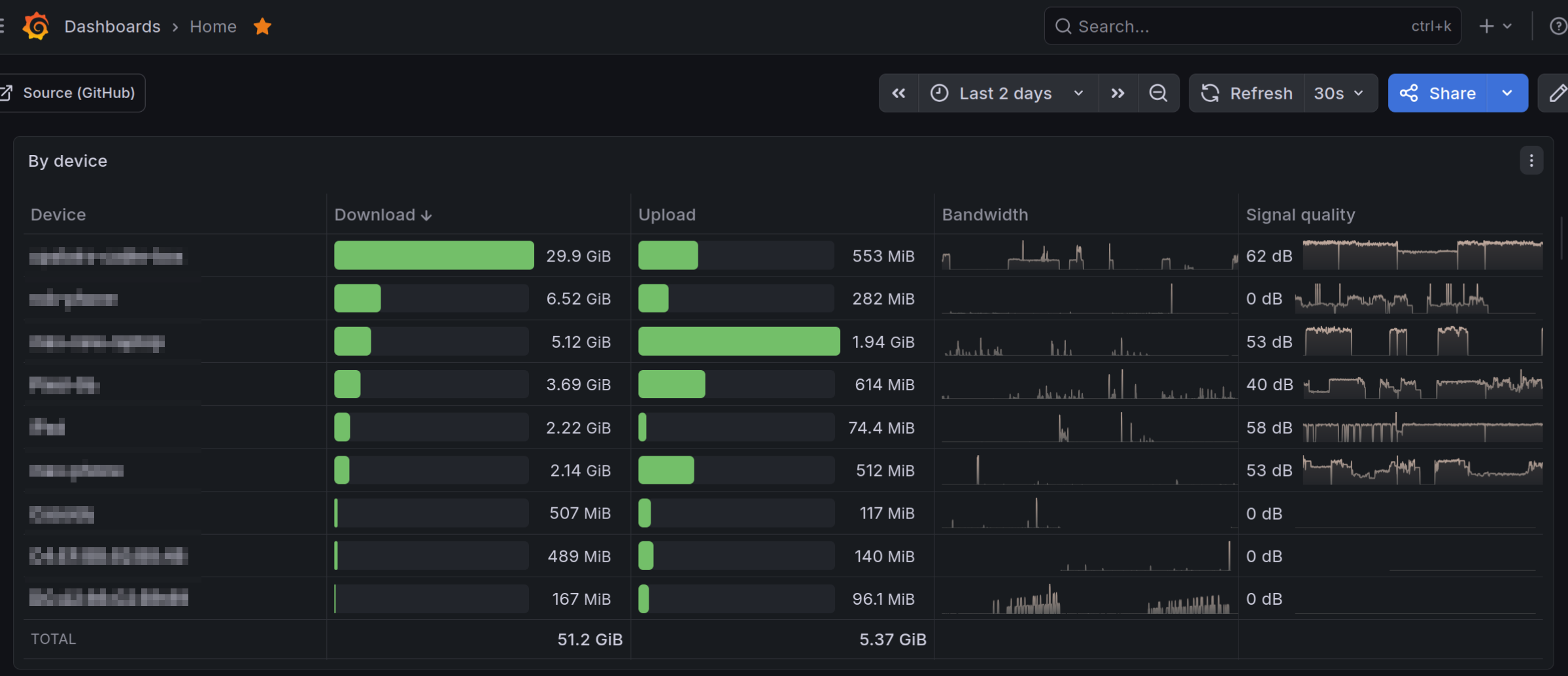
That's what I personally do at least: I have nlbwmon [0] installed on my OpenWRT router to track data usage per device, then I scrape it every minute with Prometheus and plot it in Grafana [1]. This helps me see if any IoT devices are compromised, but it probably won't help much if people are using sketchy free VPNs on their phones. I also adblocking enabled on my router [2], which helps block a few malicious domains (but certainly isn't a panacea).
[0]: https://github.com/jow-/nlbwmon
[1]: https://www.maxchernoff.ca/files/grafana-network-bandwidth.p...
The FSF has the right idea about all this:
> Some web developers have started integrating a program called Anubis to decrease the amount of requests that automated systems send and therefore help the website avoid being DDoSed. The problem is that Anubis makes the website send out a free JavaScript program that acts like malware. A website using Anubis will respond to a request for a webpage with a free JavaScript program and not the page that was requested. If you run the JavaScript program sent through Anubis, it will do some useless computations on random numbers and keep one CPU entirely busy. It could take less than a second or over a minute. When it is done, it sends the computation results back to the website. The website will verify that the useless computation was done by looking at the results and only then give access to the originally requested page.
> At the FSF, we do not support this scheme because it conflicts with the principles of software freedom. The Anubis JavaScript program's calculations are the same kind of calculations done by crypto-currency mining programs. A program which does calculations that a user does not want done is a form of malware. Proprietary software is often malware, and people often run it not because they want to, but because they have been pressured into it. If we made our website use Anubis, we would be pressuring users into running malware. Even though it is free software, it is part of a scheme that is far too similar to proprietary software to be acceptable. We want users to control their own computing and to have autonomy, independence, and freedom.
https://www.fsf.org/blogs/sysadmin/our-small-team-vs-million...
This makes it a prime target for aggressive scraping by LLM companies, but it also makes it accessible and fast, and a prime target for benign use (like archive.org or "read later" services).
For my own sites, I'll eat the cost of the crawlers (mitigated by making the sites as efficient as possible) and keep them available to everyone.
Maybe there's no point for the scanned server to block the address, but couldn't collective / shared block lists help with sites that may get scanned by the same address after the initial one?
The main problem becomes managing lists of millions of individual addresses. My (only semi-reliable these days, due to lack of time for maintenance) little project has nearly 2.3 million addresses recorded - although only 590k are from 2026, and only 38 were probes on ports 80 and 443. So maybe more manageable than I thought (but my servers don't host anything beyond personal interest to me, and access is filtered via cloudflare, which is it's own "internet control issue").
> In general, these companies range from those that aspire toward some appearance of legitimacy, advertising "GDPR compliance" for example, to others that are just overtly sleazy.
Overall, my gut feel on residential proxies is that they're an untrustworthy scourge. I'd be interested in any arguments for residential proxies by people who don't (intend to) profit from using it facilitating them.
In regards to Bright Data, one of the companies that attempts to appear legitimate, at minimum these domains should be blocked:
brdtnet.com
luminatinet.com
bright-sdk.com
luminati.io
As listed in this article, on HN's front page 34 days ago: https://news.ycombinator.com/item?id=48422993 (https://blog.includesecurity.com/2026/06/the-smart-tv-in-you...)
The users presumably don't know about this, or you know, they clicked, "I agree."
Nearly Half of LG Smart TV Apps Contain Residential Proxies
At which point, millions of people will be forced to complain to their local representatives and... hey presto? :)
I use them to scrape closed sites to make the information more open. For example YouTube.
More likely there isn't any kind of universal standard that's easy to implement for browser makers, has low overhead, and preserves internet users' anonymity as much as possible.
The currently existing friction of using micropayments is the problem here, I suspect.
I don't get it. Don't we keep blacklists of this stuff? And if they hammer thousands of requests per site per second and never reuse an IP, they'd run out of addresses in a few weeks.
Then they'd switch to IPv6, and... well, are we using IPv6 for anything important?
Like we need it for IoT, but do you want random IoT devices talking to your web server? (IPv4 handled mobile phones just fine not that long ago, right?)
Probably not, but since IoT manufacturers did zero to lock down their devices, those devices are doing a lot more than their owners think they are doing