Posted by theanonymousone 12 hours ago
https://files.parasmittal.com/openai_aa_luna_dsflash.svg
1: https://openai.com/index/advancing-the-price-performance-fro...
So, are they planning to announce an optimized coding agent harness as well ? DSv4 flash is a fantastic model, and my daily driver. With reasonix or pi, I can code all day long and pay a few pennies for it. No token anxiety. Whereas the same model with fireworks/openrouter, with zdr thrown in, token costs ratchet up with no explanation. Likely that the model is subsidized for gathering usage data. I am waiting for the day I can run this locally.
I am using openrouter with zdr guardrail which routes to any provider that supposedly doesnt train on user data. I also use fireworks (directly, not via openrouter) which is a provider promising zdr and has a bunch of open weights models. My issue is that these zdr providers dont transparently disclose caching/tokens etc and so they end up being far more expensive than directly using DS.
"For the Code Agent tasks among the public benchmarks above, DeepSeek-V4-Flash-0731 is evaluated with the minimal mode of DeepSeek Harness (to be released) as the agent framework, using the max reasoning effort level with temperature = 1.0, top_p = 0.95."
I meant something I could download and run.
Does the file hosting actually cost peanuts when you do it yourself and the cloud has shattered my understanding of what it actually costs to deliver so much data?
At the scale of Huggingface, that still amounts to a lot load of money. Significantly less than if you did the same in AWS, but still a lot
That said, they do have a deal with AWS to make the data available in AWS ip space. Maybe they got some cheap hosting out of that too
CDN costs are pennies compared to inference and training though, HuggingFace will just get another 100 million and be set.
Plus a size you can genuinely run at home: Unsloth lossless Q8 at 162GB.
But it makes little to no sense as long as API prices are what they are. Except for maybe privacy reasons.
owning a few GPUs is a lot cheaper than supercars.
I don't use it for local inference so much. I use it to learn.
I also use it as my daily driving Aarch64 development system.
Aside it's also very cool what else can be done with unified GPU memory, once you realize you have it...
maybe it is Fable level
It use the stock model, no new models requires.
Worth spend a few hours to try.
The DGX Spark requires a small hack to ignore the difference between sm120 vs sm121, but it does run on sm121.
It’s so cost effective I can offer a generous free tier since my goal isn’t to make money with it.
One feature of the app is that all scripture is verified and what’s show to the user doesn’t come from the LLM at all and instead a trusted source.
I think exploring scripture this way does not alleviate you from struggling to learn and apply it. It hasn’t for me.
But there are ways to control and constrain the LLMs and what the user is presented with.
These are all top of mind for me and why I felt there could be a better option than asking ChatGPT directly.
I think it depends, Catholics wouldn't be able to use this because the Magisterium is the ultimate authority on interpreting Scripture, so the personal interpretation isn't really needed. This is not to say that Catholics don't read the Bible, they are encouraged to do so since it deepens their faith
On the other hand, for Protestant it varies, the High Church denominations are closer to Catholics (though none of them accept the Magisterium) in terms of scripture interpretation, but the Low Church ones (like Baptists or Non-Denominational ) are more open to personal interpenetration.
Disclaimer: I'm a Catholic, so if I made a mistake here fellow Protestants, please correct me.
What's difficult and doesn't have to be with philosophy/ spirituality is to find relevant bits off situation, theme etc.
This app does that very well, LLMs are good at entity recognition.
I'm on a team that develops a Bible study app, and we're all relatively content with how the basic models converse regarding scripture. Even as far back as GPT-4 was excellent. They occasionally have minor hallucinations (a dealbreaker for a production app), but they do an excellent job with theology and Bible scholarship, given reasonable guardrails.
I'll admit I'm coming from the perspective of "should we be implementing this?" It seems, on the surface, that a strong embedding-based verse retrieval covers the bases at a microfraction of the cost.
If you're interested, check out the development server where we're working on this. You navigate to the search (magnifying glass) and then hit "Meaning". Sorry for the confusing route; we're still deciding on back-end details and haven't focused on the front yet.
So it’s less about model choice and more about governance of scripture.
I will check out the link you sent for sure!
Anyways, impressive app! We haven't tackled such an ambitious project just for it being daunting.
flash is suitable only for a toy apps, not for production environments :)
Deepseek v4 Pro prices with Opus 5 perf would be freaking unbelievable!!
This is probably a dream.
https://artificialanalysis.ai/models/deepseek-v4-flash?intel...
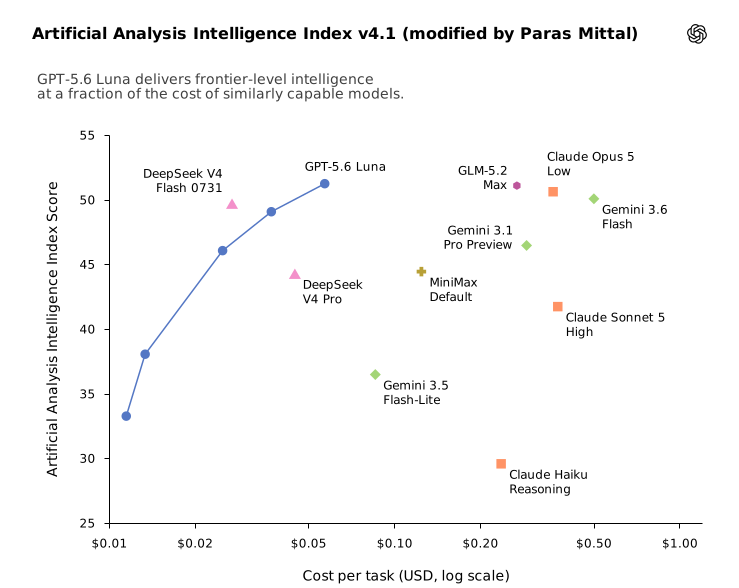
First, your direct comparison, Deepseek V4 Flash 0731 (max effort) $0.03 (rounded up) per task @ index 50.
OpenAI Luna:
* high effort $0.03 (rounded down) @ index 46
* xhigh effort $0.04 @ index 49
* max effort $0.07 @ index 51
So I would say a fair statement would be "OpenAI Luna between 2x and 3x the price of Deepseek Flash, what you get is 2 to 5 times faster inference"
The cheapest OpenAI model that beats it is OpenAI Luna (max effort) $0.07 @ index 51 (if you take the rounding out it summarizes to triple the price for similar performance), but still close to 3x faster.
And can SOMEONE please tell artificialanalysis that using dark blue for both Deepseek AND OpenAI is an especially unfortunate choice of colors, especially today?
For simple tasks, they're already saturated, and you'd prefer the faster model, so that you can have a realtime/interactive-ish experience.
Or to put it bluntly, it's cheaper if you don't value your time. That goes for smaller models in general -- need more handholding, more correcting -- but the Chinese ones are slower on top of that.
As for speed, Sol on Low is faster than Luna on most settings.
uhh openai is dark gray: `rgb(31, 31, 31)` and i'm pretty sure it always has been?
It’s also so inefficient, when they release the full performance numbers it’s not going to be good.
One example, it takes about 3.6x more tokens to finish the same work as Gemini Flash 3.6.
That depends. Is it also more reliable?
If two books, one big one slim, prove the same thesis, what I would be interested in is the quality of the content, not the size. There can be a measure of efficiency in "have you really thought it through", but it is clearly complex - it requires measuring how solid the reasoning is.
Mind you, until the recent price cuts to Luna - Gemini 3.6 Flash wasn't even egregiously priced (but oh how things change in just 1 week).
It's good.
> who is the customer
If no one else, then definitely those that can only budget $1/mo to $5/mo. Probably 100s of millions, if not billions, of the Global South.
[0] Free access to DeepSeek v4 Flash is indeed available from providers like OpenRouter, OpenCode, and Freebuff (to name a few), but no ZDR.