Posted by theanonymousone 11 hours ago
"Resistant starch intake facilitates weight loss in humans by reshaping the gut microbiota"
https://pmc.ncbi.nlm.nih.gov/articles/PMC10963277/
Edit: Ah, HN submission 2 years ago: https://news.ycombinator.com/item?id=39592367
this is a great study if you are an overweight/obese adult without overt metabolic disease, willing and able to consume 90 g/d of starch supplement within a controlled diet, and living in Shanghai with similar baseline fiber intakes endemic to that population. it is extremely not generalizeable to you or even me though I fit more of those characteristics than I care to admit
stay skeptical of small studies like this, friend
But there's already a general advise on this: eat more fiber.
https://med.stanford.edu/news/all-news/2017/08/hunter-gather...
We're a great ape, our body evolved to process a lot of fiber from fruits and starches. It's the modern fiber-deficient diet that's really weird.
90g/day of fiber is similar to the Hadza tribe diet, where they can consume 100-150g of fiber per day.
sample size is 37, number of authors 29
But obviously, most people are a lot more interested in finding a magic food which does this rather than a proven calorie deficit, which is highly effective.
Purely behavioral lifestyle interventions have the lowest long term success rates of all available treatments for obesity. It's especially unreliable if you have weight loss targets higher than 15%.
They are of course still widely recommended due to numerous benefits other than weight loss, but "highly effective" is just wrong in the context of obesity treatments.
It's the same thing for the mental issues epidemic... you can't build a completely hostile environment to human life and well being and then say "welp, I guess we need drugs to make you feel normal now", now they'll sell us the drug and the cure, and you'll be clapping and thanking them for saving you, truly amazing.
What? Surely changing one's behaviour - particularly the parts of behaviour that caused the obesity in the first place - is a sure way to stop being obese.
If you opt for it, then yes of course, abstinence-only sex education is a sure way to stop ten pregnancy.
Similarly, if you opt to change your lifestyle and start living healthier, and follow through, it will work.
If someone tries to force you, of course it will fail (in both of these cases). There is no way to stop someone else from being fat. We can only change ourselves.
It's funny how proposing an healthy diet is unrealistic and watching fatties eat themselves to death is the new normal, complete value inversion and looser mentality
Behavioural changes work, the issue is that most people don't actually change their behaviour.
It definitely is not "you can just go on a calorie deficit", that is how jo-jo effect works.
For average person that has children, full time job, and whole range of adult responsibilities it is hard. Not impossible but hard, this is why people are looking fo easier solutions.
I've lost weight through forcing myself into a calorie deficit, and it works really well, but it's not particularly fun.
For the "eat to get slimmer" claim, I think we're at the point where "extraordinary claims require extraordinary proof."
What do you mean by "these foods"? Just buy unprocessed food and 99% of the problems disappear. There is no fake, no people trying to sell you these out of malicious intent. Just buy local food people had access to in 1900 and you'll cure all your problems.
A good dietician is worth a few consults if you don’t have the will power to just fast. And as a bonus you don’t lose muscle mass as well because they’ll focus on keeping protein up.
Fasting is like using a nuke where a bullet would do.
How will a dietician measure your maintenance calories? How will they continuously update your macros and calories when your maintenance calorie change week to week?
I am making a claim here: most dietician will not be able to track your maintenance calories better than MacroCodex's algorithm.
Many dieticians simply rely on BMR/TDEE static formulas, and the limitation of this approach is that it cannot reliably track a user's actual maintenance calories well through the span of their dieting journey.
Short term "diets" are nonsense. The solution is permanent lifestyle changes.
How are you defining highly effective? In the sense that a body will definitely lose weight when starved? Or in the sense that counting calories is broadly effective as a weight loss strategy?
The former is painfully obvious and entirely unhelpful, and the latter is provably false.
Anyway what's cute about this is that this isn't novel phenomenon. There are lots of parallels to this in other fields where often effective solutions do exist, but at a system level don't seem to work.
Telling people to diet doesn't fix population level obesity. Telling people about personal financial management doesn't stop people from accruing too much high interest debt. Telling teenagers to stop idolizing instagram influences doesn't fix body anxiety issues. Telling people to stop smoking/drinking doesn't fix addictions. 3-2-1 data backups absolutely work but people lose files all the time.
If your maintenance calories are 2700kcal and you eat 300kcal less than that, is eating 2400kcal starving for you?
Most people cannot tell a difference if they eat 100-150kcal less in a day.
>Or in the sense that counting calories is broadly effective as a weight loss strategy?
Yes, it is, and the reason people fail with it is not because calorie counting doesn't work, but because people's maintenance calorie estimates are often poor.
Deficit = maintenance calories (TDEE) - calorie intake
In this, even if your calorie tracking is on point, a deficit requires you to have a decent estimate of maintenance calories.
To throw a monkey wrench into all this, your maintenance calories often shift downward as you progress in your "diet" journey.
It's already factored in our algorihtm: https://macrocodex.app/knowledge/macrocodex/smart-calorie-bu...
Method here: https://macrocodex.app/knowledge/rethink/adaptive-tdee/
People can find the algorithm here: https://macrocodex.app/knowledge/macrocodex/smart-calorie-bu...
In fact, our claim on the app is results within 2-5 weeks for both weight gain and weight loss; I've yet to find a guy who did not achieve success with this.
Calorie deficit is the most effective method for weight loss.
What's funny is when people actually measure their metabolism with this approach, they realize they aren't far off from the average!
I don't disagree that calorie restriction is effective. I just think that you're dropping appetite from the equation when GLP-1 agonists have proven that reducing appetite is effective too.
I am not anti-GLP, someone who believes using GLP drugs is cheating and people should achieve that with blood, tears, and sweat. I see it as a "tool" in the arsenal. I've no use for GLP as I've no problem sustaining deficits as large as 600-700kcal for long. But I've met people who can't do this, so for them GLP is a valid choice, but I'd recommend they pair it with proper dieting and lifestyle changes.
You want to eat good stuff and avoid stuff not good for you; blanket reducing appetite may result in loss of both good and bad.
Here's what GLP users say about the macrocodex method: https://www.reddit.com/r/tirzepatidecompound/comments/1omfgx...
The guide linked in the above post is macrocodex's prototype method, which was later formalized into an app.
I don't want to make strong claims on this, but using GLPs may increase the risk of developing gallbladder stones, as GLPs make it very easy to eat far less than necessary.
A proper macro and calorie balanced diet can give you better results with a smaller GLP dose.
Use GLPs if your actual problem is staying on a "sustainable deficit." Many people who use macrocodex report they do not feel hungry when on such a small deficit, but there are a few who are hungry even at a deficit as low as 300 kcal; for them, GLPs are more suitable, but not a replacement for proper dieting and lifestyle changes.
I mean, observing the weightloss / gain or lack thereof itself will tell you whether you need more of a calorie deficit or surplus. What does an independent metabolism estimate buy you?
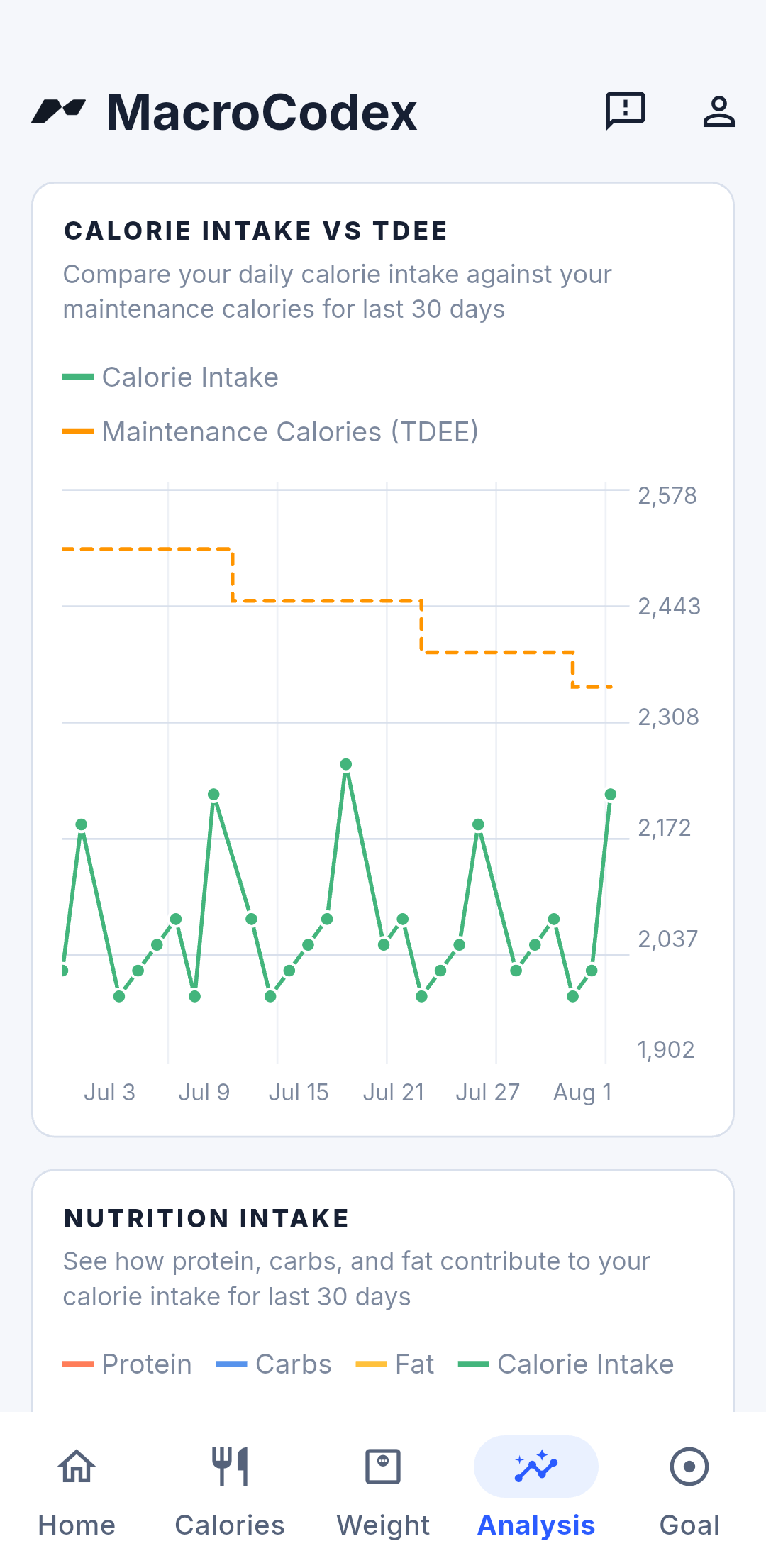
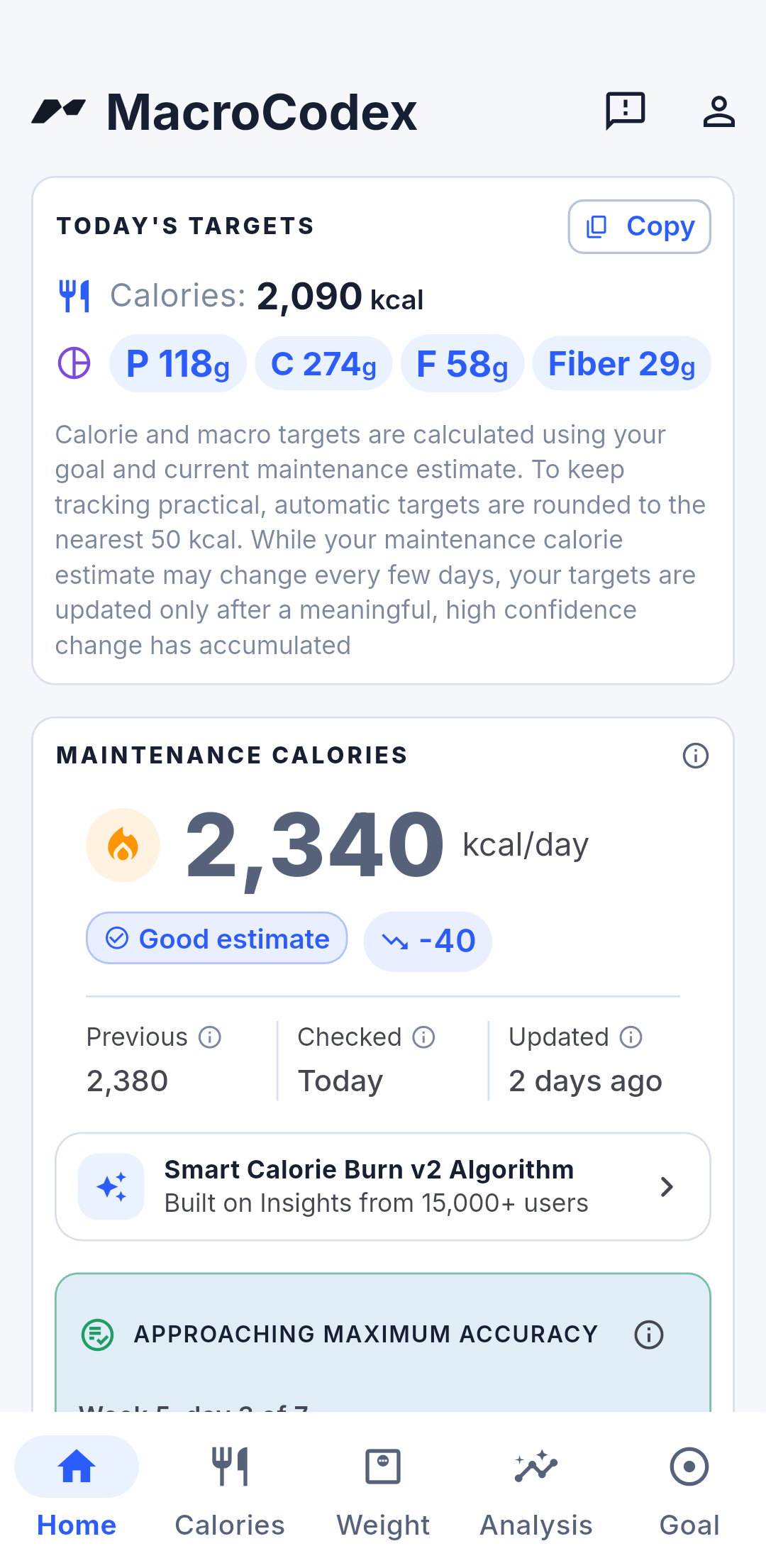
How difficult is it? Just eat below the orange line to lose weight and eat above the orange line to gain weight: https://macrocodex.app/assets/hero-tdee-line.v3.1b8c60c2271f... In the image, you see the app continuously updates maintenance calories from observed evidence; on the homescreen, it provides the calorie and macro targets you need to follow: https://macrocodex.app/assets/flow-targets.v3.edc3f34458a1.p...
It was never this easy, imho. Many people used TDEE calculators in past, which suffer from the limitation described here: https://macrocodex.app/knowledge/rethink/adaptive-tdee/#tdee...
It's useful for both Newbies and Pros.
When a person figures out their maintenance calories and looks for the average metabolic rate / maintenance calories for their height, weight, and gender, they realize they are not "genetically inferior" or have some serious issue which is stopping them from progressing if their maintenance calories are within average range!
Just knowing that there is nothing wrong with your metabolism gives people enough push to continuously walk on this path and achieve their goal.
>I mean, observing the weightloss / gain or lack thereof itself will tell you whether you need more of a calorie deficit or surplus.
You can read app reviews and these will tell you, complete newbies are having great success with this approach.
If you ask a layman on the street, they'll tell you eat less to lose weight, eat more to gain weight.
The question is: what is less, and what is more? How many calories precisely do we need to eat to achieve 1lb per week of weight loss?
Your total calorie burn for the day changes week to week; people don't know how to make the right adjustments.
Many people crash diet; they lose weight, then they cannot sustain it for long, binge eat, and gain it all back.
What key knowledge are they missing? Sustainable deficit. If you apply a sustainable deficit over a longer period of time, you may not "suffer" as much as you would otherwise
I am not saying drastic deficits are not useful; they are to those who are experienced. Let's say an MMA guy or bodybuilder can do it just fine!
Also, for lean bulking in natural bodybuilding, you need a specific rate of weight gain; let's say for a beginner it's a weight gain of 0.25–0.5% of body weight/week. It's hard for many to achieve this precise range because your maintenance calories are changing all the time!
And if you are an advanced lifter, then the rate of gain you want to target is even smaller: 0.1–0.25%/week.
That's why pro natural bodybuilders use Macrocodex and find it useful.
for those that aren't, you can't actually measure metabolic rates this way.
for a way to actually measure it see: https://en.wikipedia.org/wiki/Indirect_calorimetry
Baer, David J., et al. "Dietary fiber decreases the metabolizable energy content and nutrient digestibility of mixed diets fed to humans." The Journal of nutrition 127.4 (1997): 579-586.
> The study was conducted in Shanghai, China from 3 July 2013 to 14 October 2016
Figuring out and understanding the physiology of different gut bacteria is not just for people trying to shortcut weight loss while still eating unhealthy food or to be sedentary all day.
Somehow American Heart Association and its European counterpart are in denial, and still pushing dinasour screening mechanism with very low accuracy for heart disease risk prediction.
The standard risk model for CVD based on PREVENT (US) and SCORE-2 (Europe) like parameters are very poor as reported in the recently published paper on the their accuracy performance by the Swedish team [1]. As all CVD risk stratification with cardiologist review (expert-in-the-loop), the most important accuracy metric is sensivity/recall (avoiding false negative that will escape review) of PREVENT and SCORE-2, 26% and 48%, respectively.
The paper alternative proposal increased the sensitivity to 58% by performing clustering instead of conventional regression models as practiced in the PREVENT and SCORE-2.
These type of models including the latest proposal performed very poorly as indicated by their otherwise excellent and intuitive display of graphical abstract results [1].
[1] Risk stratification for cardiovascular disease: a comparative analysis of cluster analysis and traditional prediction models:
https://academic.oup.com/eurjpc/advance-article/doi/10.1093/...
https://www.mayoclinic.org/tests-procedures/heart-scan/about...
https://www.mayoclinic.org/tests-procedures/ct-coronary-angi...
My dad’s doctor said he should get one, Medicare denied it, but he paid out of pocket to get one anyway. He found out he was 95% blocked pretty much everywhere and had a quadruple bypass. It likely added many years to his life and avoided a heart attack.
If you’re under a certain age (I want to say somewhere in your 50s), there isn’t any guidance for what normal is. If you’re in your 20s or 30s, I wouldn’t run out and get one. But if you’re in your 40s with a family history, or up into your 50s and beyond, it’s worth thinking about. I’ve also heard you’re only supposed to get them every 2-3 years, it’s not a yearly thing, due to the radiation.
(I am not a doctor)
The time to take action is long before you have a CAC score. e.g. Start tracking ApoB regularly, see if you have genetic LPa exposure, and avoid the foods that increase your exposure while ignoring the grifters telling you it's a nonissue.
Emphasis on non-invasive diagnostic screening as invasive testing like angiogram need to be operated by specialist and can take months to be arranged, and only done after incidents e.g heart attack.
ECG is excellent for generic top level CVD anomaly conditions for examples arrhythmia and ischemia.
(Edit: This is intended to be sarcastic. I agree 100% with the comment)
(Edit 2: Added the smiley face)
A lot, probably. You could sell people on the idea that it should be a part of your yearly health screening.
"And if you really care about your health you should do them every 3 months to catch problems early!"
or some such.
An ECG if it was just part of the normal yearly panel of things that get looked at I don't think ppl will stop doing it just because it doesn't find something right away
I do not consider the average HN commenter to be average.
Getting an ECG, EKG, TTE, CAC, carotid duplex US, lipid panel, CMP, TSH, 25-OH Vit D, B12 + folate were what my cardio recommended before appointment #2 on hypertension. Both of us are data guys.
Those are the same thing, did you mean to type something else?
BMI is easily misunderstood by people who know just enough to see that it’s imperfect, but not enough to understand why it’s still a valuable screening tool.
I’ve been in the “overweight” BMI range with low body fat before. It’s not too hard to get there if you’re lifting weights and paying attention to your diet consistently for years, but it takes a lot of work to get there. It doesn’t happen accidentally except for people who win some genetic lottery to build a lot of muscle and keep body fat low without trying.
Getting all the way to the obese BMI range while having healthy body fat is only happening for people with an extreme dedication to body building and diet (and let’s be honest, a lot of the people in this category are manipulating hormones too).
Yet whenever BMI comes up some people try to dismiss it as too flawed based on these possible edge cases. The edge cases for BMI exist, but that doesn’t mean it’s not useful. It’s a good general purpose screening tool with numbers that are available. If someone has more precise measurements available, those should be used instead. BMI is a really good first pass screener to determine if a closer look should happen.
In other words, for my height, I have a very long torso and very short legs. I think it should be relatively obvious that an inch of leg weighs significantly less than an inch of torso, so at a given level of body fat percentage, I'm going to weigh quite a bit more than someone my same height with more typical proportions, and thus my BMI reads me as more overweight than it otherwise would.
My point is not that BMI is bad or useless or anything else. My point is that it was designed as a population statistic and that it can be fraught when one tries to apply it to any individual with no nuance. A high BMI should cause one to consider and examine your health and weight. But it should not over-ride specific details about your physiology that point in the other direction.
People tend to think in absolutes. Even perfectly rational people fall logically foul to not considering outliers.
Did you do that as a natural lifter? It’s hard for me to imagine most guys being able to get into the “overweight” range at < 15% body fat without some assistance.
I am only 6' and only an intermediate lifter. I'm overweight, but BMI makes me look obese. It really only takes a normal person a year or so to get to three plates on squat with no supplements other than chicken broccoli and rice if they don't skip workouts. Assuming no injuries. That level of strength easily distorts bmi wildly if you are even a little taller than average.
Anything to pretend they aren't too heavy.
And sumo wrestlers.
The line seems to be drawn at (effortful) activity level more than anything else. And BMI doesn't say anything about that.
I think the vexation comes from the focus on an attribute that is not directly mutable, per one's agency, because that's easier to sell things related to. Versus action that you have a lot more direct control over (social or physical circumstances notwithstanding).
(from https://en.wikipedia.org/w/index.php?title=Sumo&oldid=136533...), so I'm not sure this is a counterexample.
Many active gym people have pretty high BMIs but fairly low fat (because muscle is dense), and unsurprisingly have better outcomes than the average person (if you ignore the share that uses/overuses anabolic steroids and co)
I think this is greatly exhaggerated.
Yeah you can put on as much muscle as Arnold and have a FFMI of about 27 then maybe have a BMI of 34 if you have 20% body fat.
But a very gifted natty might cap out at maybe 24 with a BMI of 30 at 20% bodyfat. But let's be realistic. This is not "many active gym people". This is the guy winning the local strongman meet.
Yes a couple of years training for most people can add a couple of points to BMI but I think people exaggerate how much this is. Go look at a 20lb brisket at costco - you don't see people with that much extra muscle all that often.
At 6 feet / 183 cm that it takes 184 lbs / 83 kg to be overweight. From what I could find, for regular gymgoers the typical weight for people around 6feet is 180-190lbs, which put many people around the overweight threshold. I am myself at 24.9, and while not skinny I am definitely in the skinnier half of the people at my local gym.
Yeah really well muscled guy being BMI 27 is probably ok but by 30 it's not natural muscles that are making the scales go up.
And obviously genetics matter, but it look at master level soccer players: athttps://pmc.ncbi.nlm.nih.gov/articles/PMC6239137/
I’ve been in the overweight BMI category with low body fat by being active at the gym and focusing on diet. It takes some work to get there.
If I check the calculators for the obese BMI range, there was no way I could get there without either gaining a lot of fat on top of the muscle. The amount of muscle required to have an obese BMI with healthy amount of fat is absurd.
E.g. 20% bodyfat at 250lbs is still a lot of fat.
Of course it's difficult to ever get very high on absolute fat if at 15% or below.
Additional muscle is positive for health, but only up to some reasonable threshold. There is no health benefit to having very high levels of muscle, and in fact it may be negative for your health at extreme levels. E.g. many bodybuilders have trouble breathing, sleep apnea etc.
Both people in the example have 60lbs of fat. 1lb of muscle doesn't cancel out the negative health effect of 1lb of fat
It’s not the fat that kills. It’s oxidated lipids that kill.
1. https://www.cdc.gov/nchs/data/series/sr_03/sr03-046-508.pdf
As for 2, men in the US are getting shorter because of immigration which adds many confounders.
https://medlineplus.gov/ency/article/003998.htm
"People typically lose almost one-half inch (about 1 centimeter) every 10 years after age 40. Height loss is even more rapid after age 70. You may lose a total of 1 to 3 inches (2.5 to 7.5 centimeters) in height as you age."
So people DO in fact tend to lose about 2 inches at age 80 versus their younger selves.
I often wonder far from the median I am in this regard. I was under the impression that it was pretty accurate for assessing populations, but fell apart very quickly at the individual level. How many "normal"/otherwise healthy people do fall outside BMI's numbers?
BMI has known biases in gender, age, and race. It misclassified Asians, women, elderly w sarcopenia, and people with high body fat to lean tissue ratio.
The people most obsessed with "BMI isn't accurate" are overweight people making excuses for themselves.
I like to think of this as four quadrants around two axes. Low fat/low muscle is simply skinny. High fat/high muscle is the "big guy/gal" look that I associate with laborers. Low fat/high muscle is an athletic look; unhealthy in extremes (bodybuilding) but generally desirable. High fat/low muscle is skinny fat, which I associate with sedentary knowledge workers.
[0] And that, at least somewhat, tracks visual perceptions. Nobody looks at me with a shirt on and believes I need to lose weight, because 10-15lb isn't _that_ much extra on a tall frame. If I were 40-50lb overfat then that would be painfully obvious regardless.
My actual methodology is pretty crude though -- when I was 15lbs lighter I had borderline visible abs and other visual indicators of being around the 15-20% body fat mark, and aside from gaining weight I don't have any reason to believe I've had any notable muscular atrophy since then, so I'm estimating the actual excess fat in that ballpark. It's be easy for numbers to be off 10lb or more, but even then it'd still indicate the overfat surplus being much less than the overweight surplus.
A better methodology uses calipers and various skin measurements to estimate true body fat percentage.
"Overweight" can mean the same thing for weight, but it also refers to those with a BMI specifically between 25 and 30, and those with BMIs greater than 30 are classified as "obese".
It's specifically a high level of visceral body fat.
Genetics determines which parts of the body gain fat first as you gain fat overall, and some people have the unfortunate genetics to gain it first viscerally and some people have the fortune to gain it there last (and everything in between).
This means that you can have different people with the same body fat percentage but drastically different disease risks.
But yes this was also known already.
That's why it's been recommended to take a waist measurement alongside BMI to get a much more informative screening tool. Waist-to-height ratios are another alternative.
It is what is called “skinny fat“.
It's just a particular type of abdominal fat so obviously the more abdominal fat that you can see it means you also have more of the type that can't see as well... It's not that complicated
BMI
Waist circumference (WC)
Waist to hip ratio (WHR)
Subsequent risk of nine cardiovascular/mortality outcomes in >260,000 people followed for ~20 years
To make it even more useful they should have included DEXA scan bodyfat%.
Also, BMI becomes somewhat biased at height extremes because body mass doesn't scale exactly with height². Humans aren't geometrically scaled copies of one another and empirical scaling exponents are often somewhere between 2 and 3. Conventional BMI tends to read relatively high in very tall people and relatively low in very short people. But changing the exponent would only fix one relatively small limitation of BMI
For better height adjusted replacement for BMI itself, one option is Trefethen’s BMI
WHR and WC is positively correlated to bodyfat% but this may get distorted for strongmen or sumo wrestler who tend to have much higher than average lean mass, may also have higher WC and WHR but difference maybe waist to shoulder ratio, they tend to have much bigger and powerful shoulders.
what's interesting is, for sumo wrestlers specifically, WC still correlates strongly with BF% one study reported r ≈ 0.86
There is a category in fitness called "skinny fat" where you are at low bodyweight (so low BMI) but your fat mass is relatively higher when compared to lean mass, so higher bodyfat%
Many skinny fat people refuse to believe they carry higher bodyfat% because they think they've low bodyweight so they can't possibly carry higher fat, which is wrong.
If you are interested in knowing more about bodyfat, this may help you: https://aretecodex.pages.dev/knowledge/measure/bodyfat
Thirty years after we learned that abdominal fat distribution matters, large-scale longitudinal evidence shows that waist measurements meaningfully reclassify cardiovascular risk beyond BMI alone.
For example, I’m 45yo/178cm/93kg and am obese by BMI measurement. However, my body fat is 20% (Dexa), VO2 of 50 (lab) & have the aerobic fitness to run a half marathon after work and not care.
I’m not surprised that you need other metrics like hip/waist ratio, measured body fat, visceral fat, etc to better understand the composition of someone’s body and how it might relate to health outcomes like heart disease.
Any idiot with a bathroom scale and a measuring tape can do it. And by adulthood, height doesn't change significantly and you probably know it, so you may not even need that measuring tape. Other metrics need specialized equipment, error prone or complex procedures, etc... I don't even know how to make a waist measurement. Where exactly? How relaxed should the subject be? How long after eating?...
That's the value of BMI: simple repeatable. Not the best but enough to get and idea and make statistics.
But height does change in adulthood [0]. On average people living past 40 gradually lose height. At age 80, it's likely height loss will be >=2 inches. This loss is reflected in higher BMI even when body fat content hasn't changed. Average BMI increase isn't large, but think about a person losing 4 or 5 inches of height while maintaining body fat unchanged.
Self-reported height is generally greater than measured height. Adding 1/2 to 1 inch is common (per experience measuring height). "Height inflation" has modest effect on BMI but problematic in research and workup for medical procedures. In the latter cases, measuring height is necessary.
[0] https://www.uhhospitals.org/blog/articles/2024/10/why-do-peo...
If I'm reading that right, it sounds like obesity (and therefore BMI) is still a better predictor for all-cause mortality. Perhaps waist circumference is better at predicting cardiovascular risk but BMI is still useful.