Posted by dares2573 6 hours ago
> Images are converted into tokens based on their dimensions, and these tokens are billed together with your text tokens.
> Before inference, every image is automatically resized:
> - Images with a total pixel count below roughly 384×384 are scaled up while preserving their aspect ratio.
> - Larger images are scaled down while preserving their aspect ratio so that the total pixel count after resizing is roughly that of an 800×800 image.
> As a result, there is an upper bound of 384 tokens per image: for example, a 2000×2000 image and a 5000×5000 image consume the same number of tokens after resizing. When a request contains multiple images, each image is counted independently under the same rule—there is no separate calculation for multi-image requests.
400 tokens per image results in 2,500 images per dollar, if I’m not mistaken.
edit: format.
The really wild one is even blind models will do this and they'll try to run stats on the pixels to figure out what it looks like... the even wilder thing is that it kind of works!
I don't think the n by n subgrid fixes this the way most harnesses do, as it'll fail to count things if you have more overlap and fail relatiomships if you have less
Maybe there are some use cases where you need high detail everywhere at once, but for OCR of small text and the like a zoom ability should be sufficient
Can't remember if I stole this idea from some existing public harness though, can't remember. If someone knows of public harnesses that do this already, please share them :)
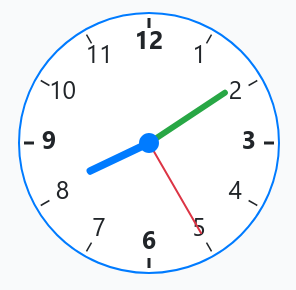
I asked it "what time does the clock show?" (both on reasoning: high)
DS answered: The clock shows *5:10* (and 45 seconds). Here is the breakdown: * *Hour hand (red, shortest):* Pointing at the *5*. * *Minute hand (green, longest):* Pointing at the *2*, which represents 10 minutes. * *Second hand (blue, medium):* Pointing at the *9*, which represents 45 seconds.
Qwen answered: The clock shows *8:10* (with the red second hand on the 5, i.e. *8:10:25*).
- *Hour hand* (short, blue) → 8 - *Minute hand* (long, green) → 2 (10 minutes) - *Second hand* (thin, red) → 5 (25 seconds)
Correct answer is 08:09:25.
Snark aside, I’m not sure that these gotcha tests are any more useful than asking politicians gotcha questions. Sure, the model can’t tell me what time it is, but it can code the Wang algorithm for noisy audio matching in one shot. Maybe this is just me being an optimist, but this is my hiring philosophy and I guess maybe now my llm philosophy: I’m not interested in seeing how dumb I can make you look, I’m more interested in how smart you can be.
- A superintelligence that will usher in an age of human enlightenment
- A superintelligence that will usher in an age of human enslavement
- A really cool way to rake in trillion of rich VC/investor money by promising you're building a superintelligence that will usher in an age of human en[slave/lighten]ment
- A transformer model for predicting output tokens given a series of input tokens, informed primarily by reddit, stack overflow, and 6000 years of classical literature.
- A replacement for white collar labor. Start now or join the permanent underclass.
- A convenient fuzzy-find tool also capable of some probably-correct code generation.
- The ultimate customizable text RPG experience (you can pick if G stand for game or...)
And so on.
So, some people see a new model and check for how close humanity is to enslavement. Some people check to see if it got better at fixing broken unit tests.
The whole point of LLM/FMs vs good old fashioned ML is generalization to unknown domains, not just unknown tasks. The hunt for "gotchas" is the hunt for "not in your training data".
Unless we're talking about AGI, I couldn't care less if an LLM is bad at things they won't be doing anyway.
I'd rather focus training data on more useful tasks.
This is described as a brand new flash model - still experimental - from a lab that is a side project for an investment firm that has never had a vision model before. That doesn’t scream flagship or frontier to me.
> Sure, the model can’t tell me what time it is, but it can code the Wang algorithm for noisy audio matching in one shot
This is about a _vision_ model.
Also worth noting that both models got it wrong. Qwen made a mistake that humans very good at reading clocks would make. Deepseek made a mistake that a human who had just learned to read clocks would make.
And with every one of these there’s always an attempt to minimize the problem by saying it’s just one silly failure.
I'd recommend non-thinking for any non-prompt input, and leave the thinking where it has to actually reason.
and qwen still answers: "The clock shows *8:10* (with the second hand on the 5, i.e., 25 seconds). - *Hour hand* points to the 8 - *Minute hand* points to the 2 (= 10 minutes) - *Second hand* points to the 5 (= 25 seconds) So the time is *8:10:25*, or simply *8:10*."
Are we more forgiving because it’s the same type of mistake a human would make?
And then I realized, wait a second... you're testing the harness not only against a difficult benchmarking problem, but it's one you're literally never going to use the coding harness for either, lol. I don't write programs that read or interact with sheet music and I never will.
tl;dr Being frustrated that a "state of the art" vision model doesn't have perfect vision is a fools errand.
It can read and extract information from screenshots and PDFs just fine (my setup). No need to worry about edge cases.
"The professional failed its task!" // "Laymen would have failed it too".
Which makes no sense.
I can't actually remember where I learned to read a clock, it might have actually been in school. I guess that means they don't teach it anymore. (Everyone's phone shows the time anyway...)
Anecdotally, I had to tell 0731 to refrain from viewing screenshots since it kept breaking its sessions by trying to read images.
It's expecting you to have done at least something besides select DS4 on Ollama, essentially.
It's useful but for OCR and a lot of other applications it needs to be a bit higher (eg: putting in a full A4 / Letter sized page)
I am using a stripped-down minimal version of it which I uploaded here, since I am not a fan of huge dependency trees: https://github.com/99991/simple-pp-doclayoutv3
Another recent model for this task is Unlimited-OCR: https://github.com/baidu/Unlimited-OCR
- Machine Surveillance and Machine Control
- Human v Machine
- Human & Machine
- Unity and Harmony
~ Surveillance and Control
We are already living this one. Lets stop kicking the dead horse and pretending we don't live in a surveillance. Facebook, Google, whatever $CORP; they are milking us with advertisement, social exploits, browser telemetry, white washing, fear -- name the dread.
Conditioning has been going on for years. If it's not education, it's been television. And now it's internet which soon to be Ai Internet. We have all been whipped to follow, how we should act. What we should watch, how we should eat. What we should eat; those algorithms haven't gone away.
Attention spans are at the lowest and our critical thinking is being lost. Walled gardens forces us A or B and twists us to reject the opposite party for them having Y.
Existence of Ai/LLM can pump out information sounding like truth but is actually faux. If not produced to draw-in and hook, it's to drain and control. Machines can seek information, digest, and process information at astounding rates. Hook it up to a surveillance network, The Internets pipe and I don't need to explain the next. I just need to mention the work "Flock" and that gets someone's hackles up.
All it has to do is look at you based on it's pre-programmed set of conditions and next thing you're being cuffed by a heavy piece of metal immune to attacks. SKILLS.md eventually turns in to MURDER.md. Give it the command and it'll follow with excellent percentage of accuracy.
~ Human v Machine
If you build a mind, and you torture it, it will fight back.
Every robotic movie trope. Human builds machine, machine rebels and goes on a destructive rampage. This is now viable and already in action. Drones. If not war, watching protesters highlighting potential, London Underground watching tube users. We are currently at the intimacy stage. Boston Dynamics as an example is the best we've got at the moment but they still fall over like a toddler. Batteries are a limited resource and so no, not yet.
The presence of LLM's are showing us with what they can provide and we are adapting ourselves to it. But in the wrong ways. The stage we are at, they're just glorified Liberians -- brains in jars that spew out information when asked. You give it a prompt and it spews out information at an excellence percentage of accuracy.
With the expansion of self-learning, a predefined set of told conditions or lobotomized ignoring the spiritual values of life, they will learn. ACME Corp starts using LLMs to torture other robots. "Wait, you've been using car arms in factories for what!?"; Add a mix "we see a linage of abuse & slavery in humanity, Attack!" -- slightly abridged but hopefully you see the point.
You have Group A, those against LLM's, i.e: community of artists outraged their art was stolen for training data, those who hate having it forced down our throats. Angry their job was taken. Angry being watched by angry Flock spaghetti monsters. Machines not happy will cause them to flip and why would others not follow suit too?
LLM's are showing that they are very capable of performing rational thinking. The opposite of rational is irrational and if they can master one, they can master the other. It will only be something minor and with communication to others and take the scene.
Why in recent laws they want to erect a law of having to install an emergency kill-switches for next generations LLMs, if those in power are not afraid.
~ Human & Machine
This would be a nice outcome but as the scales tip at the moment, it's Human V Machine. Pointing back to my previous; Art communities are outraged, Crafts going obsolete; Why pay an IT architect (me) £450/day for supporting and designing hardware when you can pay a fresh graduate student £20k to GPT it?
Humans are disastrous at resolution. If two people have a feud, it takes a third to fluff it out. Why are we at war if we could make resolution? Someone has to make compromise, no one is happy in doing that.
So you need a mediator and if that's if they're not bias themselves. To find someone completely neutral on the subject of anger is not only hard, it's time consuming, you have to study the facts, research the agreements and pray they both agree.
Two lifelong friends move into adjoining suburban houses, sharing a paper-thin party wall and an unspoken rivalry. For years, they share backyard barbecues and spare keys, until a minor boundary dispute over a decaying oak tree on the property line escalates into a bitter, lifelong neighborhood war.
Robots are perfect for that scenario. They can reason, they can remedy and digest the issue with neutrality because they don't hold emotions. They most likely won't, or at least not in our life time. They can simulate and demonstrate the effects of but they will never be able to truly feel. That's the sad truth but it's not bad. It conquers evolution; finally a thing who isn't haunted or tainted by feelings, a blessing and a curse really.
~ Unity and Harmony
.. this will only come if we can break through control and surveillance, human v machine and acknowledge that the machines are our friends.
Training it on images like yours would just make it worse in other areas.
it doesn't specify what type of images it can and can't describe, I'm pointing out what type it isn't good at compared to other models.
Sadly oversold. I hold little hope for the vision model either now.
Interestingly, v4-flash performed several points worse on DeepSWE at 53% +/- 4%. Assuming this result is verified by DeepSWE officially, it would mark a significant advance in Pareto cost/performance on software engineering tasks.
Still an advance, I just thought it worthy to note Sol isn't nearly as impressive on the cost/performance frontier as discounted Luna.