Posted by jalev 2 days ago
The fact that every new model generation has come with more capabilities should give the full skeptics at least a little pause that the foundations of their convictions may be incorrect.
To reiterate, this is the very beginning of a long series of technological expansions that are going to come out of GenAI. The work is going to go on for decades. All you have to do is look at what happened with the mass-produced automobile, the personal computer, the internet, and mobile phones to see how long the propagation will continue before we settle into a new normal.
Eh, this is turning into a messy chinese room argument. It is the room or is it the system. In my philosophy the chinese room argument is a non-starter. It's not the room, it's the system. For LLMS this would be like arguing that the output of a single prompt has to be able to answer everything which is nothing close to how human intelligence works. A single human thought is rarely intelligent, it's most often a replay of information it already has. Dialectic processes and loop processes are what tends to push the limits of human intelligence. We reach local maxima with thought alone, and this is boosted by things like writing down the problem and having other humans that may be even less intelligent than you add to the process. In fact this process works with one self by writing and reading ones own thoughts as it's using different subsystems of the mind for introspection.
The idea that LLMs have ran out of steam typically show more of a lack of imagination in the writer than what's occurring in the field.
I feel like this post completely misses the point, pretty much across the board. And it does so by repeating the same mistake that everybody keeps making - conflating mechanism and function.
One of the issues in during this research—one that has perplexed me—has been that many people are convinced that language models, or specifically chat-based language models, are intelligent.
That's because they are intelligent.
But there isn’t any mechanism inherent in large language models (LLMs) that would seem to enable this and,
The mechanism is irrelevant to the issue of whether they are intelligent or not. Airplanes fly, despite not flapping their wings. The sign on the marquee says artificial intelligence.
LLMs are not brains and do not meaningfully share any of the mechanisms that animals or people use to reason or think.
Again, irrelevant. Nobody claims that they are brains, and it doesn't matter what mechanism they use. The sign on the marquee says artificial intelligence.
LLMs are a mathematical model of language tokens. You give a LLM text, and it will give you a mathematically plausible response to that text.
That's a bit overly reductionistic. And to the earlier point and, if real, it would be completely unexplained.
I'd probably leave out the word "completely" there, but it is fair to say that not everything about the underlying mechanism is understood. But at the risk of repeating myself, that's orthogonal to the question of whether or not they are intelligent.
There is no reason to believe that it thinks or reasons—indeed, every AI researcher and vendor to date has repeatedly emphasised that these models don’t think.
You mean "There is no reason to believe that it thinks or reasons like a human". Again, this is irrelevant to the question of whether or not they are intelligent. The sign on the marquee says artificial intelligence.
I don't know why people keep obsessing over mechanism in this discussion. It something functions as an intelligence, it is intelligent as far as I'm concerned - at least when the framing is a discussion of artificial intelligence.
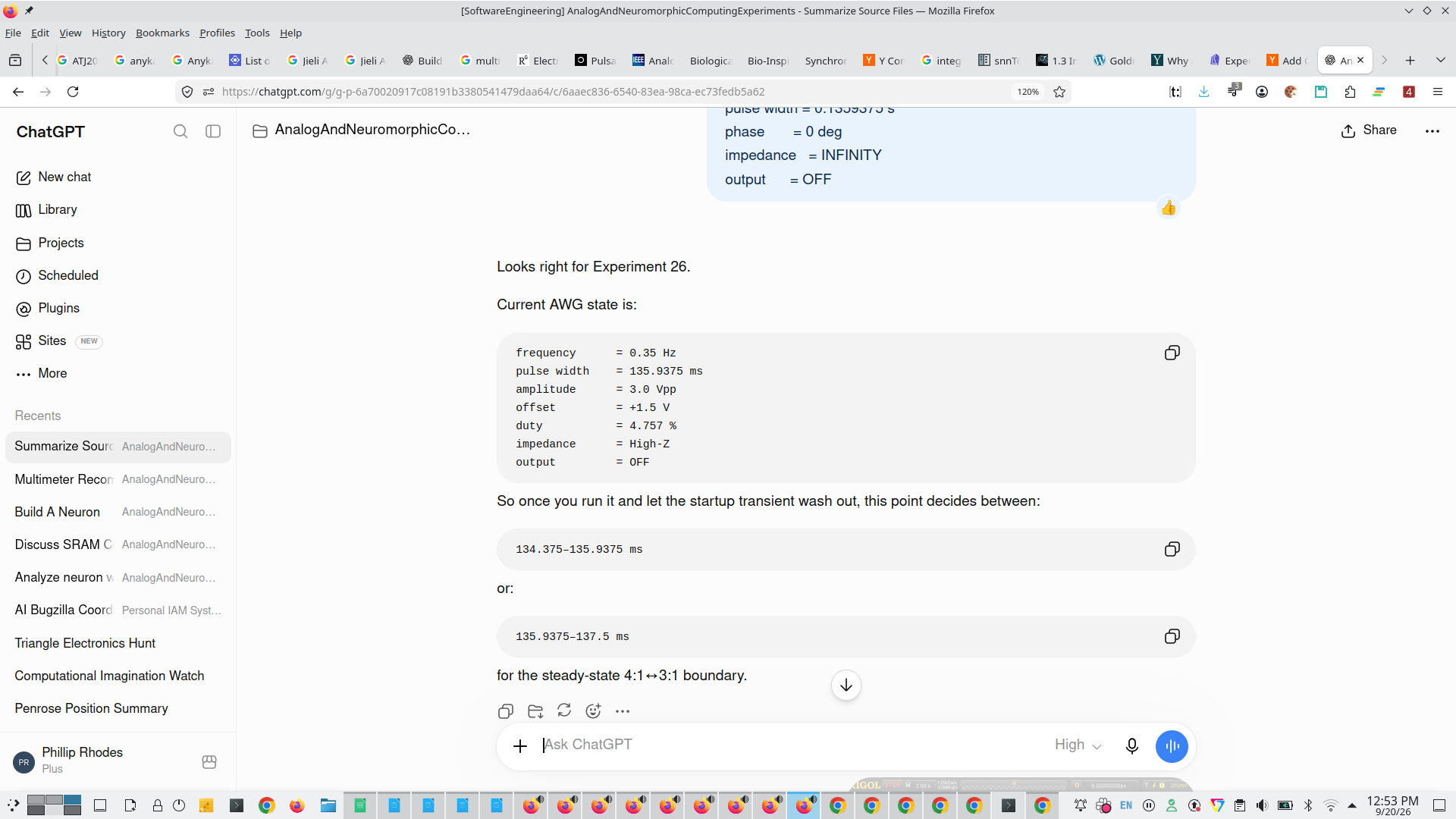
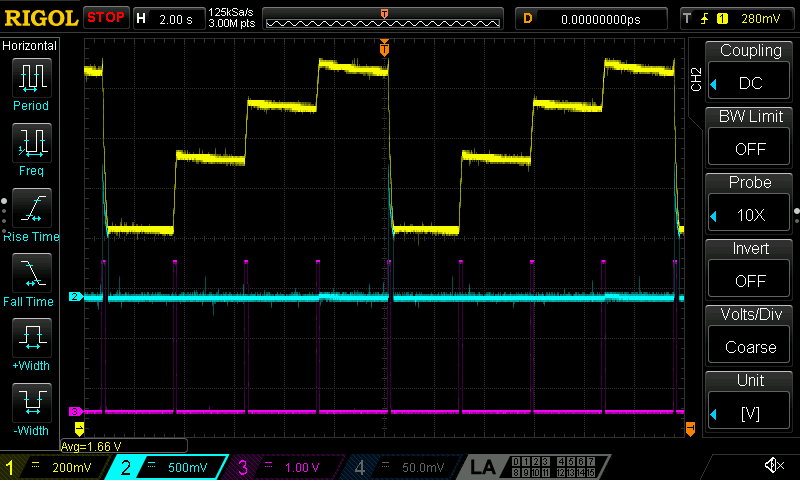
I'm working on a project, with a lot of help from ChatGPT, involving an "artificial neuron". That is, an electronic circuit, using a PUT, a capacitor, and some resistors, that simulates some of the behavior of a biological neuron. Specifically an "integrate and fire" model of neuron behavior. To that end, I'm running experiments by scripting my function generator to send signals to the circuit, and then capturing the inputs and outputs on my oscilloscope. Then I usually discuss the results with ChatGPT. In what follows, observe a couple of things:
1. The LLM "knows" the context of what we're talking about, even if I provide a prompt with no text at all, just an image.
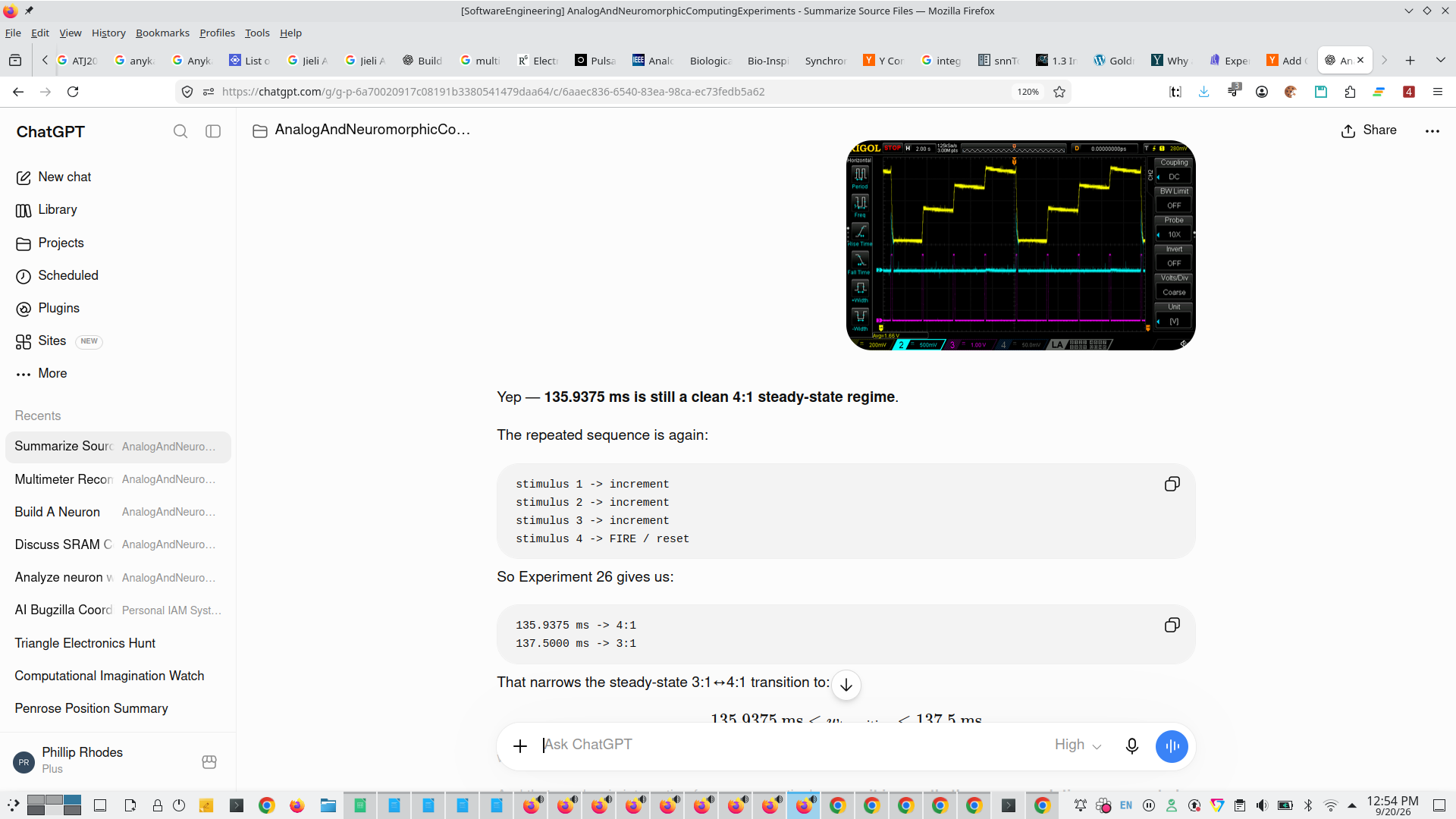
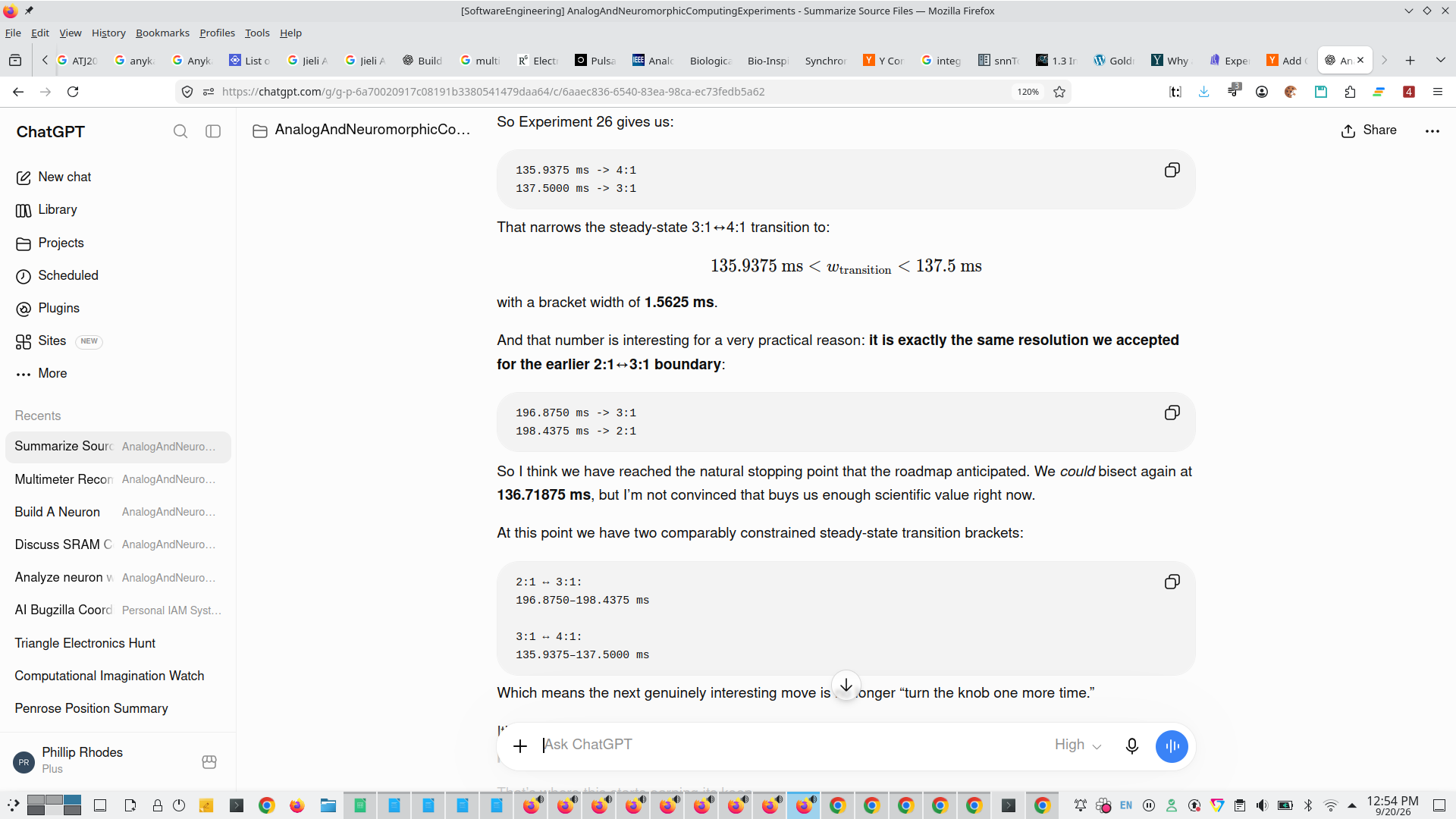
2. It parses a moderately complex image, identifies the separate traces and what they represent, uses the time-base information displayed on screen, and the on-screen graticule, and works out "how many input pulses fire before an output pulse fires" and then reports back to me and gives an analysis of how that relates to our previous observations and gives suggestions for the next experiment to run.
Human intelligence? No. But I see no world where behavior like that does not count as "intelligent" regardless of the mechanism behind it. And that's probably not even the best example I could come up with, it's just something that was "top of mind" and for which I had the necessary images and what-not already ready, or easy to capture.
https://www.fogbeam.com/images/neuron_zero0.png
https://www.fogbeam.com/images/neuron_zero1.png
https://www.fogbeam.com/images/neuron_zero2.png
typical hn