Posted by plaguna 2 days ago
For context, it's a hard enough problem that Google Translate's own romanised pronunciation guides are frequently wrong, or disagree with their text-to-speech.
Well, it wouldn't be the first time ;)
Seems a bit drastic. Don't use it as the main font in a japanese textbook, sure, but use it with the disclaimer that it's not perfect and will get some readings wrong? Why not, still pretty useful. Should people also not use Google Translate? (also, you can stuff an entire llm in a font, it's been done).
If I asked you 'are you a sewer (pronounced "soo-er")?', would that make sense? Maybe if you looked at it hard enough and thought about it, but in the meantime, I would probably get some very strange looks for asking.
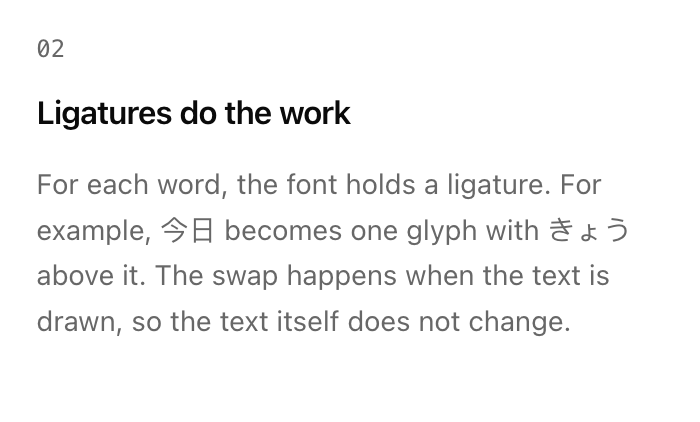
One small thing on the Japanese version of the page: in the "Ligatures do the work" section, 合字 itself only gets じ over 字, and 合 has no reading. It should be ごうじ. I guess 合字 isn't in the dictionary, so it falls back to single kanji, and 合 is skipped because it has several readings.
[0] https://litherum.blogspot.com/2019/03/addition-font.html
[1] https://en.wikipedia.org/wiki/Turing_completeness#Unintentio...
In the present context, an example is that the common reading of a Kanji word isn’t always well-defined, and neither is the decomposition of a sequence of Kanji characters into words.
  for each character in text
    characterToPrint = Parse(character)
    if character is LigatureStartCandidate
      characterToPrint = LookAheadForNextLigatureCandidateAndResolve(character)
Print(characterToPrint)But you could set this as the default system font for Japanese and enjoy furigana everywhere, even in places that don't support ruby tags at all.
From practicality standpoint, this would not work on unprepared texts, as pronunciation of Japanese words are a bit arbitrary and so correct pronunciations would need to be manually selected for each words.
i.e. "maize" could be read "corn". I believe LLMs don't necessarily have good intuition for that, being trained on plain texts.
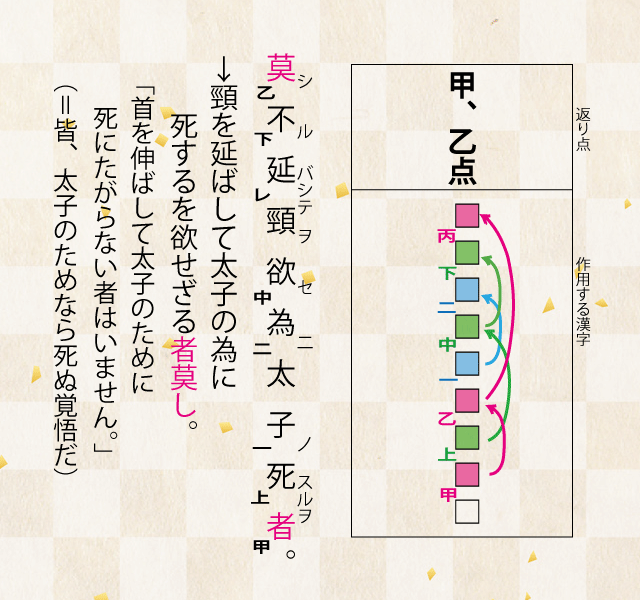
As to how could such a situation could ever manifest: I would blame the fact that the official language of historical Japanese governments having been a really creative interpretation of medieval Chinese[1] sprinkled with labels and jumps and supplements[2][3], resulting in people just accepting wild divergence between literal and spoken Japanese. I'm not a linguist or a language major so I'd happy if anyone could further elaborate...
1: https://en.wikipedia.org/wiki/Kanbun
2: https://youtu.be/_k0I6bi2pYs?t=248
3: https://d1ysbfo9sxjda0.cloudfront.net/wp-content/uploads/201...
A few people here rightly pointing out inaccuracies and other methods of display (ie Ruby tags) but IMO they are somewhat missing the usefulness here - there are many applications (ie e-readers, random web contexts, custom apps etc) where the traditional methods of display are hard or fail. I recently ran into it trying to get custom Japanese ebooks to display furigana with ruby tags on my kindle. It’s a giant nightmare. Excited to try this out.
Maybe it is:
With the ligatures to adApt to pronunciation of words.