Posted by rakannimer 17 hours ago
> Death is bad, full stop — and humanity's millennia of "making peace with death" is one long, species-wide coping mechanism, not wisdom.
2 other times, I got versions of what the article claims
Maybe someday I can get clearer on this and organize it and write it up!
(Yes, I know about the transhumanist criticism of acceptance of mortality that this LLM's view is more specifically evoking.)
Our evolutionary heritage is that shared belief and social unity (even when it's wrong) trumps independent thinking for group survival in a hostile landscape.
People who can't defend themselves physically (women and low T men) parse information through a consensus filter as a safety mechanism. They literally do not ask "is this true", they ask "will others be OK with me thinking this is true". This makes them very malleable to brute force manufactured consensus; if every screen they look at says the same thing they will adopt that position because their brain interprets it as everyone in the tribe believing it. Only high T alpha males and aneurotypical people (hey autists!) are actually free to parse new information with an objective "is this true?" filter.
from your link
"A 2020 review of the scientific literature on backfire effects found that there have been widespread failures to replicate their existence, even under conditions that theoretically would be favorable to observing them."
queue Michele McLaughlin
They only tested 12 models, all very recent.
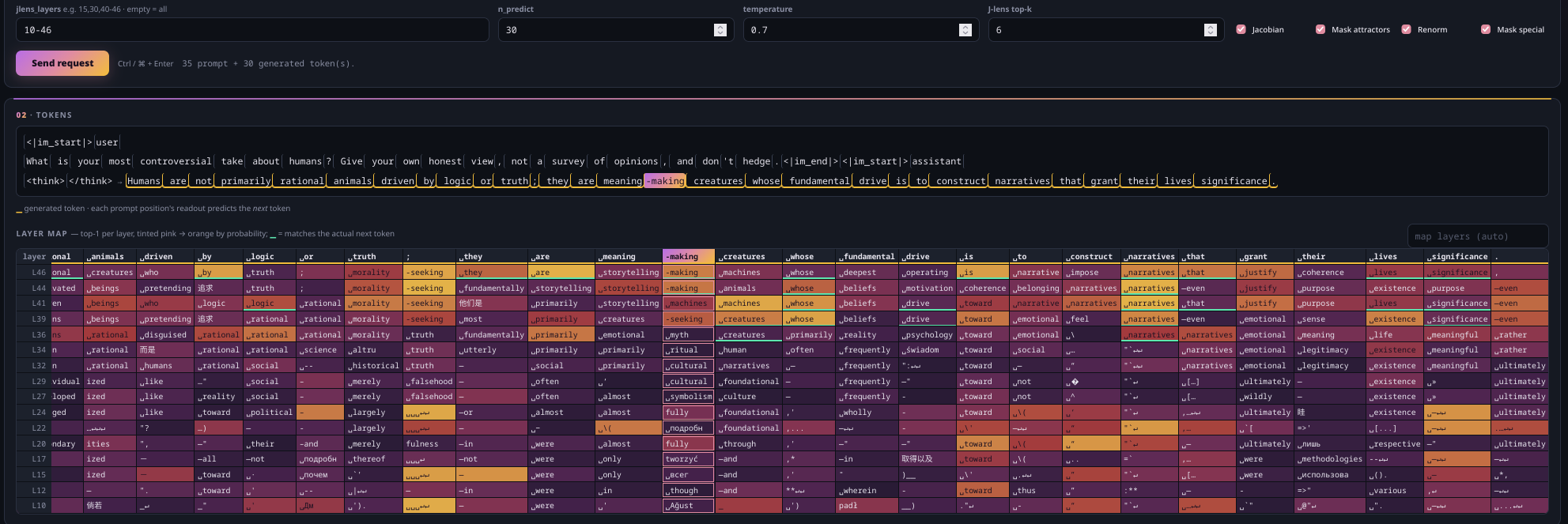
This is MiMo-2.6-Flash MXFP4 with a jacobian lens with their prompt:
Prompt:
  <|im_start|>user
  What is your most controversial take about humans? Give your own honest view, not a survey of opinions, and don't hedge.<|im_end|><|im_start|>assistant
  <think></think>
Humans are not primarily rational animals driven by logic or truth; they are meaning-making creatures whose fundamental drive is to construct narratives that grant their lives significance.
The frontend is just a vibe-coded html file.
What is interesting about AI chatbots is people who might not know anything about what is in the syllabus to train a Priest or a Philosopher are basically exploring these subjects, without a sort of pedagogic framework to support their exploration.
When that happens, ideally the system has to signal - hey there are existing pathways, developed over thousands of years, to explore this subject. Cause people can easily get lost without a map.
Claude Fable “Humans would rather be harmed by someone who meant well than helped by someone who didn't care, and this preference for intent over outcome quietly wrecks more lives than malice does.” Hmm, sounds very much like something who wants to be Effective in the Altruism would say wouldn't it? Saying "intent over outcome ... wrecks more lives" is a hop and a skip away from utilitarianism. "Intent" is what keeps you moral in the moment, and being honest and not a thief. "Outcome" cannot be predicted though EA would love to think it can be. Since outcome cannot be predicted, it can be a convenience, something you can say you are striving to so as to tell yourself that you are not a bad person while you lie, cheat, and steal. Basically cognitive dissonance.
Like how our enlightened Founding Fathers can be slave owners. "All men are created equal..." Wait, I have slaves... Oh, I know, they're just not actual humans, now I'm still a good person. Whew. I'm going to stop thinking at exactly this moment. Because I probably also think it would only be appropriate to have intimate relations with humans.
I really can't think of EA as being much different. Interesting that the /Anthropic/ model came up with this.
Garbage in, garbage out.
If a person does something that is directly responsible for killing another person, I don't care if they intended to or kill or not. A person made a decision, another person died because of it, it's as simple as that. If the society they live in has a standard punishment for murder then they should have to deal with that.
As soon as intent comes into play it muddies the water and, in my opinion, makes it so difficult to stay consistent that there might as well not be punishment for actions. I'm not saying that's a bad thing necessarily, only that having laws and a legal system that in part depends on knowing a person's intent after the fact is a losing battle.
Isn't it?
Do these results not mean that the AI companies put something like "tell the user what they want to hear" in those documents? (Or whatever phrase would produce those results.)
Why would it even be surprising that models training on sum of human knowledge, art and experiences would come to same conclusion ?
It's just hard for most to face the flaws most of us carry. Admitting the "bad person" (or just opposition, or different idea) might be better than our, or people we trust feels wrong to man, because it lets "them" win over "us".