Posted by geox 16 hours ago
As I understand it, this is very common across much of the developing world now. So the tracking of how much solar energy there is in the world is almost certainly a lower bound on the reality.
Personally i'm waiting for the next iterations of Kesterite cells.
If we can get single cells to crack ~20% efficiency. With a tandem cell architecture, it's going to become the new standard overnight.
Durability of silicon cells or better, but orders of magnitude $ cheaper to produce, and without the need to use toxic agents as in perovskite cells.
We're movin' fast.
For over a decade we were stuck at ~12% efficiency. And in the last 4 years (probably with AI help) we've cracked 15% efficiency
https://interestingengineering.com/energy/chinese-researcher...
Few more years, and with a bit of luck, we'll all be around to see solar panels that cost 1/10th of what they do now.
I doubt that. Currently the cells itself makes only <50% (maybe <30% meanwhile) of a PV module. So the limit to the bottom is by the glass and frame and cable, not by the cells.
But $/watts can significantly go down with more efficiency.
I get the impression they're already really damn cheap, to the point that the issues are more so with grid interconnections, land use, and storage
I wonder if as panel costs goes down, will people start to wire their homes again for 48V DC? You could conceivably run your HVAC and fridges at least off of it, this would negate the need for a larger (more costly) inverter.
The only place it makes sense is personal tech and computing, where USB chargers are cheap and ubiquitous, with technology replacement in 2-5 years instead of 5-10 for standard appliances.
This was the best bet at the time when it was chosen, but it must be a good case of the sunken cost fallacy by now, given how long it's taken to build, and didn't follow an existing design*
As a risky policy choice, many distributed solar and wind farms with modern sodium-ion batteries would be a safer and more distributed (failure and weather resilient) modern choice.
*If the original design was defective, why are they using it in A and B?
"Current levelized cost of storage ranges from $150-300 per MWh for established pumped-storage systems, while newer solid-mass gravity systems estimate costs of $200-400 per MWh. These figures are competitive with long-duration storage applications but remain higher than lithium-ion batteries for shorter-duration uses."
https://eureka.patsnap.com/report-gravitational-potential-en...
Batteries are scheduled to become so cheap that these type of physical storage systems just won't be able to keep up in terms of cost.
Most pumped hydro projects are now put on hold as batteries have been coming down.
https://www.elevenenergy.co.uk/#sodium-ion
They are larger than lithium batteries, but potentially cheaper and better performing around temperature extremes.
Example: Lifting a 10-metric-ton stone by 36 meters stores just about 1 kilowatt-hour (kWh) of energy. This is roughly equivalent to the capacity of a small power station used for a camping trip.
Solar is cool but solar that can make it through the night and a couple cloudy days is way cooler
The fun part is that we're still well before the point when this even matters.
Almost 60% of the US grid is still fossil fuels, with around half of that still happening during the day. Which means you can get down to ~30% fossil fuels without any storage at all because all you do is go from burning fossil fuels during the day and at night to burning fossil fuels only at night.
only natural gas plants can do this. a coal plant cannot spin up just for the night and turn back off when the sun comes up - it's incredibly inefficient and probably causes more premature wear/tear too.
The big issue is what's called "ramp rate" - how fast can output power be increased or decreased? This tends to be around 1% to 3% of capacity per minute. See Figure B-2 in [1], which is a detailed discussion of how to improve your coal-fired power plant's ramp rate.
Natural gas plants have much higher ramp rates, and for batteries, it's under a second. Nuclear plants can be ramped up and down, slowly, but since it's all capital cost, cutting output raises the price of the power.
"Increased rates of component life consumption due to thermal fatigue, mechanical fatigue and wear caused by differential thermal expansion comprise the bulking of cycling (costs)," according to the International Energy Agency's Coal Industry Advisory Board.
"Every time a power plant is turned on and off, the boiler, steam lines, turbine and auxiliary components go through unavoidably large thermal and pressure stresses," the National Renewable Energy Laboratory (NREL) wrote in a report on cycling costs published in April 2012.
"
https://www.reuters.com/article/business/energy/to-survive-c...
Batteries are coming, and will solve it, but it will still take time for them to be come cheap enough.
Only once we have ~7 days of storage (~100 GWh of storage) will we be able to get rid of the last fossil plants.
Other countries are better positioned. e.g. UK has really spiky wind energy. Right this second more than half the grid is wind. Which is both cool and problematic for managing the grid.
Grid scale cheap storage would dramatic help manage that chaos
That and low density storage located at sea with the turbines.
For Europe to get rid of more fossils without putting the grid at risk we will need more storage.
https://www.eia.gov/todayinenergy/detail.php?id=45956
If you shut down by day, it can take multiple hours for it to be able to provide full load... and multiple hours for it to shut down cleanly. During this time it is producing power at less than optimal rates and/or using the fossil fuels to keep the wheels spinning and in sync with the grid so that they don't have to go through a phase matching period.
(aside for coal - note that it takes more than 12 hours for a coal plant to get running from a cold start)
Wind also helps since wind makes more power at night, as does demand which is dramatically lower at night.
For coal, Great. Making coal economical is excellent. We should have banned it worldwide 20 years ago.
There's a good number of 'em: https://en.wikipedia.org/wiki/Category:Pumped-storage_hydroe...
https://www.ferc.gov/media/licensed-pumped-storage-projects-...
You'll see that most of them are in the Appalachian mountains and in the Sierra mountain range.
The one in Missouri is one of the interesting ones that isn't in either.
https://en.wikipedia.org/wiki/Taum_Sauk_Hydroelectric_Power_...
> The Taum Sauk pumped storage plant is a power station in the St. Francois mountain region of Missouri, United States about 90 miles (140 km) south of St. Louis near Lesterville, Missouri, in Reynolds County.
It has a hydraulic head of 860 feet and that represents the challenge - you need to find places in the US where you can get several hundred feet of elevation in a short distance.
Hypothetically, lets build one in Minnesota... Taum Sauk Mountain is the highest point in Missouri. The highest point in Minnesota is Eagle Mountain (in the boundary waters - you can't build there, pretend we can) ... the elevation to the top os 550 feet (about half what Taum Sauk provides) over 3.5 miles (Taum Sauk is just over 1 mile). ( https://maps.app.goo.gl/vHfWarwubaLvsf5z7 )
Much of the US is too flat for it to be useful.
That makes 300B
Eu pricing
Even if we handwave all the science needed to build batteries big enough to power cities for days, I don't think it's realistic to handwave the science needed to power a city for weeks. We don't even have enough oil for that.
"Power when it is inconvenient" is pretty much the basis for a modern society.
Heavy clouds and zero wind, for weeks? That's a once-a-century freak event. Just build gas peaker plants if you are worried about it. You could even add carbon capture, but constructing it might emit more than it will ever capture...
I assume you never tried measuring the output of a solar panel when it's cloudy. It's 10-15% of a sunny day. Closer to not working than working.
On a rainy day that drops closer to 20%.
As an aside - cloudy days avoid a problem I have with shade. In winter, at 3:30pm, the sun goes behind a tree and my production plummets to near zero. If there's cloud cover the sunlight is far more dispersed and there's no "shade".
And you’re still able to power your entire home? What if the rain lasts for a few days, which is pretty common in many places.
I did have one rainy day back in the middle of Winter that was 16% but that will end up being literally the worst day of the year.
Our energy grid can't currently handle the ability to charge electric haulers locally at any scale let alone to move an entire city's worth of energy, so the solution is not to 85x the national electric grid all at once.
A common battery for grid level storage is pumped hydro - that is, use the peak power during the day(s) to push water from the bottom of an elevation to the top, and hold it there - bonus points if it captures water delivered from other solar processes (evaporation -> rain)
The overwhelming majority of generation and storage is best deployed at the point of use.
Grid scale anything, is a massive inefficiency.
The only reason grid and city scale is so prevalent in public discourse is because this is the only electricity the utility is paid for, and they are very actively impeding any other solution.
In the US, there is a very large inventory of flat roof industrial buildings, in the industrial parks that are using huge amounts of electricity. Covering all of those roofs with solar (especially here in the west US) would prevent a tremendous amount of grid scale generation, and implementing storage there would eliminate a large part of the transmission line upgrades the utilities are calling for.
The biggest problem in the US isn't technical, it's the governments desire to primarily support the solutions that are best at serving utility shareholder returns, instead of the technically superior solutions.
In aggregate, grid operators have a lot of other tools at their disposal via flexible pricing, flexible demand, and automated systems that can adapt to this to e.g. charge cars when there is a surplus of energy, turn on/off water boilers, etc. There's a lot of innovation around this topic in this space. This by the way is as much as making sure generated power doesn't go to waste than it is about ensuring there is enough power. They use batteries to time shift excess power to when they can utilize it.
Interconnected grids means that e.g. an operator in Denmark can import/export to and from the UK, Norway, Germany, etc. On a windy day they'll be exporting wind power. On a sunny day, they might add some solar to that mix. When there's no wind or sun in Denmark, they might pull in Scottish/German wind, Norwegian hydro, Swedish nuclear, etc. Batteries are being deployed all over the place at a pace that is only exceeded by the pace at which solar is being deployed. Whenever there's a surplus energy, batteries get charged up. It's very rare for all of the available generation to disappear all at the same time for long enough to drain all the batteries. And for those times of course fossil generation is still a thing as well, and will be for decades to come. There are a lot of gas based plants throughout Europe. As well as some nuclear plants of course. Singling out the EU market here but it's going to be similar elsewhere.
The point here is that there's no need to pair solar setups with days/weeks/months worth of storage. A few hours goes a long way.
A decade or so behind, in the US.
If the US didn't block import of Chinese tech, we could have electrified a decade ago.
The tech available at the current moment, is even more capable of replacing petroleum based electricity.
But our government is banning Chinese tech to serve our outdated industries instead of importing it to serve the population.
As any wise country would do when faced with superior technology, we should import it with the condition of technology exchange. Chinese manufacturers should be training US workers and industrial ownership how to produce cheap, efficient, sodium batteries.
This benefits the populous immediately, and the industries are able to advance into the current century's tech.
Europe tried doing that. And our green technology sector promptly collapsed, because it couldn't compete with Chinese undercutting our prices. The only thing left now are wind turbines, but Chinese are making inroads there too. In the meantime, the green transition barely moved a needle when energy shock arrived in 2022 or this year. Rendering rest of our industry, especially chemical industry, uncompetitive.
If it were a matter of industrial protectionism against a country which was not hostile, not authoritarian, didn't rely on slave labor, etc., then I'd agree with you. Countries have other pressing reasons besides immediate economic advantage to prevent this sort of thing.
To greatly oversimplify: Japan fought against opening their markets, as did China, out of political and social concerns for the stability of their states, far more than economic ones.
Doesn't matter though. The big mistake was allowing manufacturing to be exported from the US to begin with. Nearly any advanced technology we use or wish to produce is now dependent on China. They control not only the advanced manufacturing process, but also the refinement of rare earths (we can mine it but not refine it) and have cheaper labor. Not only can't we make tech without them, we can't sell it at competitive prices. Things will soon get worse as robotics and vertical integration makes Chinese products even cheaper and better quality. And we can't compete on robots because China controls that production chain too.
The smart play would be to build up our own green energy sector to gain cost savings, while investing in its manufacturing, so we can eventually compete and support ourselves (which Biden and Obama passed funding for). Trump eliminated all that when he came back, because the oil companies wanted more profits, they literally don't believe climate change is real, and they have no idea how diplomacy works. We could've had cheap battery, wind, and solar manufacturing in the US. Not anymore.
1. As a US citizen, you would probably not a get permit necessary for entering the Tibet region.
2. If you could get a permit for Tibet region and go there, you would be followed by police officers dressed in civilian clothing. The locals would be quite hesitant to speak to you.
(Source: been there long ago, seen it). China has many qualities, but freedom is not one of them.
I don't think the poster you're responding to is writing in good faith; they're either an agent of an authoritarian power, or blind to the difference of being one.
People in China can say anything the government approves of, but they can't say "long live freedom and democracy," unless they want to be executed.
Neither, I suspect, will Chinese AI models make any statement in sympathy with personal freedom, democracy, or human rights; it would come at the expense of the people who paid to train those models, and that can't be allowed.
As a child of immigrants from the Soviet Union, and also as someone who knows people still resident in authoritarian dictatorships: This is patently ridiculous. Everything else in your post is a spray of nonsensical policy points and predictions. You led off with the tell. Frankly, it makes everything you say afterward sound like what an authoritarian enemy government would want people in the US to think about their own country.
What you wrote in your first sentence is either (a) wildly misinformed (like, you have no idea what life is like in an authoritarian country with actual slave labor, which is an insult to the people who do currently live there), or (b) intentionally nefarious (like, you work for such a country, in a capacity to minimize the distinction between their system of autocracy and the United States' democracy). If it's (a), study at least a little bit of the history of mass murder in the 20th Century. If (b), well, we live in a free country so you can spew whatever garbage you want. Interestingly, we have not been overtaken by any of the dictatorships that have sprung up in Eurasia over the past hundred years, and I don't think we will be soon.
Paranoid is me testing the plates I bought off amazon for lead, and throwing away the bathtub mat which smelled like petroleum waste. I'm fairly convinced that the goal of that ruthless dictatorship is to poison, degrade and infiltrate every single household abroad in every way possible. A fast attack might be to bring as many devices offline as possible, but the slow attack is simply to lower people's intelligence by hardware or software methods (e.g. TikTok, Qwen... or, let's say, not notifying anyone for a few months that a new SARS virus had escaped a lab). Everything that comes out of communist China is warfare, even if it looks like a plush toy.
It protects American companies who operate in the green energy generation and storage arena from Chinese competition.
Not only does Chinese competition get blocked, but governments are incentivizing green energy. For instance, just recently it was reported that Tesla’s $10B solar factory could get 35 years of tax breaks in Texas (Oil Capital!!!)
https://electrek.co/2026/10/23/tesla-solar-factory-texas-35-...
Wont someone think of the big beautiful clean coal companies
Then again, I'm basing this opinion on a recent-ish video from NightHawkInLight: https://www.youtube.com/watch?v=eq7fR9ISuCw
The technology I'm most excited about is ultra low capex thermal, as being done by Standard Thermal. Capital cost per unit of energy storage capacity as low as $0.10/kWh(th), so it can work with seasonal storage and just a few tens of charge/discharge cycles over its lifespan.
Standard Thermal has raised $11M and is building in Germany, where they say they can deliver 365/7/24 solar resistive heat (400 C or perhaps 600 C) for half the cost of heat from burning natural gas there.
A regular 18650 cell has about 0.1 square meters of electrode surface. And you have thousands of these cells in a car battery, resulting in literal football fields of electrode area.
We can get to 95% using just short term storage. I suspect that most jurisdictions will just say "95% is good enough" rather than paying for ridiculously expensive long term storage.
We've got the nat gas capability already; keeping it around for the 5% is quite inexpensive, making the massive investment in long term storage for marginal benefit hard to justify.
OTOH, while the premium for e-fuels seems excessive, if you're only running that nat gas plant 2 days a year that premium is not so scary.
For covering Dunkelflauten? Yes.
For seasonal storage with a prolonged discharge (so, low power/storage capacity ratio)? I think thermal storage wins there.
Those are 2 very different use cases.
Thermal is low rate extraction. It's 1 cycle per year, but the extraction is performed over months so is low rate.
Electricity long term storage is high rate extraction. It's only used a few times a year, but when it is used it needs to cover roughly 100% of the entire grid's needs. I doubt thermal storage is suitable for high rate extraction, but I'd love to be wrong.
Edit: rereading your parent comment you seem to think thermal is suitable for a different use case? Could you elaborate further? When is "prolonged discharge" useful?
https://www.orcasciences.com/articles/standard-thermal
https://austinvernon.substack.com/p/building-ultra-cheap-ene...
They talk about temperature up to ~600 C, which I believe is limited by the desire to use cheap steal (much hotter and creep becomes a problem). This is also perhaps not coincidentally about the temperature of steam from a coal fired boiler, so one of the eventual goals is to repower retired coal fired power plants with this storage providing the heat instead of coal combustion.
You're right this is not good for something needed "a few times a year" for relatively short periods, for example to cover Dunkelflauten. Combustion of an e-fuel is better for that. But it's well suited to seasonal storage of solar energy, as that would be extracted over months, more or less continuously. The resistive heaters should also be much cheaper per W than electrolyzers.
But what is that useful for? During almost all of those months it would be a lot cheaper to use renewables & short term storage. And it's not fast enough for the few days it's not beaten by something cheaper.
Put another way: if you oversize the solar to be adequate in winter, you have enormous amounts of surplus solar in summer. So why not store it?
Because 0.10 $/kWh(th) / 0.4 kWh(e)/kWh(th) is expensive.
https://www.cleanthinking.de/thermischer-erdspeicher-erdhueg...
E.g. 100 GWh (4 days of 1GW thermal power) with a 100C temperature swing (you can't go down all the way to room temperature) will need around 3.6*10^4 tons of sand. That's a lot.
Honestly, power-to-gas sounds like the only reasonable way for now. In theory, with SOFC (Solid Oxide Fuel Cells) for power generation, it can beat the steam cycle.
View another way: if we hook several piles in series, then lukewarm air from a first mostly discharged pile can be directed into later piles for more heating. In the continuous limit this is the concept I described above.
No, because your steam will be at a lower temperature as you draw down the heat, bringing down efficiency.
Over the season, your sand drops from ~1000 to ~600 (which is fine since your power needs drop in the spring)
At 1000C steel will react with _water_.
To be clear, I'm not talking about cooling a small crucible but a structure that is at least 20 meters in size.
But I have no reference for the cost of setting up such a storage and how it compares to battery or hydro.
https://www.eia.gov/todayinenergy/detail.php?id=67205
But for the most part it will trail solar, because the first chunk of the solar doesn't really need storage. But once there's a healthy percentage of solar, all new solar will have storage or it won't get paid.
The costs of large number long distance HVDC lines with accompaning invertor stations would be as expensive as a electric generation based on nuclear power.
https://blog.sintef.com/energy/future-hvdc-grids-yes-please-...
LiFePO4 is probably the chemistry best suited to it ATM. Lasts a long time, more stable, pretty cheap, and just a bit less energy density than other lithium ion options. Sodium-ion is looking promising but only just entering the market AFAIK.
I have a 5 kWp solar plant that produces ~25kWh per day, but it is grid-tied. I considered a hybrid setup with LFP battery back up, but decided to separate the two systems to avoid a single point of failure.
LiFePo4 however is excellent and reasonably low cost these days
Fortunately that doesn’t seem like it will be an issue since battery storage costs are also seeing an exponential reduction.
I guess using electricity to heat during the night could be an issue, but we could also accept to let the temperature drop.
Solar is never gonna be a complete solution. At the end of the day, we could do it more efficiently by just building suns here on earth for the panels, but of course then you've achieved fusion and you're already generating more than solar could ever hope to. We shouldn't hinge our future on half of a technology.
My larger point is that solar is only ever going to be a piece of the puzzle at best. In space it might be quite nice, but otherwise it's kinda goofy to invest too much in.
Doesn’t that apply to any power source?
Stars don't have this problem because they're very large so there's only so far neutrons can go.
1. Stars do it. Yes. But stars also have size and gravity, something no nuclear plant will ever have; and
2. "People once said X was impossible" ie the Galileo Gambit. Just because Galileo was mocked for his heliocentric model but was later proven right does not mean everything is possible.
Thing is, I'm not even talking about physics. I'm talking about engineering. Something not only has to be possible but it has to be technically viable and sufficiently cheap. Put it this way: would you pay $60 billion for a 1GW power reactor with a lifespan of 30 years and an annual maintenance cost of $2B? Even if the fuel was completely free the wholesale cost per MWh would be ~$600. Nobody would build that.
Fusion research has been going on for decades and the best we've done thus far is fire a laser for about a second to induce a fusion reaction and also spend billions building magnets to try and contain a turbulent fluid at 100 million degrees, which, again, will do nothing about the neutrons that will destroy that vessel.
The joke is that fusion is always 50 years away and always will be. If you're an optimist it's always 30 years away and always will be.
I think solar is amazing and we need more of it - but I can't stand this solar and storage go at it alone mentality. It's pretty thickheaded to discount the other forms of energy that we can use and will need.
There are legit reasons to push back against “solar and batteries everywhere” but I find it hard to credit resilience in a conflict situation as one of them.
Solar has the advantage that it can be widely distributed on buildings rather than in just a few centralized locations.
Batteries have use in war and power. It will likely scale faster than PV. What we need is the second derivative, so production of the latter can be turbocharged just before battery production is about to break through.
Ideally we see people like Form Energies, using iron-air (rust) batteries, for much easier to scale storage. https://www.technologyreview.com/2026/10/06/1145020/2026-cli...
- Battery energy storage has grown at an exceptional pace, with global installations increasing more than 20-fold in storage capacity over the past five years. This growth has been driven by falling battery prices, abundant supply and relatively short project lead times. As variable renewable generation expands in many markets, battery storage is becoming an important source of flexibility and resilience for power systems, while also representing a growing commercial opportunity for battery manufacturers.
- However, more than 90% of battery storage applications rely on LFP batteries that are almost exclusively supplied from China, which accounts for almost all global manufacturing capacity and the associated technical expertise. Korean producers are investing to scale up LFP battery production that can offer an alternative, but they face intense competition from established, lower-cost Chinese producers in an oversupplied market.
https://www.iea.org/commentaries/battery-storage-is-scaling-...
- Battery storage now accounts for around 18% of installed dispatchable capacity in Australia, compared with 7% in China, 5% in the United States and 4% in Europe – underlining how rapidly batteries are becoming an important part of the electricity systems in some regions.
https://www.ess-news.com/2026/06/02/global-battery-additions...
Battery storage is right behind the solar adoption curve. Net zero in five years? Probably not. Ten to fifteen years? Almost assured considering rate of change and the overall economics (assuming ~1TW/year of solar PV deployment and enough battery storage to soak up that low carbon generation while also providing grid services to replace thermal generation grid support [voltage, frequency, etc]).
(China is curtailing renewables equal to the annual combined generation of Spain and the Philippines every six months, and India about ~100-120GW/month due to not enough battery storage, for example)
Not sure whether other brands could be better but there seem to be various options that would suit. If you are in 120v land you may need to check if there are models to suit.
Its largely modular, inverter sits on top of modular batteries in 8-9kw chunks.
But they are app-infested. IE wants a wifi connection, app on your phone to their servers... etc etc.
I hate it, but the wife likes it. This is a recent thing so I am still working out if there are possible solutions for privacy and control over my own objects.
[0]https://solarbatterysupermarket.com.au/products/sigenergy-ba...
Their car charger was doing my head in.
I pulled it apart and found an Ethernet plug and it was a complete game changer.
But: the app and their servers remain.
My recommendation would be to see if Ecopower storage and inverters are a good fit for your use case. If you're feeling adventurous, you could build your own battery pack, but I only recommend if you are knowledgeable and confident. This comes with substantial property and life safety risk, only proceed if you know what you're doing and understand the risk (I'll work on my high voltage EV battery packs, but only with a helper nearby holding a 2x4, for example).
1. Then you need small scale transformers 2. Lots of roofs have shadows on them a lot of the time, like from trees or other nearby buildings 3. Most roofs have to get replaced every 15 years 4. Roof installed solar is fixed in place
I think parking lots, rural empty land and the like are a better starting point that avoids all 4 of these issues.
I have solar on my roof btw.
I'm surprised to hear that you need to replace roofs every fifteen years. What are they made of? The roofs I know last decades longer than that.
In red state language, conservation is being in tune with nature and environmentalism is regulatory capture.
Instead we have a captured system where it's cheaper to buy the politics of wealth extraction. Historically speaking this has always led to increasing wealth inequality that is ultimately resolved by war or revolution.
If the ultra-wealthy were smart, they'd declare victory because they've never had it so good and they'd seek to give back a little to placate the populace and stave off that war and revolution. But they don't. Greed has no bounds. So at some points, the guillotines are probably making a comeback. And a lot of people are going to die as climate refugees in the coming decades.
So even if a place like the US goes lighter on solar that is reasonable, Places like Spain, Italy or Morocco will go all in just to minimize dependence on a resource a third party can control. It's the ultimate counter to the Hormuz situation. Squeeze access to oil for long enough, and you accelerate the move away from it.
Oil wells decrease in production over time. It's called the decline rate. For wells in the Permian basin, the average decline rate is about 15%. So a 1000 barrel per day ("bpd") well produces ~850bpd in year 2, ~700bpd in year 3 and ~550bpd in year 4. That means you need to be constantly drilling wells. That's more wealth concentration opportunity.
1MW of solar produces 1MW in years 1 through 20.
Additionally, the fight for control over resources induces demand for weapons. Solar doesn't do that. This is summed up as No one goes to war over a solar panel [1].
Efficiency isn't the goal. Wealth extraction is.
[1]: https://www.theenergymix.com/no-one-goes-to-war-over-a-solar...
I agree with your post, but the above statement is not technically accurate.
Panels do drop in production over time; A very rough rule-of-thumb is around 1% loss per year.
So after 20 years production is at like 80%. (Ymmv)
Of course this isn't really a big deal. The panels themselves are cheap and can be replaced very easily. Equally there is a market for 2nd hand panels as they still produce, and are ideal for places that are not space constrained.
It goes all the way back to this kind of thing:
https://en.wikipedia.org/wiki/The_Fundamentals
The pamphlet from which we get the term "fundamentalism" was published by an oil industry tycoon.
So the right is incentivized to protect this industry even if it becomes obsolescent and is no longer the most economical or practical way to generate at least much of our energy needs (electricity).
While the right has often sounded pro-nuclear, in practice they tend not to be that enthusiastic about it when they actually get into office. Obama supported the first new nuclear plant in decades.
https://politifact.com/factchecks/2012/mar/02/barack-obama/o...
Climate change:
> By increasing our American energy supply and decreasing the long term demand for oil, we will be well positioned to address the challenge of climate change and continue our longstanding responsibility for stewardship over the environment.
...
> As part of a global climate change strategy, Republicans support technology-driven, market-based solutions that will decrease emissions, reduce excess greenhouse gasses in the atmosphere, increase energy efficiency, mitigate the impact of climate change where it occurs, and maximize any ancillary benefits climate change might offer for the economy.
...
> Because Republicans believe that solutions to the risk of global climate change will be found in the ingenuity of the American people, we propose a Climate Prize for scientists who solve the challenges of climate change. Honoraria of many millions of dollars would be a small price for technological developments that eliminate our need for gas-powered cars or abate atmospheric carbon.
Clean energy:
> Alternate power sources must enter the mainstream. The technology behind solar energy has improved significantly in recent years, and the commercial development of wind power promises major benefits both in costs and in environmental protection. Republicans support these and other alternative energy sources, including geothermal and hydropower, and anticipate technological developments that will increase their economic viability. We therefore advocate a long-term energy tax credit equally applicable to all renewable power sources.
Reducing demand for fossil fuels:
> Conservation does not mean deprivation; it means efficiency and achieving more with less. Most Americans today endeavor to conserve fossil fuels, whether in their cars or in their home heating, but we can do better. We can construct better and smarter buildings, use smarter thermostats and transmission grids, increase recycling, and make energy-efficient consumer purchases. Wireless communications, for example, can increase telecommuting options and cut back on business travel. The Republican goal is to ensure that Americans have more conservation options that will enable them to make the best choices for their families.
...
> We must also produce more vehicles that operate on electricity and natural gas, both to reduce demand for oil and to cut CO2 emissions.
> Given that fully 97 percent of our current transportation vehicles rely on oil, we will aggressively support technological advances to reduce our petroleum dependence. For example, lightweight composites could halve the weight and double the gas mileage of cars and trucks, and together with flex-fuel and electric vehicles, could usher in a renaissance in the American auto industry.
[1] https://www.presidency.ucsb.edu/documents/2008-republican-pa...
The argument that the fossil fuel industry historically being a major source of their funding is why they currently oppose renewables is weak because that has been a major continuing source of their funding for many decades.
Hence to explain why the renewable support in the 2008 party platform went away we need to look for an explanation other than simply the fossil fuel industry wanted it.
It still may be due to the fossil fuel industry, but to make that argument one needs to explain why they didn't have enough power before to stop it from going into the platform in 2008 but they did have enough later to get rid of it.
That baseload capacity comes from natural gas power plants. By building solar and wind you are guaranteeing a market for their products in the future.
Not sure what religious fundamentalism has to do with any of this.
So I think the pivot you're talking about, which I agree with eventually happen, will be offset in at least significant part.
For the right to actually embrace solar, you need either big money in solar to start it's own propaganda campaigns or you need big oil to collapse to the point where they can't afford paying propagandists. Right now, they are making record profits so don't count on that anytime soon.
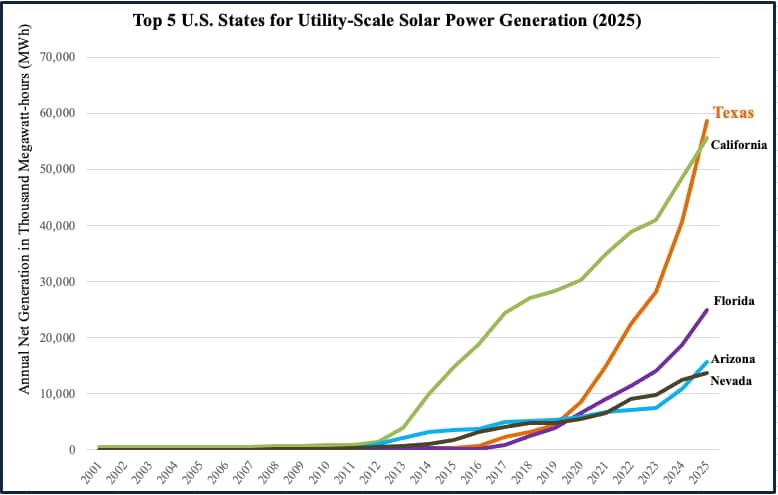
https://texas2036.org/news-analysis/growth-of-utility-scale-...
tl;dr: https://mlu3fafnp1cd.i.optimole.com/w:778/h:495/q:mauto/f:be...
The U.S. solar industry installed 43 gigawatts (GW) of new capacity in 2025, remaining the dominant source of new capacity added to the grid for the fifth consecutive year. Solar and energy storage represent 79% of new capacity installed in the first year of the Trump Administration [2].
[1] https://www.chooseenergy.com/solar-energy/solar-energy-produ...
[2] https://tedmag.com/report-u-s-added-43-gw-of-new-solar-capac...
Maybe the voters don't, but the businessmen and politicians definitely do, maybe more so than democrats. Just in different sectors (military).
Obvious counterpoints: Trump's $700m "clean, beautiful coal" handouts, or Trump's $2B buyback of wind farm leases.
>Private industry should be able to profit off the sun and it's disturbing that you think asserting this is a dunk.
It wasn't a "dunk", you added that interpretation yourself.
A bit of realism would help here. Yes, there's a left/NIMBY overlap to some degree, but the forces from the non-right camp seeking to limit power development comes from the NIMBY elements, not the left elements.
https://ember-energy.org/data/electricity-data-explorer/?tem...
Solar's global peak month in (northern hemisphere) summer 2024 nearly equaled nuclear, the full calendar year 2025 slightly beat nuclear and now it's possible that the next yearly minimum month coming up this december will match nuclear. That's a lot of change in just 2.5 years.
Also, the graph shows the world needs more wind power as it counter cycles both solar and hydro supply.