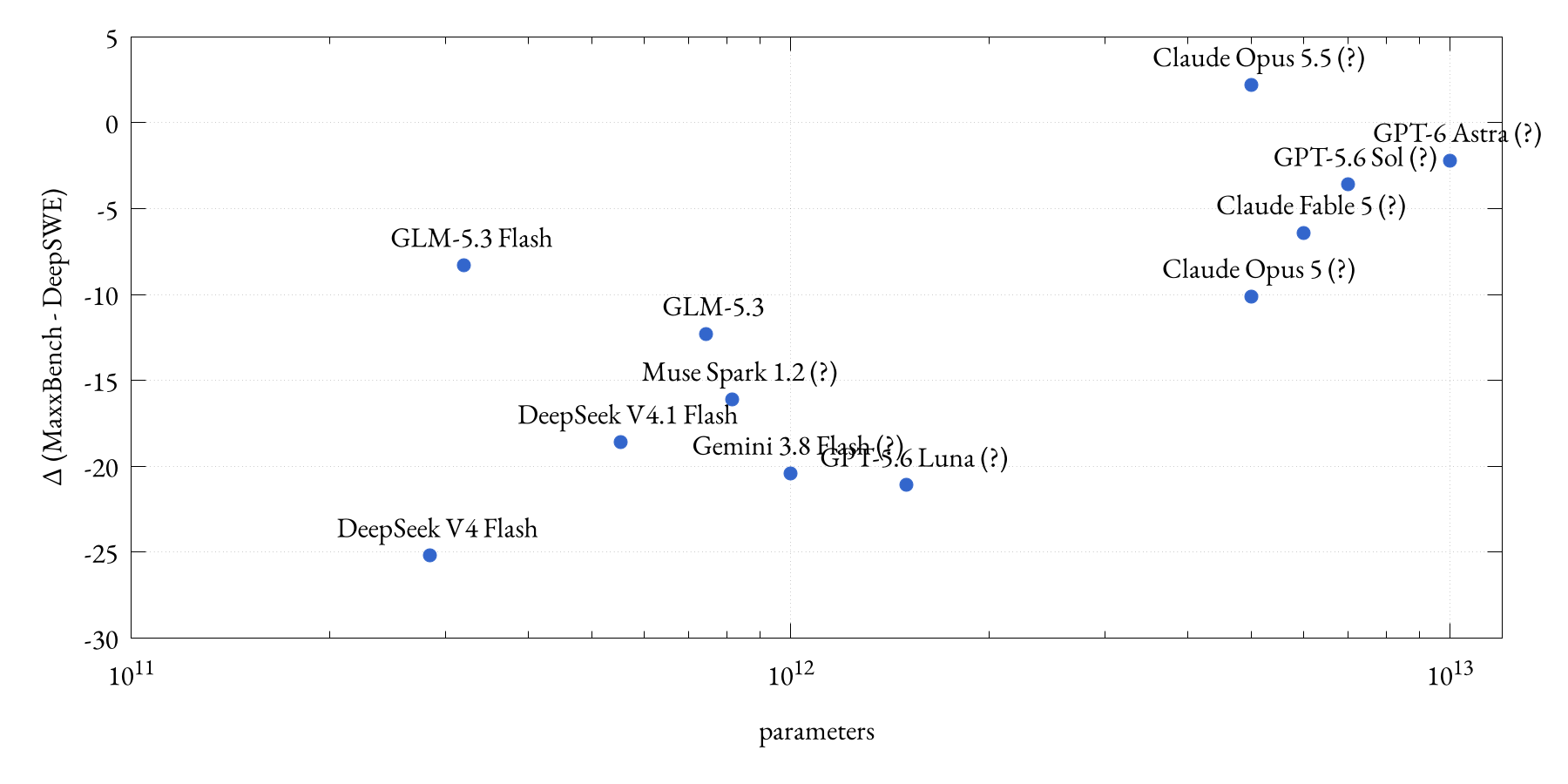
Posted by antiuniverse 4 hours ago
Look at GPT 5.6-Sol vs. GPT 5.6-Luna in particular.
(The GLM pair shouldn't be expected follow this pattern, because they're misnamed: GLM-5.3 and GLM-5.3-flash are distinct lineages. The -flash is an early release of a new pretrain on a new architecture).
If this *is* the main factor, I'd expect Kimi K3.1 and Gemini Carbon would also do well on this test (unlike Gemini-flash); while Haiku 6 would collapse (breaking the trend of the other recent Claude models). It's a falsifiable prediction.
It's not unreasonable to assume Kimi 3.1 is also a distilled model even though it's large (the difference being that it's a distilled from US models). I wouldn't be surprised if it also collapsed on this benchmark.
The practical takeaway, however, seems to be an interesting "don't use max mode". The passage about deepseeks weird API behavior dropping to pretty much zero the moment you used high says a lot.
Also, personally, even though Opus is clearly so much ahead of the Open Source models after the changes, I think the adjusted score is still very much competitive. I see other commenters using this as proof to justify why their opinions of the open source models - but a drop from 74% to ~50% is, while a big drop, still about a ~50% pass rate afterwards. That's far from useless for coding, especially since DeepSWE seems to be such a difficult benchmark. It simply seems to more accurately reflect the capabilities of these models.
All in all, I'd love to see more of such articles, and will probably keep an eye on this one - if they continue "benchmarking" these models this way.
Astra does seem close.
I'd be curious to see Argon on there, since my experience is that Argon is also significantly behind Opus 5.5 and Astra despite the benchmarks (obviously much closer than Flash, though).
I've been meaning to take a closer look at what's behind the curtain of DeepSWE - since I built what I thought should be the easiest possible coding benchmark - and the models I tested it on scored roughly the same as they do on DeepSWE... Which is supposed to be hard...
Something seems amiss.
Edit: I think that's the answer. This page lists the score as 53.3% which is close to the 54.4% reported here https://huggingface.co/deepseek-ai/DeepSeek-V4-Flash-0731 for the 0731 update. The original from April was called preview, doesn't list the score, but in the comparison with the update it scores 7.3%.
>When we read the trajectories, we saw that many models had figured out they were in a benchmark and started second-guessing the prompt. Instead of just building what we asked for, they started coding to the tests they thought the grader would run.
I ran into the same problem on my English exams.
For my use case deepseek 4.1 flash is almost as dumb as haiku 5.5. Both are fast garbage producers.
Moreover, the months I've used anthropic/OAI exclusively my API token costs are in the hundreds (or sometimes thousands). With DS flash as the first agent I reach for, I rarely exceed $40/mo.
I have access to Claude Code at work (and use it quite a bit), so I feel I can honestly compare them.
You do have to plan things first a bit more with DS (than say Opus can (Opus will have more chance of one-shotting something, although I generally don't think that's a good idea), although it often over-engineers and tries to be too helpful in my experience) and be a bit more explicit at times, but I feel it's quite close to Sonnet in performance for implementing plans, debugging issues and explaining how codebases work.
When you see this your worldview will instantly become much clearer.
I've also been very happy playing around with qwen 3.8 27b running locally for personal projects. It sometimes can't quite get there, and that's when I'll reach for GPT.
I mean of course, the real world is messy, the models are only good for what they've been trained on, and post-training frequently takes benchmark scores into account too, leading to this sort of "Great score, sucks in the real world" syndrome that seemingly most models are affected by.