Posted by Tomte 10/27/2024
Fat was bad. We got reduced fat milk, everything was fat removed stuff. We at margarine.
But the breakfast cereals were laden with sugar.
To this day this trend continues. I saw a box of cookies at Fry's the other day. Reduced fat! But same calories as the non-reduced fat box, just less fat and more sugar.
Which other industries have distorted reality, and which future ones will be revealed in the coming decades?
Great book about it The Fish that Ate the Whale.
https://www.amazon.com/Fish-That-Ate-Whale-Americas/dp/12500...
imagine if they were as rare as dragonfruit or durian
Only because sugar is bad for you does not mean fat is good for you. Evidence is rather on the side of complex carbs, high fiber, moderate protein, moderate unsaturated fat and low saturated fat intake.
But I would say that in general, 'x is good/bad for you' is a harmful oversimplification. Sugar is also not 'bad for you'. It's not that simple. Glucose is important and sometimes extremely beneficial to consume (in any form).
As for saturated fat: it's complicated. Correlation != causation. For transfats we have a pretty good idea via which causal mechanism problems arise. For saturated fat we only have correlations. Given how hard nutritional research is and especially how hard it is to draw conclusions from it, I would say it's better to refrain from feigning confidence on substances where the jury really is still out.
Right, in small amounts though. You don't need that much. Eat a handful of nuts and you're good.
It's like a teaspoon of sugar in your tea won't cause huge issues. Cold drinks with 10 teaspoons in a bottle however are a problem.
Frankly, the number of carbs and fiber you need throughout your life is 0.
Sincerely, what are you talking about? It's been well-known a diet high in fiber lowers your risk of cardiovascular and metabolic diseases.
Also, no carb diets are largely bullshit. There's plenty of complex carbs with many nutrients. The problem is while "no carb" might be somewhat effective, it's not sustainable for the vast majority of people. That, to me, makes it very close to worthless.
For most of humanity, humans ate 100+ grams of fiber a day and had a diet almost entirely composed of carbohydrates. Access to farmed meats is a very new phenomenon. I think this is the part people are missing - they believe paleolithic humans ate mostly meat. They didn't. They ate mostly carbs. Also, the meats they did have had very little saturated fats because they were game meat, not farm meat.
A burger isn't really the same thing as a wild antelope.
Think of the places where corruption is endemic. Having an outlook of "well, everybody is corrupt" normalizes the behavior and makes it easier to justify sliding into corruption oneself.
If the outlook were useful, it would help to fix the problem instead of doing the opposite.
The disillusionment doesn't offer any benefit that can't also be gained with a touch of common sense alone. But going from "some people are terrible, sometimes" to "everybody is terrible" forecloses any possibility of improvement.
To ignore gradations of disappointment is to excuse everything via apathy.
One thing can be bad, while another is worse.
tell me about how netflix dumped millions upon millions of gallons of oil in the ocean and wiped out entire ecologies.
There are definitely egregiously-bad actors compared to those that aren't.
Most industries employ honest people, don’t have to cover up anything major.
There’s a big difference between slightly misleading marketing (say, calling your 10% hand stitched clothes “hand stitched”) and outright paying scientists to cover up genuine harms to health and the environment.
Someone has a vested interest in the side of the story you’re getting, and they may have even paid for it.
In addition, transporting glass is inefficient, and it is much more prone to breakages.
The real issue is the fact that every company gets to have their own plastic bottle design, with 3-4 different plastic types that have to be triaged. They typically also want way thicker bottles than required because they feel more premium.
A government that mandates a specific shared plastic bottle designed to be recyclable would be much, much ecologically effective than switching back to glass.
I don’t know if metal cans or tetrapack are better.
I've got an old 7up bottle that was about 20 years old when I bought it in a 6-pack.
Given the thread we're in that bottle will some type of unimaginable cancer after 30 years and in 2070 people will be talking about how big plastic captured government.
Glass on the other hand is the definition of inert, who cares if it's more expensive if it keeps us alive longer?
Also, it doesn't further enrich/entrench the oil industry to the same degree as most plastics based manufacturing does.
Those are not environmentalist, but people who are trying to find any excuses to oppose renewable energy. Environmentalists know that wind turbines kill a fraction of the numbers of birds killed by things like house cats or power lines.
Eg:
> Fiber cannot, however, be recycled endlessly. It is generally accepted that a fiber can be used five to seven times before it becomes too short (as a result of repulping and other handling) to be useable in new paper products.
- https://archive.epa.gov/wastes/conserve/materials/paper/web/...
I thought the same about glass but that turns out to be genuinely endlessly recyclable. Good to know!
It definitely is great to be recycled but hauling around cullet in diesel trucks that is further away than your raw materials might not be the best decision.
“In the councils of government, we must guard against the acquisition of unwarranted influence, whether sought or unsought, by the military-industrial complex. The potential for the disastrous rise of misplaced power exists and will persist.” -Dwight Eisenhower farewell address 1961
Did we listen? Nope.
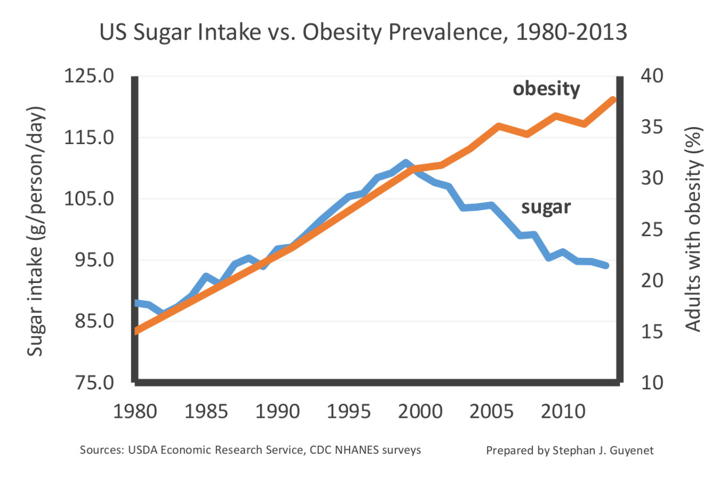
https://marginalrevolution.com/wp-content/uploads/2021/11/Su...
I think it has more to do with 'too many calories' than blaming sugar.
Because a lot of US sweetener consumption has moved away from sugar to corn, because subsidies.
For added fun, you can try to eat “too many calories” as well.
After, you can report to me how successful you were in gaining weight.
If you eat a load of sugar in one sitting you will feel sick, lethargic, have a sugar high or some combination. It also literally _feels_ bad for your teeth. Having a coke or a cookie every now and then is fine but constantly eating it just feels off.
Eating lean chicken with a small amount of butter or oil feels obviously healthy.
Most of the other gaps are just things like OK, you're working 50 hours a week to optimise your bank account, just wind that back a tiny bit and spend 5 hours on your personal health, stop being a mug and take it seriously.
It's like when people ask "how do you have time to...". You turn off the TV and Instagram for a bit (no problem with using them, just maybe not for 2-3 hours a day) and pick up that book you wanted to read or whatever. Job done. It's both trivially easy and very hard if you make it a core aspect of your personality that you are some sort of helpless plebian.
So TLDR the sugar industry paid for (1?) literature review paper that said that existing papers reporting risks of sugar were flawed.
But what I hear is that _until recently_ sugar research has been put on the backburner, and only recently are people starting to re-examine the links between sugar and heart health.
How are these two related? Did the one paper really put people off researching it for 50 years?
Yeah, sugar isn’t good for you. It’s a lot of concentrated calories. And possibly has some other issues as well. Probably stay well below the guidelines. An occasional sweet treat isn’t gonna kill you but don’t go guzzling down coke instead of water.
Lots of fats aren’t good for you either. Especially the saturated kind.
PS: Is there a concerted pro fat effort going on HN right now? We’ve had 1 opinion piece by a non scientist journalist paid by industry to pretend saturated fat is good for you against all evidence so far, and now we have a 2016 article being pushed up to the top defending fats without being marked as such, within hours.
It's not that dense though. Fat is 2.25x as calorie dense as sugar. Many are surprised to learn that peanuts, fatty meats, oils, butters, and granolas have more calories per gram compared to Skittles. The only way to avoid overeating fat is to make the portions sizes absurdly small. There is often a shock at learning that only a tablespoon of peanut butter, which is a miniscule amount of food, is 100 calories. It's trivially easy to adds hundreds of calories with butters and other fats.
It's common for posts here to lack date markings that they should have. It doesn't change the conclusion of the research, except that "60 years ago" would be more accurate now.
It also seems to be common (enough that I've noticed the pattern within a couple of months) that there are suddenly two articles on related topics out of nowhere. A lot of the time, this seems to happen because someone reads the first link, browses around and find something else interesting.
If someone finds high fats good for themselves, then they might feel lied to and want to shout it.
That may be reason for what youre observing.
So many cases in human history are where one thing is believed, people and studies come and show that it's false, and then it takes a really long time for culture to come around to it. Earth being round, tobacco, climate change among others.
Based on what the non-industry funded science shows, saturated fat being considered any bit healthy is in the long stage of culture taking a long time to accept what the science is saying. And it's not helped by studies with industry funding that know how to skirt the edges. Many places to choose from, but here's one from Dr. Barnard talking about sugar vs saturated fats [2].
[0] https://news.ycombinator.com/item?id=41957637 [1] https://www.youtube.com/watch?v=OkqWdY5_2-8 [2] https://www.youtube.com/watch?v=8xeHDqBB6X0