- https://altstack.jp for Japan
- https://worktree.ca/taffer/canadian-alternatives for Canada
- and ofc https://european-alternatives.eu/ for the EU
But I just wanted to point out that https://alternativeto.net/ recently (well, over a year ago) added a flag next to each suggestion so you can easily tell where its from. It's all crowd-sourced and I've both contributed to and greatly benefited from the project myself (especially for finding FLOSS alternatives to popular software). Here's an example
https://alternativeto.net/software/github/
I think the fact that it's crowd-sourced gives it a lot more staying power than a lot of these one-off projects that are presumably maintained by a single person or team.
The project has no backend and is purely browser-based, but I’m based in Europe and developing the project here, so I consider it a European project =)
I think the purpose of the site is more about the alternatives to 'large players', platforms and infrastructure companies. Still Constantin Graf should have clarified out of politeness but possibly he's busy or doesn't have time to respond to every email.
However I'd point out there is a market for European 'Product Hunt' that would include more of these smaller projects.
Millions and millions of people need to make and send invoices. Many more than people who need domain name registrars, uptime monitoring services, content delivery networks, or microblogging services.
About European Product Hunt - very good idea.
I was thinking recently that we need more European social networks, messengers, etc.
It’s a very good time to build imo =)
Older members of HN will remember that Product Hunt probably came to life a lot because of HN and the submissions/comments from rrhoover (founder of Product Hunt). He's still active here, but before/during Product Hunt launch he was very active if I remember correctly.
Maybe a grander idea is a European Hacker News, that has the potential to spawn the European Product Hunts of tomorrow :)
This started out as an ideal about Goods. You make a Doodad in Venice, clearly there should be as few obstacles as possible to prevent somebody in Dublin having that Doodad, so no export taxes between Venice and Dublin, shared regulatory framework so that your Venice "This Doodad won't choke a baby/ burn down a house/ spy on you/ etc." paperwork is valid in Dublin, and so on.
But immediately people who make goods said well this rule needs to include Capital, it's great that I can sell Doodads from Venice in Dublin, but if I want to build a Doodad factory in Venice but my money is in Dublin that should be easy too. And Workers realised if it's just Capital and Goods then it's a race to the bottom for Labour, the Capital and Goods will go where it's cheapest but the workers can't move. So very soon Workers can move freely too, in order that Hans the Doodad Engineer can move to Venice and the courts ended up deciding that in practice everybody gets this freedom, a 5 year old can't have a job and a 105 year old probably doesn't want one, but maybe Hans needs to support his 5 year old grand-daughter and his 105 year old grandfather, so Freedom of Movement must apply to all EU citizens.
So, with that idea in mind, I suspect the EU's perspective is that you should come to Europe and write software here, rather than that you should stay exactly where you are and if it's not an EU country then too bad, no EU Product Hunt for you.
"The new government policy shouldn't require iPhones" is a long way from "Nobody can read The Onion", and even in its hardcore "Sign up for YCombinator" mode Hacker News really isn't anywhere close to the former.
Although because idiots I am no longer in the EU I'm in Europe too.
Ok, but what are your actual arguments against it? Again your comment contains things about the EU and US which I don't know why you keep bringing up.
Do you have any arguments against a European Hacker News that isn't related to the EU and US geopolitics or government policies?
I'm sure musicians and city dwellers could have some stories they're more interested in versus less interested in, but this gets into the newsgroup hierarchy problem where too much specialisation means there's nothing left to talk about. We presumably agree that a Hacker News for people named Brian who work at Meta is a bad idea?
I am sorry but no. This is a common myth, but go way back to the original treaty of Rome and you’ll see much more than free movement for goods. It was just a convenient first step.
However once I'd fought the EU's terrible web search I did sit and read a bunch of the actual Treaty of Rome, and yes that actually does very clearly specify Freedom of Movement for Workers and is broad enough in how it treats this freedom that it's not a surprise courts subsequently concluded that basically every EU citizen should be able to live anywhere in the EU.
Open-source security framework (1). Applied 16 August 2025. Company registered in Switzerland (EFTA). No reply.
However, European Alternatives is a personal (sole proprietorship) website and has nothing to do with Europe, despite the name and style, which are slightly misleading as they mimic official EU website aesthetics.
Btw tirreno looks very cool, just starred on GitHub :)
https://info.addr.tools/bunq.com https://info.addr.tools/lifebit.ai https://info.addr.tools/tomtom.com
Unfortunately they did really well at SEO at one time, and more active alternatives appear far below in the search results.
I've also found other problematic ones:
https://euro-stack.com/ (I couldn't understand how to submit a new entry)
https://www.goeuropean.org/ (all submissions fail with an AirTable error [sic] that the workspace is at the record limit)
    A wordpress.com based website hosted in California by the US company Auttomatic

    Fronted by Cloudflare, a US monopoly (this is probably part of wordpress.com paid subscription)

    Edits its letter to EU Commission asking to support European IT industry in Microsoft Word.

Converts it to PDF with Adobe softwareI plan to add a paid “pro” version with more features, but the current functionality will remain free.
Webpage: https://twonly.eu/en
Starting working asap on this because in Poland (where I live) it will be required from April 2026.
Issue to follow: https://github.com/VladSez/easy-invoice-pdf/issues/121
Maybe this was enough to not include it?
=)
Already done: replaced SendGrid with Sweego.
Later: move domains from US registrar to EU based.
The difficult bit is the Microsoft Office because we are also using Azure DevOps for code, tickets, wiki and ci/cd.
Just moved all my hosting and dbs from a US company to Hertzner after 15 years of good service. Moving domains now.
Sometimes hosting companies suspend accounts. If that happens, it's useful to have your domains and backups with different providers.
It's all in there.
Context: I used to run a domain-related service that used registrar api's and gandi's seemed the most well thought out by a considerable way. The drawback was they're quite expensive for registrations/renewals unless you're doing it at volume.
I had reservations about them being a French company wrt support but their API was so good I never needed to contact them on anything.
Definitely worth a look.
Unfortunately there's not that many and often the process is broken.
You are talking about DNS zone hosting which can be separate. And I always prefer to keep it that way.
Wero is another name for iDEAL, it has been pushed by Dutch, but it is an engineering fiasco.
There is no way Poland would adopt it. Blik is just on another level price- and feature-wise.
Side note: Looking at their job listings I don't see any engineering positions (with the exception of a security engineer which is a grey area in a bank IMO), only managers and business roles.
But you just answered your own question.
Wero is a money extraction business that secured European Commission support. There is no engineering nor payment system to it.
I am not deep into this, but I heard multiple times that the choice of the pan-european payment system was largely political and technnically suboptimal. Old Europe pushed for the aging iDEAL against a much more advanced Blink, so Eastern European banks led by Poland left the consortium.
In the end, iDEAL rebranded as Wero was dead on arrival because a successful system needs to be supported by everyone.
Wikipedia gives an overview by year.
As for the axe, I have no personal interest.
Sure I'd rather use Wero than PayPal -if it was decent- and building it on top of SEPA instant transactions is neat. But the lack of buyers protection is a deal breaker for me! And quite frankly I'd rather use a digital Euro governed by the ECB than some rent seeking hobby project by a bunch of private banks. Especially because they will inevitably enshittify it with ads and hostile BNPL like PayPal.
The digital Euro has not been implemented yet. Some analysts are skeptical but this is the EUs answer for Visa/Mastercard.
Wero is coming and it should work across Europe
Why do European drug firms charge so much more for their drugs in the US than in Europe? That is an actual difference between what it is like to be in a consumer in US vs Europe. Even Bernie Sanders thinks it is a problem: https://www.npr.org/2024/09/24/nx-s1-5123689/novo-nordisk-ce...
When American customers pay European firms, it's just capitalism, sorry bro.
You’d have a point if you had examples of European pharma companies cutting off supply to American entities for political reasons. You don’t, so you don’t have a point.
If US firm profits in Europe are "protection money" then EU firm profits in the US should also be added to the ledger.
Hell, the EMV standard — used in all cards worldwide — means "Europay, Mastercard, Visa".
Look after your toys better.
Lesson learned, at least for me. I am in the process of moving everything digital to Europe.
We're done with Europeans treating us as suckers. Doing nice things for Europe leads to nothing but contempt from Europeans.
The system is packed with opaque middlemen such as pharmacy benefit managers, many of which are making big rents
American Politicians are really famous worldwide for being selfless, defending other nations interests to the detriment of their own nation
Especially the Republican ones, which have blocked and still trying to block all efforts to bring drug prices down by negotiation.
They are known for being very caring people. Especially for the poor and disadvantaged
Same way the defense companies probably said something like "it is good to deter Russia so that Europe can remain free and democratic".
Hilarious, isn't it?
Anyways shouldn't you get back to work so you can afford all the new weapons you're going to have to buy?
"American Politicians are really famous worldwide for being selfless, defending other nations interests to the detriment of their own nation." Well yes, we did that for you guys for 80 years after WW2, a very peaceful and prosperous period for Europe by historical standards. We got nothing but hate and laughter for it. Now we're done.
You're either very stupid believing that the American Engagement in Europe was just charity or just a very good troll.
I guess Vietnam, Iraq, Afghanistan, Iran (pre-Mullahs) and other countries that were gifted with democracy were also other selfless endeavours by the Americans.
Europeans always imply that NATO is some sort of vast American conspiracy. But they are hardly ever able to give compelling examples of American benefit. The US benefit from NATO always remains a sort of esoteric wisdom which is mysteriously beyond the grasp of the average American. I suppose if we were more educated on European geography trivia, like you guys, that might help us understand why the US needs NATO so badly.
"Vietnam"
Yes, that was seen as analogous to another very recent war in Korea. If it wasn't for us, the state known as "North Korea" would cover the entire peninsula.
"Iraq"
One of the worst dictators in history, that Saddam Hussein. Europeans laughed at us for our opposition to him. It's why we now have little interest in opposing Putin, who is a herbivore by comparison.
"Afghanistan"
Depending on who you ask, we are either imperialists for displacing the Taliban, or complicit for allowing them to displace us right back. Typical double-bind.
"Iran"
You mean the country which is at this very moment crying out for American intervention, asking the Americans to protect protesters? It's fascinating to me how certain Europeans can simultaneously beg the US for protection, and also assume that the US must be up to no good in other countries where the US gets begged for protection.
Hopefully you can see why I support Massie's bill to withdraw the US from NATO at this point. I'm tired of it all. I want a Swiss foreign policy for the US. Do you also support Massie's bill? Maybe that's something we can agree on.
Also your reasons to invade Iraq were made up Lies about Weapons of Mass destruction, and the US propped up the Taliban against the Soviets in the first place.
Both were quite liberal states compared to today, after they were blessed with US intervention
I think your narratives are oversimplified or inaccurate, but ultimately it doesn't matter.
The important point is: Since US intervention is so bad, according to you, can you understand why I want to withdraw from NATO? Can we at least agree on that? Don't you want to save your continent from the evil US intervention such as all the billions we've sent as support to Ukraine?
See why I want out of NATO? The Swiss stay perfectly neutral, they never had a 9/11, everyone loves them. No one blames them for the situation in Ukraine (they contribute little) or anything else. That's what the US was like pre-WW1 with regard to Europe. I want to go back.
Have you thanked the French for getting involved in US wars?
And when you say "we", does that include yourself?
>And when you say "we", does that include yourself?
Yes, in the sense that me and my ancestors have been paying taxes to support a military which was supposed to be able to win against the USSR. That money should have stayed in the United States for peaceful purposes. Euros should've defended themselves. If the USSR took over the entire continent that's not our problem. We have to focus on our own problems instead of playing world police.
You can't both demonize the US for its every foreign policy move, and also demand the US protect you. That makes zero sense. You can't both trash the US for its every supposed problem, and also demand that the US pay more attention to Europe's problems. That also makes zero sense. There's nothing coherent in the European ideology beyond just "America Bad". Fine, we'll take our toys and go home. I sure hope it makes you happy.
For the EU, Visa and Mastercard dependence form a duopoly controlled by a hostile foreign power. An alternative is essential.
https://wallethub.com/edu/credit-card-interchange-fees-by-co...
The EU had such a good deal with the US. But they couldn't resist making fun of us. They made fun of us for our military spending while we deterred Russia. They made fun of us for our health spending while we subsidized their drug development costs. They made fun of our long work hours, while demanding Ukraine contributions based on our high GDP (which is high in part because we work long hours). They talk so much about America's soft power in Europe, without realizing that Europe's soft power in America is practically all gone at this point.
The regulation also forced all merchants to accept Visa/MC without being able to surcharge a fee for it.
Both Companies are quite happy with that deal as it boasted the adoption for their cards across Europe
MasterCard or Visa also aren't operating as a charity in Europe.
Before the capping of fees was introduced, their acceptance was shit at most businesses, and most bank consumers also didn't have one, as opposed to cards of the national scheme which had lower fees both for customers and merchants
Then it comes out that MasterCard/Visa fees in Europe are actually far lower than in the US.
Now the Europeans are laughing at the Americans for being suckers.
This interaction basically sums up the entire EU/US relationship and the absurdity of Europe's rhetoric around it. Copy/paste this template, change a few words, and it applies pretty much everywhere.
And we also look with horror because most of the bullshit in the US is coming to Europe with a 20 year delay
I need to worry about secret police in my state murdering randomly people. I have no time to think of Europe. Hence it is best to withdraw from NATO. Agreed?
Go look at what these people thought of us before Trump: https://www.pewresearch.org/global/2024/06/11/views-of-the-u...
> Sweden: 47% had a favorable opinion of the US.; Germany: 49%; France: 46%; The Netherlands: 48%
And this was after the US committed over $120 billion in aid (all weapons and cash) to Ukraine, and, for some reason, allowed Sweden to join NATO--the same Sweden that pledged neutrality when Finland was invaded by the Soviets, who stole the Karelian Isthmus and other bits of its territory, and similarly did nothing when Norway and Denmark were invaded and occupied by Nazi Germany.
By May of last year (before the Greenland drama--I'm against that of course), more Europeans liked China better than the US. Maybe we should start shipping materials for weapons to Russia, like China does, to see if that improves our popularity with Europe.
"Soft power" is an absurd talking point. Doing nice things for Europe has brought us nothing but anger and contempt. Just scroll through this thread, there's plenty of proof. They are a very entitled and condescending people.
Last I checked, Trump was elected in 2016.
In 2021 he tried an autogolpe and by the time this survey was done in 2024, he was not in prison for treason but instead again running for president as nominee of one of only two major parties. What sort of opinion should one have of such a country?
> allowed Sweden to join NATO
What sort of absurd argument is this? Now that Sweden changed their mind and want to enter treaty obligations to help defend e.g. the Baltics, we should refuse them?
Also, I can't begin to comprehend how Sweden would militarily defend Finland, who entered WW2 as an ally of Nazi Germany after being invaded by USSR, and simultaneously fight against Nazi Germany.
Trump is only pushing that « free for all » policy even more, I wouldn’t expect to see things improve for you.
Instead of fixing your country and making the rich accountable, you’re being manipulated to look elsewhere.
Anyway, I believe that the eu cutting ties with the USA is the best thing that could happen to us and I’m glad you’re satisfied. We should have spent much more on military and put an end to the USA military supremacy across the world a long time ago.
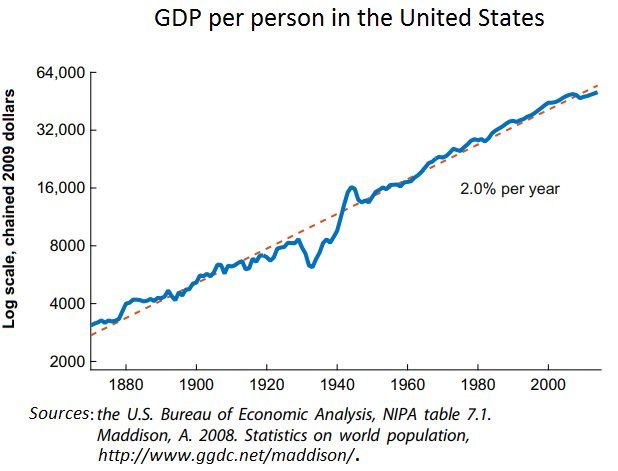
Our relationship with Europe is not very important for American prosperity. The GDP growth trend is the same before and after NATO was founded: https://upload.wikimedia.org/wikipedia/commons/0/01/GDP_per_...
Like the US benefit from NATO, "soft power" always remains a sort of esoteric wisdom which is mysteriously beyond the grasp of the average American. I've spent tens or even hundreds of hours arguing online with Europeans. They've never given a compelling explanation of how US "soft power" is supposed to work in a democratic country when the majority of the population dislikes the US. They just stick their nose in the air and say "too bad you're an ignorant American, if you were European like us, you would understand". Europeans think Americans are suckers, in other words.
It's very ironic to me that Europeans say that Americans are purely self-interested, but when it comes to actually convincing to us, they are barely ever able to muster any sort of compelling appeal to our self-interest. (They don't just want us to defend them; they also want us to make the argument that it is in our national interest to defend them! It's rather astonishing.) At the end of the day, "Americans only care about their self-interest" is just another "America Bad" rhetorical point, as is proven by the actions of Europeans.
If you want us to be benevolent to you, give us credit for being a benevolent actor in your region. If you truly believe we are self-interested, appeal effectively to our self-interest, and respect our decision if we conclude that your appeal is unpersuasive or the juice isn't worth the squeeze. But don't constantly talk about how we are evil and self-interested, and then de facto expect us to help you on the basis of altruism. That's what you've been doing for years now. At this point we are burnt out. "The beatings will continue until morale improves."
Take a step back to reflect on what you're writing here, done earnestly it may resolve your frustrations. It's easy to not notice the world revolving around you and just take it for granted until it's not the case anymore.
"Don't be an obnoxious asshole to someone if you need their help" is just basic etiquette. Europeans seem constitutionally unable to grasp this point. Maybe it will help if you follow your own advice, and reflect on it for a bit.
(If you don't need our help, continue being a jerk of course. It will help me achieve my goal of getting the US to withdraw from NATO.)
I don't want the world to revolve around me. I'm completely tired of that. I want to be Switzerland. We stayed out of Europe's problems pre-WW1 and we can do it again just fine.
I probably won't reply to your further in this thread, because I expect any further comments from you will be additional fact-free condescension. (If you want me to reply I suggest you start by apologizing.)
Anyways, good luck with Russia.
And of course good intentions are no guarantee of good results, e.g. I believe Bush had good intentions with Iraq, he was just incompetent.
China is very smart to simply not get involved in much of anything. As soon as you do something, it gives people the opportunity to blame you, if even a single person thinks the result is even a little bit less than perfect.
Switzerland is the smartest.
There are regulations. Both Visa and Mastercard were happy with those and made quite a lot of money from their business in the EU. They absorbed and merged with local alternatives and competitors. It’s a bit rich to complain after the game has been going on for a while that the rules are as they are: they’ve always been that way and if they were not happy, they could just have ignored the European markets. Now, if your point is that you’re being shafted, then congratulations: realising is the first step towards solving. Now, vote for a government that will actually regulate the sector in the people’s favour, not the big corps. We cannot help you for that.
I am pointing out the absurdity of the original European claim that such fees are "protection money" to the US, when the EU is getting a sweetheart deal relative to the US. It's typical disingenuous European rhetoric.
I know it's difficult for you to comprehend, but Governments are supposed to act in the interest of the general population of their country, not for companies and the 1%.
And that includes making sure that markets are working and regulating (near) monopolies
They have to put an absurd sticker price on the drugs so that the "Pharmacy Benefit Manager" (an useless middlemen that only exists in US Healthcare) can "negotiate" a "discount" on behalf of your insurance (aka the real price), for which he takes a cut based on how big the "discount" is
https://news.ycombinator.com/item?id=29627097
What's insightful to me is how fast the list of alternatives are growing.
The list is much better now than 2021 and we still have a long way to go.
Also Constantin Graf needs to add a new Category: "LLM Clients" or "AI Tooling"
Open source is the global alternative you're looking for. There's even interesting hardware options like https://starlabs.systems/
The US also has had an unfair advantage in tech/defense and finance because it hosted the global hubs of the free world. This attracted eye-watering amounts of money to places like SF and NY. With this newfound isolationism, tariffs etc. reducing the viability of hosting the global hubs, there's massive opportunities opening in europe and elsewhere.
While I agree with your sentiment, European and nationalistic are two contradicting positions, unlike the other three mentioned superpowers.
I mean sure, your example shows that the virtue of being "European" represents a certain demographic and a sovereign territory. Again, it's a continent, so what?
Right, it they do not. You’d have to stretch the definition of nation beyond its breaking point for Europe to be a nation. It would include Russia and Ukraine, Finland and Greece, none of these nations have much in common.
Europe is many things, but probably a poor base to push any nationalistic aspiration.
It is not "nationalistic" to prefer things that are made in Europe. Europe is not a nation and very few people feel anything close to national pride about it. I like that we have European alternatives instead of German, French, Swedish, etc, alternatives.
But that's not what's happening. It's a clear and obvious security risk to their sovereignty. If the government can't guarantee that to its citizens then what even is its purpose? The Trump admin has already tried to use American tech dominance as leverage.
Ask yourself this question, what if there was a foreign tech competitor that managed to scale up to be basically a better cheaper AWS. Would the US government ever allow it to encroach its market to the point that AWS or Azure did in Europe? Look at what happened to tiktok if you want to see what approach they'd likely take.
So how exactly would you envision an objective and neutral provider in a world of geopolitical competition?
As long as they're actual alternatives of course, rather than just another monopoly but at a smaller scale.
It's not even that. We euros were more than willing to look the other way (see the umpteen attempts to reconcile our privacy-friendly legislation with the free-for-all of American services, ongoing for decades) in the name of convenience and fundamentally shared values. The turning point was really in 2024/2025, when those shared values were summarily swept away on the other side of the Atlantic.
Besides, the "global alternatives not subjected to power-hungry overlords" are actually very much subjected to the worst of humanity, and wide open to exploitation from such overlords.
This is, in fact, what "overlord" means!
What we should work towards, though, is interoperability and open source solutions.
We should not; we must. But at the same time we need to recognise that we are powerless to affect the American government, which can go rogue at any moment. So from a pure risk analysis, we also need to have local alternatives. I regret this state of affairs, but it is an unavoidable consequence of the US threatening its nominal allies.
ps: congrats on your success