Posted by surprisetalk 6 hours ago
One, the article asserts that too many stops is the main cause of low ridership in the US. I didn’t even see a correlation (which would still not prove one causes the other) between number of stops and ridership. This is the central thesis of the article.
Two, removing stops will likely not make the remaining stops nicer. Cities aren’t thinking about how to allocate a fixed bus budget. They’re asking themselves how much they have to spend on buses. This is the core of the problem: low cost services are in a death spiral in the US. Budget cuts -> services get worse -> reduced users -> more cuts.
In my experience, the bus is not a nice experience. The bus feels dirty, unsafe and hostile. Further, the arrival times are not reliable and are often a long time apart. This means you need to arrive ~10 minutes early and time your bus so that you also arrive at your destination early. You will be wasting possibly 20+ minutes each way. Of course you are also standing in the sun or the cold or the rain while you wait, and probably walking on a hostile stroad and across several lanes of traffic before that point.
So while the number of bus stops might matter at the margins, we’re not talking about a system where marginal improvements will matter. If you want to improve ridership, you need to make the bus an attractive option for more people.
Even if every current person's mind has been completely made up based on past experience, there are always "new adults" learning to get around and forming opinions.
So I strongly disagree: marginal improvements DO matter. And I agree with the author that this would be a relatively easy improvement to deliver for many cities.
I live in Chicago with the third-closest stop spacing per the article. I'm personally able to walk a block or two further to a bus stop no problem. Bus stop consolidation would save me a lot of time over the course of a year!
Decreasing the number of As and Bs by half might reduce that 20% start/stop time by half, shaving 10% off the total time. (This is ignoring the fact that more people will need to board and leave at each stop, which might mean in reality you’re saving like 8%.)
But you will also increase the distance walked to the bus stop. That means battling cars and weather.
I’m really curious how this would pan out here, but it can’t be the only solution.
“A block or 2” each way at the start and destination is a significant difference (4-8 blocks) for most elderly people.
Busses fill two different roles, as primary means of transportation and arguably more importantly as a backup means of transportation. They can serve a vital role for cities without the kind of investment it would take to make most typical HN reader consider them as a primary means of transportation.
As such latency isn’t necessarily as critical vs coverage here.
One bus route can't wear two hats. Faster, sparser routes are typically complemented by slow, meandering collector routes which provide the kind of backstop you describe. Moreover, elderly and disabled people can use paratransit [1], which exists precisely to serve people with mobility issues too severe for regular transit.
Anyway, I reject the notion of buses as a second-tier transit option reserved for poor and disabled people. The only way poor people ever get decent service is when they use the same infrastructure that affluent people do. A bus system that doesn't serve the middle class is a system that will quickly lose its funding and become inadequate for anyone to use.
Paratransit is for a far smaller percentage of the population due to the significant expense.
In the US, buses (and public transport in general), are thought of as social programmes. Anyone can use them, but they are really for people who can't drive or are too poor to own a car.
The rider makeup then looks like that. The elderly and the poor, sadly. Services run at a huge loss and are dependent on massive and unpopular government subsidies. Quality of service is bad. There's a stigma to using it. You end up with long, slow bus lines because this allows as many of the current demographic (elderly, poor) to take the bus. And there are always bailouts or brutal cuts on the horizon. You end up at a sort-of local maxima of inadequacy.
In an alternate universe, public transport is run to compete with the car, and attracts all demographics. Day-to-day operations are un-subsidised, and therefore relatively expensive. It competes on value. People use it because it's a better experience than driving.
This alternate universe is a city like London. Transport for London has a balanced budget, and despite what grumpy Brits like to say, quality of service is on an ever-upwards trajectory.
In my opinion, operating transport as transportation programme, not a social programme, is how you get more adoption in the long term. You make public transport attractive to more demographics.
The usual pattern is when a bus only lane is proposed, drivers complain because they view the bus as a social program. Local legislators often take the drivers' side because they also view the bus as a social program. Even if you get the political capital to push a bus only lane, traffic enforcement will routinely ignore bus lane violations. LA is making waves on the latter problem by attaching cameras to buses which automatically write tickets for cars blocking the bus lane.
Ultimately it's a politics problem. If nobody wants to spend political capital on running a bus system as a transport program, it ends up as a social program.
1. Where the Government wants to subsidize some group (e.g. help the disadvantaged by giving them discounts) they should pay the fair price to the transit agency out of the budget of Welfare, not drag on the financials of the transport agency. In other words, it shouldn't be possible that the transport agency is insolvent only because most of their customers are paying next to nothing. Discussions about whether we should spend a certain sum on subsidizing the poor to ride the bus/train/etc are purely welfare budget discussions.
2. The Government should move additional money into the system when they realize an expansion of transport helps further societal goals: e.g. congestion pricing funds should help to expand transit, or the government pays part of the cost to build new rail service to reduce congestion on the roads.
Instead of TfL being forced to take the loss, they are reimbursed by local government cost of the transport.
As an aside, I also take some issue with this pass being completely free to use. In my experience, people end up using it to go a single stop just because it's free, so why not -- which slows bus service for everyone else. I think it should be 20p per journey or something like that.
I can't make any excuses for the social and class implications, but if it got more people on the bus, it might only need to be a temporary measure.
It’s a large percentage of total bus revenue by design, and a significant expense for some local governments. But the number only look large because of how we split the vast majority of government spending into federal and state budgets with local budgets being relatively anemic by comparison.
Perhaps the tiny subsidies (in absolute terms) are because the bus systems are just so small?
SFMTA's farebox recovery is around 25%. London Underground is about 130%. Osaka Subway is 209%.
Fundamentally as another commenter here said, a bus "can't wear two hats." In most large US cities, the bus, and sometimes the subway (if one exists), is mostly a welfare program, and its target demographic is the elderly, the poor, and the homeless. Two of those groups are rarely in any hurry.
The fact that urban professionals also rely on transit to actually get to work is not very much considered in the decisions ultimately made. This is why any changes to it are so fraught.
To actually serve both populations, you'd need to have two independent systems, but that would represent a tremendous amount of incremental cost. That's why they used to have (do they still? I'd guess not, post-pandemic) buses paid for by Apple, Google, Facebook etc. to shuttle people to work -- it's something the city government could never accomplish because the choices that make transit useful to those with jobs make it problematic for the other group.
Nothing stops you have adding express bus routes, thus allowing busses to work for yet another population. Further, bus networks are inherently cheap as long as they see reasonable ridership numbers it’s more economically efficient than cars.
When living in many a European city, I have chosen to walk instead of using a bus route due to the frequent stops making the bus trip a lot more expensive and marginally quicker. I have also lived in places where the eldery get a separate service, tailored to them, if they need it. Works a lot better IMO.
Alternate buses stop on the one-mile points only.
Until there' a snowstorm, and no one shovels. And you have a broken leg, or are elderly, or disabled. Sure, it might save you personally some time, but we live in a society and should try to help out the one's who need help.
And this is why point-to-point transportation is almost always faster and more convenient, if you can afford to use it. (That load-bearing "if" is important, though.)
Point-to-point transportation is faster and more convenient because:
1. we don't have bus lanes so buses are forced to sit in the same traffic as cars and 2. buses are often underfunded so have slow/infrequent service.
Point to point transportation is often slower and less convenient if buses and public transit is done right. I can count on my fingers the number of times I used an Uber or drove a car in the 1 month that I stayed in Europe - this was going out every day, in multiple cities, rural and urban, and across different countries.
This is a good thing! If more people use public transit when it's possible, it opens up the roads for the handful of people who actually NEED to use a car.
They make even more sense if they are a bit larger and can accommodate multiple people at once. Something like a large van or small bus.
(Also, tunnels are useful not just for the increase in traffic, but for moving car traffic away from non-car traffic, which makes both kinds of traffic safer, faster, and more efficient.)
Even the rush hour traffic is trivially solved by mild carpooling (small vans for 4-6 people).
We're talking about cities, of course; in rural areas, nothing beats cars.
A single bus carries on average 20 times the people cars occupying the same space would (as you rarely get more than 1 person per car in peak hours).
I'd rather take buses than the car in any city. Cars make cities dangerous, noisy, polluted, congestions make people nervous behind the wheel, fights are far from uncommon. Finding parking, paying for it is another issue, common in Europe where (luckily) city centers are often millenia older than cars.
At no point of me living in the US I found the car-centric model anywhere better.
The things you say about noise and pollution are also true in the US, and American drivers are acutely aware of them. But the alternative is not a European bus, so people drive.
Taking the bus around sf makes it immediately clear why (not all, but most) people who have options choose them.
Even factoring in parking, traffic, and bus lanes, it's much faster to drive within SF than take the bus. Stopping every 2 blocks and missing every other green light kills throughput.
My local bus stop to connect to BART supposedly had service every 20 mins, but often a bus would be out of service and the wait would be 30-40 minutes. Unless a bus was right there, it was faster to walk.
But yeah the fact that it's often faster to walk (and definitely faster to take a bike/scooter) is also an issue.
Actually I think it is both. Car culture in Europe is nowhere as dominant as it is in the US. Many Europeans grow up with public transportation as the default mode of getting around. So they are more likely to be accustomed to things that become grievances for Americans.
I was born and raised in Turkey, and now live in the US. In Turkey when you take a bus or train during rush hour you’re often packed like sardines. No concept of personal space. Same with many cities in Europe. That type of thing wouldn’t fly anywhere in the US, except maybe NYC. Even then though New Yorkers tend to dislike it.
It has always baffled me why they make it so hard for first-time users in particular. Sure, they mostly care about the regular customers who make up 99% of their passengers, but everyone has to be a first-timer before they can be a long-timer. It's not just UX papercuts, the experience seems designed to be maximally hostile. Is it because one more marginal person is a little more delay, a little more crowding, etc? It feels like there are perverse incentives at work.
Do you have any sources on that? In basically any European country the car dominates and is used far more than public transport. Even in cycle-friendly Netherlands the majority of people go to work by car.
https://www.cbs.nl/nl-nl/visualisaties/verkeer-en-vervoer/pe...
Basically in the Netherlands, if you're within 5-10km, you go by bike. If public transport is reasonable, which it mostly is in urban areas, you take it. You'd almost never choose car within a major city, unless it's on the outskirts.
Make it legal for kids to move around on their own and take transit to school, just like they do in most of Europe and beyond. Parents are lazy, so many kids will. That's a lesson in public transportation use right there.
... it is legal though? But if you live in the typical US suburb then good luck with that. You'll catch a district provided bus to school and if your parents don't want to drive you somewhere you'll ride a bike or just not go.
Taking the bus in the suburbs often means walking 15 minutes, waiting on 45+ minute service, and switching routes at a transfer station. It's an ordeal to say the least.
Even if you are poor in the US cars are remarkably accessible. You can finance a used car with no credit and a couple dozen dollars a month.
Europe builds apartment complexes which are ~3 to ~10 stories tall, the US builds sprawling suburbs, zoned so that there's no grocery store in sight.
If you're packed 3 to an apartment in a 10-story complex, it's unlikely there's enough parking for all of you.
the top comment is right and this article is a good exmaple of what transit people do. they get so excited about transit and how awesome it is that they forget about some of the more fundamental issues.
But to call NYC, LA, Philly, Chicago, Minneapolis, Houston, etc sparse doesn't seem very accurate. Yes, LA is vast, but I wouldn't call it sparse.
http://www.demographia.com/db-worldua.pdf CTRL+F for "BUILT-UP URBAN AREAS BY URBAN POPULATION DENSITY: 2025"
America is the exception for population density in general.
Busses go places I care about: two blocks from my work, and to the airport.
My US city is dense. Not like Europe, but unless the argument is that major metropolitan areas in the US are not dense enough (LA?), I don’t buy it.
Bus transit has problems, but I don’t think it’s as simple as the parent is asserting.
1: you live with ADHD: "Oh my God, I need to leave five minutes ago" scheduling method. To anyone who says, "You just need to be more disciplined about time," I refer you to the part about ADHD.
2: If your quality of life depends on activities that are more wilderness/far away from cities, such as hiking, astronomy, camping, bird watching, and don't include (actively exclude?) urban experiences that require amenities.
3: Friends and family live 30 minutes to 6 hours away.
I have no problem with improving bus service for people and getting them out of cars because that means there'll be more room for me to go to where I want to go when I want to go.
You're not asked to give up going to the wilderness.
Regarding scheduling, in my eyes public transport where the mean time between busses is not under 15 minutes is not public transport. Running after a bus is a signal that the frequency is too low. "I need to leave five minutes ago to take the bus I intended" should be followed by "if I leave now I'll be a few minutes early for the next one".
Funny thing about scheduling. I have to plan to leave an hour earlier than I need to, and even then, I'm frequently late. Yet, my hyperfocus kicks in when I sit in the car and go through the rituals of "I'm driving now." The vigilance can be exhausting, but usually only bothers me when I'm leaving an observing site at 3 o'clock in the morning or I'm driving at twilight in deer country.
2. This is why non-car-centric countries don't ban cars. If you're that kind of person (and not everybody is), you buy a car. You may not use it beyond these wilderness activities though.
3. Trains.
Trains are an interesting subject. For them to be useful, you would need to have rails covering the same destinations and paths as the highway system. One should also be aware of network effects when adding another layer of transportation services, including how they affect the distribution of services and residences. From experience, we know that roadways encourage spread because they allow you to cover a greater area with little time cost. Rail will likely encourage denser development and a higher cost of living due to a greater influence of rent-seeking entities.
One of the tensions one would need to explore is the tension between the need/desire of a chunk of the population to keep their distance, keep their living space separate from others, and be acoustically and physically isolated from them, while still needing services a 30-minute drive away.
ADHD is a big part of the reason I don't drive. I'm lucky enough to live in Berkeley which is very walkable with decent transit, and I would hesitate to move anywhere more car-oriented exactly because I have ADHD.
I think the reason I've been hypervigilant about safe driving practices is that my father owned a rigging company, and I was driving forklifts and stake trucks in the yard from about 13. I understood the impact a vehicle could have on other things, people included. Living in that world from about age nine on teaches you to be obsessive about properly securing a load (Molding machines, air handling units, lathes, etc.).
I've often thought people would be better drivers if they started their driving experience with the motorcycle safety training course curriculum and drove for a year on motorized two wheels, taking up the lane and keeping up with traffic.
I wish it had better public transport in general but I honestly wish that about pretty much any place.
COTA provides decent service to get around in the downtown and directly adjacent neighborhoods, but it drops off sharply as soon as you get outside of that area.
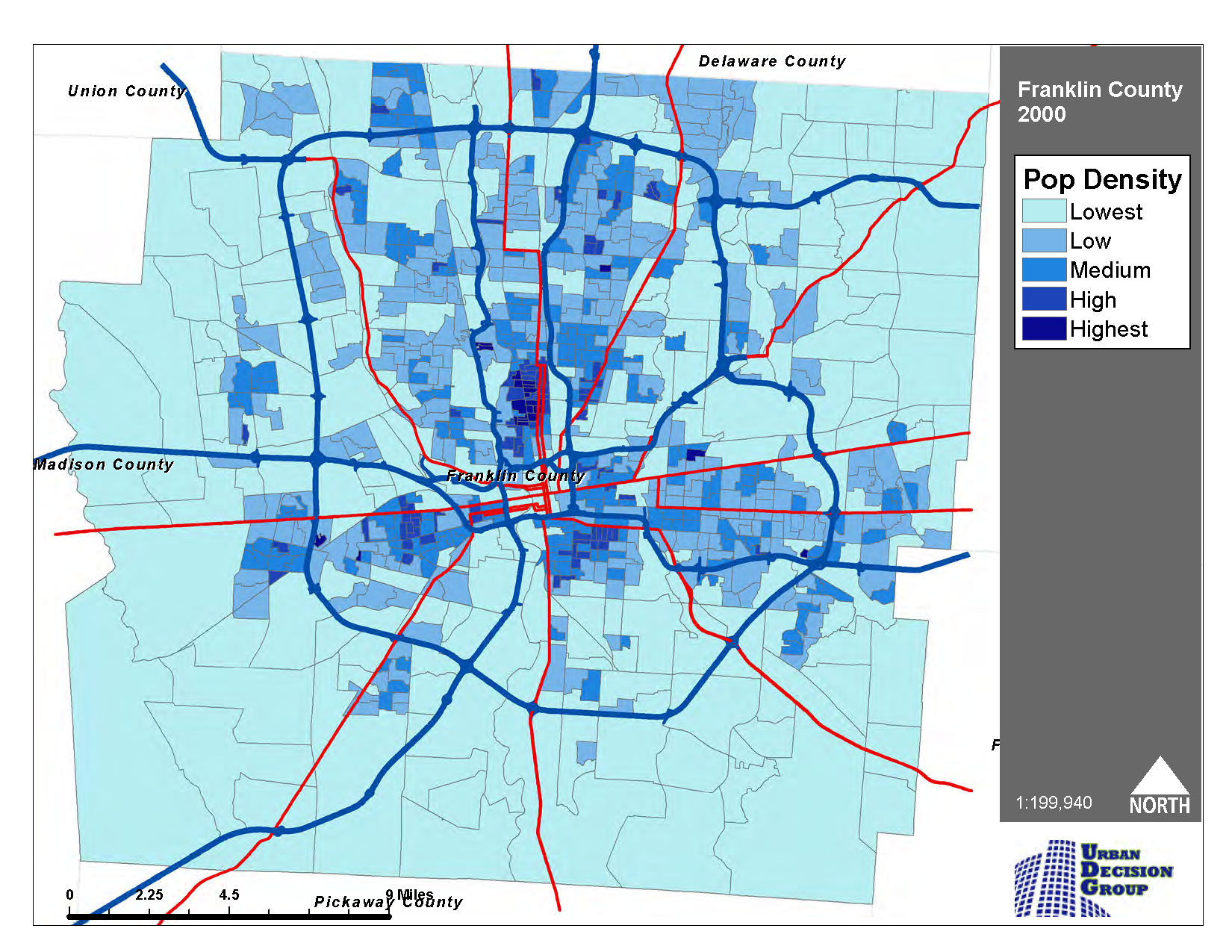
Part of the problem is the typical US sprawl of the place. The area inside the beltway is ~200 square miles - https://urbandecisiongroup.com/wp-content/uploads/2013/04/fc...
I live just outside the beltway. Driving to the OSU stadium just north of downtown would take me about 25 minutes. According to Google maps, the nearest COTA stop is a 20 minute walk away, then it's an hour and ten minutes to get to the stadium.
Agreed it would be lovely to be able to hop on a bus or train and get somewhere within a reasonable amount of time.
If something is worth doing, it's worth doing right and physically separate bus lanes is doing it right.
Trams and trains generally offer far more reliable schedules, frequencies and journey times than busses because they either have completely dedicated alignments or have priority where there is any interface with normal traffic.
Most buses inevitably bunch (see https://setosa.io/bus/ for a nice simulation) and/or get stuck in traffic as a matter of routine. The inconvenience may be less per delay but busses are delayed far more frequently than trams and trains on most of the public transport systems I've used. So for regular users, the cumulative inconvenience is much worse on busses than on trains/trams. Which is why people flock to trains and trams when available as an alternative to busses.
Specifically with regard to the parent, the frequency at which unplanned outages happens with tram services in Zurich is extremely low in my experience - certainly planned changes to schedules or routes (for maintenance, upgrades, etc.) are far more frequent. And when "something happens" (i.e. a traffic accident), the path for trams is cleared as quickly as possible - often in 30 minutes or less - so you'd really have to be unlucky to be inconvenienced by such an occurrence.
Busses, at least the one where I live in Europe, are very loud, noisy and smelly. I'd rather have 20 cars pass my home than one bus. I don't hear or feel those cars but once that bus passes my coffee cup visibly shakes. I also don't mind cycling behind most cars but cycling behind a bus is a terrible experience. You feel the heat blasting out of the rear-right side and the diesel smoke is terrible.
Some animated GIFs illustrating how much space automobiles take up compared to alternatives:
* https://old.reddit.com/r/Damnthatsinteresting/comments/9ft67...
But that’s not at all what the article is about? The thesis is not that having bus stops with music and heating and free drinks will make more people take the bus, it’s that in the U.S., the slowness of buses is making them an unattractive option. And stopping too often is a major reason.
As someone living in SF I 100% agree. The bus stops all the time. The muni is also crazy slow on the west side because it has to mark every single stop at every block just like any car instead of just having priority.
What? I see English words, but it’s still not parseable.
My first transfer was in Sacramento. The entire bus got held up for over an hour because someone saw a man with a knife and security had to search absolutely everyone to try to find it.
Half the stations were literally crumbling, as in the ceilings were falling down and covered in water stains and flecks of black mould. The drivers often turned up hours late, which is apparently expected and normal. The stations tended to be in exciting hotspots such as Skid Row, to cater for the desperate clientele who had no choice but to run the gauntlet.
Also, after the first time I rode it and told everyone about the knife that nobody ever found, people started showing me news stories about the man who got beheaded on a Greyhound in Canada.
Overall I think they have very patchy bus and coach systems and over-index on the worst examples.
I have a car, which I use when the weather is not nice, or when it would be inconvenient to take public transportation.
Otherwise, on sunny week-ends i often chose public transports. Here they are efficient , clean, secure and most importantly predictable. We have apps for payment and bus status that show us , on the phone, exactly where every bus is at any moment.
You know your bus will be there for you in exactly 2 minutes. Like a Uber, but much much cheaper.
Predictability is a game changer.
Works very well.
One reason that trains "work" is that the rails on the ground is a promise that a train is coming.
The only time in recent memory that this screwed me was in SF trying to get a Muni that I thought was a surface route and was in fact underground. So I was standing at a trollybus stop directly over top of the station where I was missing my train.
The one major gap I still feel a lot as a visitor is wanting a transit-aware business search. In Google Maps the "search for X in this area" is a completely distinct workflow from "how to get to X by <mode>", and implicit in the first workflow is that you can infer how long it will take based on the crow-flies distance. And that assumption is very much not true if you are using transit. For example, I would love to be able to be like "show me three-star hotels ordered by transit convenience to X airport and Y event venue" and have it figure out both rides, and call out which ones will have what service level in the evening, overnight, etc.
I would recommend Citymapper (https://citymapper.com/) in such a situation.
My internal thought process as a tourist is that I have a starting point and end point in a city, and some number of hours in between. I want to do some touristy things in that time, and I don't want to waste it all waiting for transfers. I'm not asking Google Maps to be a tour operator for me, but it also can't even help when I have a specific thing I need of which there are many instances, and I'm like... I don't care which electronics store I go to, I just need an electronics store and would like one that's convenient to where I am by transit. Or like, there are four Apple Stores in this city, which one is fastest to get to by transit?
Another recent example was having a seven hour layover in Tokyo where I had to do the Narita -> Haneda shuffle, and wanted to eat something not-airport-food during that time. I really struggled with getting Google Maps to show me where would be a good point to aim for a stop that was convenient by train to both airports; in the end I asked ChatGPT which suggested Ueno Station and I ate monjayaki which was delicious.
n = 1 but this is precisely why I seldom rode the bus in college. Except for going clear across campus in the evening to apartment complexes that were a semi-substantial trek down the highway it was always quicker to walk. Walking 1.5 miles in 25 minutes was faster than a bus that made 14 stops before it got to where you were going.
I like light rail. It has the advantages of cutting through traffic and being more efficient to boot. I'd say we should adapt buses to a similar modality but anecdotally bus-only lanes don't work as well as they ought to because, as a surprise to nobody, people are bad drivers and interfere with their operation.
That said, I do agree that this being the number one issue everywhere or even where I live is far from certain.
As a driver, the number one thing I hate are bus stops near intersections without dedicated bus lanes.
With all due respect, I feel the one asserting things without argument might be you. The whole article is about how number of stops is too high and so drives low ridership.
I am incapable of even trying to provide quotes from the text, as that would mean simply restating the text in its entirety.
- removing stops makes the bus faster: obviously true.
- bus stops in america are closer together than bus stops in other places: backed up by data in the article.
- making the bus faster makes it better for riders. subjective, but as a bus rider i very much agree.
i don't understand how you can read this article and come to the conclusion that it's about making bus stops "nicer". that's just a little tangent it mentions. it'd be nice if bus stops were nicer.
The article points to case studies where reducing stops increased ridership: clearly this does make a difference
But I agree that truly good bus service requires commitment and budget. A city that only improves its transit in fast, cheap ways is doomed to bad transit.
Which results in the trams being incredibly slow compared to driving even if they are frequent, clean, and generally nice. Since the network already needs total overhaul to be wheelchair accessible, there has been a plan to combine 3 stops in to two wheelchair accessible ones. Which will also speed up the trams since they don’t have to stop as often.
It is possible to have faster buses, even time competitive ones. Though stop spacing is only one component of such a system, the other being dedicated infrastructure and traffic priority.
I don’t think public transit is ever that pleasant, but I rarely felt unsafe in Vancouver or even NYC compared to LA.
One thing that I disagree with is the timing. In a lot of cases I’d rather spend 20 minutes more on the bus than driving. It’s much easier to hop on a bus, listen to music and walk to my destination than deal with traffic or parking. Also, in cities that have properly invested in transit, there are things to do around the transit points. Grocery stores, coffee shops, general stores etc, so I’m often doing 2-3 things in a single trip. Whereas in LA, each of those things is a separate car journey away for me, so overall things are less efficient.
I went to Seattle for one weekend and experienced the sad view of only the poorest people taking the bus. It was enlightening and changed my outlook on life.
This depends very much on where you are in the world.
Full disclosure: I have visited a lot of cities/countries, approx 70k flown miles last year. I almost always try to use public transport where possible.
The last "not nice" experience in a bus was in SFO, travelling back to my hotel from the Cathedral of Saint Mary of the Assumption. Make of that what you will.
That's not what I read. The article is saying that you can get meaningful service improvements via what is essentially a free measure: cutting the number of stops. I personally regularly take a route in San Francisco that would unquestionably be better off by cutting a swathe of stops through the Mission, where it stops every two blocks on a street with painful light cycles and tons of pedestrian traffic.
The result is that by the afternoon, two or three buses on this route have piled up, one right behind the other, and passengers have to wait 45 minutes for the next one if they miss one of those.
Buses running between full on stations are faster than buses that comprise the network edges. Because the core of the network is focused on capacity. Buses that meander around to provide coverage, minimize walking, and stop every other block are really slow. Like 6 MPH end to end, no faster than riding a bicycle! Do we want a bus network to compete with walking/biking or with driving downtown?
Low ridership actually makes public transit feel even worse. Encourages loitering and restricts ridership to only the most desperate people. In NYC at least the buses tend to be pretty heavily utilized and I've personally never felt unsafe or put off by the condition of a bus. It's marginally more pleasant than riding the subway.
You believe wrong. The article gives examples of cities that have already done that, and have seen average speeds go up and total ridership go up as well.
> Cities aren’t thinking about how to allocate a fixed bus budget.
Lol, dude.
It's incredibly unlikely that there is one coherent cause for low or high ridership. All we can do is improve the utility of the service. That means improving comfort (keeping it clean), reliability (running on time with minimal detours), throughput (carrying enough people), speed (minimizing the number of stops on the route), latency (minimizing the wait until the next bus), availability (more stops that service potential destinations), and coherence (more routes that take you directly from A to B, minimizing transfers).
Personally, I feel most undeserved by latency: the routes that are convenient to me run every 30min, and the routes that run most often run every 15min. I would ride the bus way more often if routes ran every 10min. I would ride them all the time if they ran more often than that. This seems like a pretty obvious opportunity that will never happen so long as prospective budget is determined by current ridership.
The central argument of reducing stops is increasing bus speed, not reducing margins, It's in the second paragraph.
[edit]
Top comment is a straw man, attempt to correct course downvoted... I'm not sure how much value HN has left for useful discourse, who the fuck are you people, if you even are people.
Compare that to the subway which several stories below city hall, nasty, dirty, filthy, stinking air, human excrement, rats, etc... I love the bus
...but then your "In my experience..." section repeats the article's assertions? As in, everything you list as a drawback of riding the bus is exactly what the article claims can be improved by intelligently cutting out some percentage of stops.
Also, I didn't see the claim that "too many stops is the main cause of low ridership." That would be an overreach. The central claim that I see is that optimizing the number of stops, which turns out to result in a net reduction in pretty much all major American cities, is a relatively easy way to marginally improve many aspects of bus systems.
I think your counterarguments are valid, but they're just fleshing out the article's thesis. Simply reducing bus stops and holding everything else constant would not magically improve ridership and the overall experience. And as you say, reducing bus stops and removing money supporting the system will definitely not result in improvements. (And I agree that it is the likely way it would transpire politically.)
You would need to reduce stops and direct the savings into improving the remaining stops. You would need to convert the change into more reliable schedules. To make sense, that would need to increase ridership, and adjust the demographics of riders to include people who don't have to accept "dirty, unsafe and hostile" because they have no other choice. There's little incentive to improve things when the audience is captive and powerless. Also, increased ridership leads to more resources to accomplish the rest.
Of course, the dependencies between all these changes make the improvements more speculative and harder to achieve politically, so I do agree that you can't "just" reduce the number of stops and improve everything. As you said, that would more likely just drain more blood from an already anemic system. But the article is talking about a relatively cheap and easy way to improve things; everything else transit agencies can do is harder and/or more expensive.
> So while the number of bus stops might matter at the margins, we’re not talking about a system where marginal improvements will matter. If you want to improve ridership, you need to make the bus an attractive option for more people.
That first sentence says marginal improvements won't matter. The second sentence says that marginal improvements ("an attractive option for more people") are what are needed. Maybe you're saying that marginal improvements have to reach a threshold in order to be worth doing or achieve any noticeable gains?
It's not marginal at all. Stops rebalancing actually address your core issues. Less stops also mean more money per stop to provide nice shelters which solves your second issue.
Autonomy could improve responsiveness to demand but you still run into other issues. DRT usually won't be able to take advantage of things proven to make buses faster and more consistent (bus lanes, reducing stop count, transit priority signals). Futher, consistency and response times gained by dynamic routing can easily be overshadowed by increased variability in trip time as the route adjusts to add new passengers or make out of the way drop-offs.
As an example, all throughout the Eastern Caribbean this system works really well (in my experience better than most centrally planned bus systems in large cities). On any given island you can go to any main road and within a few minutes a minibus will come along. Most of the time if your aren't familiar with the geography, you just tell the conductor where you are trying to get to, and they will make sure that you get off in the right spot to get where you are going or connect to another minibus. Typical cost was ~$2.
Predictability was pretty low, but because of the small size of busses, there were a lot of them roaming around, I don't think I ever waited more than 15 minutes, and that was in very out of the way places.
The GP was arguing that it NEVER works out, and I'm just pointing out that it does work in many places.
I would much rather rely on the Caribbean minibus systems than try to rely on transit in cities like Phoenix.
How do scheduled bus routes standardize a journey time vs a demand shuttle?
> out of the way journeys in my experience.
How do buses fair in this regard?
> It's really not ideal
Are buses?
Has it? When, where and with what technology?
> Predictability is really important and ridership drops as soon as users start having to plan too far ahead
Uber etc have proven this to be patently false. Existing buses are experiencing dropping ridership - Uber is not.
> won't be able to take advantage of things proven to make buses faster and more consistent
You're replacing buses with auto-shuttles. Just let the shuttles use the bus lanes.
> bus lanes, reducing stop count, transit priority signals
All of these are usable if you widen the scope to include auto-shuttles.
> consistency and response times gained by dynamic routing can easily be overshadowed by increased variability
What is the difference between Busing and Shuttles here? A bus user can keep yanking the stop cord, there can be 1 or 2 disabled passengers who take several minutes to board, there can be 50 children getting on / off. These issues are constants and all are improved with demand based shuttles.
The app would say - meet here.
> One might call such a meeting point a “bus stop” :)
Call it what you want, it could be in a strip mall parking lot, a convenient corner or just in front of the apartment building. Optimized for traveling distance between the passengers.
You can't just have buses stopping randomly everywhere, it doesn't scale.
This is based on the observation that people, including police, tolerate taxi drivers stopping at places where it's technically illegal.
I don't know that 'removing' these as bus-stops would actually change anything. I think a larger question is whether route changes should occur.
There was a large effort in Philly called the 'Bus Revolution' [1] that aimed to re-balance routes (I have a map from the 50s on my wall and the bus routes are the same, including numbers, as they are today). The problem there was that there was a funding crisis that massively delayed the implementation [2]. These services are massively under-funded, and that's the primary issue; implementing the article's suggestions are not free.
[1] https://wwww.septa.org/initiatives/bus/ [2] https://www.nbcphiladelphia.com/news/transportation-and-tran...
(for context: the 124/5 operate locally west through center city before getting on the highway while the 27 only makes 1-2 more stops in center city before getting on the highway)
Making these extra stops causes the bus to 'miss' the light cycle at almost every stop.
[1] https://www.septa.org/schedules/124?startStop=17842&endStop=...
[2] https://www.septa.org/schedules/125?startStop=17842&endStop=...
[3] https://www.septa.org/schedules/27?startStop=17842&endStop=3...
This would be a much bigger change, but it's also possible for the lights to give priority to buses. When a bus approaches a light, that should trigger the lights to advance to the part of the cycle that gives the bus the green light. That way, you prioritize the 20 people in the bus rather than the 10 people each in their own car.
It's slightly irritating as a pedestrian when you're waiting to cross the road to get to a tram stop, and you see that the tram is coming in less than a minute, and you know you're not going to be able to cross in time. But that's the sort of slight irritation I'm okay with for better fuel efficiency and faster trams.
Which is the issue. Philadelphia's blocks were sized in the 1600s, they weren't designed to be the optimal spacing for bus stops. Given how tiny the blocks are, there is no need to stop at every block.
A surprising number of bus routes in Dublin still follow, to a large extent, tram routes laid out in the 1870s. And use the same numbers. This stuff is _sticky_ (partly because significantly redesigning an existing route tends to annoy people; there's a fairly strong tendency to just make a new one and leave the existing one running in some capacity).
Unless you can address this fundamental problem "just walk more" isn't a viable option for transit users.
In other ways - wheelchair accessibility for example - the US is miles better than many European cities.
I see a lot of idolization of NW Europe from the US, but this is still a problem in Europe too. True, it's better than most of the world, but not every NW European city is as walkable or as accessible as people think it is.
Just one thoughtless example: Austin TX downtown is actively hazardous to non-motor vehicle users. One example is worn down and effectively camouflaged pucks the same color as the roadway about 10 cm wide by 6 cm high sticking out the middle of the road randomly that once represented bike lane merge path markers. Ask me how I know. :/
To me, this exemplifies a type of thinking that is endemic to policymakers in the US. We can tinker at the edges, we can use computers to optimize what we have, but the idea of using money and political will to change anything at all in a meaningful way is anathema, beyond the pale. Giving up before even getting started. Sure, optimize away, but don't expect me to be inspired by pushing papers around.
I suspect that removing half of the bus stops in a city will piss people off and cause even less ridership.
This feels like it's optimizing for the wrong thing.
Also, the example given cites New York City buses. But New York City is always the worst example because it's the most extreme of everything. The vast majority of US cities do not suffer from crawling buses.
Maybe this should say New York City needs fewer bus stops? I'd like to see you try.
The other is the group of people who might ride the bus if it were convenient. Not just in terms of accessibility to a stop, but also accounting for the journey time. If someone tries riding the bus and finds that a 20 minute drive becomes an hour with stops every single block, they might never ride it again.
In most US cities (outside of the few big ones with decent transit), public transit is basically treated as a welfare service for those who cannot get around by any other means. Not saying that this service doesn't have value, but making all decisions in that mindset isn't going to attract more ridership from those who could choose to drive instead.
The bus might come 2x per hour. Maybe 2:18 and 2:48. But it might come at 2:15 or 2:25. So you need to arrive at 2:13 and possibly wait 12 minutes. Or if you arrive late you might be waiting 30+ minutes.
Make the buses fast and safe.
1. Dedicated bus lanes (speed, predictability).
2. Traffic light priority ( speed, predictability).
How many US cities implement even one of those?
I don't care how long it takes to get off the bus nearly as much as I care how long it takes to get on.
Separately, the variability problem can be somewhat solved with the real-time location updates that many agencies provide. You'll still have to wait the same amount of time, but some of it can be done comfortably in your house when the bus is running late.
Safety is only one of the issues. Convenience and comfort are others. Basically a city needs to decide whether it wants people to use the bus, and then act like it.
Ridership collapsed in 2020 because of the pandemic, for obvious reasons, but it's hard to really blame that on the service itself, or the riders.
Ridership has been gradually recovering since then. Total trips are now up to something like 70% of 2019 levels, and continuing to rise. Number of unique riders is actually above the 2019 level now.
Maybe you haven't tried riding BART again within the past several years?
And in this example, how many stops would you have to cut to turn an hour-long bus ride into a 20 minute one, to compete with the car? You're effectively cutting it down to two stops - where you board, and where you disembark. That's just not a plausible way to organize a bus route, aiming it at one person with a car.
I find this very unlikely to be true for people who have spent any amount of time driving in a city.
So yeah, if your point is that if you take away all the bad parts of using a car, and leave public transit as is, then using a car comes out ahead. Splendid.
> I think the majority of city residents tend not to own cars
This depends a HUGE amount on the city. NYC/London/Paris probably true. LA? It is not uncommon for a household to have more cars than drivers
But I don’t want to drive three miles to park in a sketchy lot to hop on a train that will drop me off a mile from the venue.
It was unreal.
In my city bus stops have 1km between them (sometimes it is 700m sometimes 1.3km) so about 3200 feet.
It is about 15min walk between each bus stop, so when I need to wait for bit longer I prefer to walk to the next bus stop, just to have something to do.
Huh... How is it set up where you live? I've ridden buses in Europe and I remember them having cables, or at least buttons.
To European eyes they seem old fashioned, untidy, and possibly dirty.
Also not sure what is old-fashioned about a pull cord compared to a bunch of buttons. Just a different way of activating an electrical circuit.
The Paris Metro is an absolute run-down antique compared to the trains in Seattle. It would be silly for me to declare that all European metro systems are therefore run down and tatty. If I compare the Barcelona metro to New York, it makes Europe look great. Meanwhile the London Tube is cramped, frequently dilapidated and has its own species of mosquito.
SF is another good example of too many stops. It's honestly comical and I stopped riding the bus in SF at times because the stop count was painful.
I've been to Seattle once, (ex-Amazon here) where the DevCon was held in the town while my team was located in Bellevue. I took initiative to rent a bike for a day (60$ for drop-bar gravel bike) I must say although I did not beat the time between Day-1 (Office across spheres) and Bingo (Bellevue office), it was not far off. Even comparing the "Shuttles" Amazon operated, shuttle took about 1h while ride takes around 1h15m. (Plus sweat)
> P.S: I would say I am in a "fair" shape as I ride quite a lot throughout the year.
time is important to bus riders, speeding up the buses helps them. It also attracts others. Only a few are harmed more than helped - but they tend to complain the most even though they are a minority
That’s not how bus routes in NYC are organized at all.
Only if your trip is to Manhattan or along the line. Otherwise, in Brooklyn and queens, North-south subway service is almost non-existent. I live in South Queens a block from the A train. However, If I wanted to go shopping at Queenscenter Mall or along Queens Blvd, I have to take a bus up Woodhaven Blvd.
But that only works because density is low and there's only one plausible destination.
Crawling busses are an issue all over the place. The easy way to spot it is when noticing stacked busses during peak periods.
These issues are really hard because they are fundamentally local and change is difficult and fraught with NIMBY bullshit. There is a strong inertia. My small city has a pretty good bus service that winnowed out surplus stops and added BRT. In the public hearing, one of the loud objectors to moving a bus stop 1000ft was that it would encourage inner-city youth to "rape and pillage" in the "good" neighborhood. We're literally talking two blocks away.
I'd like to see your math, as it isn't just the loading of passengers that takes time. It would seem that slowing down, completely stopping, lowering the bus, opening the doors, and then closing the doors takes up at least some of the time at each bus stop.
(Bafflingly, they went through a transition period where ~all of the buses had two doors, but the driver rarely opened the back door. It wasn't really until covid that using the back door became standard. Improved things greatly.)
> and jockey for position and for a seat before the bus can start moving again
Do urban buses where you are require people to be seated? Didn't realise that was a thing anywhere. Any (urban, non-intercity) bus I've ever been on takes off as soon as the last person gets in.
My point is that you're totally disregarding everything a bus does to stop apart from waiting for passengers to board and de-board. At the very least it has to slow down, then accelerate. Half the time it has to swing the ramp out, which takes forever. Maybe someone has to load or unload a bike. Then it has to re-merge with traffic, and maybe every 10th car will let it in, so that can take a long time too. I don't even know if waiting for passengers is _half_ the time spent, let alone all of it.
The counterpoint is any bus route that has an express option that runs in parallel. Every time I have taken the express route, the bus can be full to the gills, but is always faster than the non-express bus.
surely we can think more critically than this...
This is even worse than the usual slight of hand wherein one takes a widely diffuse hard to quantify cost and rounds it to zero and then dishonestly acts as though that justifies implementing their pet policy that has some small upside because in this case the downside is known and the upside is less defined.
I'm open to the idea that we could improve the system by deleting stops, but in light of a quantifiable downside I don't see a convincing argument without having some quantification on what the upside looks like.
The real killer for bus travel times is not getting up to speed, and the delay from finding a break in traffic when pulling out of a stop.
Additionally, many stops with a lot of people loading and unloading are hubs which would never be balanced away, and often are designated timing points where the bus will wait to get back on schedule, so loading/unloading time is often irrelevant because predictability is being prioritized over speed. Improving speed and consistency with techniques like removing unnecessary stops increases predictability and allows for tightening up timetables and minimizing average hold times.
[1] https://www.wmata.com/initiatives/plans/Better-Bus/frequentl...
True I've seen that first hand.
This:
> I suspect that removing half of the bus stops in a city will piss people off and cause even less ridership.
is thrown out but how do we know it's true? That commenter throws it out as their opinion but my opinion is the opposite -- the stated preference will be that people think it's bad but the revealed preference will show even more ridership as travel times improve.
As a religious belief it would be inappropriate for me to report stats from my local cities bus service. First of all they didn't get into a religious opinion logically and rationally, so spouting numbers and facts at them will not make them change their mind. Secondly my local city has multiple simultaneous impacts so its almost impossible to estimate how their experiments with stop removal has affected ridership. The article falsely claims the only variable in the system is stop spacing whereas bus service is in extreme turmoil in most communities.
Pre-covid vs Post-covid is wildly different, there has been massive inflation in operating expenses, there's a long term decline in my area WRT passenger-miles before covid which seems to be increasing post-covid, fares have increased by a factor of a little over 4x since 1990 while incomes have roughly stagnated. The article claims the opex of stops is "high" but our city invested $0 (this is a low crime suburb LOL). We got rid of 1/4 of our routes (and drivers) and increased the standard of stop spacing from never more than 950 feet to an average of about 1100 feet now. The elderly and infirm were very mad and very loud about that and they are the most reliable voters out there but halving the fare quieted them down. We lose so much money on the bus service that giving it away for free wouldn't impact the budget very much.
Currently our opex per passenger mile is about $4.50. Fare for adults is $2. We lose about $7 per ride. The loss per rider would pay for two extra people to take an uber on the same route, so there are continual demands to scrap the entire system to save money. Empty buses driving around is causing more, not less, road congestion, and more, not less, environmental damage. Our "Unlinked Passenger Trip per Vehicle Revenue Mile" is about 0.6, which boils down to on average every mile traveled by a bus driver results in 0.6 passengers stepping aboard. Our routes are about 4 miles long and run about once an hour, so on average a driver picks up about three passengers per 4 mile trip. Our drivers are usually alone in the bus. Another way of looking at it, is on average we pay our bus drivers $23/hr, so an hourly route costs $23 in labor, and they pick up less than $6 in fares during each work hour... The ratios are better during rush hour... but worse outside of rush hour.
(edited: I don't understand some of the numbers on the report, if it costs $23 to pay the driver to run a route that picks up three people the fares can't be more than $6 so even if diesel and maint were free we lose $17 per hour per route, so why does the annual report claim opex per passenger mile traveled is only $4.50? After federal subsidies or similar?)
In the long run, an unusable bus service is simply too expensive of a luxury to fund and we'll end up eliminating it. I don't think changing distance between stops matters if the stops, and the bus, are empty, other than it makes sick and old people very angry. If almost no one uses it, it doesn't cost any extra to stop quite literally on every street corner or even stop at every driveway, so increasing stop distance merely makes people suffer needlessly, which seems unusually evil.
Oh do you now? Where do these suspicions come from? How much time do you spend on city busses? Do you have any idea how absolutely infuriating it is to be sitting on a bus while it makes stop, after stop, after stop, after stop, every single one a block or two apart, crawling down the road at a walking pace? All the while backing up traffic behind it and eroding whatever support the transit system had with the majority of the tax-paying public that never uses it.
I suspect that people find a destination on Google Maps, click the navigate button, see that the bus takes 3x as long as driving, and take their car or an Uber.
According to my cities 2022 annual report (where are 2023-2025?) they provided precisely 464344 unlinked pax trips (UPT) so someone stepped aboard a bus and threw money in the real or virtual fare box 464344 times that year. "Sources of operating funds expended directly generated" which I read as annual fare revenue was $660748.
We have a very simple two tier system $2 for adults and $1 for seniors and disabled. 2(464344-x)+1x=660748 x=267940
So we only had 196404 healthy young adult bus riders that year vs 267940 senior citizens. Your experience is not unusual but also is by far not the majority; a SUBSTANTIAL majority of the people on the bus in my city are too old or too sick or too blind to take long walks in the rain, snow, ice, heat, cold, etc.
Honestly the bus is so slow, if they could walk, they'd probably just walk. So it should not be overly surprising that most on the bus quite literally can't walk, and really need bus stops close together for disability reasons.
So all of this theoretical "well it would be so much faster if there were fewer stops" is irrelevant if the served population is primarily physically disabled, and the system can't survive. And we'd be talking about excluding one of the most powerful voting blocks in the city, that being old people. Eliminating stops would eliminate or reduce 58% of the current riders which would shut the system down, I don't think it could politically survive a hit like that.
Ironically that shutdown might be good as everyone would be better off both financially and environmentally in cars than in buses. Bus exhaust is not exactly perfume to mother nature LOL, and essentially our bus program is not a transit system, its a corrupt jobs program for drivers, mechanics, and especially for highly paid administrators.
Maybe my city is different, but in every city I've spent substantial time in, there are little tiny busses for those who are not able to walk or roll the average distance between a stop and their home or destination. They are direct, point to point shuttles. If no bus is available, they will send a cab. Those buses and cabs are exactly why you don't have to run a bus up and down every road, with a stop in front of every house, and a driver who can escort passengers to their door. They are astronomically expensive to operate, but the only way to make a transit system that serves everyone.
But in my city, we pay a small fortune to run these little busses, and then _also_, for some reason, assume that no one riding the main system has any mobility.
Also, I'd argue that the reason a "substantial majority" of your transit population is "old, sick, or blind" is because it's such an unattractive option for anyone who has a choice. When the bus is slower than riding your bike, you're not getting Olympic athletes on that thing.
I wonder if this savings includes the additional time to walk further to a stop.
Especially in light of this quote:
> In England, where 28 percent of all bus passengers are on concessionary fares for age or disability
Humans walk at roughly 2.1-3.0mph. "European cities" are listed as having bus stops 984-1476 ft apart, which would imply you'd typically walk half that to reach the nearest one (492-738 ft), which for a fit 3.0mph person is 2-3 minutes, and for a frail old 2.1mph person is 3-4 minutes.
Of course, people can be further away than that (they live orthagonally to the bus route), but you get the point. If you doubled bus stop distances to 1476ft apart, it would not add many walking minutes for the users.
Bus users can compensate for extra walking time by leaving earlier, provided the bus is on time. Good bus services can estimate arrivals in realtime, and show it to users on websites, apps, etc. as well as at the bus stop.
Bus punctuality is affected by a number of factors (e.g. traffic congestion, temporary and dedicated bus lanes), including number of stops.
The faster a bus can complete its route, the higher the route frequency can be with the same number of buses+drivers, which means buses pick up passengers more often, which means fewer passengers per stop (because less time between pickups), which means faster boarding, which in turn allows for a higher reliable route frequency. Having payment schemes like tap on/tap off, and having multiple entry doors also improves boarding times.
And that doesn't even consider that a faster bus route means you need fewer buses to run the same number of trips, so you can either run more trips (and save even more time for riders waiting for their bus) or cut down costs for the transit operator.
One can calculate how much area and thus passengers the stop covers and calculate walking times.
It's not completely trivial (with longer distance people chose alternatives), but can be done similar to the way the whole study was done with similar accuracy.
Somehow we combine inaccessibly rare bus stops with speed barely over walking.
The solution, I imagine, requires many changes that are politically infeasible. First, double the number of buses to reduce the wait between them. Second, add neighborhood circulator buses to get people from the neighborhoods to the express buses. Third, either add dedicated bus lanes in congested areas or, in an ideal world, make all congested inner-city roads toll roads, and use the tolls to subsidize buses.
Furthermore signal priority and own lanes are almost always beaten by good circulation planning, reducing the number of traffic lights and cars on the route of the bus.
I will give the PRT (formerly Port Authority) a shout out though:
1. Bikes are quick and convenient to bring along
2. The numbering system is intuitive enough that you can almost guess how to get to new neighborhoods
3. Accessibility is clearly a priority, and they successfully serve many disabled people
Unfortunately, the naysayers usually get their way as changing the status quo like this is hard to do. Transit Authorities need to be given more leeway to operate how they want w/ less political involvement.
Countries that are less NIMBY/lawsuit/etc happy have vastly better public transit b/c of this.
Philadelphia City Council (which actually doesn't have any direct oversight of SEPTA) pretty much killed SEPTA's attempt at this.