Top
Best
New

Posted by Jrh0203 6 hours ago

Elevators(john.fun)
651 points | 171 commentspage 2
abhaynayar 1 hour ago|
I have destination dispatch at my office, and while I don't like my personal user-experience of it, I can't imagine what would better suit a building when you have so many elevators in the same place i.e. in my case 10+ I think?

What I find annoying though is you clunkily go click a floor then clunkily wait then clunkily walk over to the elevator assigned which may or may not be on the other end of the space. Also another interesting thing I've seen is that it seems in my case the distance from destination selection and elevator assigned seems to reduce at times when the office is emptier so that too seems to def be accounted into the algorithm.

dperfect 5 hours ago||
Destination dispatch should be no worse than standard up/down buttons, right (at least in theory)? It provides additional information about the destination, but it should be possible for that information to be interpreted as if it were just an up/down button press, so RSR could still be used. I have a feeling a better algorithm could in fact make destination dispatch slightly better than RSR... or am I missing something?

Of course, user error is also a factor, so this isn't accounting for people not understanding how to use it and making things worse that way.

brd529 4 hours ago|
As the article says, the problem with destination dispatch is that it 'locks in' an elevator. The passenger gets told at call time what elevator to go to, and it can't change that mid flight. RSR has the advantage that the passenger has no idea which elevator will come, and so RSR can change the elevator they will get in real-time as conditions change. This was an insight I had not considered before reading the article.
dperfect 4 hours ago|||
That sounds like two separate things then. Could you not have people select a destination without locking in an elevator?

(I've never encountered destination dispatch myself, so I'm not really sure how it works in practice)

hypersoar 4 hours ago||
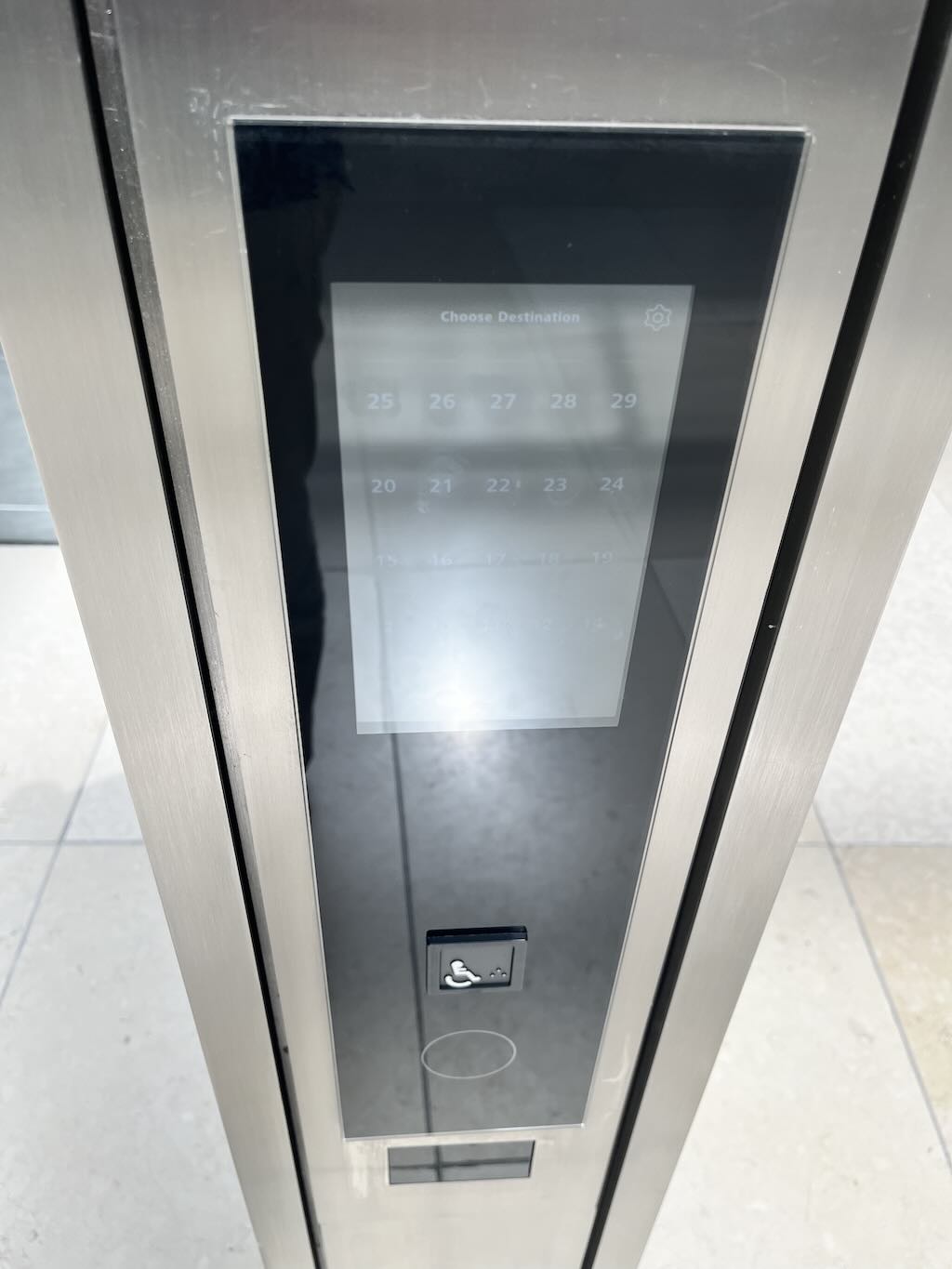
The way I've seen it work is that there's a touch screen in the elevator lobby. You tap a floor, and then screen will say "Car C" (along with an audible message). The problem is that then the system can't reassign you to a different car after that. You'll typically have a bunch of different people going to a bunch of different floors, and there would be no reliable way to communicate to each individual their new assignment. Each car will also typically display which floors it's going to when it arrives. I suppose that, rather than assigning a car immediately, you could have passengers check cars as they arrive to see if they're going to their desired floor. Then the system could do reassignment, but people would be scrambling to check every car to see if it's the right one for them, and that's assuming that they understood the system. It would be way too chaotic in practice.
nicwolff 3 hours ago|||
Little extra "fun" anecdote: my building has two banks of eight elevators, each servicing 20 or so floors, and has six destination dispatch kiosks: one at each end and the middle of each bank. The kiosks originally had nice metal buttons for each floor and you could easily tap yours as you walked by.

Sometime during Covid, the metal buttons were replaced with glass touch screens – which are totally unreadable on sunny days, because in our stunning glass-ceilinged atrium mezzanine they sit directly in sunbeams[0]. So now you have to walk up to the kiosk, shade it with your body, and squint at the screen to make out where to touch it.

[0] http://www.angel.net/~nic/photos/elevators.jpg

namibj 2 hours ago||||
You could give each one a diceware-eff-wordlist-like "ID" when they input where they want to go, perhaps have a "group" and "single" button/column per destination in the menu as well to inform the elevator if it's a group traveling together, and importantly have a fast-food-pickup-counter style dispatch screen up top visible from the waiting "hall", that assigns you a cab with an appropriate notice/heads-up period so you can make your way over to the assigned cab.
JoshTriplett 3 hours ago||||
Display a set of floors on a big overhead screen (in floor order so they're easy to find), have the "elevator" column blank until the elevator is assigned, and let them watch the column that's going to show them which elevator to use.

But yes, this seems like a case of "unfortunately, people".

hypercube33 2 hours ago||||
After visiting a hospital with like 5 floors and 2 elevators people were having a hell of a time with just 'going up ' or down arrows
dperfect 4 hours ago|||
Thanks for the context. That makes sense.
fellowniusmonk 4 hours ago|||
I think the problem with simulations like this is that it doesn't include the chaos of innatentive humans.

Forcing functions that dump people into well defined funnels can have such a high net positive effect it more than makes up for theoretical losses.

It's like narrow, hard road bike tires losing performance because of deflection from rough road surfaces and how long it took designers to factor that in to real bikes.

lefra 3 hours ago||
Kind of like airplane boarding. The ideal algorithm would be to make people board from back to front, and from window to aisle. However, people are not disciplined enough to strictly sort themselves, they won't all take the same time to sit, and some people want to board together (family with children for example).

Apparently, the fastest known way to fill up a plane in real-life conditions is to let people board in random order, without pre-assigning a seat.

taftster 4 hours ago||
In these various elevator algorithms, it's not commonly discussed the overall wear and tear on the elevator. More movements would typically translate to faster repair times. Hydraulic fluids needing to be replaced, parts breaking, etc.

Efficient elevator algorithms will often suggest moving an elevator into a preempted positioning strategy, based on time of day or peer elevator positions. The scheduler might move an elevator up to offset one coming down, for example. The demand-signal algorithms at least minimize movement in this way.

I think minimizing maintenance at the cost of increasing wait times is probably an important balance to get right. No doubt, the cost owners for maintenance are not going to perceive the wait time of passengers to be as important.

jasonlarue 4 hours ago|
Not to mention maintenance means taking an elevator out of service, meaning average wait times go up during that period.
brewdad 4 hours ago||
Someone needs to design an elevator that only breaks down between midnight and 5am. Maybe a different model to accommodate late night crowds returning to large residential buildings.
geephroh 5 hours ago||
Slightly OT, but this reminded me of Colson Whitehead's _The Intuitionist_[1], an amazing speculative mystery novel about two dueling schools of elevator inspection philosophies: the Empiricists and the Intuitionists.

1. https://en.wikipedia.org/wiki/The_Intuitionist

Waterluvian 5 hours ago||
Makes me want to play Sim Tower again.

There’s something so satisfying about watching a machine just dutifully work through queued tasks like this.

wlesieutre 3 hours ago||
A fun tidbit about Sim Tower:

> After my lecture, a Maxis employee who shall remain nameless buttonholed me. "You guessed right," she said. "Sim Tower was built around a real elevator simulation program we bought from a Japanese guy."

https://web.archive.org/web/20090916193335/http://www.gamasu...

Waterluvian 3 hours ago||
Would that be Yoot Saito? I remember his name on the box.
Sohcahtoa82 4 hours ago|||
If you liked SimTower, Project Highrise is worth taking a look into.

https://store.steampowered.com/app/423580/Project_Highrise/

stackskipton 4 hours ago||
Project Highrise doesn't have elevator simulation. Elevator is just portal that teleports the sim to proper floor.
b3lvedere 5 hours ago||
I had another game in mind.

https://archive.org/details/elevator_nes

pseudosudoer 5 hours ago||
This is commonly referred to as the "dial-a-ride" problem, which is an optimization problem with a multi-variate cost. Back in college for my senior design project we built a multi-axis closed loop servo system which would emulate a slide guitar. The dial-a-ride problem is identical to optimizing travel for a string of notes/chords.
userbinator 2 hours ago||
It's worth noting that for roughly half of the last century, elevators were entirely controlled by relays, with no computers at all; these algorithms would be implemented in hardwired logic. Look at Otis' old patents for some interesting details, including schematics.
danso 1 hour ago||
Oh wow, this is perfect reading for me. One of my first college career fair questions was "Tell me how you would program an elevator". Forgot what sad attempt at an answer I gave, but I pretty much thought about that algorithm every time I've ever waited for the elevator. Which was pretty much daily when living in NY.
jabroni_salad 1 hour ago||
This was fun to read and play with but I'd like to see it with different usage patterns, too.

The simulator seems to have passengers spawning on a random floor and then transiting to a different random floor. But for where I work, the trips are pretty much always from the lobby to a floor, or from a floor to the lobby. Nobody goes inbetween floors except maybe the cleaners.

heironimus 5 hours ago|
No mention of an algorithm/sensor for checking capacity of the car. It's a pain when your elevator car shows, it's full, and your request is canceled, meaning you have to press again. Better if the car was full and just moved on.

I can see how that could be challenging when people get off on intermediate floors, making a full car available again, changing status. And, if 3 people are waiting and there is room for 1, should it stop or not? Etc.

My favorite takeaway from this is how simplicity often beats complexity.
barrkel 4 hours ago|
Load penalty is part of the Otis RSR algorithm, it's in the article.
More comments...