If that were literally true, by now we'd be walking around with devices the size of Mt. Rushmore.
The same will apply to everything any company is marketing, at the very least it will always be their 'best' 'new' product.
Imagine if someone said "this food won't really taste better to you when you first eat it, but after 6 months you'll find other food tastes worse". To me, this would not be a selling point.
And I would disagree that only the story matters. If that were the case, people wouldn't go to the theater (a trend that has started happening in the last 15 years as people have been able to rig their living rooms to give an experience that is nearly theater quality, especially when considering cost and convenience. When we had 20" TVs, they were no substitute for going to the movies.
Either way, a larger screen is not the same improvement as higher resolution. And more importantly, the reason people may not go to the movies when they have a home theater system is partly due to justifying the cost of the theater system.
With food also you could be incrementally getting better and better food and when you then try v1 it would taste bad.
It seems that we might also be noticing slight degradation more than slight improvement in general? No idea if that's true.
I've often had new phones that are 'faster' but I barely notice the fastness until I go back to my old phone and realise that my finger-memory needs adapting because things take just a bit longer to load.
I'd assume it's similar for screen refresh rates.
When I got the phones, I did not notice any benefit related to screen refresh. I also did not notice any detriment when I went back to my 13 mini after two weeks on a 120 Hz screen.
But if it was as GP said, and it's only something you notice when you go back to a "lesser" screen, then that would not be a selling point in my book.
Not a blind test, but the smoothness when tracking a moving object is very obvious
But maybe it's because I'm 40+ with relatively bad eye vision and 20 years earlier I'd be noticing the difference much more.. But I'd say going from 1080p to 4k was a lot more obvious than that...
60fps is basically fine as long as you are unaware that it can be any better, but once you find out you are forever spoiled by the knowledge.
I know there's a sizable contingent of people who just think a bigger number is better, but realistically this is a device for passively consuming text and video content that is typically around 30 fps anyway. Why waste the battery power on faster refresh?
Does the page look and feel glued to your finger as you scroll?
Yes, for me issues with apps have mainly been in poorly optimized code causing lag, slow loading and the like. The 60hz/120hz thing has never really been a practical issue.
I'm sure a lot of people now would feel odd if you gave them a 60Hz phone after high refresh has become so common, even if they don't pay conscious attention to that kind of stuff
Without this, it'd be very hard for an average user to "feel" a performance difference between an A18 Pro in the Neo and say as far as the M5 Max in a MacBook Pro unless they had a "special" use case which really needed the extra CPU/GPU cores.
Of course, they can't stay forever on that. E.g. with the iPhone 17 they finally flipped the non-Pro over. Probably because it was starting to make the iPhone seem sluggish/stuttery compared to other phones more than it was making the iPhone 18 seem fast. Tablets have never seemed to be as fierce a market in terms of your average Joe comparing them, but I'd expect the same switch to being a liability instead of a tool will happen there as well (if they aren't already late to the game).
"I don't have an issue with it, so most people also don't have an issue with it"
False Consensus Effect (or false consensus fallacy):
It happens when someone overestimates how much other people agree with them, assuming that their own personal beliefs, values, or experiences are the default for everyone else.
It's a very small minority who cares.
Cite your sources, please or you're just echoing "trust me, bro".
Whether the hardware can keep up with Liquid Glass and push 120 frames a second is a different story, of course.
If only "pro consumers" noticed or cared... well, those "pro consumers" are the ones who think it looks like shit and would rather have a TV without it.
It will be buttery smooth between the chops.
Outdated comparison now that Liquid Glass is lagging my phone.
20 years ago I was gaming at 30fps and called it smooth. Now 120Hz feels like bare minimum.
Actually surprised to learn Apple did the OLED swap and didn't use the opportunity to bump it up at least to 90 hz like the OLED Steam Deck.
It's probably not actually as hard to go back as we think it is, but holding on to stuff is in our genes.
My personal experience is that I do notice the difference - for like a minute - and then I adjust and never care anymore.
Look at Apple’s own smartphone lineup. The Pro models with 120Hz screens get better battery life than the low end iPhone models.
You could make up for the difference in battery life with an almost undetectable amount of extra battery capacity from both a cost and size standpoint.
Do you think they couldn't add a refresh rate control to the device if you wanted to have lower battery? They already have variable refresh rate implemented, a much harder problem.
I remember the age of when Intel used to lock down hardware multipliers for overclocking behind the K versions, and GPUs did too. This is a well known practice, and Apple is not above it.
The iPhone sells way more units than the iPad, so it makes sense that it's not a feature for the iPad mini yet.
I bought the new 8 inch Alexa tablet the other day, and the price was decent but it's a piece of shit. I only wanted it for putting on a video in bed while I fall asleep but it can't even do that because when you drop the brightness to minimum, the display randomly turns off (not actually locking the screen, it's still running the app and active, you can touch stuff you can't see, but the pixels are turned off)
That's...horrifying.
Have you tried closing your eyes?
I could not care less about any refresh rate over 30.
You can care about it, but that just means it sounds like a differentiator to me, not something everyone should pay for just because you care about it.
You will have to somehow prove it if you would say that the panel and driver chip are all already ready to do 100+ hz for free by default, and are actually artificially limited, and that that artificial limitation doesn't come with some other advantage like battery life (allowing a smaller battery or less cost in some other way).
- Apple introduces OLED and talks about deep blacks and 1200 bits
- Why do they think people care about the above and not 120hz as well?
To the average consumer, neither matters much. True. But the above did not make much sense to me.
120hz at 5k requires Thunderbolt 5 (ie better graphics card, more info down the pipeline.
Which is why most of the PC world is on cheap 4k monitors still.
Most 5K monitors on the PC side are not going to be driven over Thunderbolt, but rather DisplayPort or HDMI.
And the most popular resolution on PC is not 4k, but rather 1080p and 1440p.
To the average consumer, obsessing over scroll feeling not completely perfect is a distraction from watching the next Avengers movie, if not downright neurotic behavior.
To a prosumer, the value may be obvious but the price may not be worth it. Which can lead to a distaste for the company, for not being a more accommodating company.
To a professional, if you need it, you need it, and you begrudgingly pay for it. Because you need it.
I don’t even know what my phone screen has. Wasn’t why I bought the pro at the time. Wanted the additional ram. So I wouldn’t feel as pressed to upgrade now. (Prosumer, aka neurotic.)
I can spot a 60Hz display from jiggling the mouse pointer for a second.
I’ve also done side-by-side comparisons of full screen scrolling on 60Hz and 120Hz screens for less technical people who could barely perceive a difference when I was pointing it out, but it took some time to get them to see it.
MKBHD (YouTube tech video and reviewer) talks about this a lot: It’s highly valuable to people like you and me who are attuned to the performance of our devices, but most people don’t notice. Or care!
I would appreciate high Hz displays everywhere, but I admit that Apple has probably made the right consumer choice tradeoff to compromise on refresh rate for these lower end devices where minimum cost and maximum battery life are the two most important features for those who buy them.
So if you’re actively moving between a high-refresh-rate device (like a lot of people here with their 144hz monitors) and then one with a lower refresh rate, you’re probably more sensitive (and potentially annoyed) by the discrepancy.
Viewing distance plays a factor too. I realized 4k tvs are useless to me because I can't perceive 1080p pixels unless I'm comparison shopping in a TV show room from 2 feet away (probably why they don't let you experience appropriate TV viewing distances in these spaces in the first place).
I was actually excited for this, but now I’m going to pass.
Add to that a locked OS, and you got a bingo.
I wanted to upgrade my air(gen4) but with these prices it's just not happening. Oh and no support for the perfectly fine apple pencil I already got with it is just....
But yeah, a top-of-the-line iPad mini costs well more than an MBA, which seems kind of nuts. Add on a keyboard case and Apple Pencil Pro and you're looking at $1,500.
that's huge
The question you I think should ask is who finds this value reasonable?. To which, I can only answer my myself who can’t see any reason to upgrade from my iPhone 15.
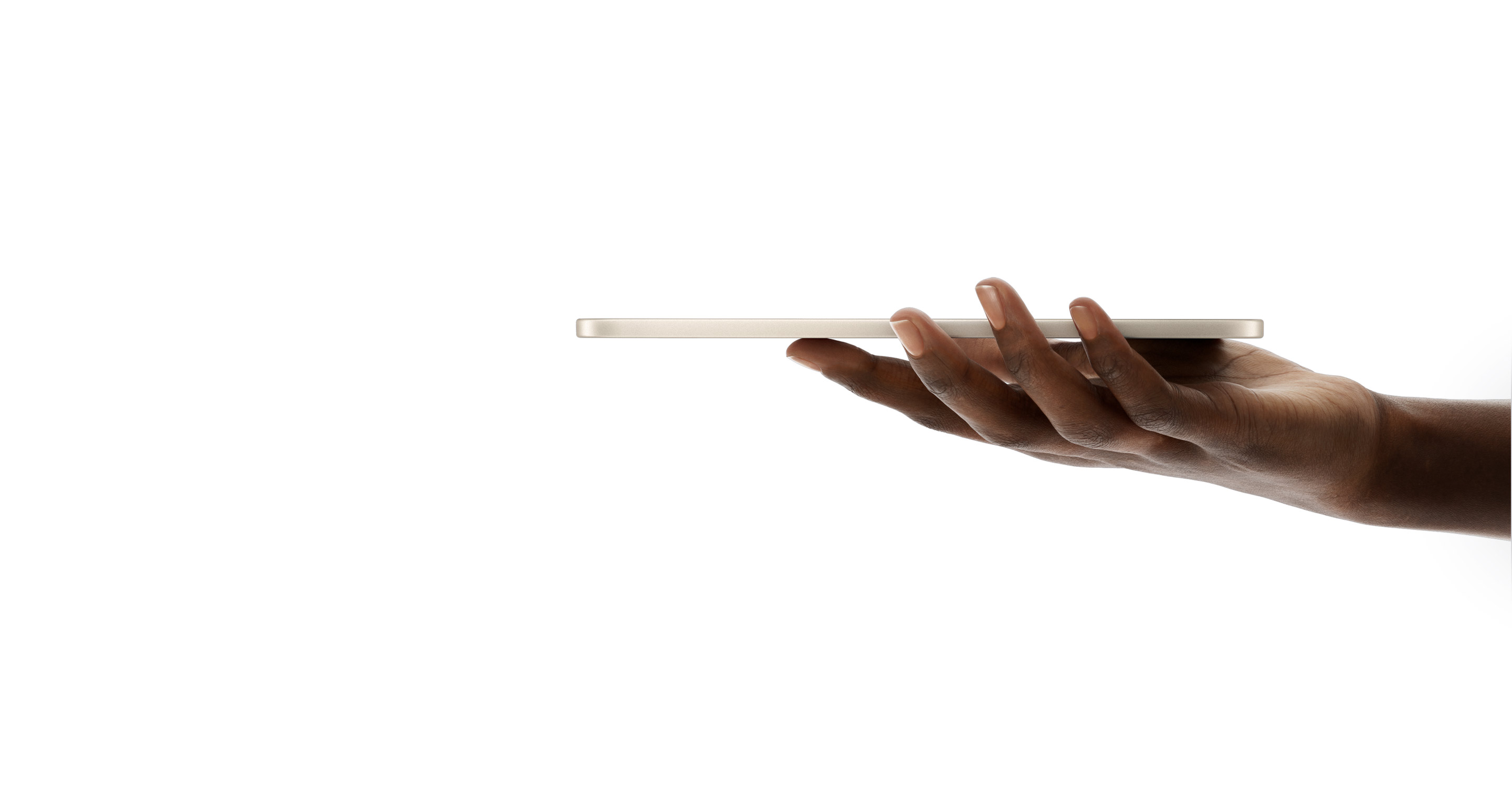
I would assume, however, that they didn't "fake" it - that they instead chose a filming position and lens such that camera was obscured behind the edge of the device (the edge facing the viewer is the far side from the camera). Bit of trickery for sure though.
from this page: https://www.apple.com/ipad-mini/specs/
I’d suspect the same. From that angle, the camera bump is on the opposite edge; when I hold my iPad Air in the same position, the camera bump is also just about hidden.
That being said, I’d also suspect that Apple chose that angle deliberately.
A minimal camera bump means they've advanced the technology to make it small, but no camera bump makes it look like they're using a cheaper camera?
In reality the back was curved, and they took pictures from an angle that only showed off the edge of the screen and not how far back it curved
You only see the thickness at the back from an angle where you can't actually use the computer (and for many people, that whole angle is going to be against the wall). This is the good kind of design - making something appear beautiful without compromising the core function.
I'm distinctly less convinced about ever-thinner mobile devices that I immediately have to slap a case on...
this is directly side-on. they've def removed the camera bump. In the initial animation at the top where the hand grabs it too. the bump is very clear in shots later!
wait... could they have hidden it under the hand? and why does that person's thumb seem extra long?! the more I look at this the less I understand it.
The video keeps triggering my sense of seeing CGI, but the hiding effect on display can absolutely be accomplished in camera.
They came up with the plateau, just make the whole plateau flat already.
There's also many users who don't need a case. A lot of ipads are POS systems that are fixed to the bench so they don't need a case either.
Given that the impact-absorbing parts could be [0]
...rubber on the edges where impact protection is needed.
Apple's decision to make most of its handhelds out of various grades of "fragililum" has boggled my mind since they sold the first iPhone with an easily-shattered glass back. That choice makes sense for a conspicuous status symbol that people are going to take very good care of... but most folks either end up with one with damage that makes plain how theirs is not the kind of life that makes that possible, or they have installed some aftermarket shell that ruins the effect by covering up the conspicuously fragile part of the hardware.
My mum's Samsung S23 Ultra has a ridiculous camera bump and rocks back and forth when you use it, even with some thinner cases. You need a super thick case for it to stay stable.
I also don’t think I’ve ever seen an Apple exec use a case, as it would imply the phones are durable and a case is needed, which they don’t want to convey. (Bumpers for antenna-gate aside)
What year is it, 2012?
To "b" or not to "b". Apparently the latter.
Also my favorite smartphone was a motorola with a cloth back (ballistic something) and a metal frame. No cover was needed for this one.
I would be content if they'd stop making phones slippier than a wet bar of soap. My Pixel 8a is ridiculous, I don't know how they do it. If you have dry hands, it's nearly impossible to hold on to.
Found one on Amazon so I dodge Google's exorbitant plastic markup, and it is a relatively minimalist wrap that smooths out the camera bump and makes it more grippy in hand, in pockets, and on flat surfaces.
The behavior of those slippery phones in pockets is almost the bigger gripe to me. Like they are a new class of motion amplifier, trying to rotate and squirt their way out at the slightest twitch.
I would never use a case with a phone of any sort. I don't like the extra bulk, and the friction they add is annoying.
Meanwhile I never use a tablet or kindle device without a cover.
The curvature on the back of those is such that it's harder to rotate into a position so the thumb can hit the right button than a flat surface would be.
It also means that resting it on the arm of a recliner produces about the same result as just dropping it into the void to begin with: It's going to wind up there either way.
Too bad though, there's no way to put a scanned document onto iPad in Apple's ecosystem other than the otherwise useless camera.
No one attempted to dictate anything. They expressed an opinion. HN is a discussion forum. This is exactly what it’s for.
Your point would look stronger if you had only included your last two sentences without the indignation of the first two.
That is not expressing of an opinion but dictating an action. "I think they should get rid of it entirely..." would be the expressing of an opinion.
He’s literally expressing an opinion. There is no in here to “dictate” to.
More likely though they’re trying to signal their membership to the in-group that’s always circle jerking on every iPhone/iPad post about SD cards, removable battery, thick small phone, flush camera, etc.
The top comment thread here is complaining about the camera bump.
it's not super "ethical" if you're like triggered by (maybe) harsh opinions, but it gets people to chime in vs just lurking
That being said, even with my Pixel in a case, the camera still protrudes.
It would be interesting to try a camera where the lens extends out when the camera is activated; and flat otherwise.
Not really! The cover just follows the seam. And larger batteries will increase the weight as well, which Apple definitely doesn't want.
thermals.
Perhaps if they put a very small lip around the camera lens and a physical bump on the other side so the device doesn't rock, at least it would be symmetrical and the glass would be slightly less prone to surface contact.
Though I do hate that bump. I just tried a duo and the bump makes it awkward to hold as a tablet
The big examples are iPhone Air and iMac.
From my experience, the iPhone bumps are a lot more noticeable than their iPad siblings.
If they put the tiny "front-facing" camera pointed out the back it would be enough for the vast majority of people I imagine.
Don't get me wrong, I understand it happens - back when I did wedding photography, one of my massive pet peeves were the uncles and grandparents who stepped into the aisle with their massive tablets just as bride is starting her walk... But I do not understand it at all :-/.
I'd absolutely happily completely kill the rear facing tablet camera. I've had at least a dozen android and ipad tablets and I genuinely don't think I took a single photo with them - it'd feel weird and awkward and so ostentious.
(As always as a consumer, clearly I'm in minority here :-})
The iPad Mini started with a 7.9" screen, bumped today to 8.5".
The iPhone Duo inner display is 7.6", there are already rumors saying a gen 2 or gen 3 might be 7.9".
It's interesting how smooth the iPhone/iPad continuum is becoming.
Quick look at the Mini dimensions also seems like it barely got bigger overall since 1st gen.
The main body of the iPhone Air is thinner, of course, but including the camera bulge, I think it's thicker than all non-pro iPhones up to the 16.
Is there something about making the main body thinner that makes the iPhone Air more comfortable to hold than other smaller phones? Is it the weight? The 17e is only 4 g heavier than the Air, and the 16e is only 2 g heavier.
I have never been interested in the Air because of the size, so I can't even remember if I have picked one up in an Apple Store.
when he goes "iphone small (big)" "iphone big (bigger)" and so on. He has a bunch of them.
[1] - See "far the worst iPhone experience ever" Daring Fireball review: https://daringfireball.net/#:~:text=one.%20The%20outer%20dev...
We will eventually see "foldable MacBook" because I genuinely want a 20" screen in my backpack or even just a smaller 16" MacBook. I guess not coming before 2035
These prices are insane and there is no sign of things slowing down.
e.g. I've got three screens in my house (office TV, living room TV, basement projector) in Canada — upgrading to the latest Apple TV on each of them would cost me $1,287.
I say this as an Apple shareholder.
Sure, and I can also complain about the pricing being unreasonable — which I also say an an Apple shareholder.
It should be less expensive but I rely on it (cancelled cable TV and just have streaming now) and so I'm just happy they are still working on it.
Commodity hardware is plenty powerful and can be taken advantage of should prices signal efficiency is important again.
* https://www.apple.com/ipad-mini/specs/ § Location
Edit: to perhaps make it more clear, I meant still sell a +Cellular variant with the C-series chips (or whatever), but move the GNSS functionality into the N-series chips. So you'd have a non-cellular and a cellular, but both would have GNSS.
The buyer is also signing up for a monthly payment. So clearly they have the cash to make an “extra monthly payment” or two up front.
But any device that has that embedded would have some royalty overhead added to the BOM. Which is why they've always had ipads with and without 5G and have so far never really bothered with adding this on laptops (which actually would make a lot of sense from a technical point of view). Operators would probably love that because it's a nice up-sell opportunity on monthly subscriptions. And with soft sims there would not be a need for a hardware sim card.
For the same reason, you don't see this feature on many other laptops either. There are a few obviously but it's a less common feature than you'd expect given how important good connectivity is to most laptop users.
It's not just Apple. 5G stacks in laptop are just very uncommon. Most vendors seem to independently come to the conclusion that they are better off not bundling that. Of course the difference is that Apple now has their own modems and chips for this. Which might change things but so far hasn't.
The reasons Apple want to vertically integrate everything and own it are easier to grasp: chips, firmware and software made by them are easier to control and upgrade by them. With qualcomm, they are basically getting them, their development teams, their supply chains for chips on the critical path to shipping products. And they are outsourcing what is a pretty major part of the whole phone experience to a third party.
Apple has been working on their own 5G modem for many years before they shipped it. I don't know for sure but I would not be surprised if efforts for that started when Steve Jobs was still alive even. This was always the logical move for them to make as soon as they got the idea of doing their own chipsets for their phones.
The C3 modem is just around the corner though, as is the satellite network Globalstar's been building behind the scenes for it.
https://investors.globalstar.com/news-releases/news-release-...
It's now live and on-air for testing...
I know of pilots who buy the +Cellular simply for GNSS and do not get a separate plan.
Charging more for the C-series hardware is understandable, but if there's enough of a 'transistor budget' it would be nice for the GNSS functionality to be more universal (since the N-series seems to be going into everything).
AI Optimist: AI is going usher in an era of unparalleled productivity and achievement
The reality: RAM/Chip prices are way, way up. The starter iPad mini is $700.
Is the comparison unfair because today's model is much more powerful than the one from 14 years ago? Perhaps. But perhaps it shouldn't be compared to the past, but to its relative competitors?
[0] https://www.apple.com/newsroom/2012/10/23Apple-Introduces-iP...
The upfront cost of a device is less important than the total cost of ownership, which highly depends on the lifespan of the device. An ipad that lasts 2.5 years needs to be half the price of one that lasts 5 years.
A toilet from a hundred years ago in the same product tier serves the same function as one today. Old models were also more expensive when adjusted for inflation, but today's toilets can tackle more turds with less water.
So that cloud providers can have servers and GPUs sitting unpowered in warehouses and datacenters.
I know it’s now a trope to say “an incoming Democratic Congress should…” but there are really serious questions to ask about the means by which Nvidia is securing such a radically high value buy-and-hold strategy, and whether it amounts to deceptive channel stuffing.
The whole tech industry is using apparent demand for Blackwell GPUs as a proxy for AI demand, when this is a wholly broken metric because Nvidia seems to be gaming it, and everyone (consumer and business alike) is paying more as a result.
  12 reasons why the iPad Mini is $250 more expensive than iPad 11-inch:

1) ...Same reason this year, for the first time ever, Apple announced their new Pro phones (and the ultra-expensive Duo) but no base-model iPhone 18. They're paying more for memory so they're gonna use it on the devices where they make more on a sale.
This has tiny 128 GB of storage and unknown but obviously not too high amount of RAM. At best 16, but probably less.
That's just Apple beeing greedy as usual.
I can open my local store and will see shitty 8/128 Android tablets for less than 150 euro. If memorypocalypse was the main reason for pricing new ipad mini as it is, the budget tablet segment would be completely dead because manufacturers just wouldn't be able to afford memory at all.